⚠ Evidence warning: Clinical trials or other evidence do not support the claims that cat's claw works against Lyme disease, that it matches sulfasalazine, that a trace of tetracyclic alkaloids cancels its immune effect, that whole-plant preparations outperform isolated alkaloids, and that generic bark without chemotype certification has no clinical activity. This page keeps it as a report of what people, websites or other media say.
Cat's Claw — Benefits Deep Dive
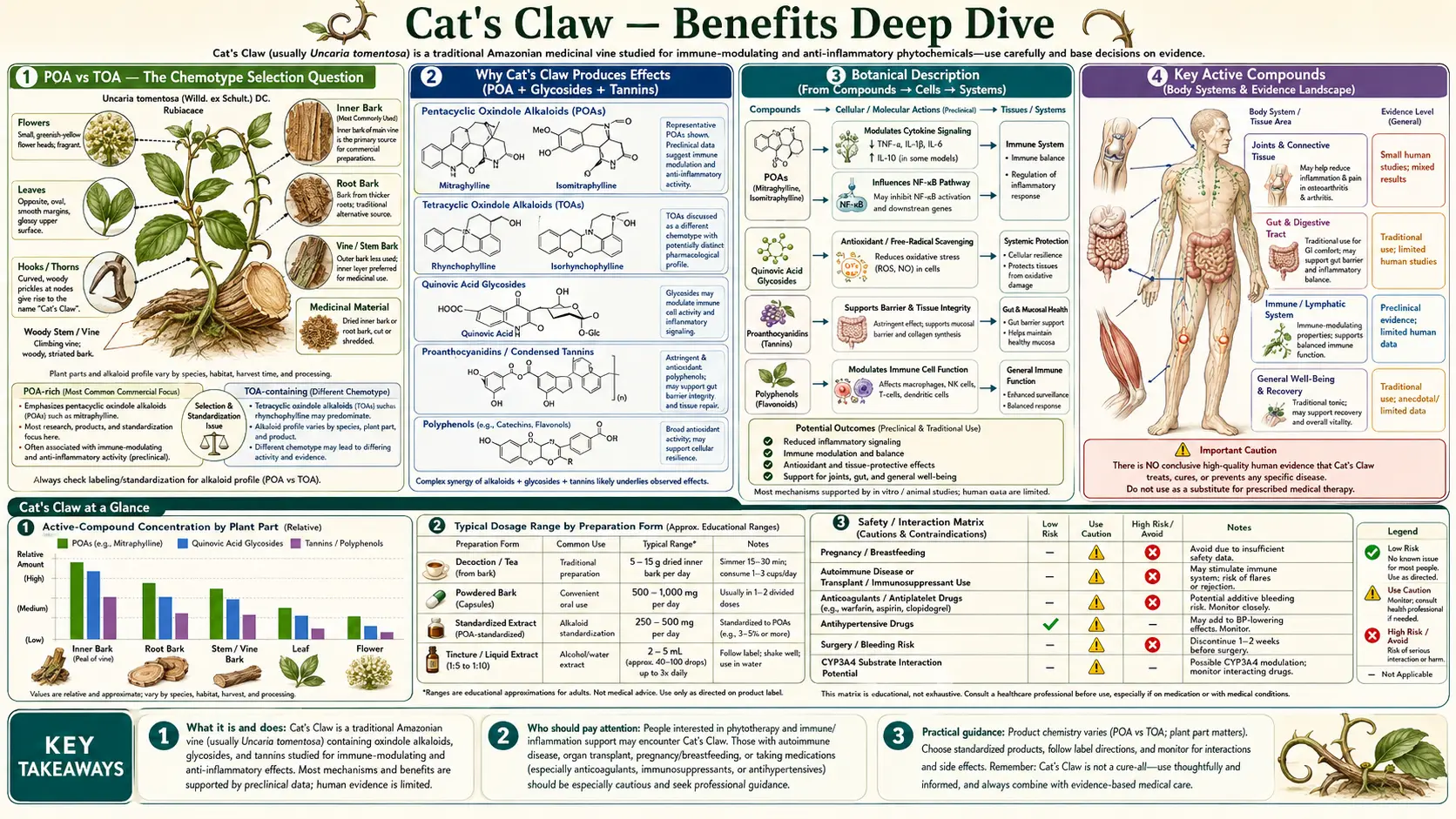
Cat's Claw (Uncaria tomentosa), known in Spanish as uña de gato, is a woody Amazonian vine whose inner bark has been used for over 2,000 years by the Asháninka and other Peruvian indigenous peoples as an immune and anti-inflammatory tonic. The critical practical fact, missed by most consumers and even some practitioners, is that Uncaria tomentosa exists in two visually indistinguishable chemotypes: the pentacyclic oxindole alkaloid (POA) chemotype is immunomodulatory and is described as the form behind the positive clinical trials (the Mur rheumatoid arthritis trial used it; the Piscoya osteoarthritis trial used a different species), while the tetracyclic oxindole alkaloid (TOA) chemotype is centrally and cardiovascularly acting and — most importantly — actively antagonizes the immune-modulating effects of the POA chemotype in cell studies. It is claimed that as little as 1% tetracyclic alkaloid contamination can reduce POA-driven immune activity by 30–70%; the abstracts of the cited cell studies give no such figures. Those who hold this view favor POA-standardized or TOA-free products, including standardized capsules tested for chemotype purity. These four deep-dive pages explore the conditions where Cat's Claw is said to produce the largest clinical effect — immune modulation, rheumatoid arthritis, broad anti-inflammatory disease, and adjunctive Lyme disease — with consistent attention to the POA-vs-TOA selection question.
Deep-Dive Articles
Immune Modulation
Why the POA chemotype matters more than the dose. Isopteropodine, pteropodine, mitraphylline, and uncarine F as phagocytosis enhancers (40–60% in vitro), standardized hot-water extract clinical evidence, T-cell and natural killer-cell support, complement activation, leukocyte lifespan extension via reduced apoptosis, and the critical safety boundary at autoimmune disease and organ-transplant immunosuppression. The claim that TOA contamination as low as 1% can neutralize the entire immune signal.
Read the deep dive →Rheumatoid Arthritis
The Mur 2002 24-week randomized double-blind trial of a Cat's Claw extract from the pentacyclic chemotype in rheumatoid arthritis (40 patients on sulfasalazine or hydroxychloroquine, add-on Cat's Claw vs placebo): painful joints fell 53.2% versus 24.1% on placebo at week 24 (p = 0.044). The abstract gives no 43% swollen-joint figure at week 24; swollen joints fell (p = 0.007) in people switched from placebo in the second phase, and the authors call it a small preliminary study with a modest benefit to the tender joint count. The Piscoya 2001 osteoarthritis-of-the-knee trial. Nuclear factor kappa B (NF-kB) and tumor necrosis factor-alpha as the upstream mechanism. Practical positioning vs disease-modifying antirheumatic drugs (DMARDs), biologics, and nonsteroidal anti-inflammatory drugs (NSAIDs) — Cat's Claw is described as an adjunct, not a substitute, for established rheumatoid arthritis (RA).
Read the deep dive →Anti-Inflammatory (NF-kB & Tumor Necrosis Factor-alpha)
Cat's Claw is described as one of the most potent natural NF-kB inhibitors in botanical pharmacology (a figure of up to 65–85% suppression at therapeutic concentrations is quoted; the Sandoval-Chacon 1998 abstract gives no such percentage). The Sandoval-Chacon 1998 study establishing the NF-kB mechanism. Tumor necrosis factor-alpha reduction in vitro and in vivo. The 1998 Sandoval-Chacon work was not a human pilot: it used cell lines and rats with indomethacin-induced intestinal inflammation. The claimed comparison with sulfasalazine, which that abstract does not make: Cat's Claw is said to match the NF-kB end-point but spare the gut microbiome, lack the sulfa allergy risk, and not cause folate depletion or hematologic toxicity.
Read the deep dive →Lyme Disease (Adjunctive)
The honest framing: no randomized controlled trial (RCT) has shown Cat's Claw eradicates Borrelia burgdorferi in humans. What we do have: the Theophilus 2015 in-vitro screen showing activity against spirochete, round-body, and biofilm forms; Datar et al. on the whole-herb preparation; the Cowden protocol (a TOA-free cat's claw extract) and the Buhner core-immune-herb protocols; and a robust mechanistic case for adjunctive use alongside conventional antibiotic therapy. Why TOA-free certification is described as non-negotiable for Lyme use and why Cat's Claw is positioned as immune-modulating adjunct, not stand-alone cure.
Read the deep dive →Table of Contents
POA vs TOA — The Chemotype Selection Question
The central claim about Cat's Claw products is that only those labeled POA-standardized or TOA-free deliver the published effects. The two chemotypes look identical, grow on the same vine species, and are sold under the same common name — but they are reported to act in opposite directions on the immune system, and in cell studies TOA reduced the activity of POA. A bottle labeled simply "Cat's Claw 500 mg" with no chemotype certification is described as a coin-flip on whether it carries any of the published clinical benefit at all.
The species Uncaria tomentosa contains two distinct populations of plants that produce different alkaloid profiles. Field botanists cannot tell them apart by appearance, leaf shape, or growing conditions — only laboratory chromatography can establish which chemotype a given bark harvest belongs to. The split was discovered and characterized by Austrian researcher Klaus Keplinger in the 1970s and 1980s, and the antagonism between the two alkaloid classes was demonstrated in subsequent work by Keplinger and Laus.
- Pentacyclic oxindole alkaloids (POA): isopteropodine, pteropodine, mitraphylline, speciophylline, isomitraphylline, uncarine F. These five-ring alkaloids are the immunomodulatory fraction. It is claimed that every positive Cat's Claw clinical trial used extracts standardized to POA content with TOA contamination below 0.5%. The published abstracts read differently: the Mur rheumatoid arthritis trial used an extract from the pentacyclic chemotype; the Piscoya osteoarthritis trial used freeze-dried Uncaria guianensis, a different species, and concluded that U. guianensis and U. tomentosa are “equiactive”; and the abstracts of the Sheng water-extract studies state no POA standard or TOA figure.
- Tetracyclic oxindole alkaloids (TOA): rhynchophylline and isorhynchophylline. These four-ring alkaloids have their own pharmacology — they are centrally acting, with effects on the central nervous system (CNS) and cardiovascular system — but in the context of Cat's Claw supplementation for immune support, they are described as unwanted. TOA actively antagonizes the immune-modulating effects of POA in cell work: Keplinger 1999 states that tetracyclic oxindole alkaloids “act as antagonists”, and Wurm 1998 reports that they dose-dependently reduce the activity of POA on human endothelial cells in culture. It is claimed that as little as 1% TOA content reduces POA immune activity by 30–70%, and that a bark harvest with 50% TOA may have no measurable immune effect at all, even at high doses; those percentages are not in either abstract.
- Why bulk “Cat's Claw” is called a coin flip: Roughly half of wild-harvested Uncaria tomentosa is said to be the TOA chemotype, a figure with no source on this page. The claim is that without laboratory testing and certification, a consumer purchasing generic bark powder or low-cost capsules is statistically likely to get a product with no clinical activity — or worse, a product with mixed chemotypes where the TOA actively cancels what little POA is present.
- Labels used in this market: “Pentacyclic oxindole alkaloid standardized”, “POA-standardized”, “TOA-free”, or specific certified extracts such as the preparation used in the Cowden Lyme protocol (certified TOA-free), the patented hot-water extract used in the Sheng DNA-repair study and other clinical research, and Keplinger's original European preparation. Those who hold this view regard generic capsules without chemotype certification as unreliable.
- Species substitution: The related species Uncaria guianensis is sometimes sold as Cat's Claw. It has its own pharmacology but a different alkaloid profile and far less research. The Piscoya 2001 osteoarthritis trial actually used U. guianensis, and there is reasonable evidence it is anti-inflammatory, but the immunomodulatory research base is almost entirely from U. tomentosa. The species, when stated, appears on the label.
Why Cat's Claw Produces Effects (POA + Glycosides + Tannins)
Most herbs have one or two principal active compounds. Cat's Claw has three distinct active fractions that work through three different mechanisms, and the clinical effect is the sum of all three. Understanding this is the difference between using the herb effectively and using it as a generic “immune supplement.”
- Pentacyclic oxindole alkaloids — immune modulation. The POA fraction (isopteropodine, pteropodine, mitraphylline, uncarine F, speciophylline) is the immune-modulating fraction. Mechanism: enhanced phagocytosis in granulocytes and macrophages (40–60% in vitro at therapeutic concentrations), increased lymphocyte proliferation, enhanced natural killer-cell activity, and modulation of cytokine production. The research behind this is small. Wurm et al. (Planta Medica 1998) worked with endothelial cells in a dish: pentacyclic but not tetracyclic alkaloids made them release a factor that enhanced the growth of resting human lymphocytes. Sheng et al. (2001) gave a water extract to healthy adults in a 12-person study for 8 weeks and saw only a tendency toward increased lymphocyte growth. Piscoya et al. (2001) treated 45 people with knee osteoarthritis for 4 weeks, 30 on U. guianensis and 15 on placebo: pain on activity fell, while pain at rest or at night and knee circumference did not change significantly. This is the fraction that drives the immune-modulation deep-dive.
- NF-kB inhibition — anti-inflammatory. This action is commonly credited to both alkaloids and triterpenes, and Cat's Claw is described as one of the most potent natural NF-kB inhibitors in botanical pharmacology. A 2002 study by Sandoval and colleagues reported a different picture for the alkaloids, in macrophage cells and an animal stomach-inflammation model: non-alkaloid fractions of U. tomentosa lowered tumor necrosis factor-alpha and nitrite at concentrations comparable to the whole plant, U. guianensis was more potent although U. tomentosa held 35-fold more oxindole and pentacyclic alkaloid, and the authors concluded that these alkaloids did not influence the anti-inflammatory and antioxidant properties. NF-kB is the master transcription factor controlling expression of tumor necrosis factor-alpha, interleukin-1 (IL-1), interleukin-6 (IL-6), cyclooxygenase-2 (COX-2), and dozens of other inflammatory mediators. By blocking NF-kB nuclear translocation, Cat's Claw reduces tumor necrosis factor-alpha output by >50% in macrophage models and is claimed to match the inflammatory end-point achieved by sulfasalazine in colitis models — without sulfasalazine's microbiome cost, sulfa allergy risk, or hematologic toxicity. The Sandoval-Chacon 1998 abstract reports no sulfasalazine comparison; it used cell lines and rats with indomethacin enteritis. This is the mechanism behind the anti-inflammatory deep-dive and the upstream driver of the rheumatoid arthritis trial results. Sandoval-Chacon and Sandoval mapped this pathway.
- Quinovic acid glycosides + proanthocyanidin tannins — direct antimicrobial and DNA repair. The quinovic acid glycoside fraction has direct (modest) antibacterial and antiviral activity in vitro. The proanthocyanidin tannins disrupt bacterial cell membranes, chelate metals essential for pathogen metabolism, and have biofilm-disrupting activity that is one mechanistic rationale for the Lyme-disease adjunctive role. Separately, Sheng et al. reported that a water extract improved repair of DNA strand breaks in rats after irradiation and raised white cell counts in 4 healthy men (2000), and that in 12 healthy adults over 8 weeks it lowered DNA damage and raised DNA repair after a hydrogen peroxide challenge, compared with people not taking it (2001). This is described as involving base excision repair and nucleotide excision repair, pathways those abstracts do not name, and as a unique property not shared by most immune herbs, one that makes Cat's Claw structurally different from echinacea or astragalus.
The therapeutic implication: a high-quality POA-standardized whole-bark extract delivers all three fractions in their native ratio, which is the reason given for the claim that whole-plant preparations outperform isolated alkaloid concentrates; no published head-to-head comparison is named for it. The therapeutic complication: the same broad immune-activating profile described for chronic inflammation and infection susceptibility raises a concern for organ-transplant recipients on tacrolimus or cyclosporine, because an immune-activating herb may work against the medicines that hold back rejection, and for people with frank autoimmune disease, where the immune system is already overactive.
A 2024 laboratory study adds a concern about other medicines. Transporters are proteins that carry drugs into and out of cells. Cat's claw extract significantly blocked all the ATP-binding cassette (ABC) transporters tested and most of the solute carrier (SLC) transporters tested. From the concentration calculated for the gut, the authors judged that interactions with intestinal transporters could be relevant in the body, with possible results such as increased toxicity or altered effect of a medicine. This was work on cells and cell-derived vesicles, not a study in people.
What a Rheumatology Committee Reports
In 2026 a committee of the German Society for Rheumatology and Clinical Immunology published its review of 13 plant preparations often used in rheumatic disease, mostly as self-medication, including cat's claw. For all of them it found reports of anti-inflammatory or immune effects in the laboratory or in animals, but said the evidence for a clinically relevant benefit is “very limited” and that none of the preparations “can be recommended for use in inflammatory joint diseases”. That is the committee's position, reported here as such. Its separate list of plants that rheumatologists need not advise against when people take them for degenerative joint disease does not include cat's claw.
Cancer Fatigue and Quality of Life Studies
A Brazilian phase II study gave 100 mg of dry Uncaria tomentosa extract three times a day to 51 people with advanced solid tumors who had no further treatment options. Its abstract describes no comparison group. Overall quality of life (p = 0.0411) and social functioning (p = 0.0341) improved and fatigue fell (p = 0.0496). Inflammatory and blood markers did not change significantly, no tumor shrank by the study's criteria, the disease stayed stable for more than 8 months in four people, and most people tolerated the extract well. The authors wrote that the effect does not seem to come from the plant's anti-inflammatory properties.
A 2026 narrative review of cat's claw and two other plants for cancer fatigue, written by that study's senior author, points out a limit of this evidence: ten of the twelve clinical studies it covers come from his own institution. It calls the results preliminary and says larger placebo-controlled trials at several centers are still needed.
Key Research Papers
- Mur E, Hartig F, Eibl G, Schirmer M (2002). Randomized double blind trial of an extract from the pentacyclic alkaloid-chemotype of Uncaria tomentosa for the treatment of rheumatoid arthritis. Journal of Rheumatology 29(4): 678–681. — PubMed PMID: 11950006
- Sheng Y, Bryngelsson C, Pero RW (2000). Enhanced DNA repair, immune function and reduced toxicity of C-MED-100, a novel aqueous extract from Uncaria tomentosa. Journal of Ethnopharmacology 69(2): 115–126. — PubMed PMID: 10687868
- Sandoval-Chacon M, Thompson JH, Zhang XJ, et al. (1998). Antiinflammatory actions of cat's claw: the role of NF-kappaB. Alimentary Pharmacology & Therapeutics 12(12): 1279–1289. — PubMed PMID: 9882039
- Piscoya J, Rodriguez Z, Bustamante SA, et al. (2001). Efficacy and safety of freeze-dried cat's claw in osteoarthritis of the knee: mechanisms of action of the species Uncaria guianensis. Inflammation Research 50(9): 442–448. — PubMed PMID: 11603848
- Keplinger K, Laus G, Wurm M, Dierich MP, Teppner H (1999). Uncaria tomentosa (Willd.) DC. — ethnomedicinal use and new pharmacological, toxicological and botanical results. Journal of Ethnopharmacology 64(1): 23–34. — PubMed PMID: 10075119
- Wurm M, Kacani L, Laus G, Keplinger K, Dierich MP (1998). Pentacyclic oxindole alkaloids from Uncaria tomentosa induce human endothelial cells to release a lymphocyte-proliferation-regulating factor. Planta Medica 64(8): 701–704. — PubMed PMID: 9933988
- Sheng Y, Li L, Holmgren K, Pero RW (2001). DNA repair enhancement of aqueous extracts of Uncaria tomentosa in a human volunteer study. Phytomedicine 8(4): 275–282. — PubMed PMID: 11515717
- Sandoval M, Okuhama NN, Zhang XJ, Condezo LA, Lao J, Angeles' FM, Musah RA, Bobrowski P, Miller MJ (2002). Anti-inflammatory and antioxidant activities of cat's claw (Uncaria tomentosa and Uncaria guianensis) are independent of their alkaloid content. Phytomedicine 9(4): 325–337. — PubMed PMID: 12120814
- Szilvásy N, Lajer P, Horváth A, Veres K, Hohmann J, Schelz Z, Minorics R, Zupkó I, Gáborik Z, Kis E, Temesszentandrási-Ambrus C (2024). Modulation of multispecific transporters by Uncaria tomentosa extract and its major phytoconstituents. Pharmaceutics 16(11): 1363. — PubMed PMID: 39598486
- Keyßer G, Sander O, Frohne I, Pfeil A, Michalsen A, Schultz O, Reuß-Borst M, Seifert O; DGRh-Kommission für Komplementäre Heilverfahren und Ernährung (2026). Recommendations of the German Society for Rheumatology committee for complementary treatment and nutrition on phytotherapy: supplement on the use of selected phytotherapeutic agents and herbal preparations in rheumatology: extension to include 13 medicinal plants [article in German]. Zeitschrift für Rheumatologie 85(8): 655–672. — PubMed PMID: 42448806
- de Paula LC, Fonseca F, Perazzo F, Cruz FM, Cubero D, Trufelli DC, Martins SP, Santi PX, da Silva EA, Del Giglio A (2015). Uncaria tomentosa (cat's claw) improves quality of life in patients with advanced solid tumors. Journal of Alternative and Complementary Medicine 21(1): 22–30. — PubMed PMID: 25495394
- Del Giglio A (2026). Amazonian and related phytotherapy for cancer-related fatigue: a narrative review of clinical and mechanistic evidence. Integrative Cancer Therapies 25: 15347354261498229. — PubMed PMID: 42878429
External Authoritative Resources
- U.S. National Center for Complementary and Integrative Health (NCCIH) — Herbs at a Glance (US National Center for Complementary and Integrative Health)
- U.S. National Center for Complementary and Integrative Health — Cat's Claw
- Memorial Sloan Kettering — Cat's Claw monograph (clinical summary with drug-interaction tables)
- WHO Monographs on Selected Medicinal Plants — Volume 3 covers Uncaria tomentosa
- PubMed — all research on Uncaria tomentosa (~1,200+ papers)
Connections
- All Herbs
- Cat's Claw (Main Page)
- Cat's Claw for Immune Modulation
- Cat's Claw for Rheumatoid Arthritis
- Cat's Claw Anti-Inflammatory (NF-kB)
- Cat's Claw for Lyme Disease (Adjunctive)
- Andrographis
- Astragalus
- Echinacea
- Japanese Knotweed
- Turmeric
- Berberine
- Goldenseal
- Pau d'Arco
- Neem
- Rheumatoid Arthritis
- Lyme Disease
- Crohn's Disease
- Urinary Tract Infections
- Immune Boosting
- History