Javanese Turmeric — Benefits Deep Dive
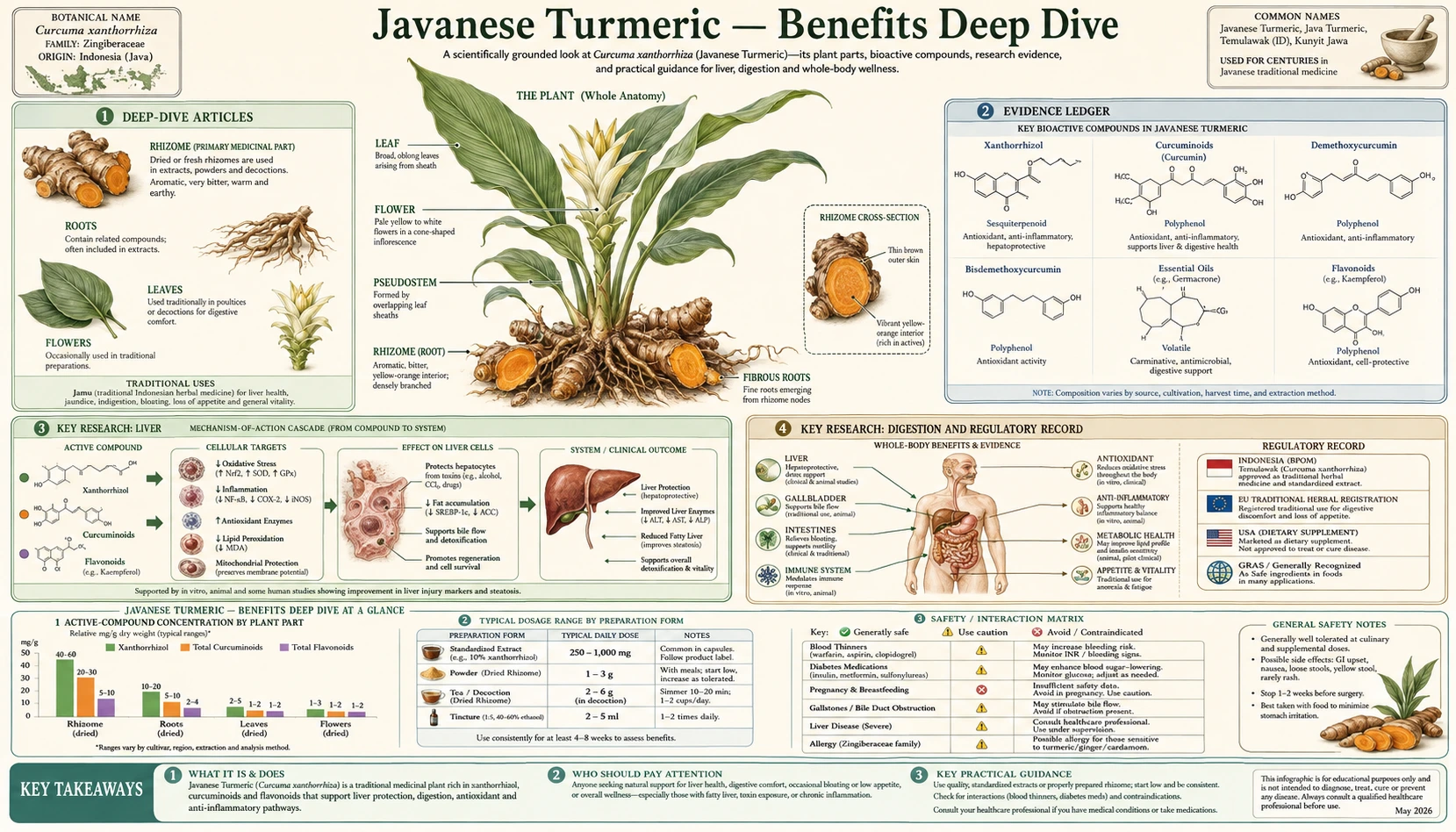
The main Curcuma zanthorrhiza page already gives temulawak an honestly hedged treatment: real traditional use, real xanthorrhizol chemistry, and an evidence base it correctly describes as “overwhelmingly animal and cell-culture research.” This hub goes one level deeper into the four claimed-benefit areas most worth examining closely, each checked against the live indexed literature rather than assumed.
This is the third Curcuma species built in this batch, after C. zedoaria and C. caesia, and it turned out to have the most distinctive story of the three: a genuine, well-documented European regulatory history — a German Commission E monograph since 1990, an ESCOP monograph, and a 2014 European Medicines Agency traditional-use monograph (a Community herbal monograph, not a product registration), none of which the main page mentions — resting on two real human trials of curcumin’s effect on the gallbladder. Set against that unusually well-documented digestive claim is a genuine negative: a 2017 double-blind, placebo-controlled human trial of the whole herb in lupus patients found no anti-inflammatory benefit, the only properly designed clinical test of that claim located anywhere in this four-page set. And the main page’s antimicrobial section leans further than its sources, in the opposite direction from what earlier builds in this batch found: it describes a “small human literature” on temulawak mouthwash, yet a dozen targeted searches found no human clinical trial, and later searches in other databases found only a few small human studies — a mouthwash thesis, two toothpaste studies and a chewing-gum trial. Most of what exists is laboratory work, including one 2023 study using real human saliva grown as a biofilm in a dish, which is not the same thing as a clinical trial.
Deep-Dive Articles
Javanese Turmeric and the Liver
Three decades of consistent rodent hepatoprotection data, a more clinically relevant chemotherapy-injury model, curcumin bioavailability data suggesting oral dosing barely reaches the liver at all — and the European regulator’s own statement that the herb “is not recommended in case of obstruction of the bile duct, cholangitis, liver disease, gallstones and any other biliary diseases.”
Read the deep dive →Digestion, Dyspepsia and the European Regulatory Record
A genuine regulatory history running back to 1963 in the Netherlands and 1976 in Germany, a 2014 EU traditional-use monograph quoted in full, two real human gallbladder-contraction trials, and the regulator’s own arithmetic showing why the approved dose is unlikely to reach the threshold their own pharmacology data required.
Read the deep dive →Xanthorrhizol: Anti-Inflammatory and Anticancer Research
A wide, mechanistically detailed cell-line survey across six cancer types and a real xanthorrhizol-curcumin synergy finding — led, as it should be, by the one properly designed human trial in this entire set: a 2017 double-blind randomized controlled trial (RCT) in lupus patients that found no benefit.
Read the deep dive →Antimicrobial and Oral-Health Research
A genuinely deep in-vitro antibacterial and antifungal literature, including an identified molecular target (the FabI enzyme) and a 2023 study using real human saliva as a biofilm source — and a check of the main page's claim of a “small human literature” on mouthwash: targeted searches found no clinical trial, and later searches found only a few small human studies (a mouthwash thesis, two toothpaste studies and a chewing-gum trial).
Read the deep dive →Table of Contents
Evidence Ledger
Claims ranked by the strength of what actually supports them, across all four topics, rather than by how confidently each is marketed.
A registered regulatory indication, resting on real human pharmacology
- Digestive/choleretic traditional use. Evidence: a 2014 EU traditional-use monograph (Directive 2004/24/EC, Article 16a), a 1990 German Commission E monograph, an ESCOP monograph, and two real human trials (1999, 2002; N=12 each) showing dose-responsive gallbladder contraction from isolated curcumin. In plain numbers: 20 mg of curcumin shrank the gallbladder by 29.3% within 2 hours in 12 healthy volunteers (1999), and 20, 40 and 80 mg shrank it by 34.10%, 51.15% and 72.25% at 2 hours (2002). Verdict: a genuine, well-documented traditional-use registration — tradition plus plausible pharmacology, explicitly not proof of efficacy, and the regulator's own “Well-established use” column is entirely blank.
- The 2022 review of the monograph. The European regulator reviewed the herb again in 2021–2022 (addendum EMA/HMPC/166164/2022, adopted 20 July 2022) and decided that no change to the 2014 monograph was needed. Its PubMed search found 43 newer papers, most of them animal and laboratory studies, and the EU side-effect database (EudraVigilance) held only 3 reports: malaise, dizziness and excessive sweating (hyperhidrosis).
Negative: adequately tested and failed
- Xanthorrhiza extract for inflammatory disease activity. Evidence: one double-blind, randomised, placebo-controlled trial (Wahono et al., 2017; NCT03155477) in 40 patients with systemic lupus erythematosus, a registered protocol, 60 mg/day (3 × 20 mg for 3 months) Curcuma xanthorrhiza added to vitamin D3 versus vitamin D3 plus placebo, three validated/objective endpoints (SLEDAI, IL-6, TGF-β1). Verdict: negative — no significant difference on any endpoint. The strongest and most important trial in this entire four-page set, and the one most likely to be missed because it sits under “anti-inflammatory chemistry” rather than under a headline liver or digestive claim.
Preclinical, consistent, and mechanistically rich
- Rodent and cell-culture hepatoprotection against toxin-induced liver injury (D-galactosamine, CCl4, cisplatin). Verdict: real, reproducible across three independent groups spanning thirty years, entirely preclinical, and undercut by curcumin bioavailability data suggesting oral dosing barely reaches the liver at all.
- Anti-inflammatory and anticancer cell/rodent mechanism (NF-κB/cyclooxygenase-2 (COX-2)/iNOS suppression; apoptosis induction across HeLa, HCT116, MDA-MB-231, A549 and other cell lines). Verdict: extensive and mechanistically detailed, entirely preclinical, and now directly contradicted at the human clinical-outcome level by the one trial that tested it (above).
- Oral-pathogen antibacterial and antifungal activity (S. mutans biofilm, periodontal bacteria, multiple Candida species), including an identified molecular target (FabI enoyl-ACP reductase) and a genuine antifungal drug-synergy finding (with ketoconazole/amphotericin B). Verdict: real, mechanistically grounded, entirely in-vitro.
Real, but about a different thing than it sounds like
- Xanthorrhizol against HepG2 cells. Evidence: a 2012 paper showing DNA fragmentation and apoptosis in cultured human liver cancer cells. Verdict: an anticancer-cytotoxicity finding, the mechanistic opposite of hepatoprotection, and easily and wrongly conflated with it because both involve the word “liver.”
- The 2023 human-saliva biofilm study. Evidence: a nanoemulsion tested against a microcosm biofilm grown from real human saliva on a laboratory disc. Verdict: the most “human” of the antimicrobial literature, and still an in-vitro model — not a clinical trial, not evidence a product works in an actual mouth.
Checked and found overstated on the main page
- “Small human literature on temulawak or xanthorrhizol mouthwash.” Direct, repeated phrase-locked searches for “mouthwash,” “oral health,” “dental plaque,” “clinical trial,” “patients” and “volunteers” combined with the species name, xanthorrhizol, and temulawak found no human clinical trial. Later searches in other databases found a few small human studies: a mouthwash thesis, two toothpaste studies and a chewing-gum trial. These and the laboratory and cell-model work are described on the antimicrobial deep-dive.
Real, and cutting against the traditional framing
- The liver-disease contraindication. The European Medicines Agency's own monograph lists “liver disease” among the conditions in which Curcuma xanthorrhiza is not recommended, alongside bile-duct obstruction, cholangitis, gallstones and other biliary diseases. The monograph states no reason; one reading is that the same bile-stimulating mechanism marketed as liver support can provoke biliary colic or worsen biliary disease when the system it acts on is already compromised. Benefit and hazard here are one property, read two ways depending on whether the liver receiving it is healthy or not.
Javanese Turmeric and Warfarin in Animal Research
In a 2021 rat study, Javanese turmeric extract was given for 7 days before a single dose of the blood thinner warfarin. At the higher extract dose (18 mg/kg), blood warfarin levels rose significantly: total exposure (area under the curve) was 77.54 against 35.27 mg·h/L in control rats for one form of warfarin (R-warfarin), and 316.26 against 40.16 mg·h/L for the other (S-warfarin). The lower dose (6 mg/kg), which the authors calculated from the usual adult human daily dose of 60–120 mg, did not significantly change warfarin levels. This is an animal result. The European regulator noted the study in its 2022 review, found no human data on the combination, and judged that this single rat study did not call for a change to its monograph.
Key Research: Liver
- PubMed: Lin et al., protective and therapeutic effects on hepatotoxin-induced liver damage, American Journal of Chinese Medicine, 1995.
- PubMed: Devaraj et al., standardized rhizome hexane fraction against CCl4-induced damage, The Scientific World Journal, 2014.
- PubMed: Kim et al., xanthorrhizol against cisplatin-induced hepatotoxicity, Toxicology and Applied Pharmacology, 2004.
- PubMed: Halegoua-DeMarzio et al., turmeric-associated liver injury, ten DILI Network cases, American Journal of Medicine, 2023.
- PubMed: Curcuma xanthorrhiza and hepatoprotection — live search.
Key Research: Digestion and Regulatory Record
- Rasyid & Lelo, curcumin versus placebo on human gallbladder function, Alimentary Pharmacology & Therapeutics, 1999. — PubMed PMID: 10102956
- Rasyid et al., dose-ranging curcumin and the gallbladder, Asia Pacific Journal of Clinical Nutrition, 2002. — PubMed PMID: 12495265
- EMA/HMPC Community herbal monograph on Curcuma xanthorrhiza rhizoma (EMA/HMPC/604600/2012), adopted 2014 — the primary regulatory document, external (not PubMed).
- EMA/HMPC full assessment report (EMA/HMPC/604598/2012) — the full evidentiary review, external (not PubMed).
- EMA/HMPC Addendum to the assessment report on Curcuma xanthorrhiza rhizoma (EMA/HMPC/166164/2022), adopted 20 July 2022 — the periodic review that found no revision of the monograph needed, external (not PubMed).
- Rusdiana T, Mardhiani YD, Putriana NA, Gozali D, Nagano D, Araki T, Yamamoto K. The influence of Javanese turmeric (Curcuma xanthorrhiza) on the pharmacokinetics of warfarin in rats with single and multiple-dose studies. Pharmaceutical Biology, 2021;59(1):639-646. Animal study. — PubMed PMID: 34062109
- Curcuma xanthorrhiza and choleretic/cholagogue activity — live search. — Search PubMed
Key Research: Xanthorrhizol Chemistry
- Singgih Wahono C, Diah Setyorini C, Kalim H, Nurdiana N, Handono K. Effect of Curcuma xanthorrhiza supplementation on systemic lupus erythematosus patients with hypovitamin D which were given vitamin D(3) towards disease activity (SLEDAI), IL-6, and TGF-β1 serum — the 2017 negative double-blind RCT in lupus patients. International Journal of Rheumatology, 2017;2017:7687053. PubMed PMID: 29445400
- PubMed: Cheah et al., xanthorrhizol-curcumin synergy in breast cancer cells, Cancer Cell International, 2009.
- PubMed: Kang et al., xanthorrhizol pharmacokinetics in mice and rats, Food Science and Biotechnology, 2022.
- PubMed: Xanthorrhizol, a potential anticancer agent — review, Phytomedicine, 2022.
- PubMed: Xanthorrhizol and apoptosis/cancer — live search.
Key Research: Antimicrobial and Oral Health
- PubMed: Antibacterial/antimicrobial effects of xanthorrhizol in dental caries prevention — systematic review, Drug Design, Development and Therapy, 2021.
- PubMed: Yogiara et al., xanthorrhizol targets the FabI enzyme in E. coli, Bioorganic & Medicinal Chemistry Letters, 2020.
- PubMed: Cho et al., nanoemulsion against human-saliva-derived biofilm, Journal of Dentistry, 2023.
- PubMed: Synergistic anticandidal activity with ketoconazole/amphotericin B, FEMS Yeast Research, 2009.
- PubMed: Xanthorrhizol and antibacterial/antifungal activity — live search.
External Resources
Unusually for a Southeast Asian herb on this site, Javanese turmeric has a real, primary-source European regulatory record rather than only supplement-industry marketing copy. What follows is what could actually be verified.
- European Medicines Agency — Curcumae xanthorrhizae rhizoma herbal medicine overview — the regulator's own public summary page.
- European Medicines Agency Community herbal monograph (PDF) — the approved indication, posology and warnings quoted throughout this set.
- European Medicines Agency Assessment report (PDF) — the full evidentiary review, including the named studies and arithmetic discussed on the digestion deep-dive.
- Altmeyers Encyclopedia — Curcuma xanthorrhizae rhizoma — a clinical phytotherapy summary including the Commission E indication and posology.
- PubMed — the index behind every research-paper search link on these pages.
Connections
- All Herbs
- Javanese Turmeric and the Liver — rich rodent evidence and the regulatory warning that cuts the other way.
- Digestion, Dyspepsia and the European Regulatory Record — the standout finding of this set.
- Xanthorrhizol: Anti-Inflammatory and Anticancer Research — led by the one negative human trial.
- Antimicrobial and Oral-Health Research — the main page's overstatement, corrected.
- Javanese Turmeric / Temulawak (Curcuma zanthorrhiza) — the main article: names, identity, active compounds, traditional use and Indonesian regulatory tiers.
- Turmeric (Curcuma longa) — the higher-curcuminoid species with by far the larger human evidence base.
- Zedoary Benefits Deep Dive — the sibling Curcuma species, with its own 2025 human non-alcoholic fatty liver disease (NAFLD) trial and dental-plaque trial.
- Black Turmeric Benefits Deep Dive — the third Curcuma species in this batch.
- Milk Thistle — the better-evidenced liver herb.
- Artichoke Leaf — a comparably-documented European choleretic digestive herb.