Horsetail Safety: Thiaminase, Nicotine and Dose Limits
This is the page that supplement marketing does not write. Horsetail is a genuinely interesting traditional herb, and it also carries four safety features that are not optional reading: an enzyme that destroys vitamin B1, a toxic look-alike species that has turned up in commercial material, trace nicotine, and a real diuretic effect with the drug interactions that any diuretic brings.
None of that makes horsetail dangerous in the way a poisonous plant is dangerous. Most people who drink horsetail tea for a few weeks will be fine. What it does mean is that horsetail is one of the herbs where duration of use is a genuine safety parameter, where the label matters, and where the research raises concerns for a specific group of people. The goal here is to explain the mechanisms honestly — not to bury them and not to inflate them — so that the decision is yours and it is informed.
Table of Contents
- Why This Page Exists
- Thiaminase: What the Enzyme Does
- The Veterinary Evidence: Horses and Cattle
- What Thiamine Deficiency Looks Like in People
- How Large the Human Risk Is: An Honest Calibration
- Heat, Processing and “Thiaminase-Free” Labels
- The Double Hit: A Thiaminase-Containing Diuretic
- Species Identity: Equisetum palustre and Palustrine
- Trace Nicotine and Other Alkaloids
- Selenium, Heavy Metals and Where It Grew
- Drug Interactions
- Duration of Use: Why There Is a Cap
- Who the Research Raises Concerns For
- Points That Come Up When Buying and Using Horsetail
- Warning Signs and What They Mean
- Bottom Line
- Key Research Papers
- Connections
- Featured Videos
Why This Page Exists
Search for horsetail and you will find hundreds of pages describing it as a silica-rich beauty herb, and a striking number that mention no cautions whatsoever. Meanwhile the European Union herbal monograph on horsetail (European Medicines Agency, 2016) states that its preparations are traditionally used over a period of 2 to 4 weeks, does not recommend it under age 12 or in pregnancy and breastfeeding, and lists conditions that call for reduced fluid intake, such as severe heart or kidney disease, as a contraindication. The monograph gives no reason for the 2–4 week period and does not mention thiaminase; the plant's thiamine-destroying enzyme is a separate concern from laboratory and veterinary work. Many marketing pages mention neither.
There is a second reason. Horsetail's cautions are unusually mechanistic — they are not vague “may cause side effects in some individuals” boilerplate. Thiaminase does a defined chemical thing to a defined vitamin. Palustrine is a defined alkaloid in a defined species. A diuretic effect has defined pharmacokinetic consequences for lithium. Mechanisms of that kind can be reasoned about, which means a reader can make a genuinely informed decision rather than an anxious guess. That is what the rest of this page is for.
Thiaminase: What the Enzyme Does
Thiamine, vitamin B1, is a small molecule with two ring systems joined by a methylene bridge: a pyrimidine ring and a thiazole ring. In the body it is phosphorylated to thiamine pyrophosphate, which is an essential cofactor for several enzymes that sit at the centre of energy metabolism — pyruvate dehydrogenase, alpha-ketoglutarate dehydrogenase, the branched-chain ketoacid dehydrogenase, and transketolase in the pentose phosphate pathway. Without it, cells cannot fully oxidise glucose. Tissues that run hardest on glucose — brain and heart — fail first.
Thiaminase is an enzyme that cleaves that bridge, splitting thiamine into two fragments that have no vitamin activity. There are two families. Thiaminase I performs a base-exchange reaction, substituting another molecule for the thiazole ring; thiaminase II simply hydrolyses the bond. Either way the vitamin is destroyed.
The important consequences of thiaminase being an enzyme rather than a toxin:
- It is catalytic. A small quantity can degrade a much larger quantity of thiamine, so the effect is not proportional to a “dose of poison” in the ordinary sense.
- It acts on thiamine, not on you. The harm is indirect: nutrient depletion over time, not acute toxicity. That is why the exposure that matters is prolonged rather than large-and-single.
- It is a protein, so it is heat-labile. Cooking, boiling and many drying and extraction processes denature it. This is the basis of “thiaminase-free” processed horsetail products.
- It can destroy thiamine in the food or gut rather than in tissues. Thiaminase-containing material eaten alongside thiamine-containing food can degrade that dietary thiamine before it is absorbed.
Thiaminase activity in Equisetum is long established: a 1989 laboratory analysis found that the horsetail species Equisetum ramosissimum, like bracken fern, had considerably more thiaminase activity and less thiamine than three forage plants (Meyer 1989; that study did not test Equisetum arvense). The European Union monograph's 2–4 week traditional-use period is stated without a reason and does not mention thiaminase. Tier: established biochemistry. PubMed search: Equisetum thiaminase thiamine degradation PubMed search: thiaminase mechanism of thiamine cleavage
The Veterinary Evidence: Horses and Cattle
Everything solid we know about thiaminase-driven deficiency from plants comes from animals, and it is worth understanding why the animal case is so much stronger than the human one.
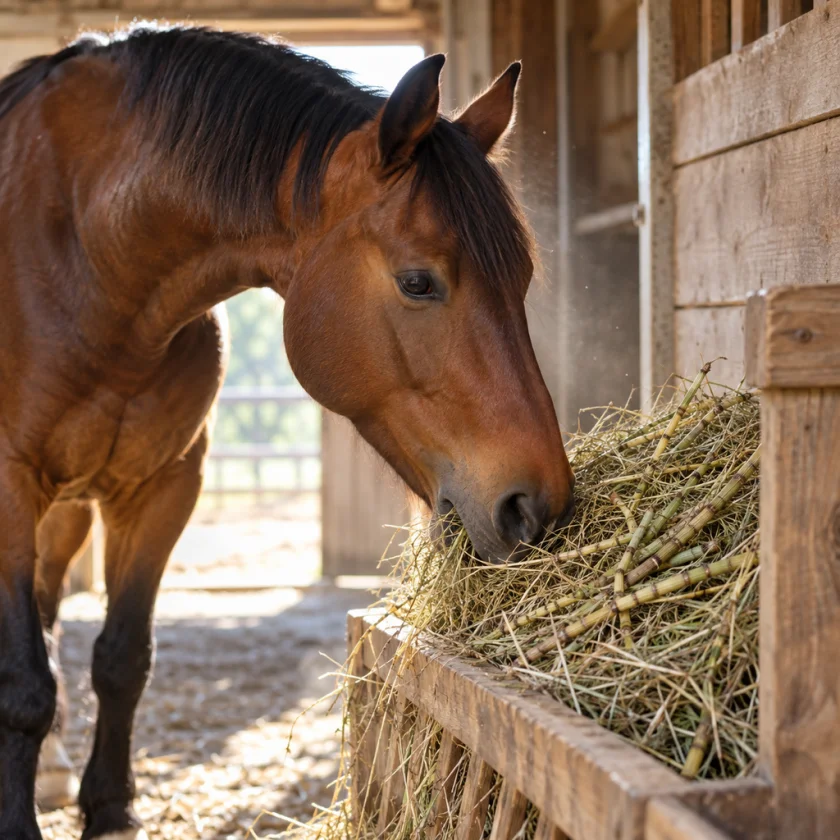
Horses are the classic case. Horses that consume large amounts of horsetail — usually because it has been baled into hay, where they cannot avoid it and where its unpalatability no longer protects them — can develop signs of thiamine deficiency: weight loss, weakness, incoordination and ataxia, and in advanced cases collapse. The syndrome responds to thiamine administration, which is the crucial piece of evidence: a deficiency that reverses with the vitamin is a deficiency, not a general poisoning. The parallel and better-studied case is bracken fern (Pteridium aquilinum), whose thiaminase produces the same picture in horses and is a well-described veterinary poisoning.
Cattle and sheep are affected differently. Ruminants make some thiamine in the rumen, which buffers them, so classic bracken or horsetail thiaminase disease is less prominent in cattle than in horses — though ruminant thiamine deficiency does occur, and horsetail-contaminated forage has been implicated in reduced condition and in poisoning reports. Cattle problems with Equisetum are also frequently a different plant problem: Equisetum palustre, the toxic species, whose alkaloids are a separate mechanism entirely.
The reason animals get the disease and people generally do not is dose and duration. A horse eating contaminated hay may consume kilograms of dry plant material a day for months. A person drinking two cups of horsetail tea a day is consuming grams. That is a difference of three orders of magnitude, sustained over a much longer period, in an animal with a different digestive system. Saying this plainly is not dismissing the risk — it is sizing it. Tier: veterinary case and toxicology literature. PubMed search: Equisetum poisoning in horses PubMed search: bracken fern thiaminase in horses
What Thiamine Deficiency Looks Like in People
Knowing the clinical picture is what turns an abstract caution into something you could actually notice.
Early and non-specific: fatigue out of proportion to activity, loss of appetite, irritability, poor concentration, unrefreshing sleep, vague muscle discomfort, mild calf tenderness. These overlap with a hundred other things, which is exactly why early thiamine deficiency is missed.
Dry beriberi is the nervous-system form: a symmetrical peripheral neuropathy beginning in the feet with burning, numbness and pins and needles, ascending over time, with weakness, loss of reflexes and difficulty walking. See dry beriberi and the nerves.
Wet beriberi is the cardiovascular form: a high-output heart failure with breathlessness, rapid heart rate, swelling of the legs, and in severe untreated cases circulatory collapse. See wet beriberi and the heart.
Wernicke encephalopathy is the acute brain emergency: confusion, abnormal eye movements and unsteady gait, which can progress to the permanent memory disorder of Korsakoff syndrome if thiamine is not given quickly. It is most associated with alcohol use disorder but occurs in any severe thiamine depletion. See Wernicke-Korsakoff syndrome.
Two features of thiamine make this worth respecting. Body stores are small — on the order of weeks, not months — and the vitamin is water-soluble and readily lost in urine, so depletion can develop faster than for most vitamins. The good news is that the deficiency is cheaply and rapidly correctable if recognised. See vitamin B1, thiamine deficiency and thiamine and beriberi. PubMed search: thiamine deficiency clinical review
How Large the Human Risk Is: An Honest Calibration
This section is the reason the page is worth reading, because both of the easy answers are wrong.
The overstated version — “horsetail causes vitamin B1 deficiency” — is not supported. There is no substantial published series of human beriberi caused by horsetail consumption. If drinking horsetail tea reliably produced thiamine deficiency, a herb this widely used would have generated a visible case literature, and it has not. Case reports do exist on the diuretic side: a 1996 Spanish report described severe low blood sodium and low potassium (hyponatremia and hypokalemia) brought on by drinking a related species, Equisetum telmateia, and a 2021 Canadian case report described low blood sodium caused by poor food and fluid intake and by SIADH (syndrome of inappropriate antidiuretic hormone secretion), possibly made worse by horsetail (Equisetum arvense).
The dismissive version — “that only affects horses, ignore it” — is also wrong, for three reasons.
First, the mechanism is not in doubt. The enzyme exists, its substrate is a vitamin with small body stores, and its action is catalytic. A mechanism this clean does not require a case series to be taken seriously as a reason to limit duration.
Second, dietary thiaminase demonstrably matters in humans in other contexts. Thiaminase-containing raw and fermented fish has been implicated as a contributing factor in human thiamine deficiency in populations where such foods form a large and habitual part of the diet. That precedent establishes the principle: eaten in quantity, over time, dietary thiaminase can affect human thiamine status. Tier: human observational and analytical. PubMed search: thiaminase in raw and fermented fish and human thiamine deficiency
Third, risk is not uniform. A well-nourished person with full thiamine stores has considerable buffer. Someone whose stores are already thin has almost none. The people in that second category are not rare: heavy alcohol use, poor or very restricted intake, after bariatric surgery, with persistent vomiting or malabsorption, in advanced age with poor appetite, on long-term loop diuretics, and in poorly controlled diabetes. In those people the concern about a thiaminase-containing herb taken daily for months is greatest, and the fact that no case report exists is not reassurance — it is an absence of data about an obviously higher-risk group.
The honest formulation, then: horsetail thiaminase is a mechanistically established, clinically undocumented risk in humans, whose plausibility rises sharply with duration of use and with pre-existing thiamine marginality. It is the kind of risk that a time limit on use addresses, and the European Union monograph's 2–4 week traditional-use period, although stated without a reason, keeps courses short. One cheap mitigation discussed for courses longer than that is a thiamine-containing supplement or a B-complex taken at a different time of day, with the course kept finite; this is reasoning from the mechanism, not a tested regimen. Separating them in time is the point, since thiaminase can degrade thiamine in the gut.
Heat, Processing and “Thiaminase-Free” Labels
Because thiaminase is a protein, it can be destroyed — and this is the most practically useful fact on the page.
Proteins denature with heat. Boiling the herb, or subjecting the raw material to a hot processing or extraction step, denatures thiaminase and abolishes its activity. Some manufacturers state that their product is thiaminase-free or has been treated to inactivate the enzyme, and that claim is chemically coherent rather than marketing invention.
Reasoning forward from that, with the appropriate label:
- A boiled decoction — simmered, not merely steeped in off-the-boil water — plausibly contains little or no active thiaminase, because the enzyme has been cooked. Tier: mechanistic inference from protein chemistry, not a measurement of horsetail preparations.
- A cold infusion or cold macerate preserves the enzyme, and is therefore the least reassuring preparation.
- Dry powdered herb in capsules is uncertain. Whether the enzyme survives depends entirely on how the material was dried and processed; low-temperature drying can preserve enzyme activity. A capsule is also swallowed with no heating step at all.
- A hot-water or hot-ethanol extract has had a heating step; a cold alcohol tincture has not, though the alcohol itself will denature protein to some degree.
Two honest limits on this reasoning. It has not, as far as the published literature goes, been settled by measuring thiaminase activity across real commercial horsetail preparations — so a “thiaminase-free” claim is only as good as the manufacturer making it. And inactivating the enzyme does nothing about the other three issues: species identity, nicotine and the diuretic effect are unaffected by heat. A “thiaminase-free” label is not a general safety certificate. PubMed search: thiaminase heat inactivation
The Double Hit: A Thiaminase-Containing Diuretic
Here is an interaction internal to the plant itself, and it is rarely pointed out.
Thiamine is water-soluble and excreted in urine. Increasing urine output increases urinary thiamine loss. This is not speculation about horsetail; it is a documented phenomenon with pharmaceutical diuretics. Thiamine deficiency has been repeatedly described in patients on long-term high-dose loop diuretic therapy for heart failure, and it is attributed in large part to increased urinary losses; some studies of thiamine supplementation in that population have reported improvements in cardiac measures. Tier: human observational, with small interventional studies. PubMed search: loop diuretics, thiamine deficiency and heart failure
Horsetail therefore does both things at once: it contains an enzyme that destroys thiamine, and it produces a diuresis that excretes thiamine. Neither effect alone is likely to matter over a couple of weeks in a well-nourished person. Together, sustained over months, in someone whose reserves are already marginal, they push in the same direction.
This convergence is the strongest mechanistic argument for short courses, matching the 2–4 week traditional-use period in the European Union monograph. It is also a specific concern, beyond simple over-diuresis, for horsetail combined with a prescribed loop diuretic — the person on furosemide is already the person at risk of losing thiamine in their urine.
Species Identity: Equisetum palustre and Palustrine
This is the fastest way for horsetail to cause real harm, and it has nothing to do with the medicinal plant.
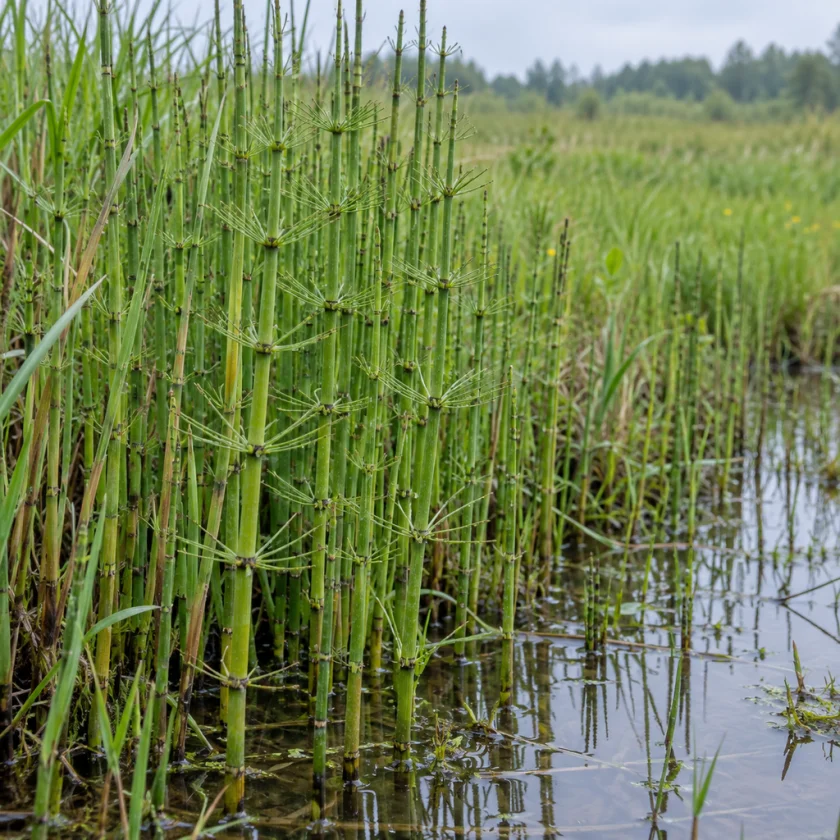
Equisetum arvense (field or common horsetail) is the medicinal species. Equisetum palustre (marsh horsetail) is a close relative that contains the piperidine alkaloid palustrine and related compounds, is regarded as toxic to livestock, and has been implicated in animal poisonings with neuromuscular signs. The two species grow in overlapping habitats — damp ground, ditches, wet meadows — and distinguishing them requires attention to stem, sheath and branch characters that a non-botanist will not reliably apply, especially to dried, cut material where the diagnostic features are gone.
Two consequences follow.
Wild-harvested horsetail carries a specific identification risk. This is not general herbal caution; it is a specific one, because the wrong plant in this genus contains an alkaloid rather than merely being useless.
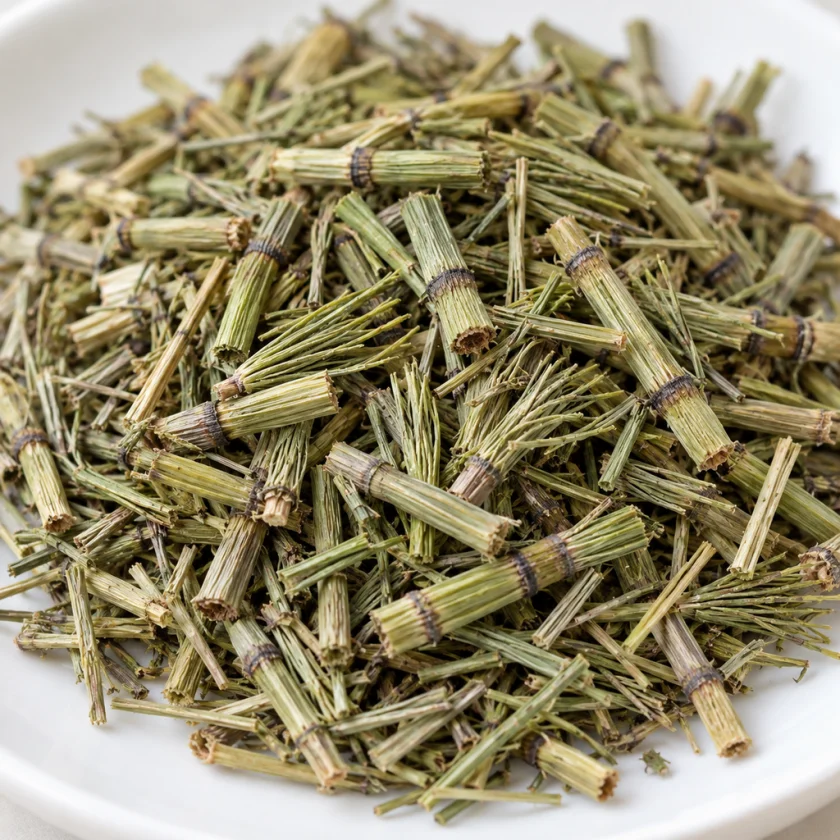
Commercial adulteration and admixture are documented problems. Analytical methods exist specifically to discriminate E. arvense from E. palustre in herbal drug material — chromatographic fingerprinting and flavonoid-profile comparison — and methods of that kind are developed because the problem is real, not hypothetical. Pharmacopoeial monographs for Equiseti herba include identity tests for the same reason. In practice, a product whose label says only “horsetail” is unidentified plant material, and a supplier who cannot state the species and how it was verified has not addressed the look-alike problem. Tier: established toxicology plus analytical chemistry. PubMed search: Equisetum palustre palustrine toxicity PubMed search: distinguishing E. arvense from E. palustre in herbal material
Trace Nicotine and Other Alkaloids
Equisetum arvense contains small amounts of nicotine and related alkaloids. It is neither negligible nor dramatic.
Why it is not dramatic: the quantities reported are trace, far below what a cigarette or a nicotine product delivers, and there is no suggestion that ordinary horsetail tea produces nicotine effects or dependence in an adult.
Why it still matters:
- Children. Nicotine's toxicity is dose-per-body-weight, and small children are disproportionately sensitive. Combined with the absence of any safety data in children, this makes the concern strongest for children; the European Union monograph does not recommend horsetail under age 12 because adequate data are lacking.
- Pregnancy and breastfeeding. Nicotine crosses the placenta and enters breast milk, and no amount has been established as safe in pregnancy. The European Union monograph states that safety in pregnancy and breastfeeding has not been established and that, in the absence of sufficient data, use during pregnancy and breastfeeding is not recommended; the alkaloid content is one further concern.
- Very high or prolonged dosing. Trace amounts of an alkaloid taken in large quantity for a long time is a different exposure from trace amounts taken briefly, and it is another argument against open-ended use.
Reported alkaloid content varies with species, growing conditions and analytical method, and figures in the literature are not uniform — another reason to treat any single number quoted online with caution. Tier: analytical chemistry. PubMed search: Equisetum arvense nicotine and alkaloid content
Selenium, Heavy Metals and Where It Grew
Horsetail is an efficient mineral accumulator — that is the same property that makes it silica-rich — and accumulation is not selective for the mineral you want. Equisetum species have been used in biomonitoring and phytoremediation studies precisely because they take up and concentrate elements from soil and water, including heavy metals.
Two practical implications:
- Selenium. Horsetail growing on selenium-rich ground can concentrate it. Selenium is essential in microgram quantities and toxic in excess, with chronic excess causing hair and nail loss, brittle nails, garlic-smelling breath, gastrointestinal upset and neurological symptoms — an unpleasant irony for a herb sold for hair and nails. See selenium.
- Heavy metals. Roadsides, industrial margins, ditches beside farmland and drainage channels are exactly where horsetail thrives and exactly where contamination is likely. Cadmium and lead uptake by wild plants from such sites is well described.
This is the main difference between tested commercial material and foraged plants, even when the species is certain: testing for heavy metals and identity is something a forager cannot replicate with a pair of scissors and a ditch. Tier: environmental analytical chemistry. PubMed search: Equisetum heavy metal accumulation
Drug Interactions
These follow mostly from the diuretic effect and are covered in more detail in the diuretic article. The European Union herbal monograph lists no reported interactions (section 4.5: “None reported”), so the list below is inferred from horsetail's diuretic effect and from how diuretics behave in general, not from reported horsetail cases. In order of importance:
- Lithium. Diuresis and volume depletion reduce renal lithium clearance and can raise blood levels into the toxic range. Lithium has a narrow therapeutic window and toxicity is a medical emergency.
- Prescription diuretics. Loop, thiazide and potassium-sparing agents are dosed deliberately; adding an unmeasured herbal diuretic risks volume depletion, hypotension and electrolyte disturbance. For loop diuretics there is the additional thiamine argument above.
- Digoxin. Toxicity is potassium-dependent; anything that might lower potassium raises the risk of arrhythmia.
- Antihypertensives of all classes — additive blood-pressure lowering, dizziness, and impaired kidney function if volume-depleted. The blood-pressure effect is measurable: a 2022 double-blind trial in 58 adults aged 25–65 with stage 1 high blood pressure found that a standardized horsetail dry extract (900 mg a day for 3 months) lowered blood pressure by an average of 12.6/8.1 mmHg, no different from the blood-pressure drug hydrochlorothiazide 25 mg a day, with no kidney, liver or blood-count changes.
- Non-steroidal anti-inflammatory drugs — combined with a diuretic and a renin-angiotensin blocker, a recognised route to acute kidney injury.
- Anything that lowers thiamine or potassium independently — heavy alcohol use, corticosteroids, stimulant laxatives.
- Nicotine-containing products. The contribution from horsetail is trace, but it is an unmeasured extra source alongside patches or gum.
- Diabetes medication. Some sources raise the possibility of blood-glucose effects; the evidence is weak.
Duration of Use: Why There Is a Cap
Most herbal safety advice is about dose. For horsetail, the parameter that actually carries the risk is time, and this is the single most useful reframing on the page.
Every one of the four hazards scales with duration rather than with a single dose. Thiaminase depletes a vitamin with weeks of body stores, so the exposure that matters is cumulative. Trace alkaloids taken briefly are trivial and taken for a year are a different exposure. Diuresis is a physiological state that is fine transiently and not a good permanent condition. Mineral accumulation from contaminated material is, again, cumulative.
The European Union herbal monograph (European Medicines Agency, 2016) states that horsetail preparations taken to increase urine flow are “traditionally used over a period of 2 to 4 weeks”. It gives no reason for that period and does not mention thiaminase. The same monograph does not recommend use under age 12 or during pregnancy and breastfeeding, lists conditions where reduced fluid intake is recommended (such as severe heart or kidney disease) as a contraindication, and reports mild stomach complaints and allergic reactions such as rash or facial swelling. The human trials are short as well: the 2014 diuretic trial gave the extract for 4 days, and the 2022 blood-pressure trial — the longest human safety record — ran for 3 months. Taken together, the hazards above point toward a course with an end date, measured in weeks, followed by a break, rather than open-ended re-ordering.
It also produces the honest tension noted in the hair, skin and nails article: nails take four to six months to replace and hair density takes six to twelve months to shift, so a duration-limited herb cannot plausibly be assessed against those endpoints. A months-long silicon intake is possible with silicon supplements that contain no thiaminase — see silicon — rather than a longer course of horsetail.
Who the Research Raises Concerns For
- Pregnant women. The European Union monograph states that safety in pregnancy has not been established and that use is not recommended; there is also the nicotine and alkaloid content, and a diuretic effect in a state where fluid balance changes physiologically.
- Breastfeeding women. Same reasoning; nicotine passes into milk, and the monograph does not recommend use during breastfeeding.
- Infants and children. No safety data, and nicotine toxicity is weight-dependent; the monograph states that use under age 12 has not been established and is not recommended.
- Anyone with low or borderline thiamine status. Heavy alcohol use is the largest group, and the most important: alcohol both reduces thiamine intake and impairs its absorption and activation, so alcohol plus a thiaminase-containing herb is the one combination with a genuinely predictable harm. Also relevant after bariatric surgery, with persistent vomiting, hyperemesis, malabsorption, prolonged poor intake, refeeding after starvation, and in advanced age with poor appetite.
- Anyone taking lithium.
- Anyone taking prescription diuretics or digoxin.
- Anyone with kidney disease or heart failure. Fluid and electrolyte balance in these conditions is actively managed; Commission E contraindicated irrigation therapy in cardiac or renal insufficiency for exactly this reason, and the European Union monograph lists conditions where reduced fluid intake is recommended, such as severe heart or kidney disease, as a contraindication. See kidney disease.
- Anyone with a nicotine sensitivity or who is deliberately avoiding all nicotine exposure.
- Anyone who cannot confirm the species on the label.
- Tested athletes — diuretics are prohibited in sport both directly and as masking agents.
- Anyone allergic to horsetail. The monograph lists hypersensitivity as a contraindication and reports allergic reactions (such as rash and swelling of the face), frequency unknown.
Points That Come Up When Buying and Using Horsetail
- Species on the label. A label that names Equisetum arvense identifies the medicinal species; a label with no species name does not.
- Identity and contaminant testing. Some suppliers publish their results. Heavy metals and species verification are the two that matter here.
- Thiaminase status. By the reasoning above, a product that states the enzyme has been inactivated, or a boiled decoction rather than a cold preparation, carries less active enzyme. A “thiaminase-free” claim is a manufacturer's assertion, not a guarantee.
- An end date. The monograph's traditional-use period is 2 to 4 weeks; a course planned in weeks has a defined end.
- The medication list against the interaction list above — pharmacists check medication lists against herbs, usually at no charge.
- Water. In diuretic use, generous fluid intake is part of the traditional method, and the monograph asks for appropriate fluid intake with preparations other than tea.
- Thiamine during a longer course. A B-complex or thiamine supplement taken at a different time of day is the mitigation discussed above for a course of more than a couple of weeks; it is cheap and aimed directly at the one mechanism.
- Children. The monograph does not recommend use under age 12, and the nicotine content is a reason to store it out of children's reach.
- Foraging. Wild plants carry the look-alike risk, and plants from roadsides, drainage ditches or industrial margins carry the contamination risk described above.
- Warning signs. The list below sets out the signs linked to this herb's hazards.
Warning Signs and What They Mean
These signs during a course of horsetail point to the problems described on this page:
- Burning, numbness or pins and needles in the feet or hands, or new unsteadiness on the feet — the pattern of thiamine-related neuropathy.
- Unusual fatigue, appetite loss, irritability or poor concentration developing during a prolonged course.
- Confusion, double vision or abnormal eye movements with unsteadiness — this triad is a medical emergency and thiamine is given urgently.
- Breathlessness, rapid heartbeat, palpitations or swelling of the legs.
- Muscle cramps or weakness — a possible sign of low potassium.
- Dizziness on standing, dark scanty urine, marked thirst — volume depletion.
- Hair loss, brittle nails, a garlic-like breath odour or gastrointestinal upset — the picture of selenium excess, and a reason to question the material's provenance.
- Any new rash, or any symptom that began when the herb was started.
If thiamine deficiency is a genuine concern, it is worth knowing that treatment is fast, cheap and safe, and that clinicians give thiamine on suspicion rather than waiting for a test result, because the test is slow and the untreated condition is not. Mentioning the herb to the clinician matters — a supplement history is frequently not asked for and is exactly the sort of detail that resolves a puzzling case.
Bottom Line
Horsetail is a legitimate traditional herb with one genuine, trial-supported action — diuresis — and four safety features that follow it around. Its thiaminase destroys vitamin B1 by a mechanism that is beyond dispute and a clinical consequence that is well documented in horses and essentially undocumented in people; a combination that points toward a time limit rather than either alarm or silence. Its diuretic effect adds urinary thiamine loss to enzymatic thiamine destruction, which is a mechanistic reason for keeping courses short. Its toxic look-alike, Equisetum palustre, makes species verification a genuine safety step rather than a botanical nicety. Its trace nicotine and its mineral-accumulating habit are real if minor, and both argue in the same direction: short courses, tested material, not for children, not in pregnancy.
The hazards on this page are smallest for correctly identified Equisetum arvense, from a tested source, ideally with the enzyme inactivated, taken for a course of weeks with an end date and with plenty of water. They are largest in pregnancy and breastfeeding, in children, in people who are thiamine-marginal, with lithium, digoxin or prescription diuretics, and with kidney or heart disease. An open-ended daily beauty supplement from an unlabelled bag is the use pattern whose risks are most easily missed.
Key Research Papers
Most entries are PubMed topic searches; entries for a named paper or document end with its record. Titles, journals and years are stated only where confident; otherwise the finding is described and the search will surface the relevant literature.
- Thiaminase activity in Equisetum. The primary literature establishing that horsetail contains thiamine-degrading enzyme activity — a laboratory concern separate from the European Union monograph's duration statement, which does not mention thiaminase. Tier: established biochemistry. PubMed search
- Thiaminase I and II: mechanism. How the two enzyme families cleave thiamine, and why a catalytic enzyme behaves differently from a dose-dependent toxin. Tier: established biochemistry. PubMed search
- Equisetum poisoning in horses. Veterinary reports of thiamine-responsive ataxia, weakness and weight loss in horses fed horsetail-contaminated hay — the clearest demonstration that plant thiaminase can cause disease. Tier: veterinary case literature. PubMed search
- Bracken fern thiaminase and equine thiamine deficiency. The better-studied parallel case, useful for calibrating how much plant material and how long an exposure it takes. Tier: veterinary toxicology. PubMed search
- Thiaminase in raw and fermented fish and human thiamine status. The human precedent showing dietary thiaminase can contribute to deficiency when consumed habitually and in quantity. Tier: human observational. PubMed search
- Thiamine deficiency: clinical syndromes. Beriberi in its dry and wet forms, Wernicke encephalopathy and Korsakoff syndrome — what the risk actually looks like if it materialises. Tier: established clinical medicine. PubMed search
- Loop diuretics and thiamine loss in heart failure. Documented urinary thiamine wasting with long-term diuretic therapy — the reason a thiaminase-containing diuretic is a double hit rather than a single one. Tier: human observational plus small intervention studies. PubMed search
- Alcohol and thiamine status. Why heavy alcohol use is the group for whom this herb's thiaminase is not theoretical. Tier: established clinical medicine. PubMed search
- Equisetum palustre and palustrine alkaloids. The toxicology of the look-alike species, and the livestock poisonings attributed to it. Tier: established toxicology, largely veterinary. PubMed search
- Discriminating E. arvense from E. palustre in herbal drug material. Chromatographic and flavonoid-fingerprint methods developed because admixture and adulteration occur. Tier: analytical chemistry. PubMed search
- Nicotine and alkaloid content of Equisetum arvense. Analytical reports of the trace alkaloid fraction. Tier: analytical chemistry. PubMed search
- Mineral and heavy-metal accumulation in Equisetum. Biomonitoring and phytoremediation studies showing how efficiently the genus concentrates soil elements — the case for tested material over foraging. Tier: environmental analytical. PubMed search
- Selenium excess: clinical features. Hair and nail loss, brittle nails and neurological symptoms — the ironic risk profile for a herb sold for hair and nails. Tier: established clinical medicine. PubMed search
- Diuretics and lithium clearance. The interaction with the most serious consequences on this page. Tier: established pharmacokinetics. PubMed search
- Carneiro DM, Freire RC, Honório TC, Zoghaib I, Cardoso FF, Tresvenzol LM, de Paula JR, Sousa AL, Jardim PC, da Cunha LC. Randomized, Double-Blind Clinical Trial to Assess the Acute Diuretic Effect of Equisetum arvense (Field Horsetail) in Healthy Volunteers. Evidence-Based Complementary and Alternative Medicine, 2014;2014:760683. 36 healthy men, 900 mg a day of dry extract for 4 days: more urine than placebo, equal to hydrochlorothiazide 25 mg, without significant changes in electrolyte loss — the evidence that the diuretic effect, and therefore the interaction profile, is real. Tier: randomized clinical trial, acute. PubMed PMID: 24723963
- Carneiro DM, Jardim TV, Araújo YCL, Arantes AC, de Sousa AC, Barroso WKS, Sousa ALL, Cruz AC, da Cunha LC, Jardim PCBV. Antihypertensive effect of Equisetum arvense L.: a double-blind, randomized efficacy and safety clinical trial. Phytomedicine, 2022;99:153955. 58 adults with stage 1 high blood pressure, 3 months; the longest human safety record. Tier: randomized clinical trial. PubMed PMID: 35168030
- Meyer P. Thiaminase activities and thiamine content of Pteridium aquilinum, Equisetum ramosissimum, Malva parviflora, Pennisetum clandestinum and Medicago sativa. Onderstepoort Journal of Veterinary Research, 1989;56(2):145-6. A direct measurement of thiaminase in a horsetail species (not E. arvense). Tier: laboratory analysis. PubMed PMID: 2748137
- Miró O, Pedrol E, Nogué S, Cardellach F. [Severe hyponatremia and hypopotassemia induced by the consumption of Equisetum telmateia]. Medicina Clínica (Barcelona), 1996;106(16):639. Tier: case report. PubMed PMID: 8656776
- Bates D, Duong TB, Kheyson S, Moore K. Hyponatremia Secondary to Decreased Oral Intake and SIADH and Possibly Exacerbated by Horsetail (Equisetum arvense). The Canadian Journal of Hospital Pharmacy, 2021;74(4):386-389. Tier: case report. PubMed PMID: 34602627
- Committee on Herbal Medicinal Products (HMPC), European Medicines Agency. European Union herbal monograph on Equisetum arvense L., herba. EMA/HMPC/278091/2015, 2 February 2016. Traditional use for 2 to 4 weeks; not recommended under 12 or in pregnancy and breastfeeding; interactions “None reported”. Tier: regulatory monograph. EMA monograph (PDF)
- Herb-drug interactions and supplement history taking. Why telling the clinician about the herb changes outcomes, and how often the question is not asked. Tier: clinical reviews. PubMed search
Connections
- All Herbs
- Horsetail (main page)
- Horsetail: Benefits Deep Dive
- Horsetail for Hair, Skin and Nails
- Horsetail, Silica and Bone Health
- Horsetail as a Diuretic
- Vitamin B1 (Thiamine)
- Vitamin B1: Benefits
- Thiamine Deficiency
- Dry Beriberi and the Nerves
- Wet Beriberi and the Heart
- Wernicke-Korsakoff Syndrome
- Fatigue and Appetite Loss
- Thiamine and Beriberi
- Selenium
- Silicon
- Potassium Deficiency
- Kidney Disease
- Kidney Function Tests
- Uva Ursi
- Dandelion
Safety and disclaimer. This page is educational and is not medical advice, and it is not a complete list of every possible risk or interaction. Horsetail contains thiaminase, which degrades vitamin B1, along with trace nicotine, and it has a toxic look-alike species, Equisetum palustre. Use only correctly identified Equisetum arvense from a supplier that tests identity and contaminants, in a course of weeks with a defined end date. Do not use it in pregnancy or breastfeeding, in children, with low or borderline thiamine status including heavy alcohol use, in kidney disease or heart failure, or alongside lithium, digoxin or prescription diuretics. If you develop numbness or tingling in the feet, new unsteadiness, confusion with abnormal eye movements, breathlessness, palpitations or leg swelling, stop the herb and seek medical attention promptly — and tell the clinician what you have been taking.