Coleus Forskohlii Safety: Blood Pressure, Bleeding and Interactions
Most supplement safety pages are vague on purpose: "generally well tolerated," "consult your healthcare provider," a paragraph about pregnancy, done. This one can be specific, because forskolin's risks are not a list of scattered adverse-event reports. They are predictions. Every caution below follows from one fact — forskolin raises cyclic AMP in whatever tissue it reaches, and it cannot choose the tissue — and each one lands in an organ where a cAMP rise does something you would not have asked for.
That makes this page unusual in a useful way. You do not have to trust an adverse-event database. You can reason it out: find the tissues where cAMP is a control signal, and you have found the side effects. The list is not long, but it includes blood pressure, platelet function, stomach acid, and one absolute contraindication.
The three that matter most, up front. If you take blood-pressure medication, forskolin can add to it. If you take an anticoagulant or antiplatelet drug, or you have surgery coming, forskolin adds bleeding risk. For polycystic kidney disease it is the one absolute contraindication on this page — cyclic AMP is the signal that makes kidney cysts grow, and forskolin is what laboratories use to make them grow.
Table of Contents
- One Mechanism, Every Caution
- Blood Pressure: Vasodilation and Additive Hypotension
- Platelets, Bleeding and Anticoagulants
- Surgery, Dental Work and Procedures
- Gastric Acid, Ulcers and Reflux
- Nitrates, Vasodilators and Erectile-Dysfunction Drugs
- Polycystic Kidney Disease: The Hard No
- Thyroid and Other Hormone Signalling
- Liver Effects and Drug-Metabolising Enzymes
- A Different Route Is Not Evidence of Oral Safety
- Pregnancy, Breastfeeding and Children
- Product Variability: What "10%" Does Not Guarantee
- Who the Research Raises Concerns For, and Warning Signs
- Key Research Papers
- Connections
- Featured Videos
One Mechanism, Every Caution
Cyclic AMP is a second messenger — the internal signal a cell manufactures when a hormone docks on its surface. It is made by an enzyme called adenylyl cyclase, and it is used by a very large number of tissues for a very large number of purposes. The full mechanism is on the cyclic AMP page; the short version is what matters here.
Almost every drug that raises cAMP does so through a receptor, and receptors are how selectivity happens. A salbutamol inhaler raises cAMP in airway muscle because airway muscle carries beta-2 receptors. Glucagon raises cAMP in the liver because liver cells carry glucagon receptors. The receptor is the address on the envelope.
Forskolin has no address. It crosses the cell membrane and binds adenylyl cyclase itself — the enzyme every cell has. That is precisely why it is a globally used laboratory reagent, and precisely why it is a poor systemic drug. There is no tissue it is aimed at, so there is no tissue it spares.
So here is the safety profile, derived rather than reported. Where is cAMP a control signal?
- Vascular smooth muscle — cAMP relaxes it. Blood vessels widen. Blood pressure falls.
- Platelets — cAMP is their master brake. Clotting is impaired.
- Stomach parietal cells — cAMP drives the acid pump. Acid secretion increases.
- Heart muscle — cAMP increases contractile force and rate. Cardiac effects.
- Kidney cyst epithelium — cAMP drives fluid secretion and proliferation. Cysts grow.
- Thyroid follicular cells — the thyroid-stimulating hormone (TSH) receptor works through cAMP. Thyroid stimulation.
- Steroid-producing cells — cAMP drives steroidogenesis. Hormone shifts.
- Intestinal epithelium — cAMP drives chloride and fluid secretion. Loose stools.
Every heading in the rest of this page is one line from that list. Nothing here is exotic. It is one molecular event arriving in eight tissues that want different things.
Blood Pressure: Vasodilation and Additive Hypotension
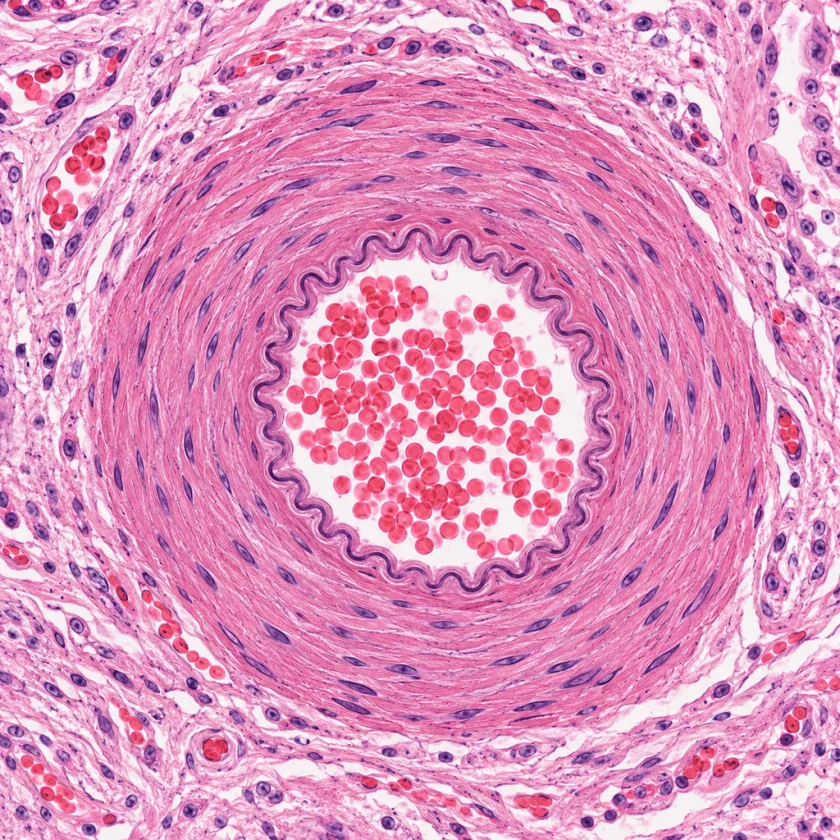
The mechanism. Arteries are wrapped in a layer of smooth muscle whose tone sets their diameter. When cAMP rises in that muscle, protein kinase A reduces its sensitivity to calcium and the muscle relaxes. Wider vessels mean lower resistance, and lower resistance means lower blood pressure. This is not a subtle or theoretical property of forskolin — it is one of the first things ever reported about it.
Indian pharmacologists described it before the molecule was even famous. Lindner, Dohadwalla and Bhattacharya published Positive inotropic and blood pressure lowering activity of a diterpene derivative isolated from Coleus forskohlii: forskolin in Arzneimittel-Forschung in 1978, and Dubey, Srimal, Nityanand and Dhawan published pharmacological studies on coleonol as a hypotensive diterpene in the Journal of Ethnopharmacology in 1981. The blood-pressure-lowering effect is in the compound's founding literature. Evidence tier: established in animal pharmacology and in monitored human intravenous studies.
What this means in practice.
- If you take medication for high blood pressure, the effects can add. That includes beta-blockers, angiotensin-converting enzyme inhibitors (ACE inhibitors), angiotensin receptor blockers, calcium-channel blockers, diuretics and nitrates. The result of additive hypotension is not usually dramatic — it is light-headedness on standing, unsteadiness, fatigue, occasionally a faint. In an older person, a faint is a hip fracture.
- People who already have low blood pressure or orthostatic symptoms have the least margin. People with postural orthostatic tachycardia syndrome, autonomic dysfunction or a habitually low reading have no headroom.
- Other blood-pressure-lowering supplements stack too. Beetroot or nitrate products, hawthorn, high-dose fish oil, magnesium at bowel-tolerance doses, and several others all push the same direction.
- "It lowers blood pressure" does not make it a hypertension treatment. No trial has shown that a coleus supplement usefully treats high blood pressure, and an unmonitored, non-selective, poorly characterised vasodilator is not a substitute for a medication with decades of outcome data. See Hypertension.
Measuring the effect: a supplement that moves a number nobody is measuring shows its effect only when someone feels unwell. Blood-pressure readings taken sitting and standing for a few days before starting, and again in the first week, are what show whether it has moved.
Platelets, Bleeding and Anticoagulants
This is the most under-reported risk in forskolin marketing, and mechanistically it is one of the most solid.
The mechanism. Cyclic AMP is a platelet's off switch. Your own blood-vessel lining uses it deliberately: healthy endothelium releases prostacyclin, prostacyclin raises cAMP inside passing platelets, and raised cAMP keeps them from activating and clumping where they are not needed. This is how your circulation stops itself clotting continuously.
Forskolin raises platelet cAMP directly. Siegl, Daly and Smith demonstrated inhibition of aggregation alongside stimulated cAMP generation in intact human platelets in Molecular Pharmacology in 1982. This was established so early and so clearly that Agarwal and Parks proposed forskolin as a potential antimetastatic agent in the International Journal of Cancer in 1983 largely on the strength of its antiplatelet action. Evidence tier: established in human platelets in vitro.
The interactions that follow.
- Anticoagulants — warfarin, and the direct oral anticoagulants such as apixaban, rivaroxaban, edoxaban and dabigatran. These work on the clotting cascade rather than on platelets, but adding platelet inhibition on top increases overall bleeding risk.
- Antiplatelet drugs — aspirin, clopidogrel, ticagrelor, prasugrel, dipyridamole. Same target, additive effect. Anyone on dual antiplatelet therapy after a stent is at the highest risk here.
- Other antiplatelet supplements — high-dose fish oil, ginkgo, garlic extract, high-dose vitamin E, curcumin, nattokinase. People taking a "stack" often have four or five of these without realising they all pull the same lever.
- Anti-inflammatory drugs — ibuprofen, naproxen and similar drugs have their own antiplatelet effect and irritate the stomach lining, which combines badly with forskolin's effect on gastric acid (below).
Signs to take seriously: bruising more easily or in unusual places, nosebleeds that take longer to stop, bleeding gums when brushing, blood in urine or stool, black tarry stools, cuts that keep oozing, or unusually heavy periods. These are signs of bleeding; black tarry stools in particular are a sign of bleeding in the stomach or gut that hospitals treat as urgent.
Surgery, Dental Work and Procedures
This gets its own section because it is frequently missed.
The usual interval given for supplements with antiplatelet activity is two weeks before any planned surgery, dental extraction, biopsy, endoscopy with possible intervention, or injection procedure. That interval exists because platelets live about eight to ten days and the affected population needs to turn over.
The reason it matters is that forskolin brings two surgical liabilities at once: impaired platelet function, which increases bleeding, and a blood-pressure-lowering effect that interacts with anaesthesia, which itself drops blood pressure. Neither is welcome on an operating table.
Two further points. Surgeons and anaesthetists can only allow for the supplements they are told about, including the ones that do not sound medical. Pre-operative questionnaires ask about medications, and patients routinely answer without mentioning capsules bought online — which is exactly how an unexplained intraoperative bleed happens. The same holds when surgery is unplanned or urgent, even for a dose taken that morning.
Gastric Acid, Ulcers and Reflux
The mechanism, which is almost too neat. The stomach's acid-producing parietal cells are switched on by histamine acting at the H2 receptor, and that receptor signals through adenylyl cyclase and cAMP to activate the proton pump. This is exactly the pathway that H2 blockers — famotidine, cimetidine, and ranitidine (withdrawn from the US market at the US Food and Drug Administration's (FDA's) request on 1 April 2020) — were designed to interrupt.
Forskolin pushes that pathway in the opposite direction. Stimulation of acid and pepsinogen secretion by forskolin in isolated gastric glands was reported by Chew in the American Journal of Physiology in 1983, and forskolin has been a standard tool in gastric physiology ever since for exactly this reason. Evidence tier: established in isolated gastric tissue.
Consequences:
- Active peptic ulcer disease — increasing acid secretion into an existing ulcer crater is directly counterproductive, and combined with impaired platelet function it is the specific combination that turns an ulcer into a bleeding ulcer. See Peptic Ulcer Disease.
- Reflux disease — more acid means more to reflux. See gastroesophageal reflux disease (GERD).
- It can work against acid-suppressing therapy. If you take a proton-pump inhibitor or an H2 blocker, forskolin is pushing the accelerator while your medication holds the brake.
- Loose stools and increased bowel activity are the complaints users report most. The small oral trials reported no clinically significant side effects, but in a nationwide online survey of Japanese users of coleus extract (Nishijima and colleagues, 2019), 10.5% of users reported a side effect; 92.0% of those were stomach and bowel symptoms and 81.3% were diarrhoea, and diarrhoea became more common as the amount of extract in the product rose. These bowel symptoms share one origin: cAMP drives chloride and fluid secretion by the intestinal lining. This is not a "detox" effect. It is secretory diarrhoea, mildly.
From the same survey, the authors estimated the amount with few side effects as under 250 mg of extract a day, adding that, given its effect, 500 mg a day might be acceptable. The survey relied on what users reported online, not on a clinical examination.
Nitrates, Vasodilators and Erectile-Dysfunction Drugs
Cells run two closely related cyclic-nucleotide systems: cyclic AMP, which forskolin raises, and cyclic GMP, which nitric oxide raises. In smooth muscle they converge on the same outcome — relaxation — through overlapping downstream machinery.
That convergence is the basis of a theoretical but reasonable concern:
- Nitrates (glyceryl trinitrate, isosorbide) work through cyclic GMP to dilate vessels. Adding a cAMP-driven vasodilator risks additive hypotension.
- Phosphodiesterase-5 inhibitors for erectile dysfunction — sildenafil, tadalafil, vardenafil — work by preventing cyclic GMP breakdown. They already carry a hard warning about combination with nitrates for precisely this reason. Adding a third vasodilating agent extends the same concern.
- Cyclic-AMP-active heart drugs — milrinone and related phosphodiesterase-3 inhibitors work by slowing cAMP breakdown. Forskolin increases cAMP production. Same variable, two directions of attack, unpredictable together.
- Forskolin has actually been injected into the penis as part of compounded multi-drug mixtures for erectile dysfunction refractory to standard therapy — a specialist procedure performed under urological supervision, and one more example of a route that has nothing to do with a capsule. It is not evidence that oral forskolin does anything for erectile function.
Evidence tier for the interaction concerns: theoretical, mechanistically grounded, not documented in human interaction studies. That combination — plausible and unstudied — means the absence of reports is not the same as reassurance.
Polycystic Kidney Disease: The Hard No
Of everything on this page, this is the one absolute contraindication, and it deserves to be understood rather than just obeyed.
In autosomal dominant polycystic kidney disease, the kidneys fill progressively with fluid-filled cysts until function is lost. Cyclic AMP is the central driver of that process. Inside the epithelium lining a cyst, elevated cAMP does two harmful things simultaneously: it drives chloride-and-fluid secretion into the cyst cavity, so the cyst fills, and it switches the lining cells into a proliferative mode, so the cyst wall grows. Yamaguchi, Nagao, Wallace and colleagues showed that cyclic AMP activates the B-Raf and ERK proliferative pathway in cyst epithelial cells from human polycystic kidneys, published in Kidney International in 2003.
The clinical proof runs in the opposite direction, and it is strong. Tolvaptan, the drug approved to slow progression in this disease, works by blocking the vasopressin V2 receptor specifically in order to lower cAMP in those cells. The pivotal trial — Torres, Chapman, Devuyst and colleagues, Tolvaptan in patients with autosomal dominant polycystic kidney disease, in the New England Journal of Medicine in 2012 — showed slowed kidney growth and slowed decline in function.
So the disease is driven by high cAMP, and the treatment works by lowering cAMP. Meanwhile, in the laboratory, forskolin is one of the standard agents used to induce cyst formation and fluid secretion in models of the disease. A compound whose experimental job is making kidney cysts grow is the reason this disease heads the list of concerns.
The concern covers polycystic kidney disease and a family history of it. It also covers people who do not know they have it: autosomal dominant polycystic kidney disease (ADPKD) is common enough — and often silent until adulthood — that a family history of "kidney problems," dialysis, or a parent with large kidneys points to the same risk with a cAMP-raising supplement. See Polycystic Kidney Disease.
Thyroid and Other Hormone Signalling
Thyroid-stimulating hormone from the pituitary controls the thyroid through a receptor that signals via adenylyl cyclase and cAMP. Raising cAMP in a thyroid follicular cell therefore mimics the pituitary's instruction to work. Forskolin is used routinely in thyroid cell biology for exactly this reason.
What that means practically is honest uncertainty rather than a documented problem. One small human trial measured it: in Henderson and colleagues' 2005 study, 23 mildly overweight women were given 250 mg of a 10% coleus extract or a placebo twice a day for 12 weeks, and the researchers saw no clinically significant change in thyroid-stimulating hormone (TSH), the thyroid hormones T3 and T4, or insulin. That trial was short, in healthy women, and no study has looked at people taking levothyroxine or people with a thyroid condition. Evidence tier: mechanism plus one short trial in healthy women; interaction with thyroid medication untested. A new cAMP-raising supplement started in the weeks around a dose adjustment or a thyroid function test adds an unmeasured factor to that test. See Hypothyroidism.
The same logic covers steroid hormones. Luteinising hormone drives testicular steroid production through cAMP, and forskolin stimulates steroidogenesis in isolated cells. The 2005 body-composition trial in men reported higher free testosterone as a secondary outcome — see the weight-loss page for why that finding is treated cautiously. Read as a safety matter rather than a benefit, it says: this supplement may have endocrine activity, taken without monitoring, at an exposure nobody has characterised.
Liver Effects and Drug-Metabolising Enzymes
Two findings from animal work deserve mention, both because they are relevant and because they are almost never mentioned in the retail context.
Dose-related liver injury in mice. Virgona, Taki, Yamada and Umegaki reported that dietary Coleus forskohlii extract generated dose-related hepatotoxicity in mice, published in the Journal of Applied Toxicology in 2013. Evidence tier: animal study. Animal hepatotoxicity does not establish human liver injury, and mice were fed proportionally large amounts. But for a supplement taken daily for months with no human long-term safety data, an animal liver signal is not something to leave out.
Induction of drug-metabolising enzymes, and an interaction that runs the "wrong" way. Yokotani and colleagues at Japan's National Institute of Health and Nutrition reported in 2012 that mice fed coleus extract (standardised to 10% forskolin) at 0.05% of their diet or more had more liver cytochrome P450 enzyme, including the enzyme activity that breaks down warfarin, and — more pointedly — that warfarin's anticoagulant effect was weakened in step with that enzyme rise.
Read that carefully, because it is genuinely important and it cuts against the simple story:
- Forskolin's platelet effect would tend to increase bleeding risk on warfarin.
- Cytochrome induction would tend to clear warfarin faster, reducing its effect and increasing clot risk.
- In test tubes, the extract also blocked the same enzyme family (CYP2C) directly in mouse and human liver preparations, while forskolin alone blocked it only slightly — a third direction.
- These pull in opposite directions. The net effect in a given person is unpredictable, which is worse than a predictable interaction in one direction, not better.
For people on warfarin, the finding is that the effect could go either way. The mouse-study authors concluded that “caution is required with the combination of warfarin and dietary supplements containing” coleus extract. The international normalized ratio (INR) blood test that warfarin clinics use is the measurement that would show a change. Cytochrome induction also means potential interference with other narrow-margin medications metabolised by the same enzymes — a category that includes many antiepileptics, immunosuppressants and antiretrovirals. Evidence tier: animal and in-vitro; no human interaction studies.
A second liver enzyme. A 2024 Japanese laboratory study (Adachi and colleagues) started from cases of sudden liver injury in patients taking several drugs and slimming health foods. In cell tests, coleus extract switched on the gene for the liver enzyme CYP3A4 more strongly than any other extract tested, and in mice carrying human-type versions of this enzyme system, forskolin raised CYP3A4 messenger RNA 3.9-fold. The authors concluded that this switch-on is one of the causes of liver-cell injury of the kind caused by the toxic breakdown product of paracetamol (acetaminophen), which CYP3A4 helps produce. Evidence tier: cell and mouse work, not a human study.
A Different Route Is Not Evidence of Oral Safety
A specific argument appears on sales pages and it needs dismantling, because it sounds reasonable: forskolin has been used as eye drops and studied by inhalation, and it is an approved intravenous heart drug in Japan — so it must be safe.
This gets safety exactly backwards. Route determines dose, distribution and which tissues are exposed. A different route is a different intervention, for risk as much as for benefit.
- Eye drops deliver a tiny quantity to the front of the eye. Systemic exposure is minimal. That the eye tolerates a drop tells you nothing about what a daily systemic dose does to platelets or blood pressure.
- Inhaled powder targets airway muscle with a small dose. Its documented side effects were local — cough, throat irritation.
- Intravenous infusion is the highest-risk route of all, which is exactly why it is done in hospital with continuous monitoring: the documented effects include flushing, tachycardia and hypotension. Those effects are the mechanism arriving fast. An approved intravenous drug is not "proof of safety" — it is proof that this pharmacology needs a monitored setting.
- And the intravenous drug is a different molecule. Colforsin daropate is a chemically modified, water-soluble derivative. Its approval says nothing about natural forskolin in a capsule.
Run the argument in reverse and its absurdity is clear: nobody would claim that because a local anaesthetic is safely injected into a gum, drinking a bottle of it is fine.
Two more asymmetries worth naming. The traditional food use does not transfer either. In parts of Gujarat and Rajasthan the fresh root is eaten as a pickled condiment — genuinely reassuring about the food, and irrelevant to a solvent extract concentrated to 10% forskolin taken twice daily for three months. And the trials' clean tolerability reports do not cover the population that worries. Those trials enrolled a few dozen relatively healthy overweight adults for twelve weeks. They did not enrol people on anticoagulants, people with ulcers, people with polycystic kidneys, or anyone at all for a second year.
A 2026 trial adds the same kind of data: 60 overweight adults aged 20 to 70 took a coleus extract or a placebo for 12 weeks in a double-blind, quasi-randomised (not fully randomised) study run by the extract maker's research department, and it reported no clinically significant changes in metabolic markers, liver and muscle enzymes, heart rate, blood pressure or reported side effects. It was again short, and its abstract reports no results for people on blood thinners or blood-pressure drugs.
Pregnancy, Breastfeeding and Children
The concern extends to pregnancy and breastfeeding. The reasons:
- There is no adequate human safety data. Not "reassuring data" — no data. For a compound that alters a universal signalling system, absence of data during organ development leaves the risk unknown.
- Traditional sources treat the root as inadvisable in pregnancy. Traditional caution is weak evidence of harm but it is not zero, and here it points the same way as the pharmacology.
- The mechanism raises specific concerns. Vasodilation affects blood pressure and therefore placental perfusion; cAMP influences uterine smooth muscle; and cAMP–CREB signalling participates in developmental gene expression. None of this is documented as harmful in humans, and there is no established benefit to weigh against it.
- Breastfeeding: no data on transfer into milk. The risk is equally unknown.
- Children and adolescents: no safety or dosing data, and no plausible indication. Weight-loss supplements marketed to teenagers are a specific harm worth naming, and this is not an exception.
Product Variability: What "10%" Does Not Guarantee
A risk that has nothing to do with pharmacology: you may not be taking what the label says.
In most countries, botanical supplements are not tested for identity, potency or purity before sale in the way medicines are. For coleus specifically:
- "10% forskolin" is arithmetic, not a guarantee. It means a tenth of the extract powder by weight should be forskolin, so a 250 mg capsule should contain about 25 mg. Whether it does depends entirely on the manufacturer's testing. Independent testing across the supplement industry regularly finds products that do not match their labels.
- Higher percentages are less studied, not better. Products advertise 20%, 40%, even 95%. The published trials used a 10% extract. A 40% product at the same capsule weight is a fourfold untested dose.
- Species identity is a real problem here. The names overlap: Plectranthus barbatus is a botanical synonym for Coleus forskohlii itself — the same plant — and in Brazil its leaves are sold as "boldo" though true boldo is a different plant entirely, while Plectranthus amboinicus (Cuban oregano, Indian borage) is a different species with no meaningful forskolin. A label reading only "coleus" is not an adequate identification.
- Plant part matters. Forskolin is in the root and essentially absent from the leaf. If the label does not say root, that is a problem.
- Standardisation is a chemistry test, not a botany test. Meeting a forskolin percentage does not prove the material came from the right plant, or from the root, or that the compound was not added in purified form to a weak extract.
- Heavy metals and contamination. This is a root crop, and roots concentrate soil contaminants. Third-party testing for heavy metals and microbial contamination is the only check on this.
- Multi-ingredient "fat burner" blends are the worst case. Forskolin frequently appears in stacks with caffeine and other stimulants. Combining an unselective vasodilator with high-dose stimulants is a cardiovascular gamble, and proprietary-blend labelling means you cannot tell how much of anything you are taking.
Who the Research Raises Concerns For, and Warning Signs
Where the concern is strongest
- Polycystic kidney disease, or a family history suggesting it. The clearest contraindication on this page.
- Pregnancy or breastfeeding.
- Children and adolescents.
- Taking warfarin, a direct oral anticoagulant, or dual antiplatelet therapy.
- Active peptic ulcer, recent gastrointestinal bleed, or oesophageal varices.
- Unstable cardiovascular disease — a tachyarrhythmia, uncontrolled heart failure, recent heart attack, or significant valve disease.
- Within two weeks of planned surgery or a dental extraction.
- A bleeding disorder such as haemophilia or von Willebrand disease, or low platelets.
Where its effects can add to a medicine or condition
- Any blood-pressure medication, or low blood pressure and orthostatic symptoms.
- Aspirin, clopidogrel or regular anti-inflammatory drugs.
- Proton-pump inhibitors, H2 blockers, or reflux disease.
- Thyroid medication or a thyroid condition under monitoring.
- Liver disease, or any medication with a narrow therapeutic margin.
- Nitrates or drugs for erectile dysfunction.
- Glaucoma — not because forskolin is dangerous to the eye, but because the risk is untreated eye pressure if it takes the place of proven pressure-lowering treatment. See the clinical-uses page.
- Asthma — the same risk applies if it takes the place of inhalers.
Warning signs reported or predicted
- Light-headedness or faintness on standing, or unusual fatigue.
- Easy bruising, prolonged nosebleeds, bleeding gums, blood in urine or stool, or black tarry stools.
- New or worsening heartburn, or upper abdominal pain.
- Palpitations or an unusually fast heartbeat.
- Yellowing of the eyes or skin, dark urine, or persistent right-sided abdominal discomfort.
- Persistent loose stools.
Yellowing of the eyes or skin with dark urine is a sign of liver injury, and black tarry stools a sign of bleeding in the gut; hospitals treat both as urgent.
What is known for people who take it
The facts that bear on use:
- A label that names the species and the root, gives extract weight and percentage, and shows third-party testing is the only kind that can be checked against the studied extract.
- The published trials used a 10% extract; high-percentage products are untested doses.
- Blood-pressure readings before starting and during the first week show whether it adds to blood-pressure medication.
- Prescribers, pharmacists and pre-operative forms can only allow for it when it is listed.
- Stacking it with other antiplatelet or blood-pressure-lowering supplements adds the same effects together.
- Twelve weeks is the longest studied course. Human trials ran twelve weeks; there is no long-term safety data whatsoever. Indefinite use is unstudied territory.
- The usual interval given for antiplatelet supplements is two weeks before any procedure.
Key Research Papers
Authors, titles, journals and years appear as plain text. Entries checked against their PubMed record end in a PubMed PMID link; the others link to PubMed topic searches.
- Lindner E, Dohadwalla AN, Bhattacharya BK. Positive inotropic and blood pressure lowering activity of a diterpene derivative isolated from Coleus forskohlii: forskolin. Arzneimittel-Forschung, 1978. The founding report of the cardiovascular and blood-pressure effects. PubMed search
- Dubey MP, Srimal RC, Nityanand S, Dhawan BN. Pharmacological studies on coleonol, a hypotensive diterpene from Coleus forskohlii. Journal of Ethnopharmacology, 1981. Early systematic characterisation of the hypotensive effect. PubMed search
- Siegl AM, Daly JW, Smith JB. Inhibition of aggregation and stimulation of cyclic AMP generation in intact human platelets by the diterpene forskolin. Molecular Pharmacology, 1982. The antiplatelet effect, demonstrated in human platelets. PubMed search
- Agarwal KC, Parks RE Jr. Forskolin: a potential antimetastatic agent. International Journal of Cancer, 1983. Rests on the antiplatelet action — included here as further evidence of how strong that effect is. PubMed search
- Chew CS. Forskolin stimulation of acid and pepsinogen secretion in isolated gastric glands. American Journal of Physiology, 1983. The gastric acid effect, in isolated tissue. PubMed search
- Seamon KB, Padgett W, Daly JW. Forskolin: unique diterpene activator of adenylate cyclase in membranes and in intact cells. Proceedings of the National Academy of Sciences of the USA, 1981. The mechanism from which every caution on this page is derived. PubMed search
- Yamaguchi T, Nagao S, Wallace DP, et al. Cyclic AMP activates B-Raf and ERK in cyst epithelial cells from autosomal-dominant polycystic kidneys. Kidney International, 2003. Establishes cAMP as a proliferative driver in cyst epithelium. PubMed search
- Torres VE, Chapman AB, Devuyst O, et al. Tolvaptan in patients with autosomal dominant polycystic kidney disease. New England Journal of Medicine, 2012. The pivotal trial of a drug that works by lowering cAMP in exactly those cells. PubMed search
- Virgona N, Taki Y, Yamada S, Umegaki K. Dietary Coleus forskohlii extract generates dose-related hepatotoxicity in mice. Journal of Applied Toxicology, 2013. Animal liver signal; not human evidence, but not nothing either. PubMed search
- Yokotani K, Chiba T, Sato Y, Taki Y, Yamada S, Shinozuka K, Murata M, Umegaki K. Hepatic cytochrome P450 mediates interaction between warfarin and Coleus forskohlii extract in vivo and in vitro. Journal of Pharmacy and Pharmacology, 2012;64(12):1793-801. Mice: liver enzyme induction and weaker warfarin anticoagulation; test tubes: direct CYP2C inhibition. PubMed PMID: 23146043
- Godard MP, Johnson BA, Richmond SR. Body composition and hormonal adaptations associated with forskolin consumption in overweight and obese men. Obesity Research, 2005. Included here for its tolerability data and its report of altered free testosterone — an endocrine signal in a twelve-week trial. PubMed search
- Henderson S, Magu B, Rasmussen C, et al. Effects of Coleus forskohlii supplementation on body composition and hematological profiles in mildly overweight women. Journal of the International Society of Sports Nutrition, 2005;2(2):54-62. Reported no clinically significant adverse effects and no clinically significant change in blood counts or in TSH, T3 and T4 over twelve weeks — useful, and limited to twenty-three healthy women for three months. PubMed PMID: 18500958
- Baumann G, Felix S, Sattelberger U, Klein G. Cardiovascular effects of forskolin in patients with idiopathic congestive cardiomyopathy: a comparative study with dobutamine and sodium nitroprusside. Journal of Cardiovascular Pharmacology, 1990. What forskolin's cardiovascular pharmacology looks like when given intravenously under monitoring. PubMed search
- Ammon HP, Müller AB. Forskolin: from an ayurvedic remedy to a modern agent. Planta Medica, 1985. A contemporaneous review covering the compound's pharmacology across tissues. PubMed search
- Nishijima C, Chiba T, Sato Y, Umegaki K. Nationwide Online Survey Enables the Reevaluation of the Safety of Coleus forskohlii Extract Intake Based on the Adverse Event Frequencies. Nutrients, 2019;11(4):866. Side effects in 10.5% of users, mostly diarrhoea, rising with the amount of extract. PubMed PMID: 30999632
- Adachi M, Kumagai T, Hosho K, Nagata K, Fujiyoshi M, Shimada M. Exploring Acute Liver Damage: Slimming Health Foods and CYP3A4 Induction. Yonago Acta Medica, 2024;67(2):124-134. Cell and mouse work on CYP3A4 induction by coleus extract and forskolin. PubMed PMID: 38803590
- Channangihalli Thimmegowda S, Hussain Mirza FH, Venkataraman R, Nagarajaiah RB. A 12-week, double-blind, quasi-randomized, placebo-controlled study to evaluate the efficacy and safety of Coleus forskohlii on body weight loss. Journal of the International Society of Sports Nutrition, 2026;23(1):2725137. Sixty overweight adults; safety markers reported unchanged. PubMed PMID: 42678522
- Pavithra BS, Govin K, Renuka HM, Krishnareddy M, Jalali S, Samuel DK, Himabindu K. Characterization of cucumber mosaic virus infecting coleus (Plectranthus barbatus) in Karnataka. Virusdisease, 2019;30(3):403-412. Cited for the botanical synonym: Plectranthus barbatus is also known as Coleus forskohlii. PubMed PMID: 31803808
PubMed Topic Searches
- PubMed: Coleus forskohlii + safety + adverse effects
- PubMed: Forskolin + platelet aggregation inhibition
- PubMed: Forskolin + blood pressure + vasodilation
- PubMed: Forskolin + gastric acid secretion + parietal cell
- PubMed: Cyclic AMP + cyst growth + polycystic kidney disease
- PubMed: Herbal supplement + perioperative bleeding risk
- PubMed: Coleus forskohlii + hepatotoxicity + cytochrome P450
- PubMed: Dietary supplement label accuracy + botanical identity
- PubMed: Intracavernosal forskolin + erectile dysfunction
External Resources
- NIH Office of Dietary Supplements — US government fact sheets on supplement safety, interactions and regulation.
- National Center for Complementary and Integrative Health — appraisals of botanical safety and evidence, including guidance on telling your clinicians what you take.
- MedlinePlus — plain-language drug and supplement information from the US National Library of Medicine.
- US Food and Drug Administration — supplement regulation, recalls and adverse-event reporting.
- FDA press announcement, 1 April 2020 — the request that all ranitidine products be withdrawn from the US market.
Connections
- All Herbs
- Coleus forskohlii (Forskolin) — the main topic page: botany, naming, forms, dosage and full cautions list.
- Forskolin and Cyclic AMP — the single mechanism from which every risk on this page is derived.
- Forskolin for Weight Loss — the claim most people are weighing these risks against, and why it is not supported.
- Glaucoma, Asthma and Clinical Research — why an approved intravenous or topical use is not evidence of oral safety.
- Polycystic Kidney Disease — the absolute contraindication, and the disease that explains why.
- Hypertension — why additive blood-pressure lowering matters, and what treats high blood pressure properly.
- Heart Failure — contractility, vascular tone and why these effects belong in a monitored setting.
- Cardiology — the full cardiovascular library, including antiplatelet and anticoagulant therapy.
- Peptic Ulcer Disease — where increased acid secretion plus impaired platelets is the worst combination.
- Gastroesophageal Reflux Disease — reflux, and why a supplement that raises acid output works against your treatment.
- Hypothyroidism — the thyroid-stimulating hormone receptor signals through cAMP, the basis of the theoretical thyroid interaction.
- Lab Tests — the blood tests worth knowing your baseline on before starting any supplement.
Safety note and disclaimer. This page is educational and is not medical advice, and it is not a licence to self-manage a medication regimen. Coleus forskohlii has no established benefit for weight loss and real, mechanistically predictable risks: it lowers blood pressure, it inhibits platelet aggregation, it increases gastric acid secretion, animal studies show dose-related liver injury and induction of drug-metabolising enzymes, and it is contraindicated in polycystic kidney disease and in pregnancy. There is no long-term human safety data at all. Prescribers, pharmacists, surgeons and anaesthetists can only allow for supplements they are told about; the usual interval given for antiplatelet supplements is two weeks before any procedure; and no research shows a supplement standing in for proven treatment for glaucoma, asthma, high blood pressure, heart disease or kidney disease. Unusual bleeding, faintness, palpitations and signs of liver trouble are the warning signs reported or predicted for it.