Chiretta: Bitterness and Digestive Stimulant Action
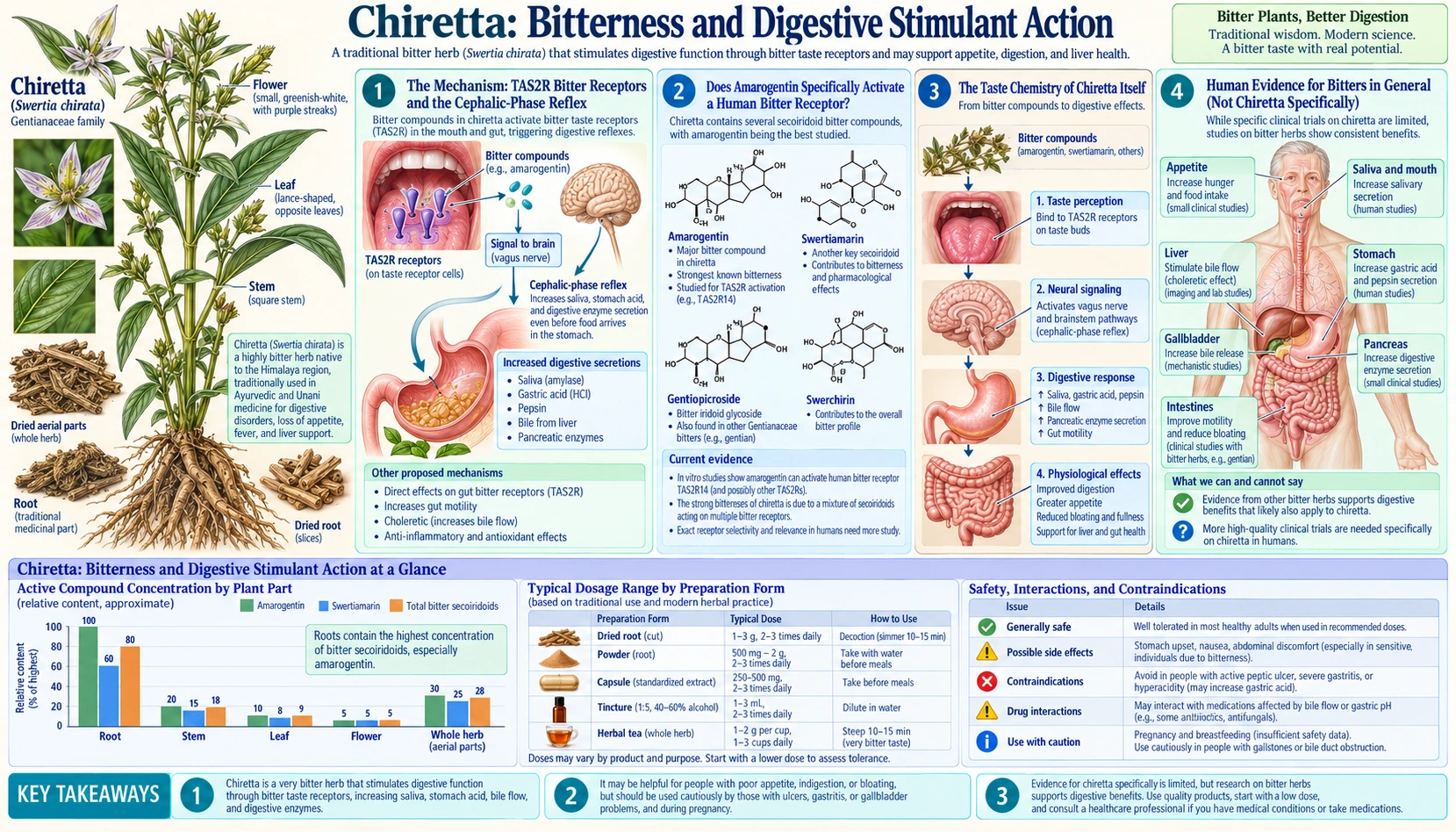
Of chiretta’s four traditional claims — digestive bitter, fever remedy, liver protectant, blood-sugar lowerer — this is the one built on the best mechanism. Bitterness is not a vague, unfalsifiable idea the way “detoxifies the liver” is. It is a specific, well-characterised signalling pathway: a family of taste receptors, a documented reflex arc running through the vagus nerve, and decades of human physiology behind it. Chiretta is, if anything, an unusually clean test of that pathway — the whole plant, root to seed, is essentially nothing but bitter, dominated by the secoiridoid glycosides amarogentin and swertiamarin, without the aromatic or sweet top notes that complicate the taste profile of a lot of other bitter herbs.
So the fair expectation, going in, is that this is the claim on chiretta’s whole Benefits set most likely to have real human evidence behind it. It does not. What exists is a strong case for the mechanism and essentially no chiretta-specific evidence that stimulating that mechanism with this particular herb changes anyone’s digestion, appetite, or anything else a person would notice. That gap is worth sitting with rather than rushing past, because the obvious next move — “fine, what about real gentian, the pharmacopoeial European bitter?” — does not rescue the claim either. Gentiana lutea, chiretta’s closest well-known relative in the same family, Gentianaceae, and the reference bitter of Western herbal medicine, has barely more human digestive-trial evidence than chiretta does. This is not a story about one herb quietly failing where its cousins succeed. It is a story about an entire class of remedies that has almost never been tested the way modern medicine tests things — with a small number of honest exceptions, covered below, that prove the testing is possible whenever anyone bothers to do it.
There is a genuinely useful, evidence-grounded takeaway despite the missing trials, and it is worth stating before the detail. Because the mechanism runs through taste receptors on the tongue, a swallowed capsule cannot deliver it. Whatever else is true or unproven about chiretta as a digestive bitter, the preparation has to make contact with taste to have any chance of working the way the mechanism says it should. That point is covered in full toward the end of this page, together with the one human study that compared bitter herbs in capsules with the same herbs tasted in water.
Table of Contents
- The Mechanism: TAS2R Bitter Receptors and the Cephalic-Phase Reflex
- How Amarogentin Activates Human Bitter Receptors
- The Taste Chemistry of Chiretta Itself
- Human Evidence for Bitters in General (Not Chiretta Specifically)
- Even True Gentian Barely Has Better Evidence
- Bitter Formulas That Do Have Real Trials
- Why the Preparation Matters: A Capsule Bypasses the Mechanism
- What Is Not Known: A Numbered List
- Verdict and Evidence Tier
- Key Research Papers
- Connections
- Featured Videos
The Mechanism: TAS2R Bitter Receptors and the Cephalic-Phase Reflex
Start with the receptor family. Humans carry roughly two dozen TAS2R genes — bitter taste receptors, a subfamily of G-protein-coupled receptors expressed in specialised taste-bud cells clustered mostly toward the back of the tongue. Unlike the single sweet receptor or the single umami receptor, the TAS2R family is deliberately broad and promiscuous: different members respond to different, structurally unrelated bitter molecules, and between them the family can detect an enormous range of plant compounds that, across evolutionary time, correlated with toxicity. Bitterness is, mechanistically, a chemical alarm system before it is anything else.
Tasting something bitter does not just register as a flavour. It triggers the cephalic-phase reflex — a vagally mediated, anticipatory response that begins in the mouth and reaches the gut before any food has actually arrived there. Sensory contact with a bitter signals the brainstem via cranial nerves, and the vagus nerve carries the response back down: increased salivary flow, a rise in gastric acid secretion, release of pepsinogen, and priming of pancreatic digestive enzymes. The physiological logic is anticipatory — the body has learned, over an evolutionary and a personal lifetime, that a bitter taste in the mouth predicts an imminent digestive workload, and it starts preparing before the workload arrives. A review of this system and its extraoral biology is collected under endocrine taste cells and nutrition — general TAS2R physiology, not specific to any one plant or species.
The receptors are not confined to the tongue. This is the detail that turns “a mouth reflex” into something with real reach into digestion itself. TAS2Rs are also expressed “extraorally” — in the stomach, the small intestine, the gallbladder, and elsewhere — where they appear to have direct local roles rather than only relaying a signal from the mouth. Recent work in a human gastric tumour cell line (HGT-1, used as a model of the stomach’s acid-producing parietal cells) has reported that the bitter receptor TAS2R43 helps regulate acid secretion and zinc handling in these cells, confirmed by switching the gene off (Orth 2025); see bitter taste receptors and human gastric acid secretion and, more specifically, TAS2R43’s role in gastric acid secretion and zinc homeostasis. A related 2025 paper reports that bitter peptides formed when pea protein was digested in a simulated stomach stimulated acid-secretion mechanisms and the release of serotonin, a satiety signal, in the same cell line, through TAS2R4 and TAS2R43 (Gradl 2025) — see bitter peptides, gastric digestion and parietal cells.
What tier this evidence sits at, precisely. All of the gastric-receptor work just cited is in cultured human cells (a tumour-derived cell line) — real human biology, genuinely informative about mechanism, but not a study of a living person eating or drinking anything. It tells you the receptors exist, where, and roughly what they do when directly stimulated in a dish. It does not, on its own, tell you what happens when a person drinks a cup of bitter infusion. That gap between cell-level mechanism and whole-person outcome is the theme this entire page returns to.
How Amarogentin Activates Human Bitter Receptors
The mechanism above is generic to bitterness as a category. The next question is narrower and more useful: does chiretta’s own signature compound actually engage it?
Amarogentin is one of the most intensely bitter substances ever characterised — its detection threshold is often quoted at around one part in fifty million in water, which is exactly why a search for amarogentin and human bitter taste receptors (TAS2R) returns real, specific pharmacology rather than nothing. Because it is such a potent bitter agonist, amarogentin turns up in the receptor-pharmacology literature partly as a subject in its own right and partly as a reference or calibration compound — a known strong activator that other candidate molecules get benchmarked against when researchers screen which TAS2R family members a new compound engages. That amarogentin reliably activates one or more human bitter receptors in a cell-based assay is about as solid a piece of receptor-level evidence as exists anywhere in chiretta’s pharmacology.
What kind of evidence that is. These are receptor-binding and cell-activation studies: a specific human TAS2R gene is expressed in a laboratory cell line — commonly a HEK293 cell engineered to carry the receptor plus a reporter system — amarogentin is applied, and the resulting signal confirms that the molecule and the receptor interact. That is real, specific, and about this exact compound — a genuine step up from the generic bitterness discussed above. It is not a clinical outcome of any kind. Nobody in this literature gave a person amarogentin and measured saliva, gastric acid, or appetite. The chain of inference from “amarogentin activates a bitter receptor in a dish” to “chiretta improves digestion” still has to cross the cephalic-phase evidence above and the human-trial evidence below, and as the following sections show, that crossing has not been made for this herb.
The Taste Chemistry of Chiretta Itself
This is the one section on this page built on evidence generated from the actual plant, recently, rather than borrowed from bitterness research in general or from another species. In 2025, Rutz and colleagues published “SAPID: A Strategy to Analyze Plant Extracts Taste In Depth. Application to the complex taste of Swertia chirayita” in Current Research in Food Science — searchable at chiretta and its bitter taste chemistry.
What the method does. SAPID-style taste deconvolution combines analytical chemistry — NMR spectroscopy and LC-MS — with a trained human sensory panel. An ethanolic extract is fractionated, each fraction is chemically profiled and independently tasted and rated by panelists for specific taste qualities, and the two data sets are cross-referenced to work out which molecules are actually responsible for which sensations, rather than assuming the most abundant compound must be the one doing the work.
What it found, for chiretta specifically. The bitterness of the Swertia chirayita extract was confirmed to trace to its iridoid content — consistent with amarogentin and swertiamarin, the compounds already implicated by the receptor pharmacology above — and the study identified other compounds contributing to the extract’s wider taste beyond bitterness alone. That is a genuine, on-species confirmation that the chemistry behind chiretta’s reputation is what the traditional and pharmacological literature has long assumed it to be.
What it is not. A taste-panel study measures how a fraction tastes to a trained panelist — bitter, sour, astringent, and so on — not what happens in that panelist’s stomach afterward. It uses human subjects, but the outcome recorded is a sensory rating, not a digestive or appetite measurement. It would be a mistake to read “a 2025 human study confirmed chiretta’s properties” as evidence for the digestive-stimulant claim; it confirmed the taste chemistry, which is the input to the mechanism discussed above, not the clinical outcome claimed for it.
Human Evidence for Bitters in General (Not Chiretta Specifically)
This is the honest core of the page, and it deserves to be stated as plainly as possible: real human evidence for the cephalic-phase effects of bitterness exists. It is just not about Swertia chirayita.
The most useful body of work here comes from McMullen and colleagues. Their 2015 paper in Evidence-Based Complementary and Alternative Medicine, “Bitters: Time for a New Paradigm”, argues that bitter tonics — used across cultures for centuries as digestive aids — had been largely bypassed by modern clinical research despite a plausible and testable physiological basis, and lays out the case for taking the cephalic-phase mechanism seriously as a research question. It is a review and an argument for a research agenda, not itself a trial — and it is about bitters as a class, not chiretta.
The same group backed the argument with actual physiological data. Their 2014 paper in the Journal of Ethnopharmacology, “Bitter tastants alter gastric-phase postprandial haemodynamics”, tested two named bitter herbs, gentian root (Gentiana lutea) and wormwood (Artemisia absinthium). Healthy volunteers drank 100 mL of water with capsules (plain cellulose, or 1,000 mg of each herb; 14 people), or water flavoured with 500 or 1,500 mg of gentian (12 people) or of wormwood (12 people), while their heart and blood-vessel responses were recorded beat by beat. The capsules changed nothing beyond what plain water did. The tasted gentian (500 and 1,500 mg) and wormwood (1,500 mg) raised the resistance of the blood vessels and lowered the heart’s output within 5–10 minutes — a response the authors classify as a cephalic-phase reflex driven by the sympathetic nervous system. That is a genuine, measurable, human, in-vivo effect of tasted bitterness during the stomach phase of digestion. It is not a study of chiretta, and it measured circulation rather than digestion itself; it establishes that bitterness as a tasted stimulus moves a real physiological needle in living people.
Their 2012 paper in Food & Function, “Caffeine in hot drinks elicits cephalic phase responses involving cardiac activity”, extends the same point to the cardiac side of the reflex. Caffeine itself is bitter, and a hot caffeinated drink produced measurable cephalic-phase cardiac activity in human subjects — evidence that a bitter stimulus, independent of any nutrient or caloric content, is enough to trigger an anticipatory autonomic response the body can register. Caffeine is not chiretta and coffee is not a Himalayan bitter tonic, but the principle being tested — bitterness alone, tasted, produces a measurable cephalic-phase response — is exactly the principle chiretta’s digestive claim depends on.
Put plainly, because this is the point the whole page turns on: this is real, replicated, human physiology. It is evidence that bitterness — as a category of sensory stimulus — does what the traditional bitter-tonic idea says it should do, measured with real instruments in real people. It is not evidence about Swertia chirayita. No study located for this page has fed people chiretta specifically and measured a digestive, appetite, or gastric outcome. The mechanism case above is borrowed evidence, borrowed honestly and labelled as such at every citation, not evidence about this herb.
Even True Gentian Barely Has Better Evidence
The obvious response to “chiretta has no species-specific human trial” is to reach for the herb that actually defined the category in Western practice. Gentiana lutea — yellow gentian, the root behind gentian liqueurs, aromatic bitters and most European digestive apéritifs, covered on this site’s Gentian page — is chiretta’s closest well-known relative, sharing the family Gentianaceae and an overlapping secoiridoid chemistry (chiretta and true gentian both contain gentiopicroside, for instance). If any single herb should have settled the digestive-bitter question by now, on reputation alone, it is gentian.
It has not. A targeted search turns up a 2026 paper by Wildhaber and colleagues in the Journal of Ethnopharmacology, “Safety and anti-inflammatory activity of Gentiana lutea L. in human bronchial epithelial cell cultures” — and two things about that title matter more than its finding. First, human bronchial epithelial cell cultures is cultured human lung tissue in a dish, not a living volunteer, and not digestive-tract tissue either. Second, the endpoint is respiratory — the paper reports that a gentian preparation reduced inflammatory markers in airway cells without harming cell viability or barrier integrity — which has nothing to do with the digestive-bitter claim gentian is actually famous for. It is off-tier (cell culture, not a trial) and off-target (lung, not gut) for the claim at hand. The one study located that gave gentian to living volunteers is the 2014 McMullen study above, which measured circulation after tasting, not a digestive outcome. The site’s own review of the gentian trial record is Gentian: What the Clinical Evidence Shows.
The point, stated precisely, because it is easy to misread. This is not evidence that chiretta specifically fails a test that gentian specifically passes. Both herbs are in the same position: a centuries-old reputation as a digestive bitter, a real receptor-level mechanism to explain why that reputation is plausible, and essentially no controlled human trial testing whether taking the whole herb actually changes digestion or appetite in people. The honest reading is not “chiretta is inferior to real gentian.” It is that almost nobody has trialled bitters as digestive aids in humans at all, and that includes the herb that gave the category its name in European herbalism. Chiretta is not an outlier here. It is a representative case of how an entire traditional pharmacology category has been left largely untested by modern trial infrastructure.
Bitter Formulas That Do Have Real Trials
To be fair to the category, and because this site’s doctrine calls for naming comparators that actually clear the bar rather than only the ones that do not, two real exceptions exist — and they prove bitters are testable, not untestable in principle.
STW 5, a nine-herb German digestive formula. This is a fixed nine-herb German combination that includes bitter candytuft (Iberis amara) as its lead bitter component, alongside chamomile, peppermint, caraway, liquorice, lemon balm, greater celandine, angelica root and milk thistle. It does not contain gentian, and it does not contain chiretta — naming this precisely matters, because “a bitter formula” is not interchangeable with any one bitter herb, chiretta included. The formula has genuine randomised-trial evidence in functional dyspepsia, a real diagnosed digestive disorder. A 2025 narrative review by Lambiase and colleagues in Expert Opinion on Pharmacotherapy summarises that trial base, covering both the original nine-herb formula and a six-herb version, STW 5-II — see STW 5 in functional dyspepsia, narrative review. More concretely, a 2025 randomised, double-blind, placebo-controlled trial by Aguilar and colleagues in Neurogastroenterology and Motility — the “IBO-2” study — tested STW 5-II for 2 weeks in 32 patients with functional dyspepsia and bloating, using a standardised gastric gas infusion as the challenge. Gas began leaving the body faster on STW 5-II (319 mL passed 20 minutes after the infusion started, against 80 mL on placebo, p = 0.015) and bloating-type symptoms rose less (score increase 0.8 against 2.1, p = 0.036), but the amount of gas still retained at the end did not differ significantly (470 against 662 mL, p = 0.431), and neither did abdominal distension; see STW 5-II, gastric gas tolerance and functional dyspepsia, randomised trial. That is a real digestive endpoint, in real patients, moved in part by a real bitter-containing product in a properly controlled design.
Two caveats keep this honest rather than letting it become a shortcut back to “so bitters work.” First, STW 5 is a nine-herb formula, and bitter candytuft is only one component — the same formula-attribution problem flagged throughout chiretta’s own evidence from an Ayurvedic polyherbal formula applies here too: a positive trial of the whole formula does not establish which ingredient, or which combination of ingredients, is doing the work. Second, STW 5 is made from different plants than either chiretta or gentian; its trial base cannot be borrowed for either of them, and is named here only as a comparator, not as evidence for chiretta. What it does establish cleanly is that a bitter-containing herbal product can be put through real randomised trials against a real digestive diagnosis, with real, statistically significant results — which forecloses the excuse that bitters as a category are somehow untestable by design.
Wormwood, and a genuine complication. A 2017 study by Schwab and colleagues in Appetite used electroencephalogram-based event-related potentials — a measure of the brain’s electrical response timed to a visual stimulus — to study how 39 healthy women processed images of meat dishes, sweets and vegetables after a brief bitter mouth-rinse with wormwood tea, compared with a plain-water rinse; see wormwood bitterness and food-cue processing. The wormwood rinse sharpened early attention-related brain responses to the food images (larger N100 and N200 components) but blunted the later positive/appetitive response (a reduced P300 component), and participants who had rinsed with wormwood rated the high-calorie foods as less arousing than the water-rinse group did.
That result cuts against the flattering half of this page’s argument, and it belongs here precisely because it complicates rather than supports the case for bitters. The cephalic-phase literature above frames bitterness as appetite- and digestion-stimulating. The wormwood finding shows that an intensely bitter stimulus — tasted, not swallowed, notably, which is itself a data point in the mechanism’s favour — can instead provoke disgust and dampen the brain’s appetitive response to food, especially calorie-dense food. Both effects are real, human, and measured with real instruments; they simply point in different directions, and which one dominates plausibly depends on how bitter the stimulus is and how much of it a given person tastes. Chiretta is, by its own main page’s description, “ferociously bitter from root to seed” with “no mild part” — closer to wormwood’s end of that spectrum than to a gently bitter apéritif. Whether chiretta’s intensity sits on the stimulating side of that line, or tips some people toward the wormwood pattern instead, has — like everything else on this page — not been tested.
The response is not the same in everyone, either. The same research group later repeated the wormwood rinse in 36 women with binge-eating symptoms and 38 comparison women. In the women with binge-eating symptoms, the bitter rinse did not lower the brain’s food-reward response to food pictures (the late positive potential); instead it was higher than in the comparison group (Schienle 2017, PubMed PMID: 28950151).
The conclusion this section supports: bitters can be trialled in humans, with real digestive and appetite endpoints, when someone bothers to fund and run the trial. STW 5 and the wormwood ERP studies are both proof of that. Chiretta specifically has not been given either kind of trial.
Why the Preparation Matters: A Capsule Bypasses the Mechanism
This point follows from the mechanism itself, and it is also the one point on this page with a direct human comparison behind it.
The core logic. The cephalic-phase reflex is triggered by sensory contact — taste, specifically — occurring before food or a supplement reaches the stomach. It is, by definition, an anticipatory response: the mouth registers something bitter, cranial nerves report it, and the vagus nerve starts priming saliva and gastric secretion in advance of a meal that has not arrived yet. The wormwood study above is a useful illustration of how little contact this actually requires — a mouth rinse, not even a swallow, was enough to shift measurable brain activity. A capsule swallowed whole never touches the tongue at all. Whatever amarogentin or swertiamarin do once absorbed further down the gut, they cannot trigger the cephalic-phase reflex from inside a gelatin shell, because that specific reflex requires oral contact as its trigger. A capsule does not deliver a weaker version of this mechanism. It delivers none of it.
The direct human test. In the 2014 McMullen study described above, gentian and wormwood swallowed in capsules (1,000 mg) caused no change beyond plain water, while the same herbs dissolved in water and tasted raised blood-vessel resistance and lowered the heart’s output within 5–10 minutes. That study used gentian and wormwood, not chiretta, and it measured circulation rather than digestion, but it is the strongest evidence on this page that a capsule bypasses the tasted response.
One honest nuance, because precision matters more than a clean story. The cephalic-phase reflex is not the only place TAS2Rs act. As the mechanism section above described, bitter receptors are also expressed directly in the stomach lining, where they may respond locally to a bitter compound once it arrives there — independent of whether it was ever tasted. So it is not quite accurate to say a capsule bypasses every possible bitter-receptor-mediated effect; it bypasses specifically the anticipatory, cephalic-phase component — the part that primes digestion ahead of a meal, which is also the part the traditional instruction to take a bitter before eating is built around. Whether direct gastric-receptor stimulation from a dissolved capsule contributes anything on its own is a separate question that, like nearly everything else on this page, has not been tested for chiretta.
The traditional preparation happens to be well matched to the chemistry, and this is worth stating as a point in its favour. Amarogentin and swertiamarin are secoiridoid glycosides — glycosylation makes a molecule more polar and more water-soluble, which is exactly the chemistry a cold-water infusion is good at extracting. Contrast that with a poorly water-soluble compound class, such as many triterpenes, which need alcohol or a fat-based solvent to come out of plant material efficiently; steeping a triterpene-dominant herb in cold water would leave most of the active material behind. Chiretta’s traditional cold infusion, described on the main page’s forms section, is not a folk guess that happened to work by accident — it is a reasonably good chemical match for the compound class actually responsible for the taste, which is also the compound class the mechanism above depends on.
What this means for how chiretta is taken. In the one human study that compared them, bitter herbs tasted in water changed circulation and the same herbs in capsules did not (McMullen 2014). The timing usually described for a digestive bitter is a small amount tasted in water, around 10–20 minutes before a meal, with timing said to matter more than quantity because the reflex is anticipatory. That timing is reasoning from the mechanism, not a trial result; no study has shown that taking chiretta this way produces a specific digestive benefit.
What Is Not Known: A Numbered List
- No human trial of chiretta on any digestive or appetite outcome exists. This is the central gap the whole page describes: the mechanism is real, the herb-specific outcome evidence is not.
- No dose-response data for the bitter-reflex effect in this species — how much whole herb, or how much amarogentin or swertiamarin, is needed to trigger a measurable secretory response, and whether more produces proportionally more.
- No head-to-head comparison of chiretta against a validated bitter comparator — gentian, wormwood, or STW 5 — on any shared digestive endpoint.
- No data on tolerance with repeated or daily use. Whether the cephalic-phase response to a bitter stimulus habituates or blunts with regular exposure, a real phenomenon in other sensory-reflex systems, has not been examined for chiretta.
- No data on where chiretta sits between “stimulating” and “aversive” bitterness for ordinary users. The wormwood finding above shows intense bitterness can tip toward disgust rather than appetite stimulation; whether chiretta’s intensity crosses that line for a meaningful share of people is untested.
- No minimum tasting-contact time established. The 10–20-minutes-before-a-meal timing is a plausible extrapolation from general cephalic-phase physiology, not a finding specific to chiretta.
- No pediatric or elderly-specific data for the digestive-bitter use, consistent with the absence of pediatric and elderly data for chiretta generally.
- No comparison between people with the “sluggish digestion” complaints chiretta is traditionally aimed at and healthy volunteers. Nothing establishes that the herb behaves differently, or better, in the population it is marketed to than in anyone else.
Verdict and Evidence Tier
- Mechanism tier: established. TAS2R bitter-receptor biology and the cephalic-phase reflex are solid, replicated human physiology, and amarogentin specifically has been shown to activate human bitter receptors in cell-based assays. This is the strongest mechanistic grounding of any of chiretta’s four claims.
- On-species chemistry tier: established. A 2025 study confirmed chiretta’s bitterness traces to its iridoid content, using the actual plant and a human sensory panel — real, recent, on-species evidence for the taste chemistry specifically.
- Human physiological evidence for bitterness as a category: established. The McMullen group’s work shows measurable cephalic-phase heart and blood-vessel responses to tasted bitter herbs and hot caffeinated drinks in living people, and the wormwood ERP work shows a real, opposite-direction appetite effect from intense bitterness — but all of this evidence is about bitterness in general, not about Swertia chirayita.
- Verdict on the chiretta-specific digestive claim: absent, not negative. No adequate human trial has failed, because none has been run. Nobody has fed people chiretta and measured a digestive or appetite outcome. That is true of gentian too, which weakens the case for treating this as a chiretta-specific shortfall rather than a category-wide research gap.
- The gap is not evidence that bitters cannot be trialled. STW 5’s randomised functional-dyspepsia trials show a bitter-containing herbal product can be, and has been, tested properly against a real digestive endpoint. The infrastructure and the willingness exist; they have simply not been pointed at chiretta.
Practical reading. The mechanism gives real reason to expect chiretta produces some measurable physiological response — salivary and gastric priming — if it is tasted before a meal, because that is well-established general bitter-taste physiology and chiretta is an unusually potent, unusually pure bitter. It does not give reason to expect any specific, quantified digestive benefit, because that has not been measured for this herb. A chiretta capsule sold for “digestive support” is backed by nothing beyond the same general mechanism that backs coffee, wormwood, or a glass of aromatic bitters — and in the one human comparison, capsules of bitter herbs did not trigger the tasted response at all.
Key Research Papers
Each paper ends with its PubMed record; the two topic searches lead to the wider literature.
- Rutz and colleagues, “SAPID: A Strategy to Analyze Plant Extracts Taste In Depth. Application to the complex taste of Swertia chirayita”, Current Research in Food Science, 2025 — the one on-species taste-chemistry study this page relies on. — PubMed PMID: 40330506
- Amarogentin and human bitter taste receptors (TAS2R) — receptor-level pharmacology for chiretta’s signature compound.
- Endocrine taste cells — review — general TAS2R biology, extraoral expression included, not chiretta-specific.
- Orth HN, Pirkwieser P, Benthin J, Koehler M, Sterneder S, Parlar E, Schaudy E, Lietard J, Michel T, Boger V, Dunkel A, Somoza MM, Somoza V, “Bitter Taste Receptor TAS2R43 Co-Regulates Mechanisms of Gastric Acid Secretion and Zinc Homeostasis”, International Journal of Molecular Sciences 26(13):6017, 2025 — human gastric tumour cell line, not a trial and not chiretta. — PubMed PMID: 40649796
- Gradl K, Richter P, Somoza V, “Bitter peptides formed during in-vitro gastric digestion induce mechanisms of gastric acid secretion and release satiating serotonin via bitter taste receptors TAS2R4 and TAS2R43 in human parietal cells in culture”, Food Chemistry 482:144174, 2025 — food-derived peptides, not a chiretta compound. — PubMed PMID: 40184744
- McMullen and colleagues, “Bitters: Time for a New Paradigm”, Evidence-Based Complementary and Alternative Medicine, 2015 — about bitters generally, not chiretta. — PubMed PMID: 26074998
- McMullen and colleagues, “Bitter tastants alter gastric-phase postprandial haemodynamics”, Journal of Ethnopharmacology, 2014 — real human physiological data, not chiretta-specific. — PubMed PMID: 24802704
- McMullen and colleagues, “Caffeine in hot drinks elicits cephalic phase responses involving cardiac activity”, Food & Function, 2012 — caffeine, not chiretta, used as the bitter stimulus. — PubMed PMID: 22614720
- Wildhaber and colleagues, safety and anti-inflammatory activity of Gentiana lutea in human bronchial epithelial cell cultures, Journal of Ethnopharmacology, 2026 — true gentian, cultured human lung cells, not a digestive trial and not chiretta. — PubMed PMID: 41580168
- Lambiase C, Usai Satta P, Bassotti G, Giacomelli L, de Bortoli N, Bellini M, “Iberogast in functional dyspepsia: yesterday, today, and tomorrow - a narrative review of a multitarget phytomedicine”, Expert Opinion on Pharmacotherapy 26(17):1867-1876, 2025 — a different bitter-containing formula (STW 5), not chiretta or gentian. — PubMed PMID: 41319263
- Aguilar A, Alcala-Gonzalez L, Barber C, Santos J, Lobo B, Malagelada C, Serra J, “Effect of STW 5-II (Iberogast-N) on Tolerance to Gastric Gas in Patients With Functional Dyspepsia. The IBO-2 Study”, Neurogastroenterology and Motility 37(11):e70123, 2025 — the six-herb formula, not chiretta. — PubMed PMID: 40684457
- Schwab D, Giraldo M, Spiegl B, Schienle A, “Disgust evoked by strong wormwood bitterness influences the processing of visual food cues in women: An ERP study”, Appetite 108:51-56, 2017 — wormwood, not chiretta, and a complicating finding rather than a supporting one. — PubMed PMID: 27664457
- Schienle A, Scharmüller W, Schwab D, “Processing of visual food cues during bitter taste perception in female patients with binge-eating symptoms: A cross-modal ERP study”, Clinical Neurophysiology 128(11):2184-2190, 2017 — wormwood rinse in women with binge-eating symptoms, not chiretta. — PubMed PMID: 28950151
Connections
- All Herbs
- Chiretta Benefits Deep Dive — the hub, with the evidence ledger for all four claims and the genus-wide substitution problem.
- Chiretta: Fever and Traditional Antimalarial Use — the richest and most safety-sensitive of the four claims.
- Chiretta: Hepatoprotective and Liver Claims — the rodent liver literature, read for what it does and does not show.
- Chiretta: Blood Sugar and Antidiabetic Claims — the same species-drift problem traced through a single reproducible search.
- Chiretta (Main Page) — species identification, the Andrographis mix-up, and the conservation and adulteration problem.
- Andrographis — “green chiretta”, the unrelated plant chiretta is most often confused with, and the one with actual clinical trials for respiratory infection.
- Barberry — another intensely bitter traditional digestive and liver herb, for comparison.
- Neem — the bitter tree that gave chiretta its Sanskrit epithet bhūnimba, “earth neem”.
- Gastroenterology — digestion, appetite and the conditions bitters are traditionally aimed at.
- Gentian — Gentiana lutea, chiretta’s relative in the same family and the reference bitter of European herbal medicine.
- Gentian: What the Clinical Evidence Shows — the human trial record for the comparator bitter.
- Covered in depth on its own page: Wormwood