Betel Leaf — Benefits Deep Dive
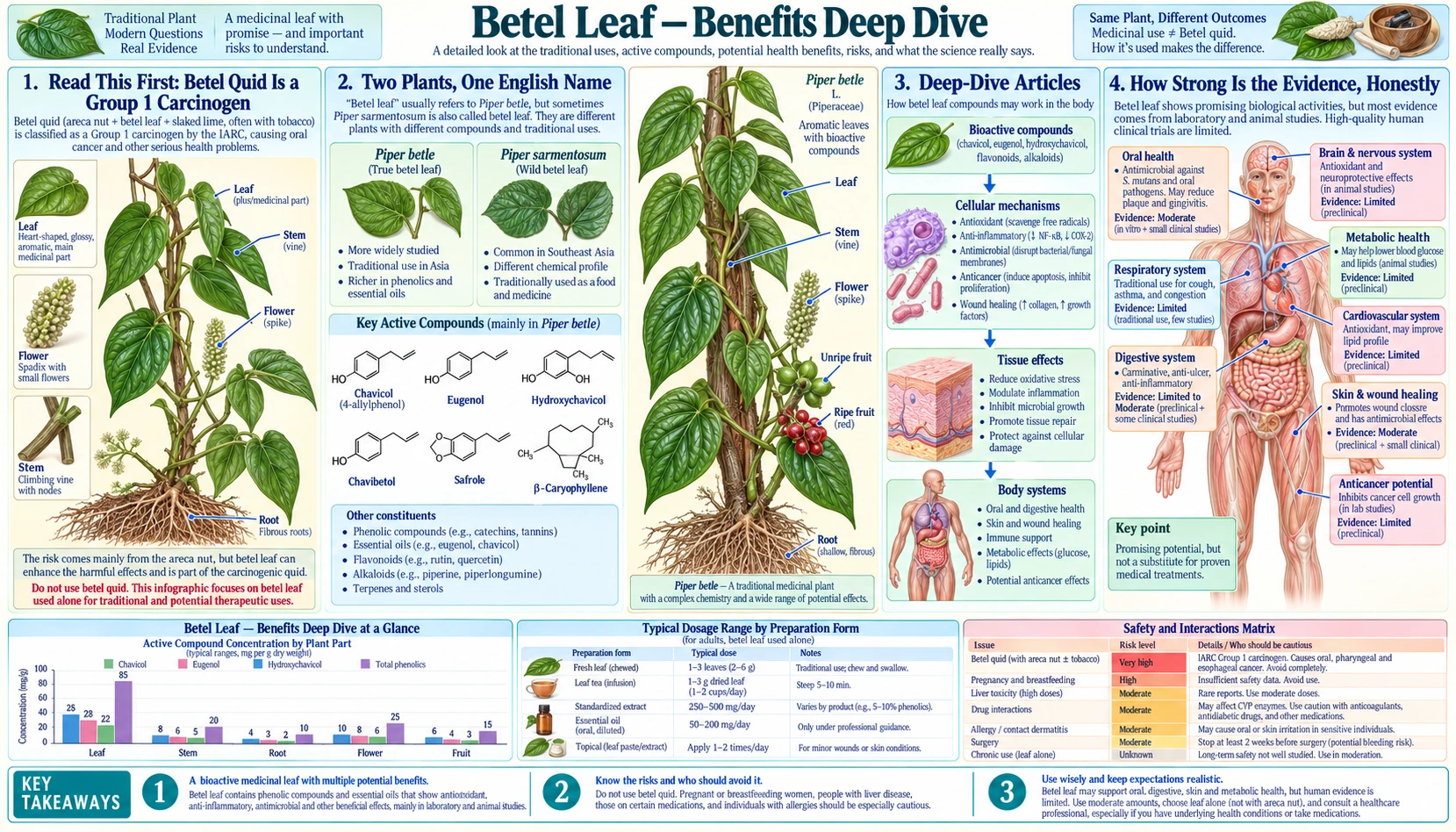
Betel leaf is the heart-shaped, glossy, peppery leaf of Piper betle, a climbing vine in the same genus as black pepper and kava. In South and Southeast Asia it is one of the most widely handled plants in daily life: folded into a parcel with areca nut and lime, offered at weddings, chewed after meals, laid on a wound, boiled into a gargle, wrapped around minced fillings in Vietnamese and Thai cooking, and pressed into service by traditional healers for coughs, indigestion, sore throats and skin complaints. Its essential oil is dominated by phenylpropanoid phenols — hydroxychavicol, eugenol, chavibetol — which is why laboratory studies of the leaf keep finding antibacterial, antifungal and antioxidant activity.
This deep dive covers what the research literature actually supports for the leaf itself, tier by tier: which findings come from randomized clinical trials (very few), which come from animals and cell culture (most of them), and which rest on traditional use alone (a substantial share). It also covers, at equal length and with more urgency, what the leaf is usually wrapped around.
The Starting Point: Betel Quid Is a Group 1 Carcinogen
Chewing betel quid causes cancer in humans. This is not a disputed or emerging finding. The International Agency for Research on Cancer, in its Monograph Volume 85 (2004) and again in the Volume 100E re-evaluation (2012), placed three separate things in Group 1 — carcinogenic to humans: areca nut on its own, betel quid with added tobacco, and betel quid without added tobacco. Removing the tobacco does not remove the hazard. Betel-quid chewing is a leading cause of oral cancer across South and Southeast Asia and the Pacific, and it is the principal cause of oral submucous fibrosis, a progressive, largely irreversible stiffening of the lining of the mouth that narrows the mouth opening and carries a real rate of malignant transformation.
How large the risk is. A 2014 meta-analysis of 50 publications found that in the Indian subcontinent the relative risk of oral and oropharyngeal cancer was 2.56 for betel quid without tobacco and 7.74 for betel quid with tobacco; in Taiwan, China, it was 10.98 for betel quid without tobacco. The risk rose with the daily amount chewed and the number of years of chewing, independently of tobacco and alcohol use. Roughly half of oral cancers in these countries are attributed to betel quid chewing (53.7% for quid without tobacco in Taiwan, China, and 49.5% for quid with tobacco in India).
How often oral submucous fibrosis turns into cancer. A 2024 umbrella review of four systematic reviews found that oral cancer developed in between 4.2% and 6% of people with oral submucous fibrosis. The authors judged the evidence weak: none of the reviews assessed the quality of their evidence, and half were of critically low methodological quality.
What is known about stopping. A 2022 review of the human evidence reports that former chewers seem to have lower oral cancer risk than current chewers, but that the effect of stopping areca nut on oral cancer risk has not been tested in randomized controlled studies.
For anyone who chews paan, gutka, mawa, pan masala with areca, or any preparation containing areca nut, the risk article bears on health far more than the benefit articles do. It is Betel Leaf vs Betel Quid: Areca Nut and Cancer Risk; Betel Nut (Areca catechu) covers the areca side in full, including what cessation support exists and what oral cancer screening involves.
Two Plants, One English Name
Almost every misunderstanding about this topic comes from one accident of English. "Betel leaf" and "betel nut" sound like two parts of one plant. They are two unrelated species from two different families.
- Betel leaf is Piper betle — a perennial climbing vine in the Piperaceae, the pepper family. The part used is the fresh leaf. Its characteristic compounds are hydroxychavicol (4-allylpyrocatechol), eugenol and chavibetol. It contains no arecoline.
- Betel nut, properly areca nut, is Areca catechu — a tall single-stemmed palm in the Arecaceae. The part used is the seed of the fruit. Its characteristic compounds are the alkaloids arecoline, arecaidine, guvacine and guvacoline, plus heavy tannins. It is International Agency for Research on Cancer (IARC) Group 1.
- Betel quid, or paan, is the preparation — a betel leaf smeared with slaked lime (calcium hydroxide) and folded around slices of areca nut, very often with tobacco, sometimes with catechu, gambier, cardamom, cloves or sweeteners. The leaf is the envelope. The nut, the lime and the tobacco are the cargo.
So the leaf has never been given a Group 1 classification on its own, and that is a real distinction with real consequences — it is why Piper betle has its own honest research literature, and why a leaf-only mouthwash or a leaf poultice is a genuinely different proposition from a quid. But the distinction is easy to abuse. In the real world almost nobody chews the leaf by itself, so "betel leaf chewers" and "areca nut users" are overwhelmingly the same population. The true statement in this section does not excuse the true statement in the section above it. The honest summary is: the leaf has real preclinical interest and a long culinary and medicinal tradition; the quid is a Group 1 carcinogen; the leaf being the innocent component of a carcinogenic preparation is not a health benefit.
Table of Contents
How Strong Is the Evidence, Honestly
It helps to sort betel leaf's reputation into three piles before reading any individual claim.
- Randomized clinical trial evidence — thin. The best-developed area is dentistry: a small number of randomized mouthwash and plaque-index trials of Piper betle extracts, mostly conducted in India and Indonesia, mostly with a few dozen participants, short follow-up, and no independent replication. Nothing here is at the level of evidence that would support a therapeutic claim in a regulated setting.
- Preliminary evidence — animal and in-vitro, abundant. This is where the great majority of the literature sits. Minimum inhibitory concentrations against named bacteria and fungi, radical-scavenging assays, rodent wound-closure and burn models, rodent ulcer-protection and blood-glucose models, cell-culture apoptosis work on cancer lines. The findings are real findings; they are simply several steps away from a person.
- Traditional use only. Chewing after meals to aid digestion and freshen the mouth; leaf juice with honey for cough; warmed leaf applied to the chest, to a boil or to an engorged breast; leaf infusion as a gargle. These are documented practices in Ayurveda, Siddha, Unani, Malay and Vietnamese folk medicine. Documenting a practice is not testing it.
Each of the three benefit articles labels its individual claims against these tiers. Where a claim appears in the traditional pile only, it is said so plainly rather than dressed up in mechanism.
The Chemistry Behind the Claims
Betel leaf's pharmacology is unusually easy to summarise, because it is dominated by a small family of related phenols in the essential oil. Oil yield is typically well under 1% of the fresh leaf, and composition varies substantially by cultivar, region, leaf maturity and season — which is one reason laboratory results are inconsistent between studies using "betel leaf extract".
- Hydroxychavicol (4-allylpyrocatechol) — the compound most consistently associated with the leaf's antibacterial and antioxidant activity. It is a catechol, meaning it has two adjacent hydroxyl groups on the ring, and catechols oxidise readily and generate reactive oxygen species in the process. That single fact explains both halves of hydroxychavicol's reputation: the reactive-oxygen burst is a plausible antimicrobial mechanism, and it is also why the same compound damages DNA in cell culture at higher concentrations. An antioxidant in one assay and a pro-oxidant in another is not a contradiction; it is what catechols do.
- Eugenol — the phenol that dominates clove oil, and the reason betel leaf smells faintly of clove. Antiseptic and mildly locally anaesthetic. Its dental pharmacology is better characterised than betel leaf's overall, because eugenol has been used in dentistry for well over a century; see Clove for Dental Pain and Oral Health.
- Chavibetol and chavibetol acetate — positional isomers of eugenol, characteristic of Piper betle oil and largely responsible for its distinctive profile against other Piper species.
- Estragole and safrole — present in variable, chemotype-dependent amounts. Neither is benign; see the next section.
- Terpenes, tannins, and minor nutrients — caryophyllene and cadinene contribute aroma; the leaf carries tannins, small amounts of flavonoids and carotenoids, some calcium, and a modest quantity of ascorbic acid. As a nutrient source a betel leaf is negligible; nobody eats enough of them for the vitamin content to matter.
What is not in the leaf: arecoline. The alkaloid responsible for the mild cholinergic stimulant effect quid chewers describe, and for much of areca nut's toxicity to oral fibroblasts, comes entirely from the nut.
Safrole: What Is Actually Known
Safrole is a naturally occurring phenylpropene found in sassafras, in small amounts in nutmeg and cinnamon leaf, and in variable amounts in Piper betle. It is a rodent liver carcinogen, it is classified by International Agency for Research on Cancer as Group 2B, possibly carcinogenic to humans, and it is banned as a deliberately added food flavouring in the United States and restricted in the European Union. It becomes genotoxic only after metabolic activation, chiefly via 1'-hydroxylation and subsequent formation of a reactive ester that binds DNA.
Three things are worth stating precisely, because this is where careless writing on both sides of the argument tends to appear.
- Safrole content in betel leaf is variable and generally low compared with the inflorescence of Piper betle, which is chewed with the quid in parts of Taiwan and is notably richer in safrole. Analytical work on Taiwanese quid components is the main reason safrole entered this discussion at all.
- Safrole–DNA adducts have been detected in the oral tissue and blood of areca-quid chewers in Taiwanese studies, which is direct human evidence that the compound reaches and modifies DNA in the target organ. That is a meaningful finding.
- Safrole is not the main reason quid causes cancer. The weight of the International Agency for Research on Cancer evaluation rests on areca nut itself, on areca-derived nitrosamines formed in the mouth under the alkaline conditions created by slaked lime, on arecoline's effects on oral fibroblasts, and on tobacco when it is added. Safrole is a contributing exposure, not the headline. Attributing quid carcinogenicity mostly to the leaf's safrole would let the nut off the hook, which is exactly backwards.
What this means for leaf-only products: the safrole concern applies to habitual, high-volume, long-term consumption of concentrated Piper betle oil or inflorescence, and not to a betel leaf wrapped around a Vietnamese beef roll.
What the Safety Research Shows
- The word "betel" on a product label may mean either plant. Supplement listings, imported extracts, herbal toothpastes and "betel" chewing products are inconsistently labelled, and some carry areca. The botanical name tells the two apart: Piper betle is the leaf. Areca catechu is the nut, and there is no established safe amount of it.
- Pregnancy. Areca-quid chewing in pregnancy is associated in observational studies with reduced birth weight and adverse outcomes. For the leaf specifically there is no adequate human safety data, and its safrole and estragole content adds a further concern for concentrated leaf extracts or essential oil during pregnancy or breastfeeding. Culinary use of a whole leaf is a different order of exposure from an extract, but the honest answer for supplements is that the data do not exist.
- Hypoglycaemia stacking. Rodent studies report meaningful blood-glucose lowering from aqueous and ethanolic Piper betle leaf extracts. In a 2005 rat study, both a hot-water and a cold ethanol leaf extract lowered blood glucose in normal rats in a dose-dependent manner and, in a glucose tolerance test, markedly reduced the external glucose load. An effect like this could add to that of insulin, a sulfonylurea or any other glucose-lowering drug; shakiness, sweating and confusion are signs of low blood sugar. See the glucose section of the digestion article.
- Slaked lime is caustic. Calcium hydroxide in the quid raises oral pH sharply, and habitual application to the same spot on the buccal mucosa produces chemical injury independent of the nut. A person who has quit areca but still chews leaf with lime has not removed this exposure.
- Bleeding and platelet effects. Constituents of betel leaf have shown antiplatelet activity in laboratory work. This is preliminary, and it raises a question for people facing surgery or taking anticoagulant and antiplatelet drugs.
- Contact reactions. Topical leaf preparations occasionally cause irritation or allergic contact dermatitis.
Key Research Papers
Named papers below link to their own PubMed records by PubMed identifier (PMID); themes without one named paper link to a live PubMed topic search, which shows the current literature rather than one paper's snapshot. Journal and year are named in the text where they are certain; where a result would need a specific number to be meaningful and that number is not firmly established, the finding is described qualitatively instead.
Theme 1 — Carcinogenicity of Betel Quid and Areca Nut
- IARC Working Group on the Evaluation of Carcinogenic Risks to Humans (2004). Betel-quid and areca-nut chewing and some areca-nut derived nitrosamines. IARC Monographs on the Evaluation of Carcinogenic Risks to Humans, Volume 85 (re-evaluated in Volume 100E, 2012) — the evaluations that placed areca nut, betel quid with tobacco, and betel quid without tobacco in Group 1. — PubMed PMID: 15635762
- Guha N, Warnakulasuriya S, Vlaanderen J, Straif K (2014). Betel quid chewing and the risk of oral and oropharyngeal cancers: a meta-analysis with implications for cancer control. International Journal of Cancer — separated quid with tobacco from quid without and found elevated risk in both. — PubMed PMID: 24302487
- Warnakulasuriya S, Chen THH (2022). Areca Nut and Oral Cancer: Evidence from Studies Conducted in Humans. Journal of Dental Research — a synthesis of the human evidence implicating the nut specifically. — PubMed PMID: 35459408
Theme 2 — Oral Submucous Fibrosis
- Oral submucous fibrosis: areca aetiology and rate of malignant transformation — the review literature establishing oral submucous fibrosis as an areca-driven, potentially malignant disorder. — Search PubMed
- Gondivkar SM, Yuwanati M, Sarode SC, Gadbail AR, Gondivkar R, Mohsin SF, Gaikwad R (2024). Malignant transformation in oral submucous fibrosis: Tertiary level evidence: An umbrella review. Oral Diseases — PubMed PMID: 37650364
- Arecoline, oral fibroblasts and collagen metabolism — the cell-level mechanism linking the nut's principal alkaloid to fibrosis.
Theme 3 — Antibacterial and Antifungal Activity of Piper betle
- Antibacterial activity of Piper betle leaf extracts and its phenolic constituents — the in-vitro body of work on eugenol, chavibetol and hydroxychavicol against Gram-positive and Gram-negative organisms. — Search PubMed
- Singh D, Narayanamoorthy S, Gamre S, et al. (2018). Hydroxychavicol, a key ingredient of Piper betle induces bacterial cell death by DNA damage and inhibition of cell division. Free Radical Biology and Medicine — hydroxychavicol's antibacterial mechanism. — PubMed PMID: 29550331
- Piper betle against Candida albicans and dermatophytes — antifungal screening relevant to oral candidiasis and tinea.
Theme 4 — Antioxidant, Anti-Inflammatory and Wound-Healing Work
- Antioxidant and radical-scavenging activity of Piper betle leaf and hydroxychavicol — assay-level antioxidant characterisation, and the pro-oxidant behaviour that accompanies it. — Search PubMed
- Wound-healing activity of Piper betle leaf extract in rodent excision and burn models — the preclinical basis for the traditional poultice. — Search PubMed
- Anti-inflammatory and analgesic effects of Piper betle in animal models. — Search PubMed
Theme 5 — Metabolic, Gastric and Safety Findings
- Arambewela LS, Arawwawala LD, Ratnasooriya WD (2005). Antidiabetic activities of aqueous and ethanolic extracts of Piper betle leaves in rats. Journal of Ethnopharmacology — the animal glucose data behind the hypoglycaemia-stacking point. — PubMed PMID: 16055288
- Gastroprotective and antiulcer effects of Piper betle in rodent models. — Search PubMed
- Chen CL, Chi CW, Chang KW, Liu TY (1999). Safrole-like DNA adducts in oral tissue from oral cancer patients with a betel quid chewing history. Carcinogenesis — the Taiwanese oral-tissue work. — PubMed PMID: 10590228
- Liu TY, Chung YT, Wang PF, Chi CW, Hsieh LL (2004). Safrole-DNA adducts in human peripheral blood—an association with areca quid chewing and CYP2E1 polymorphisms. Mutation Research — the Taiwanese blood biomonitoring work. — PubMed PMID: 15066574
- Genotoxicity and cytotoxicity of Piper betle extract at higher concentrations — the reason "the leaf is not the carcinogen" is not the same claim as "the leaf is established as safe at any dose". — Search PubMed
External Resources
- International Agency for Research on Cancer Monographs on the Identification of Carcinogenic Hazards to Humans — the primary source for the Group 1 classifications of areca nut and betel quid.
- World Health Organization, South-East Asia Region: tobacco and smokeless tobacco — regional context for areca and quid use, which frequently overlaps with smokeless tobacco.
- National Cancer Institute: head and neck cancers — symptoms, screening and treatment overview for the cancers most associated with quid chewing.
- PubMed: all Piper betle literature — the full search, if you would rather read the primary sources yourself.
- LiverTox (U.S. National Institutes of Health, NIH): herbal and dietary supplements — useful background on how thinly most botanical safety data are established.
Connections
- All Herbs
- Betel Leaf (Piper betle) — the main topic page: botany, traditional use, active compounds, forms and dosage.
- Betel Nut (Areca catechu) — the other plant, and the one that carries the Group 1 classification.
- Oral Cancer — the disease that betel-quid chewing most directly causes.
- Head and Neck Cancer — the wider category, including oropharyngeal and hypopharyngeal sites.
- Esophageal Cancer — also associated with quid chewing in several populations.
- Dentistry — the oral-health section, for context on the conditions leaf mouthwashes are proposed for.
- Periodontitis — the gum disease most studied alongside herbal antibacterials.
- Gingivitis — the earlier, reversible stage, and the endpoint used in most small plaque trials.
- Clove for Dental Pain and Oral Health — eugenol's much better-characterised dental pharmacology.
- Black Pepper — Piper nigrum, the best-known member of the same genus.
- Kava — Piper methysticum, another Piper used as a social and ceremonial plant.
- Neem — Benefits — the other South Asian antibacterial botanical routinely used for oral care.
- Nitrates and Nitrites — background on nitrosamine formation, the mechanism at work in the quid.
- Secondhand Smoke — relevant because quid and smokeless-tobacco use commonly coexist with smoking.
Educational information only. Nothing here is medical advice, a diagnosis, or a treatment plan, and nothing here is a reason to continue areca-nut or betel-quid chewing. Former chewers seem to have lower oral cancer risk than current chewers. A white or red patch, a non-healing ulcer, a lump, unexplained numbness, or a mouth that will not open as wide as it used to are signs that dentists and doctors examine promptly. For Piper betle extracts, the concerns set out above are: no adequate human safety data in pregnancy or breastfeeding, blood-glucose lowering in rats (relevant to glucose-lowering medication), and laboratory antiplatelet activity (relevant to anticoagulant medication and surgery).