Curry Leaf for Blood Sugar and Diabetes
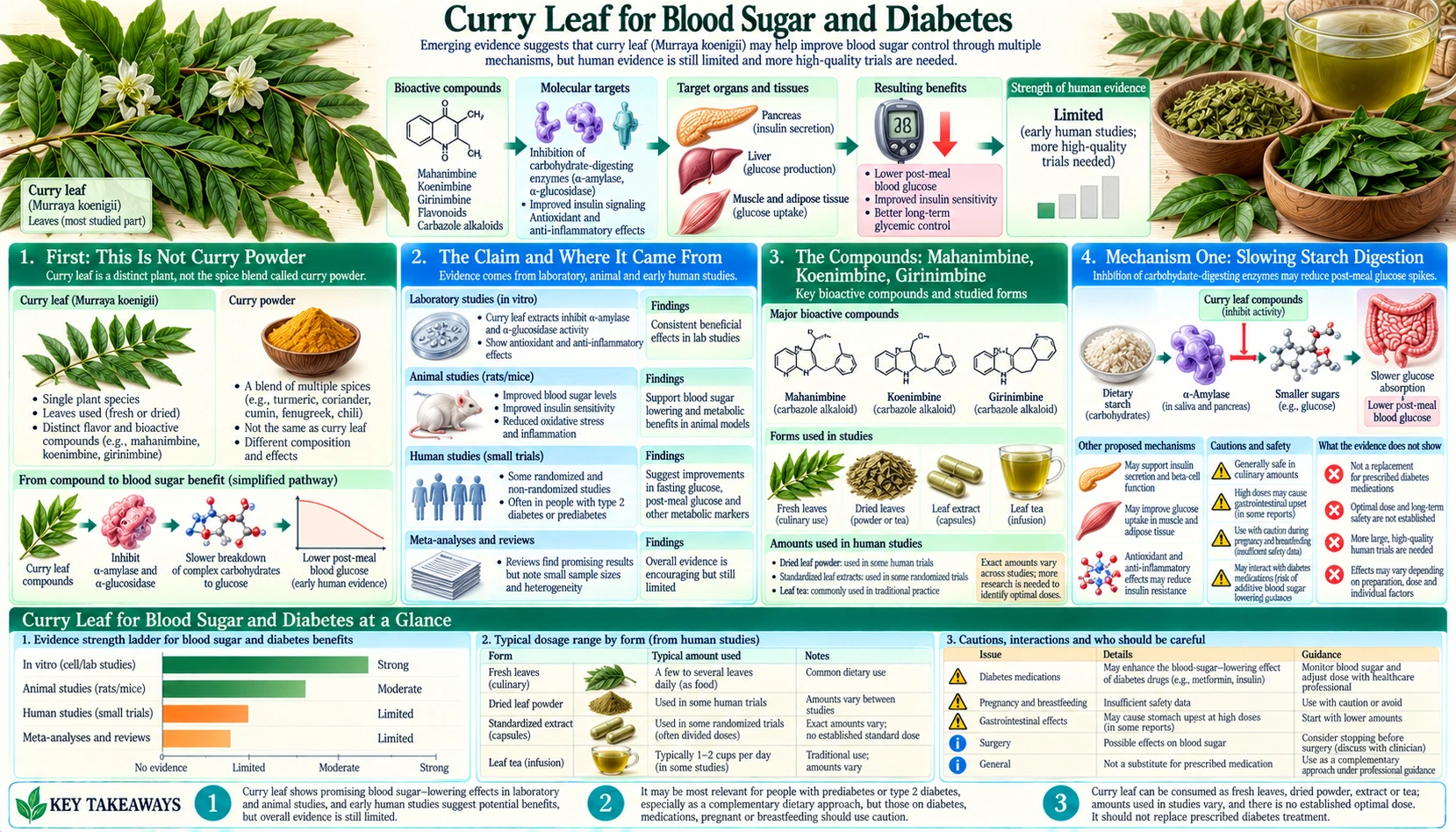
Blood sugar is the claim that sells curry leaf capsules, and it is the claim with the most research behind it. It is also the one most routinely overstated. This page walks the evidence from the bottom up — enzyme assays, then rodents, then the small human record — and is explicit at each step about what tier of evidence is being described and what it can and cannot support.
Table of Contents
- First: This Is Not Curry Powder
- The Claim and Where It Came From
- The Compounds: Mahanimbine, Koenimbine, Girinimbine
- Mechanism One: Slowing Starch Digestion
- Mechanism Two: Insulin, Uptake and Oxidative Stress
- What the Animal Studies Show
- What the Human Studies Show
- Body Weight and the Wider Metabolic Picture
- Evidence Tier Summary
- Practical Use: The Leaf Versus the Capsule
- Hypoglycaemia Risk and Drug Interactions
- What People Track When They Try It
- Key Research Papers
- Connections
- Featured Videos
First: This Is Not Curry Powder
Curry leaf is Murraya koenigii, a single leaf from a single tree in the citrus family. Curry powder is a spice blend and contains no curry leaf at all — it is typically turmeric, coriander seed, cumin, fenugreek, chilli and black pepper, blended by a manufacturer, and it was created for the eighteenth- and nineteenth-century British export market rather than for Indian kitchens. The shared English word comes from the Tamil kari and is a linguistic accident.
This matters enormously on this particular page. When a headline says “curry lowers blood sugar”, the study underneath is very often about turmeric, or fenugreek, or cinnamon — all three of which have their own, separate, and in fenugreek's case rather better, blood-sugar literature. None of it is evidence about Murraya koenigii. Everything on this page refers to the leaf, and to the leaf alone.
The Claim and Where It Came From
The claim did not start with supplement marketing. In Ayurveda the curry leaf — krishnanimba, girinimba in Sanskrit — is classed as bitter and pungent and appears in formulations for prameha, the classical disease category that overlaps substantially with what is now called diabetes. Folk practice across Tamil Nadu, Kerala and Karnataka includes chewing a few fresh leaves on an empty stomach, or drinking a leaf decoction, for what would today be described as metabolic complaints. Evidence tier: traditional use only.
Modern pharmacology picked this up in the second half of the twentieth century, and the plant turned out to be chemically unusual enough to hold researchers' interest. The result is a literature of several hundred papers — a genuinely substantial body of work, dominated almost entirely by rodents and cell cultures.
What has not happened is the step that matters most. There is no large, adequately powered, randomised, placebo-controlled trial of curry leaf in people with type 2 diabetes or prediabetes. Not one that failed — one has essentially never been run. That is the central fact of this page, and no amount of rodent data substitutes for it.
The Compounds: Mahanimbine, Koenimbine, Girinimbine
Curry leaf's pharmacology is built on carbazole alkaloids, a class of three-ring nitrogen compounds largely characteristic of the genus Murraya. Three are named repeatedly in the metabolic literature:
- Mahanimbine — usually the most abundant carbazole in the leaf, and the compound most often used as the marker in standardised extracts. When a rodent study attributes an antidiabetic or lipid-lowering effect to a single isolated molecule, this is generally the one.
- Koenimbine (also written koenimbin) — named for the species, studied chiefly for antioxidant and cytotoxic properties in cell systems rather than for glucose handling specifically.
- Girinimbine — a pyrano-carbazole, most studied for antimicrobial activity and for apoptosis induction in cultured cancer cells; its metabolic role, if any, is not established.
Alongside these sit mahanine, koenigicine and murrayanine, plus flavonoids and a small volatile terpene fraction that carries the aroma. The carbazole literature on this plant is large and mostly chemical rather than clinical.
The critical practical caveat: carbazole content varies severalfold between chemotypes, growing regions, seasons and plant parts. A capsule standardised to a stated percentage of mahanimbine is measuring one molecule out of dozens, and tells you very little about the rest of what is in it.
Mechanism One: Slowing Starch Digestion
The best-characterised proposed mechanism is enzyme inhibition. Dietary starch is broken down to absorbable glucose by two enzymes: α-amylase in saliva and pancreatic juice, which chops long starch chains into oligosaccharides, and α-glucosidase at the intestinal brush border, which cleaves those into single glucose molecules for absorption. Slow either enzyme down and glucose enters the bloodstream more gradually, blunting the spike after a starchy meal.
This is not a speculative target. It is exactly how the pharmaceutical drugs acarbose and miglitol work, and it is why they are prescribed with the first bite of a meal.
Curry leaf extracts and several isolated carbazoles inhibit both enzymes in laboratory assays. Evidence tier: preliminary — in vitro.
Now the honest caveats, because this finding is routinely presented as though it settled the question:
- Enzyme-inhibition assays are extremely generous to plant extracts. A very large fraction of everything ever tested shows some inhibition. Tannins and polyphenols bind proteins non-specifically; a crude extract in a cuvette is not a clean pharmacological probe.
- Concentration matters and rarely translates. The concentration achieved in an assay well is typically far above anything reachable in the human gut lumen after a normal serving.
- The dose form is wrong. Acarbose works because it is taken with the meal, in a known amount, every time. Leaves fried in oil at the start of a dish are not a controlled enzyme inhibitor.
- It has not been shown in people. The obvious experiment — give a standardised curry leaf preparation with a fixed carbohydrate load and measure the postprandial glucose curve against placebo — is straightforward, cheap and has not been done at any scale.
Mechanism Two: Insulin, Uptake and Oxidative Stress
Beyond the gut, rodent and cell work has proposed several further mechanisms. All are preliminary — animal or in vitro, and none is established in humans.
- Pancreatic beta-cell protection. In the streptozotocin rat model — where a toxin destroys insulin-producing beta cells — pre-treatment with curry leaf extract has been reported to preserve insulin output. Since the model works by oxidative destruction of beta cells, almost any antioxidant-rich extract can look protective in it. This is a well-known weakness of the model, not a special property of curry leaf.
- Improved peripheral glucose uptake. Some cell studies report increased glucose uptake in cultured muscle or fat cells, sometimes with changes in GLUT4 transporter expression. Interesting; a long way from a person.
- Reduced hepatic glucose output. Reported changes in liver gluconeogenic enzyme activity in treated rodents. Mechanistically plausible, entirely preclinical.
- Reduced oxidative stress and glycation. The most-cited general mechanism, and the vaguest. Curry leaf is rich in phenolics and scores well on laboratory radical-scavenging assays. As covered on the antioxidant page, a high assay score is a chemical property of an extract, not a clinical outcome.
The pattern here is worth naming, because it recurs across herbal pharmacology: a plant with broad antioxidant chemistry generates positive results in many different mechanistic assays, and a review can then list six mechanisms and sound overwhelming. Six weak preclinical mechanisms do not add up to one clinical effect.
What the Animal Studies Show
This is where the bulk of the literature sits, and it deserves credit for being reasonably consistent. Evidence tier: preliminary — animal.
Yadav, Vats, Dhunnoo and Grover reported hypoglycaemic and antihyperglycaemic activity of Murraya koenigii leaves in diabetic rats in the Journal of Ethnopharmacology in 2002 — one of the most-cited entry points to this literature. The effect in that study was modest: rats were fed diets containing 5%, 10% or 15% curry leaves. In normal rats blood sugar fell by only about 4%. In mildly diabetic (alloxan) rats the largest falls were 13.1%, 16.3% and 21.4% (the 5% diet not statistically significant), and in moderately diabetic (streptozotocin) rats the falls of 3.2% to 8.2% were not statistically significant. Xie and colleagues reported that curry leaf reduced blood cholesterol and glucose levels in genetically obese ob/ob mice in the American Journal of Chinese Medicine in 2006. Birari, Javia and Bhutani reported antiobesity and lipid-lowering effects of leaf extracts and of isolated mahanimbine in high-fat-diet-induced obese rats in Fitoterapia in 2010. Beyond these, dozens of further streptozotocin and alloxan rat studies report reductions in fasting glucose and improvements in glucose tolerance.
Why this does not settle anything:
- The doses are not food doses. Rodent studies commonly use extract at hundreds of milligrams per kilogram of body weight. Scaled naively, that is tens of grams of extract a day for an adult human — far beyond any culinary quantity and beyond most capsule regimens.
- Chemically-induced diabetes is not type 2 diabetes. Streptozotocin and alloxan destroy beta cells directly; the resulting animal is closer to a model of type 1 diabetes than to the insulin-resistant, obesity-associated condition most people are treating.
- Publication bias runs one way. A rat study finding no effect of a traditional herb is far less likely to be written up and published. The apparent consistency of the literature is partly a filtering artefact.
- The extracts are not comparable. Methanolic, ethanolic, aqueous and hexane extracts of leaves from different regions are treated as interchangeable in reviews. They are not.
What the Human Studies Show
Here the ground gets thin very fast. Evidence tier: preliminary — small, mostly uncontrolled human studies.
The most-cited human work is Iyer and Mani's study of curry leaf supplementation in people with non-insulin-dependent diabetes, published in Plant Foods for Human Nutrition in 1990. In it, 30 people with non-insulin-dependent (type 2) diabetes took 12 g of curry leaf powder a day (providing 2.5 g of fibre) for one month. Fasting and two-hour after-meal blood sugar fell for a short time, at day 15, but there was no appreciable change in glycated serum proteins, glycated LDL cholesterol, blood lipids or amino acids at either 15 or 30 days.
Two newer human studies add small signals. In a 2023 study, 45 women with type 2 diabetes took capsules of a water extract of curry leaves (5 or 10 mg per kilogram of body weight) for 45 days; fasting blood sugar, random blood sugar and glycated haemoglobin (HbA1c) fell significantly in both dose groups. The study summary describes no placebo group, so this is an uncontrolled signal, not proof. In a 2026 open-label randomised trial in Puducherry, India, 120 adults with type 2 diabetes took either a juice of Indian gooseberry, ginger and curry leaves alongside their usual diabetes tablets, or the tablets alone, for 4 weeks; 112 finished. Fasting blood sugar fell by an average of 20.3 mg/dL with the juice and 4.7 mg/dL without it, but after adjustment for starting blood sugar, age and sex the difference between the groups was no longer statistically significant (p = 0.060). Curry leaf was one of three ingredients, so that trial cannot single out its effect.
Studies in this family share a characteristic set of limitations: a few tens of participants, several weeks of follow-up, frequently no placebo arm and no blinding, and outcome measures reported without correction for multiple comparisons.
A search of the registered and published clinical-trial literature on Murraya koenigii returns a short list, and the list itself shows the shape of the problem. There is no trial of the size and rigour that would change practice, and no diabetes guideline — from any national body — mentions curry leaf.
The honest summary: a plausible mechanism, a substantial rodent literature, and human evidence too thin to build a decision on. That is not a dismissal. It is an accurate description of where an interesting plant currently sits.
Body Weight and the Wider Metabolic Picture
Some of the rodent work reports reduced body-weight gain and improved lipid handling in high-fat-fed animals alongside the glucose effects, with mahanimbine specifically implicated. Proposed explanations include pancreatic lipase inhibition (reducing fat absorption) and modulation of hepatic lipid-handling enzymes. Evidence tier: preliminary — animal. There is no human weight-loss trial of curry leaf, and the evidence does not support presenting it as a weight-loss agent.
This connects to the broader point about insulin resistance and metabolic syndrome: the interventions that reliably move these markers in humans — sustained changes in diet composition, physical activity, sleep, and where indicated proven medication — are unglamorous and well established. A seasoning leaf, however chemically interesting, is not in that category, and treating it as one displaces things that work.
Evidence Tier Summary
- Curry leaf inhibits α-amylase and α-glucosidase in the test tube. Preliminary — in vitro. Real finding, weak inferential value.
- Curry leaf extract lowers fasting glucose and improves glucose tolerance in diabetic rodents. Preliminary — animal. Consistent across many studies, at doses far above food intake.
- Curry leaf protects pancreatic beta cells. Preliminary — animal. Reported in a model with a known bias toward antioxidants.
- Curry leaf supplementation lowers blood sugar, glycated proteins or lipids in people with type 2 diabetes. Preliminary — small human studies. Modest, inconsistent, mostly uncontrolled: the 1990 study found a short-lived fall in blood sugar at day 15 and no change in glycated proteins or lipids.
- Curry leaf reduces hemoglobin A1c (HbA1c) or prevents diabetic complications in humans. Not established. No adequately powered randomised trial exists.
- Curry leaf is a treatment for diabetes. Not supported by any evidence tier. It is a food with an unfinished research story.
- Curry leaf for prameha in classical Ayurveda. Traditional use only. Historically documented; not a clinical claim.
Practical Use: The Leaf Versus the Capsule
Three products carry the name and they are not equivalent.
- Fresh leaves in cooking. One or two sprigs per dish, roughly one to three grams. Excellent safety record, centuries of daily use, and essentially no therapeutic evidence — because nobody has run a trial on seasoning. Curry leaves are prized in cooking for their flavour, and this is the version that carries no risk.
- Dried leaf powder. The form used in the human supplementation studies, at roughly ten to fifteen grams a day — a large handful, well beyond seasoning. Potency ranges from good to inert depending on age and drying, with no way to tell from the packet.
- Standardised extract capsules. The form with the least evidence, the most marketing and the only meaningful interaction risk. Commercial dosing suggestions of a few hundred milligrams to a gram daily come from manufacturers, not from dose-finding trials. There is no established therapeutic dose for curry leaf, and any source giving a confident milligram figure has invented it.
One practical note that also affects the research: the aromatic terpenes evaporate quickly on drying, so commercially dried leaves are a substantially different material from fresh ones. Freezing preserves the aroma far better than drying, which is what most cooks outside the tropics do.
Hypoglycaemia Risk and Drug Interactions
This section matters more than any benefit claim on the page.
If curry leaf extract does lower blood glucose, then taking it alongside glucose-lowering medication can stack the effects and cause hypoglycaemia. The drugs this applies to include metformin, the sulfonylureas (glipizide, glyburide, gliclazide, glimepiride), meglitinides, glucagon-like peptide-1 (GLP-1) receptor agonists, sodium-glucose cotransporter-2 (SGLT2) inhibitors, dipeptidyl peptidase-4 (DPP-4) inhibitors and insulin in all its forms. The risk is highest with sulfonylureas and insulin, which can drive glucose down on their own.
Symptoms of hypoglycaemia: shakiness, sweating, sudden intense hunger, palpitations, irritability, difficulty concentrating, blurred vision, and in severe cases confusion, seizure or loss of consciousness. Standard diabetes care treats them as a signal to test blood sugar and take fast-acting carbohydrate, not something to push through; confusion, seizure and loss of consciousness are signs hospitals treat as urgent.
What this means for people on diabetes medication who take a curry leaf supplement:
- Stacking is the hazard. Added to sulfonylureas or insulin, a glucose-lowering supplement can push blood sugar too low. Diabetes care handles this by adjusting a dose or testing more often, which is only possible when the person managing the diabetes knows about the supplement from the start.
- The first weeks are when lows are most likely to appear. More frequent testing for the first two to four weeks, including before driving, is the usual practice after any change.
- Replacing a prescribed medication with a supplement is where real harm happens, and it happens every year.
- Surgery. The commonly cited practice is to stop supplemental extracts around two weeks before scheduled surgery, when glucose around the operation is being managed deliberately.
- Culinary amounts are a different matter. Nothing here applies to cooking with curry leaves.
Other cautions: concentrated extracts have no safety data in pregnancy or breastfeeding; supplement potency varies severalfold and is rarely verified, and only some manufacturers publish third-party testing; and any product making an explicit disease claim is a regulatory red flag rather than a sign of quality.
What People Track When They Try It
For people who try curry leaf as an adjunct — alongside, never instead of, established care — these are the measurements that show an effect, rather than an impression.
- Hemoglobin A1c — the three-month average. The only outcome that would mean anything, and it needs a before and an after separated by at least twelve weeks.
- Fasting glucose and, with a meter or a continuous glucose monitor, post-meal readings. A single meal tested with and without is not proof of anything, but a consistent shift across weeks is at least a signal.
- Fasting insulin and homeostatic model assessment of insulin resistance (HOMA-IR) — if insulin resistance is the target rather than glucose alone.
- Lipid panel — the rodent work reports lipid effects too, and it costs nothing to measure alongside.
- One change at a time. When a supplement, a new diet and a walking habit all start in the same week, there is no way to tell which one did what.
Key Research Papers
Citations give authors, title, journal and year in plain text and end with a link to the paper's PubMed record; the live literature searches below them link to PubMed searches.
- Yadav S, Vats V, Dhunnoo Y, Grover JK. Hypoglycemic and antihyperglycemic activity of Murraya koenigii leaves in diabetic rats. Journal of Ethnopharmacology. 2002;82(2–3):111–116. — PubMed PMID: 12241985 — Preliminary — animal.
- Iyer UM, Mani UV. Studies on the effect of curry leaves supplementation (Murraya Koenigi) on lipid profile, glycated proteins and amino acids in non-insulin-dependent diabetic patients. Plant Foods for Human Nutrition. 1990;40(4):275–282. — PubMed PMID: 2174154 — Preliminary — small human study.
- Xie JT, Chang WT, Wang CZ, et al. Curry leaf (Murraya koenigii Spreng.) reduces blood cholesterol and glucose levels in ob/ob mice. American Journal of Chinese Medicine. 2006;34(2):279–284. — PubMed PMID: 16552838 — Preliminary — animal.
- Birari R, Javia V, Bhutani KK. Antiobesity and lipid lowering effects of Murraya koenigii (L.) Spreng leaves extracts and mahanimbine on high fat diet induced obese rats. Fitoterapia. 2010;81(8):1129–1133. — PubMed PMID: 20655993 — Preliminary — animal.
- Farooq M, Ul Ain I, Aysha Iftikhar Z, Ubaid M, Asim M, Mushtaq U, Musaed Almutairi S, Ahmed Rasheed R, Chen TW. Investigating the therapeutic potential of aqueous extraction of curry plant (Murraya koenigi) leaves supplementation for the regulation of blood glucose level in type 2 diabetes mellitus in female human subjects. Pakistan Journal of Pharmaceutical Sciences. 2023;36(2(Special)):601–605. — PubMed PMID: 37548196 — Preliminary — small human study, no placebo group described.
- Ravindran R, Nagarajan BD, John Cecily HS, Murugesan N. Effect of a polynutraceutical juice (Indian gooseberry, ginger and curry leaves) as an adjunct to oral antidiabetic drugs on fasting blood glucose in type 2 diabetes: A randomized controlled trial. Nutrition and Health. 2026 (online ahead of print). — PubMed PMID: 42924871 — Preliminary — small open-label trial of a three-ingredient juice.
- Live literature search: Murraya koenigii alpha-glucosidase inhibition — the enzyme-assay basis of the starch-digestion mechanism.
- Live literature search: Murraya koenigii antidiabetic streptozotocin rats — the main body of the rodent literature, and a fast way to see how much of it there is.
- Live literature search: Murraya koenigii clinical trial — the shortness of the list is the point.
- Live literature search: Mahanimbine and glucose — work on the isolated marker alkaloid.
- Live literature search: Murraya koenigii carbazole alkaloids — the phytochemistry underlying all of the above.
- Live literature search: Herbal supplements, hypoglycaemia and sulfonylurea interaction — context for the interaction warning above. — Search PubMed
- Live literature search: Alpha-glucosidase inhibitors and postprandial glucose — the pharmaceutical comparison that shows what a proven version of this mechanism looks like.
Connections
- All Herbs
- Curry Leaf Benefits Hub — the overview of all four deep dives and how the evidence tiers are used.
- Curry Leaf (Murraya koenigii) — botany, names, culinary technique, forms and full cautions.
- Curry Leaf for Cholesterol and Liver Health — the lipid half of the same rodent studies cited here.
- Type 2 Diabetes — the condition, and the management a supplement does not replace.
- Prediabetes — where dietary changes have the largest documented effect.
- Insulin Resistance — the underlying process most of these mechanisms claim to address.
- Metabolic Syndrome — the wider cluster of glucose, lipid and blood-pressure abnormalities.
- Fenugreek — a curry-powder component with a genuinely better human blood-sugar literature.
- Gymnema sylvestre — the Ayurvedic herb most associated with prameha.
- Bitter Melon — a close comparison: strong rodent data, thin human data, heavy marketing.
- Cinnamon — another blood-sugar herb whose trial results are far more mixed than its reputation suggests.
- Hemoglobin A1c — the outcome that would actually settle the question.
This page is educational and is not medical advice. Curry leaf is not a treatment for diabetes and no evidence supports using it as one. If you take metformin, a sulfonylurea, a glucagon-like peptide-1 agonist, a sodium-glucose cotransporter-2 inhibitor or insulin, a curry leaf supplement can add to their glucose-lowering effect and cause hypoglycaemia — the risk is greatest with sulfonylureas and insulin, and replacing a prescribed medication with a supplement is where real harm happens. Concentrated extracts have no safety data in pregnancy, breastfeeding or children. None of this concerns cooking with curry leaves.