Oyster Mushroom — Benefits Deep Dive
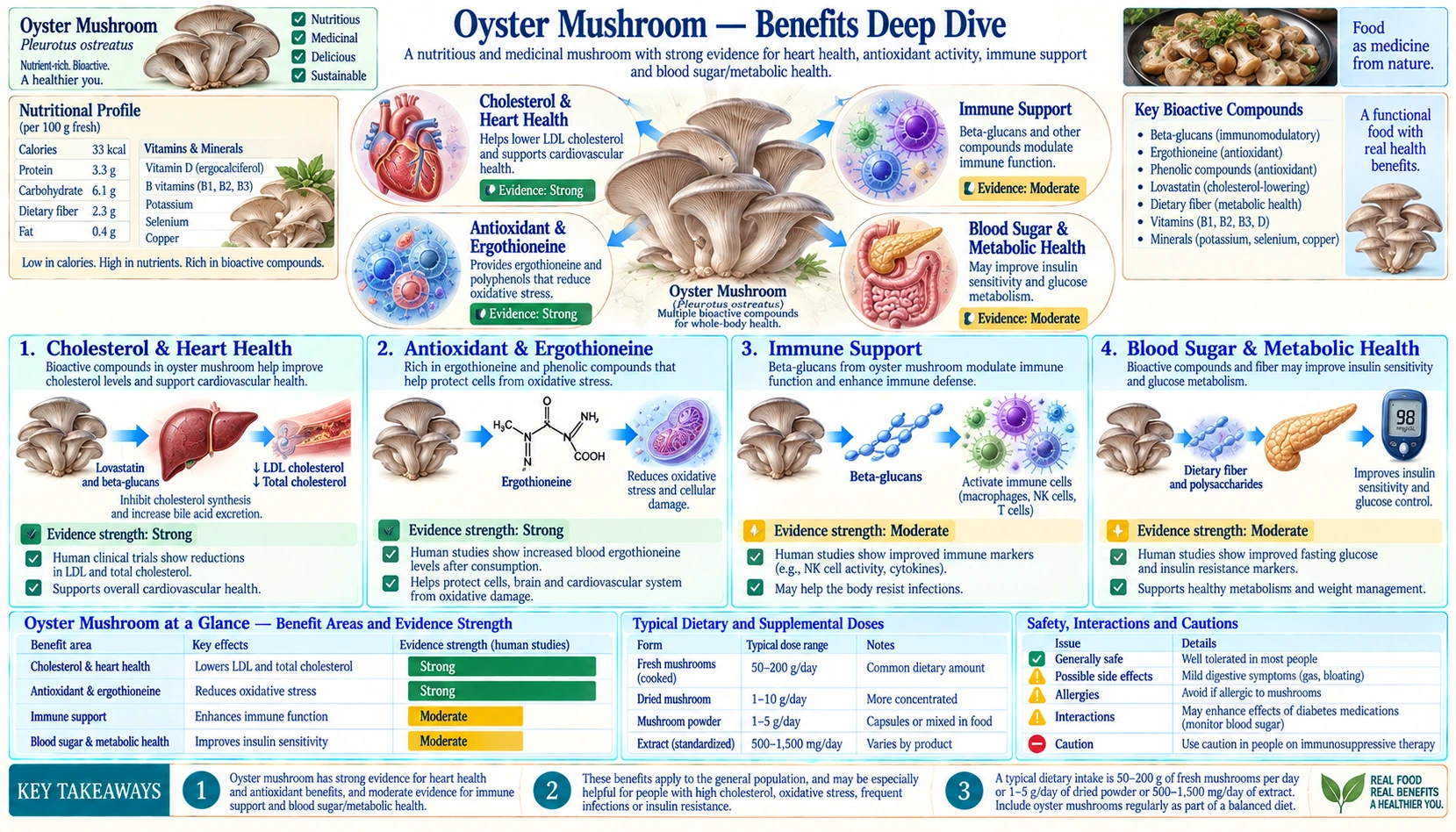
The oyster mushroom (Pleurotus ostreatus) is one of the few culinary mushrooms whose health interest rests on a molecule most people recognize from the pharmacy: Pleurotus species naturally produce lovastatin, the same compound that became the first prescription statin. That headline is real but modest — the amount in a plate of sauteed oysters is small and variable, and far below the dose in a prescribed statin, so a plate of mushrooms does not deliver a statin dose. What makes the oyster mushroom genuinely useful is the combination it delivers: a whole-food package of cholesterol-active beta-glucan fiber, the unusually stable antioxidant ergothioneine, immunomodulating polysaccharides (marketed as pleuran), and a low-calorie, high-protein, high-fiber profile that supports metabolic health. The four deep-dive pages below walk through each benefit honestly — separating what human trials actually show from what remains preclinical.
Deep-Dive Articles
Cholesterol & Heart Health
The natural-lovastatin story told honestly: how much statin is really in an oyster mushroom, why the whole-food cholesterol effect owes as much to beta-glucan fiber and bile-acid binding as to lovastatin, what the Bobek animal studies and the small human trials actually measured, and the firm caution that a plate of mushrooms is not a replacement for prescribed statin therapy.
Read the deep dive →Antioxidant & Ergothioneine
Oyster mushrooms are among the richest dietary sources of ergothioneine, an amino-acid-derived antioxidant so distinctive that the body evolved a dedicated transporter (ETT / SLC22A4) to conserve it in tissues under oxidative stress. The mechanism, the "longevity vitamin" hypothesis, the glutathione and polyphenol content, and where the human evidence is strong versus still emerging.
Read the deep dive →Immune Support
Pleuran — the beta-(1,3/1,6)-D-glucan isolated from Pleurotus ostreatus — is one of the better-studied mushroom immune polysaccharides, with randomized trials in children and athletes for recurrent respiratory-tract infections. How beta-glucans engage Dectin-1 and complement receptors, what the Jesenak and Bergendiova trials showed (in a double-blind trial in 175 children, 36% of those given a pleuran-plus-vitamin C syrup had no respiratory infection during treatment, against 21% given vitamin C alone; in 50 athletes over 3 months, pleuran reduced upper respiratory infection symptoms and raised the number of circulating natural killer cells), and a realistic read on effect size.
Read the deep dive →Blood Sugar & Metabolic Health
Low in calories, high in fiber and protein, and glycemically gentle — the oyster mushroom fits naturally into a metabolic-health diet. The human diabetic-subject data (Khatun: 89 people recruited, 30 of whom completed a 24-day mushroom, no-mushroom, mushroom schedule, with no separate control group), the beta-glucan and AMP-activated protein kinase (AMPK) preclinical mechanisms (Kanagasabapathy), the large US mushroom-consumption cohort (67,139 women and 43,541 men followed from 1986 to 2012, in which eating 5 or more servings of mushrooms a week was not linked with type 2 diabetes or cardiovascular disease, nor with blood markers of lipids, insulin and inflammation), and how oyster mushrooms compare with meat and starchy foods in calories and fiber.
Read the deep dive →Table of Contents
Why Oyster Mushrooms Deliver These Benefits
Most of the oyster mushroom's documented benefits trace back to a short list of naturally occurring components, each mapping to one of the four deep-dive pages above. Understanding the components makes it easier to read the evidence honestly — and to see where a claim is solid and where it is still preliminary.
- Lovastatin (mevinolin) — Pleurotus is one of the handful of fungi that biosynthesize lovastatin, the molecule Merck developed into the first prescription statin. In the mushroom it is present in small and highly variable amounts, concentrated in the caps, and partly degraded by cooking. It contributes to the cholesterol effect but is not present at pharmaceutical doses — the reason this benefit is framed as modest, and not a statin substitute.
- Beta-glucan fiber (pleuran) — the cell walls are rich in beta-(1,3/1,6)-D-glucans. As soluble fiber these bind bile acids and blunt cholesterol absorption; as immune ligands the same glucans engage Dectin-1 receptors on innate immune cells. This single class of molecule underlies both the lipid effect and the immune effect.
- Ergothioneine and glutathione — oyster mushrooms are among the richest dietary sources of ergothioneine, a remarkably stable sulfur-containing antioxidant that the body actively concentrates in tissues via a dedicated transporter. This drives the antioxidant benefit.
- A lean nutrient matrix — low in calories, cholesterol-free, high in fiber and reasonably high in protein for a vegetable-tier food, with B vitamins, potassium, copper, and selenium. That profile is what makes the oyster mushroom a practical tool for blood-sugar and weight management.
A recurring theme across all four pages is the honest gap between preclinical evidence (cell-culture and rodent studies, which are abundant and often dramatic) and human evidence (fewer trials, smaller, with more modest effect sizes). Where the two diverge, these pages side with the human data.
Two recent human trials add to that data. In a 2026 double-blind randomized controlled trial, 46 adults (37 female, 9 male) with moderately elevated LDL cholesterol (116–190 mg/dL) drank a beverage containing 8.4 g of oyster mushroom powder, providing 3 g of beta-glucans, or a beverage without it, daily for 4 weeks. The powder did not change LDL cholesterol, other blood fats or apolipoproteins; a post-hoc analysis adjusted for sex showed lower markers of cholesterol absorption, especially in women. In a 2024 randomized study, 60 adults aged 46 ± 12 years ate a Mediterranean-style diet (all foods provided) for 8 weeks, either without mushrooms or with 84 g a day of white button (4 days a week) and oyster (3 days a week) mushrooms. The mushroom group's fasting blood sugar improved (change from baseline −2.9 ± 1.18 compared with 0.6 ± 1.10 mg/dL), but no other measured heart or metabolic risk factor changed.
Research Papers: Cholesterol & Heart
- Gunde-Cimerman N, Cimerman A (1995). Pleurotus fruiting bodies contain the inhibitor of HMG-CoA reductase—lovastatin. Experimental Mycology — PubMed PMID: 7614366
- Gunde-Cimerman N et al. (1993). Pleurotus fungi produce mevinolin, an inhibitor of HMG CoA reductase. FEMS Microbiology Letters — PubMed PMID: 8270199
- Bobek P et al. (1994). Mechanism of hypocholesterolemic effect of oyster mushroom in rats. Z Ernahrungswiss — PubMed PMID: 8197787
- Bobek P, Galbavý S (1999). [The oyster mushroom (Pleurotus ostreatus) effectively prevents the development of atherosclerosis in rabbits] (article in Slovak). Ceska Slov Farm — PubMed PMID: 10566243
- Alam N et al. (2011). Hypolipidemic activities of dietary Pleurotus ostreatus in hypercholesterolemic rats. Mycobiology — PubMed PMID: 22783072
- Khatun K et al. (2007). Oyster mushroom reduced blood glucose and cholesterol in diabetic subjects. Mymensingh Med J — PubMed PMID: 17344789
- Johnen J, Waizenegger J, Ellinger J, Lütjohann D, Steffens KE, Wagner KG, Stoffel-Wagner B, Dolscheid-Pommerich R, Ellinger S (2026). Effects of regular consumption of a β-glucan-rich oyster mushroom powder on cholesterol metabolism in adults with moderately elevated LDL-cholesterol concentrations: a double-blind randomized controlled trial. Nutr Metab (Lond) — PubMed PMID: 42071226
Research Papers: Antioxidant & Ergothioneine
- Ey J, Schomig E, Taubert D (2007). Dietary sources and antioxidant effects of ergothioneine. J Agric Food Chem — PubMed PMID: 17616140
- Kalaras MD, Richie JP, Calcagnotto A, Beelman RB (2017). Mushrooms: a rich source of the antioxidants ergothioneine and glutathione. Food Chemistry — PubMed PMID: 28530594
- Cheah IK, Halliwell B (2012). Ergothioneine; antioxidant potential, physiological function and role in disease. Biochim Biophys Acta — PubMed PMID: 22001064
- Beelman RB et al. (2020). Is ergothioneine a 'longevity vitamin' limited in the American diet? J Nutr Sci — PubMed PMID: 33244403
- Halliwell B, Cheah IK, Tang RMY (2018). Ergothioneine — a diet-derived antioxidant with therapeutic potential. FEBS Letters — PubMed PMID: 29851075
Research Papers: Immune & Beta-Glucan
- Jesenak M et al. (2013). Immunomodulatory effect of pleuran (beta-glucan from Pleurotus ostreatus) in children with recurrent respiratory tract infections. Int Immunopharmacol. — PubMed PMID: 23261366
- Bergendiova K, Tibenska E, Majtan J (2011). Pleuran (beta-glucan from Pleurotus ostreatus) supplementation, cellular immune response and respiratory tract infections in athletes. Eur J Appl Physiol. — PubMed PMID: 21249381
- Majtan J (2012). Pleuran (beta-glucan from Pleurotus ostreatus): an effective nutritional supplement against upper respiratory tract infections? Med Sport Sci. — PubMed PMID: 23075555
- van Steenwijk HP et al. (2021). Immunomodulating effects of fungal beta-glucans: from traditional use to medicine. Nutrients. — PubMed PMID: 33920583
- Vetvicka V, Vashishta A, Saraswat-Ohri S, Vetvickova J (2008). Immunological effects of yeast- and mushroom-derived beta-glucans. J Med Food. — PubMed PMID: 19053851
Research Papers: Blood Sugar & Metabolic
- Khatun K et al. (2007). Oyster mushroom reduced blood glucose and cholesterol in diabetic subjects. Mymensingh Med J. — PubMed PMID: 17344789
- Kanagasabapathy G et al. (2012). Glucan-rich polysaccharides from Pleurotus sajor-caju prevent glucose intolerance, insulin resistance and inflammation in mice. BMC Complement Altern Med. — PubMed PMID: 23259700
- Lee DH et al. (2019). Mushroom consumption, biomarkers, and risk of cardiovascular disease and type 2 diabetes: a prospective cohort study of US women and men. Am J Clin Nutr. — PubMed PMID: 31172167
- Zhang Y et al. (2016). Antidiabetic effect of polysaccharides from Pleurotus ostreatus in streptozotocin-induced diabetic rats. Int J Biol Macromol. — PubMed PMID: 26627601
- Ganeshpurkar A et al. (2014). Antidiabetic potential of polysaccharides from the white oyster mushroom Pleurotus florida. Int J Med Mushrooms. — PubMed PMID: 24941162
- Uffelman CN, Schmok JN, Campbell RE, Hartman AS, Olson MR, Anderson NL, Reisdorph NA, Tang M, Krebs NF, Campbell WW (2024). Consuming mushrooms when adopting a healthy Mediterranean-style dietary pattern does not influence short-term changes of most cardiometabolic disease risk factors in healthy middle-aged and older adults. J Nutr. — PubMed PMID: 38135005
External Authoritative Resources
- U.S. Department of Agriculture (USDA) FoodData Central — official nutrient composition for raw and cooked oyster mushrooms
- Kalaras et al. 2017, Food Chemistry — mushrooms as a dietary source of ergothioneine and glutathione
- U.S. National Institutes of Health (NIH) Office of Dietary Supplements — Fact Sheets (beta-glucan fiber, related nutrients)
- PubMed — all research on Pleurotus ostreatus and health
- World Health Organization (WHO) — Healthy Diet Fact Sheet (context for fiber and whole-food intake)