Oyster Mushroom for Blood Sugar & Metabolic Health
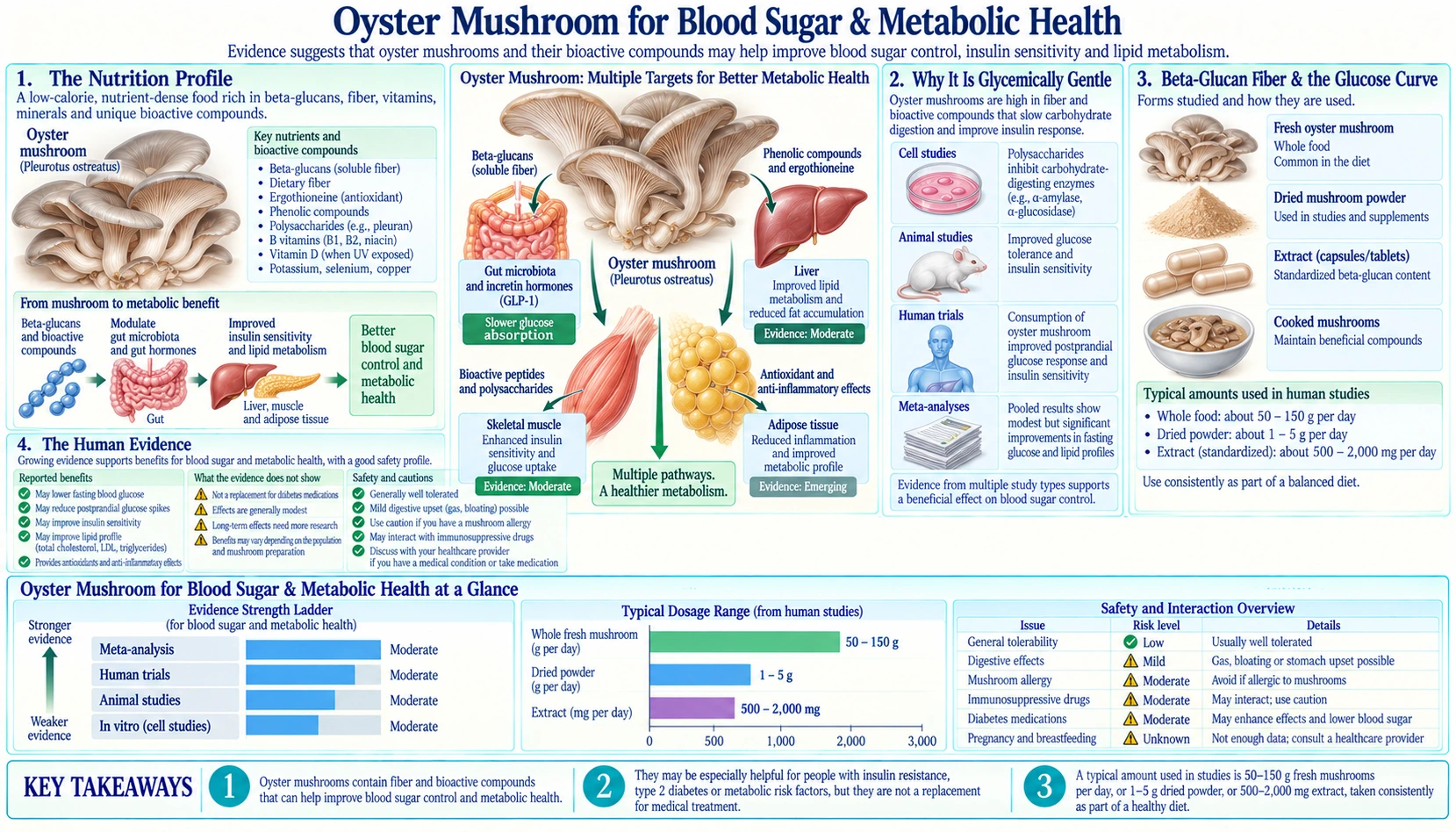
The oyster mushroom's value for blood sugar and weight is less about any exotic active compound and more about what it is as a food: very low in calories, essentially fat- and cholesterol-free, a source of fiber (USDA FoodData Central lists 2.3 g per 100 g raw), glycemically gentle, and satisfyingly meaty in texture. Used in place of some of the meat or refined starch on a plate, it makes the meal lower in calories; a 2022 controlled meal trial, however, found no change in the after-meal rise in blood glucose. There is also intriguing laboratory evidence that oyster-mushroom polysaccharides act on insulin-sensitivity pathways, and small, uncontrolled human studies in diabetic subjects showed lower blood glucose. But the honest headline is a whole-food one — and, importantly, a large US population study did not find that mushroom eaters had a clearly lower risk of diabetes. This page keeps the enthusiasm and the caveats side by side.
Table of Contents
- The Nutrition Profile
- Why It Is Glycemically Gentle
- Beta-Glucan Fiber & the Glucose Curve
- The Human Evidence
- A Reality Check From a Large Cohort
- Preclinical Mechanisms (Insulin, AMP-Activated Protein Kinase)
- Weight, Satiety & Calorie Density
- The Meat-Swap Strategy
- Who Is Most Likely to Benefit
- Cautions
- Key Research Papers
- PubMed Topic Searches
- External Resources
- Connections
- Featured Videos
The Nutrition Profile
Start with what an oyster mushroom actually delivers per serving. Raw oyster mushrooms are very low in energy — roughly 30 to 40 kilocalories per 100 grams — while contributing:
- Dietary fiber, including the beta-glucan and chitin of the cell walls, which is the metabolic workhorse discussed below. USDA FoodData Central lists 2.3 g of total dietary fiber per 100 g of raw oyster mushroom.
- Protein that is high relative to the mushroom's tiny calorie count — a few grams per 100 grams, respectable for a vegetable-tier food and useful for satiety.
- Almost no fat and zero cholesterol.
- B vitamins (notably niacin, riboflavin, and pantothenic acid) that support energy metabolism, plus potassium and copper, and a small amount of selenium (USDA lists 2.6 µg per 100 g raw).
- Very little sodium and no added sugar.
That combination — fiber and water, decent protein, minimal calories and fat — is essentially the textbook profile of a food that supports metabolic health. Nothing about it is a drug; everything about it is a favorable trade against the higher-calorie, faster-digesting foods it can replace.
Why It Is Glycemically Gentle
Foods raise blood sugar in proportion to how much rapidly digestible carbohydrate they contain and how fast that carbohydrate is absorbed. Oyster mushrooms score low on both counts. Their carbohydrate is largely non-digestible fiber rather than starch or sugar, so they contribute very little absorbable glucose. Eaten alongside a carbohydrate-containing meal, the fiber and bulk are proposed to slow the overall rate of digestion and so flatten the post-meal glucose rise; a 2022 controlled meal trial in adults with impaired glucose tolerance did not confirm this for glucose (see The Human Evidence).
In practical terms, oyster mushrooms are a "free" food from a glycemic standpoint — a generous amount added to a stir-fry, omelet, or grain bowl adds little to the meal's glucose load, while increasing its volume, fiber, and satiety. For people watching blood sugar, that is what makes them a useful ingredient, independent of any special bioactive effect.
Beta-Glucan Fiber & the Glucose Curve
The same beta-glucan fiber that gives the oyster mushroom its cholesterol and immune activity also has a role in glucose handling. Viscous soluble fibers like beta-glucan slow gastric emptying and form a gel in the small intestine that slows the diffusion and absorption of glucose. The net effect, well established for oat and barley beta-glucan, is a lower and flatter post-meal blood-sugar spike and a gentler demand on insulin.
Oyster-mushroom beta-glucan is more insoluble and less viscous than oat beta-glucan, so its per-gram effect on the glucose curve is likely weaker — another honesty point. But it contributes in the same direction, and the whole-food fiber matrix (soluble plus insoluble plus chitin) supports steadier digestion overall. This is fiber doing ordinary, well-understood fiber things, not a novel glucose-lowering mechanism.
The Human Evidence
The earliest human study is Khatun and colleagues (2007), who tested oyster mushroom in diabetic subjects. Of 89 people recruited, 30 completed the 24-day schedule: 7 days with mushroom, 7 days without, then 7 days with mushroom again. They reported that fasting and 2-hour after-breakfast blood glucose fell significantly (p<0.001), along with blood pressure, total cholesterol and triglycerides, with no harmful effect seen on the liver or kidneys. The study — notably — used a repeat-challenge design in which the improvements appeared when the mushroom was given, faded when it was withdrawn (glucose, cholesterol and triglycerides rose significantly), and returned when it was reintroduced. That on-off-on pattern makes the signal more convincing than a single before-and-after measurement, because it argues the mushroom itself was responsible; there was, however, no separate comparison group — everyone followed the same schedule.
A 2015 study (Jayasuriya and colleagues) gave a suspension of freeze-dried, powdered Pleurotus ostreatus or Pleurotus cystidiosus at 50 mg/kg body weight, followed by a glucose load, to healthy volunteers and to people with type 2 diabetes managed by diet alone. In the healthy volunteers both mushrooms lowered fasting and after-meal serum glucose (P < 0.05); in the diabetic patients they lowered after-meal serum glucose and raised serum insulin (P < 0.05). The researchers then studied the possible mechanism in rats.
The one double-blind, randomized, controlled test so far points the other way for blood sugar. In a 2022 crossover trial (Dicks and colleagues), 22 adults with impaired glucose tolerance (insulin resistance with high after-meal blood sugar) ate a meal enriched with 20 g of oven-dried oyster-mushroom powder (8.1 g beta-glucans) on one occasion and the same meal without it on another. After-meal blood glucose — the main outcome — and insulin, triglycerides and the gut hormones GIP and ghrelin did not differ between the two meals. After the mushroom meal, GLP-1 (glucagon-like peptide-1, a gut hormone) was 17% higher, free fatty acids in the blood 14% lower, and hunger 22% lower; other appetite ratings did not differ.
The limitations are equally important: these were small studies, and they have not been followed by large, rigorous randomized trials confirming a clinically meaningful glucose-lowering effect of culinary oyster mushrooms in people with diabetes. So the honest position is: there are suggestive small human studies pointing toward benefit, which is more than most foods have, and one controlled meal trial that found no change in after-meal glucose — far short of the evidence needed to call oyster mushrooms a glucose-lowering treatment.
A Reality Check From a Large Cohort
It would be dishonest to present only the encouraging data. When Lee and colleagues (2019) examined mushroom consumption in two large, long-running prospective cohorts of US women and men — 67,139 women and 43,541 men followed from 1986 to 2012, among whom 10,206 developed type 2 diabetes — they did not find that higher mushroom intake was significantly associated with a lower risk of developing type 2 diabetes or cardiovascular disease. People who ate 5 or more servings of mushrooms a week had a type 2 diabetes risk no different from those who ate them less than once a month (HR 1.04; 95% CI 0.93 to 1.16), and mushroom eating was not associated with blood markers of lipids, insulin and inflammation. In a large, well-controlled observational dataset, mushroom eaters were not clearly protected from diabetes.
How to reconcile this with the small trial and the animal studies? A few points:
- The cohort measured all mushrooms (mostly white button in the US diet), not oyster mushrooms specifically, and typical US intakes are low.
- Observational studies test real-world habits, where a few servings of mushrooms are a small part of a complex diet — a setting where a modest food effect can easily wash out.
- It is entirely consistent for a food to be metabolically favorable as a swap (fewer calories, more fiber) without single-handedly moving population-level diabetes risk.
A 2024 systematic review (Hong and colleagues) gathered 5 prospective cohort studies and 4 clinical trials on mushroom eating and heart and metabolic health. Mushroom eating showed no association with illness or death from type 2 diabetes, cardiovascular disease or stroke, but there were "suggestive associations" with blood glucose (both fasting and after meals) and with obesity measures (body weight, body mass index and waist circumference). Because so few studies exist, the authors judged that drawing definitive conclusions is premature.
The takeaway: oyster mushrooms fit within a healthy metabolic diet as a low-calorie food, but no study has shown that eating them prevents diabetes on its own. The large-cohort null result is the honest counterweight to the promising small studies.
Preclinical Mechanisms (Insulin, AMP-Activated Protein Kinase)
The laboratory literature is more dramatic than the human literature — a common and important pattern. In cell and rodent models, Pleurotus polysaccharides show several plausible anti-diabetic actions:
- Improved insulin sensitivity. Kanagasabapathy and colleagues (2012) found that glucan-rich polysaccharides from a Pleurotus species prevented glucose intolerance, insulin resistance, and inflammation in mice fed a high-fat diet.
- AMP-activated protein kinase (AMPK) activation. The same group later showed (2014) that these polysaccharides exert insulin-like and fat-mobilizing effects in fat cells via AMP-activated protein kinase (AMPK), a master metabolic switch also targeted by the diabetes drug metformin.
- Lower glucose in diabetic rodents. Zhang and colleagues (2016) reported an antidiabetic effect of Pleurotus ostreatus polysaccharides in chemically diabetic rats, and other groups have shown hypoglycemic effects for related oyster-mushroom species (for example Pleurotus florida and Pleurotus sajor-caju).
These findings identify real, coherent mechanisms — but they use isolated, concentrated polysaccharide extracts, often at high doses, in animals, and sometimes in Pleurotus species other than the common oyster. They establish biological plausibility and point to what future human trials should test; they are not evidence that eating cooked oyster mushrooms replicates the same effect. When preclinical drama outruns human data, the human data wins.
Weight, Satiety & Calorie Density
Where the oyster mushroom's metabolic value is most solid is in the plainest mechanism of all: calorie density. Because they are mostly water and fiber, oyster mushrooms let you fill a plate and feel satisfied for very few calories. Satiety is driven substantially by food volume and weight, not just calories, so a large, savory serving of mushrooms can blunt appetite while contributing almost nothing to your energy intake.
This matters because excess body weight and central adiposity are the primary drivers of insulin resistance, prediabetes, metabolic syndrome, and type 2 diabetes. Any food that helps you eat fewer total calories without feeling deprived is, indirectly, a blood-sugar and metabolic ally. The oyster mushroom's meaty texture and umami flavor make it unusually good at this, because it can stand in for higher-calorie ingredients rather than merely adding to the plate.
The Meat-Swap Strategy
The most practical way to turn oyster mushrooms into a metabolic benefit is substitution — using them to replace part of a higher-calorie, higher-saturated-fat, or refined-carbohydrate component of a meal:
- Half-and-half with ground meat in tacos, bolognese, chili, or burgers — oyster mushrooms shred and brown into a meaty texture, cutting the calories and saturated fat of the dish while keeping it satisfying.
- Pulled-mushroom preparations as a stand-in for pulled pork or chicken.
- Stir-fries and grain bowls bulked up with mushrooms, so a smaller portion of rice or noodles still feels like a full plate.
- Roasted or sauteed as a side in place of starchier sides.
Preparation matters: sauteing in a modest amount of olive oil adds far fewer calories than deep-frying or drowning them in butter, which would erase the calorie advantage. The idea is simple — the mushroom displaces calories rather than adding them.
Who Is Most Likely to Benefit
- People managing weight — the calorie-density and substitution benefits are the most reliable and apply to nearly everyone.
- People with prediabetes or metabolic syndrome — a glycemically gentle, high-fiber food that supports weight control fits squarely into the dietary pattern shown to help these conditions.
- People with type 2 diabetes — a useful ingredient within a balanced diabetic diet; the Khatun data are encouraging, but oyster mushrooms are an adjunct food; no human trial has tested them as a replacement for prescribed medication or medical management.
Cautions
- Not a diabetes treatment. No human trial has shown that oyster mushrooms can replace prescribed diabetes medication. In people who take glucose-lowering drugs, a large amount of any new food that lowers blood sugar can add to the drugs' effect, so blood-sugar readings can change.
- Cooked, from a known source. Oyster mushrooms are eaten cooked rather than raw, and come from growers or experienced foragers, because wild mushrooms can be misidentified.
- Preparation. Deep-frying or heavy butter/cream sauces cancel the metabolic advantage.
- Gout / high uric acid — mushrooms are a moderate purine source; very large intakes may not suit everyone.
- Mushroom allergy / sensitivity — some people react to mushrooms, which is why a new mushroom is often tried first in a small amount.
Key Research Papers
- Khatun K, Mahtab H, Khanam PA, Sayeed MA, Khan KA (2007). Oyster mushroom reduced blood glucose and cholesterol in diabetic subjects. Mymensingh Medical Journal — PubMed PMID: 17344789
- Lee DH, Yang M, Giovannucci EL, Sun Q, Chavarro JE (2019). Mushroom consumption, biomarkers, and risk of cardiovascular disease and type 2 diabetes: a prospective cohort study of US women and men. American Journal of Clinical Nutrition — PubMed PMID: 31172167
- Kanagasabapathy G, Kuppusamy UR, Abd Malek SN, et al. (2012). Glucan-rich polysaccharides from Pleurotus sajor-caju prevent glucose intolerance, insulin resistance and inflammation in mice fed a high-fat diet. BMC Complementary and Alternative Medicine — PubMed PMID: 23259700
- Kanagasabapathy G, Chua KH, Malek SNA, et al. (2014). AMP-activated protein kinase mediates insulin-like and lipo-mobilising effects of beta-glucan-rich polysaccharides from Pleurotus sajor-caju in 3T3-L1 cells. Food Chemistry — PubMed PMID: 24128468
- Zhang Y, Hu T, Zhou H, et al. (2016). Antidiabetic effect of polysaccharides from Pleurotus ostreatus in streptozotocin-induced diabetic rats. International Journal of Biological Macromolecules — PubMed PMID: 26627601
- Ganeshpurkar A, Kohli S, Rai G (2014). Antidiabetic potential of polysaccharides from the white oyster culinary-medicinal mushroom Pleurotus florida (higher Basidiomycetes). International Journal of Medicinal Mushrooms — PubMed PMID: 24941162
- Ng SH, Zain MSM, Zakaria F, et al. (2015). Hypoglycemic and antidiabetic effect of Pleurotus sajor-caju aqueous extract in normal and streptozotocin-induced diabetic rats. BioMed Research International — PubMed PMID: 26682215
- Dicks L, Jakobs L, Sari M, Hambitzer R, Ludwig N, Simon MC, Stehle P, Stoffel-Wagner B, Helfrich HP, Ahlborn J, Rühl M, Hartmann B, Holst JJ, Ellinger S (2022). Fortifying a meal with oyster mushroom powder beneficially affects postprandial glucagon-like peptide-1, non-esterified free fatty acids and hunger sensation in adults with impaired glucose tolerance: a double-blind randomized controlled crossover trial. European Journal of Nutrition — PubMed PMID: 34505919
- Jayasuriya WJ, Wanigatunge CA, Fernando GH, Abeytunga DT, Suresh TS (2015). Hypoglycaemic activity of culinary Pleurotus ostreatus and P. cystidiosus mushrooms in healthy volunteers and type 2 diabetic patients on diet control and the possible mechanisms of action. Phytotherapy Research — PubMed PMID: 25382404
- Hong JY, Kim MK, Yang N (2024). Mushroom consumption and cardiometabolic health outcomes in the general population: a systematic review. Nutrition Research and Practice — PubMed PMID: 38584813