Red Raspberry Leaf
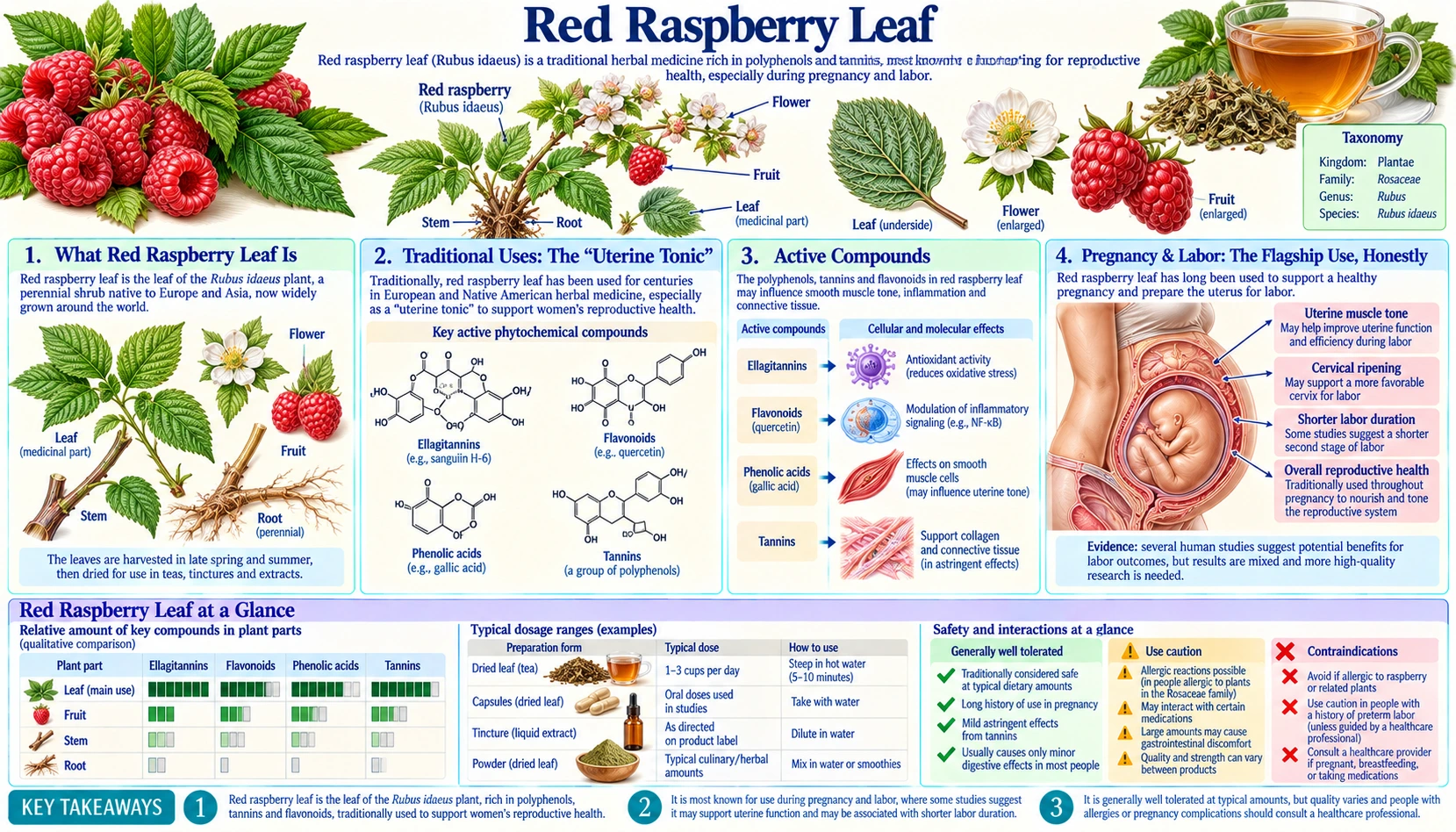
Red raspberry leaf is exactly what it sounds like: the leaf of the raspberry plant (Rubus idaeus) — not the sweet red berry. The leaves are dried and brewed into a mild, earthy tea that has been passed down for generations as a classic “women’s herb.” Its most famous role is as a pregnancy tea, sipped in the last months before birth in the hope of “toning” the uterus and preparing the body for labor. It is also a traditional remedy for menstrual cramps and a simple, nourishing everyday tea. This page explains what the leaf is, where its reputation comes from, what its active compounds are, and — most importantly — what the actual research does and does not show. If you are pregnant or hoping to become pregnant, our goal here is to be warm and honest: to respect a long tradition while being straight with you about how thin the hard evidence really is.
Table of Contents
What Red Raspberry Leaf Is
Red raspberry leaf comes from the same plant that gives us raspberries, but it is a completely different part with a completely different purpose. The berry is a food — sweet, rich in vitamin C and fiber, eaten fresh or in jam. The leaf is an herb — harvested green, dried, and steeped in hot water to make tea. If you have only ever thought of raspberries as dessert, this is the surprise: the plant’s leaves have their own long history in herbal tradition, quite separate from the fruit.
The leaf tea tastes a bit like a mild black tea without the bitterness or caffeine — slightly earthy and grassy, easy to drink plain or with a little honey. Across Europe, North America, and beyond, it earned a reputation as an herb for women: for menstruation, for pregnancy, and for the postpartum weeks. That reputation, more than any single proven effect, is why it fills the “pregnancy tea” boxes on health-store shelves today.
It is worth stating plainly at the start: a long tradition is a reason to take an herb seriously, but it is not the same thing as proof. Many traditional remedies turn out to help; some turn out to do very little. Red raspberry leaf sits in an honest middle ground, and the rest of this page tries to show you exactly where.
Traditional Uses: The “Uterine Tonic”
The heart of red raspberry leaf’s reputation is the idea of a uterine tonic. In herbal language, a “tonic” is something believed to gently strengthen and tone a tissue or organ over time — not a drug that forces a sudden change, but a slow conditioning. Traditional midwives and herbalists have long recommended raspberry leaf tea in the third trimester of pregnancy in the belief that it tones the muscles of the uterus so that, when labor comes, contractions are more effective and the birth is smoother.
Beyond pregnancy, the traditional list is long:
- Menstrual cramps and heavy periods — taken as a tea in the days around menstruation to ease cramping.
- General “women’s health” support — used through the reproductive years and around menopause as a gentle, nourishing tonic.
- Postpartum recovery — sipped in the weeks after birth to support the body as it recovers.
- A mild astringent gargle — because of its tannins, the cooled tea was traditionally used as a mouth rinse or gargle for sore throats and mouth irritation.
These uses are genuinely old and widespread, which is why the herb is still popular. But tradition tends to describe raspberry leaf’s effects with great confidence, while the laboratory and clinical evidence — which we come to below — is much more cautious and mixed.
Active Compounds
Red raspberry leaf contains a familiar herbal mix rather than one single dramatic drug-like ingredient:
- Fragarine — an alkaloid traditionally singled out as the leaf’s “active” component and credited with a gentle toning or relaxing action on the uterine muscle. Honestly, though, the pharmacology of fragarine is not well established, and older laboratory studies of raspberry leaf extract on strips of uterine muscle produced conflicting results — some preparations appeared to relax the muscle, others to make it contract, depending on the extract and the tissue. This tug-of-war in the lab is a big reason the herb’s real effect on the womb remains uncertain.
- Flavonoids and other polyphenols — plant antioxidants (including compounds such as quercetin and kaempferol derivatives) that give the leaf much of its antioxidant activity.
- Tannins — astringent compounds (including ellagitannins) responsible for the tea’s slightly drying, puckering quality. Tannins are the basis for the traditional gargle use, and they also explain one of the herb’s cautions: tannins can bind minerals such as iron and reduce their absorption.
- Vitamins and minerals — the leaf supplies modest amounts of nutrients such as vitamin C, some B vitamins, and minerals including calcium, magnesium, potassium, and iron. Enthusiastic sources sometimes overstate these amounts; a cup of tea delivers far less than a supplement or a serving of food, so raspberry leaf is best thought of as a gentle nutritive tea, not a meaningful source of any nutrient.
Pregnancy & Labor: The Flagship Use, Honestly
This is the reason most people reach for red raspberry leaf, so it deserves the most careful, honest treatment on the page. The tradition is clear and confident. The evidence is limited and mixed.
Two Australian studies are usually cited. First, a retrospective, observational study by Parsons and colleagues (1999) looked back at women who had and had not used raspberry leaf and suggested that the users tended to have shorter labors and fewer interventions. Because it looked backward at choices women had already made, though, it could not rule out that raspberry-leaf drinkers simply differed in other ways — a classic weakness of observational research.
The stronger study is the randomized, double-blind, placebo-controlled trial by Simpson and colleagues (2001), which gave raspberry leaf tablets (two 1.2 g tablets a day) or placebo to 192 low-risk women having their first baby at a large hospital in Sydney, from 32 weeks of pregnancy until labor. Its results are the honest core of the whole story:
- Raspberry leaf did not shorten the first (and longest) stage of labor — the main thing tradition claims.
- The researchers reported a small shortening of the second stage of labor (by 9.59 minutes on average) and a lower rate of forceps deliveries (19.3% versus 30.4%) in the raspberry-leaf group — but these were secondary findings, the differences were modest, and they are not enough to prove a real benefit.
- The authors reported no adverse effects for mother or baby in the trial.
Later reviews have reached the same measured conclusion. A focused review by Holst and colleagues (2009) asked directly whether raspberry leaf should be recommended in pregnancy and concluded that its efficacy is “not convincingly documented.” On safety, it noted that only the latest animal study pointed to an increased risk for the unborn child, but that all the studies were small and could not rule out negative effects on pregnancy outcome; because of the lack of evidence for both safety and efficacy, it called recommendations of the herb to pregnant women “questionable.” A more recent systematic review by Bowman and colleagues (2021) pulled the studies together and again found no clear proof of benefit, alongside no strong signal of serious harm from normal use.
A 2024 Australian prospective observational study by Bowman and colleagues followed 91 women: 44 who drank raspberry leaf and 47 who did not. Fewer of the raspberry-leaf users had their labor medically sped up (augmentation), an epidural, an instrumental birth, a cesarean, or heavy bleeding after birth; more had a vaginal birth, and all phases of labor were shorter. The authors cautioned that the results “cannot be relied on or generalised” to pregnant women in general, that seeing no safety problems “should not be taken as evidence that raspberry leaf is safe,” and that a randomized controlled trial is “urgently needed.”
The single most important thing to understand: red raspberry leaf does not reliably induce or bring on labor. It is not a way to “start” a birth. At best, the tradition and the weak evidence suggest it might make late-pregnancy contractions modestly more efficient in some women — but that possibility is unproven, not a promise.
Menstrual Cramps & Monthly Support
Away from pregnancy, red raspberry leaf’s other classic role is easing menstrual cramps. The same traditional logic applies: the herb is thought to gently tone and soothe the uterine muscle, taking the edge off cramping during a period. Many people drink a cup or two in the days before and during menstruation and find it a pleasant, calming ritual.
It is important to be even-handed here too. There are no strong clinical trials showing that raspberry leaf tea reliably reduces period pain — the menstrual use rests almost entirely on tradition and personal experience rather than on research. That does not mean it is useless; a warm, caffeine-free tea can be genuinely comforting, and some people clearly feel it helps them. Severe or worsening period pain can come from conditions such as endometriosis or fibroids, which a tea does not treat. Herbs like chasteberry are more often studied for cycle-related symptoms.
A Nourishing Everyday Tea
Setting aside the medicinal claims, red raspberry leaf makes a genuinely pleasant everyday tea. It is naturally caffeine-free, mild, and easy to drink, which makes it a nice alternative to black tea or coffee for people cutting back on caffeine. Its flavonoids and vitamin C give it modest antioxidant qualities, and its earthy taste blends well with mint, ginger, or a squeeze of lemon.
Just keep expectations realistic. As noted above, the vitamin and mineral content of a cup of raspberry leaf tea is small — it is a gentle, hydrating drink, not a way to correct a nutritional shortfall. Enjoyed on its own terms, as a warm and soothing cup, it does not need to prove any medical benefit to earn a place in the cupboard.
Forms & Dosing
Red raspberry leaf is sold as loose dried leaf, tea bags, capsules, and tinctures, but the tea is by far the most traditional and most common form.
- Tea. A typical preparation is roughly 1–2 teaspoons of dried leaf (or one tea bag) steeped in a cup of just-boiled water for about 5–10 minutes. In pregnancy, tradition usually starts with one cup a day and, if it is well tolerated, gradually works up to two or three cups as the due date approaches.
- When it is introduced in pregnancy. Traditional guidance is to begin raspberry leaf in the third trimester — commonly from around 32 weeks — rather than early in pregnancy. This is a deliberate caution: because the herb is thought to act on the uterus, most midwives and herbalists prefer to reserve it for the final stretch, closer to full term.
- Capsules and tinctures deliver a more concentrated dose than a cup of tea, and product directions vary.
There is no official, evidence-based “correct” dose — these amounts come from tradition and from the way raspberry leaf was used in the small studies, not from a regulatory standard. Tradition starts with a small amount and builds up; the one randomized trial used two 1.2 g tablets a day from 32 weeks of pregnancy until labor.
Safety & Cautions
Red raspberry leaf is widely used and generally considered low-risk as a tea, and the clinical studies that exist did not turn up serious harm. That is genuinely reassuring — but “probably safe” is not the same as “risk-free,” and a few honest cautions matter, especially in pregnancy:
- Late pregnancy, not early, in tradition. Because the herb is traditionally believed to act on the uterus, traditional guidance leaves out the first trimester and reserves it for the third trimester. For high-risk pregnancies — for example, a history of preterm labor, a scheduled cesarean, bleeding, or other complications — there is no safety data: the randomized trial enrolled only low-risk women having their first baby. Most maternity providers are comfortable with it in late, low-risk pregnancy; some will have reasons in a particular case to advise otherwise.
- What the safety research found. The 2021 systematic review (Bowman and colleagues) gathered 13 studies published between 1941 and 2016. Toxicity appeared only when animals were given high doses injected into a vein or into the belly cavity; the six human studies showed neither harm nor benefit, although one showed a clinically meaningful effect on labor. In a 2009 rat study (Johnson and colleagues), raspberry leaf given from mating until birth was linked to longer pregnancies and faster reproductive development in the female offspring; the authors wrote that it “can have long-term consequences for the health of the offspring.” That finding is in rats, not people.
- Tannins and iron. The leaf’s tannins can bind iron and reduce how much your body absorbs, which matters because pregnancy already raises iron needs. This is why the tea is often drunk between meals rather than with an iron-rich meal or an iron supplement.
- Possible blood-sugar effect. A published case report (Cheang and colleagues, 2016) described a 38-year-old woman with gestational diabetes who developed hypoglycemia (low blood sugar) after starting raspberry leaf tea at 32 weeks and needed a lower insulin dose; stopping and restarting the tea on her own reproduced the pattern. The authors wrote that raspberry leaf may lower insulin needs in gestational diabetes and that glucose levels need closer monitoring in women who use it.
- Digestive effects and interactions. Large amounts of a tannin-rich tea can cause nausea or loosen the stool in some people. As with any herb, raspberry leaf could in theory interact with certain medications or conditions; “natural” does not mean “no interactions.”
- Allergy. A known allergy to raspberries or related plants is listed as a caution.
In short: the studies so far found no serious harm from late-pregnancy use in healthy women, but they are small, and the open questions concern early pregnancy, high-risk pregnancy, diabetes, and iron absorption.
The Honest Bottom Line
Red raspberry leaf is a traditional pregnancy and menstrual tea with a long, sincere history and a devoted following. It is popular for good reasons: it is mild, caffeine-free, pleasant to drink, widely used, and — in normal amounts in late, low-risk pregnancy — probably low-risk.
But the evidence behind its headline claims is weak and mixed. The best study did not find the shorter, easier labor that tradition promises; later reviews agree the proof isn’t there. Crucially, it does not reliably bring on labor, and it is not a treatment for any medical condition. As a warm cup in the third trimester it is mild; its labor claims remain unproven, and a herbal tea does not replace prenatal care.
Key Research Papers
- Simpson M, Parsons M, Greenwood J, Wade K. Raspberry leaf in pregnancy: its safety and efficacy in labor. Journal of Midwifery & Women’s Health. 2001;46(2):51–59. — the key randomized, placebo-controlled trial; no shortening of first-stage labor, only small secondary differences, and no harm observed. — doi:10.1016/S1526-9523(01)00095-2
- Parsons M, Simpson M, Ponton T. Raspberry leaf and its effect on labour: safety and efficacy. Australian College of Midwives Incorporated Journal. 1999;12(3):20–25. — earlier retrospective study suggesting possibly shorter labor and fewer interventions, but observational and prone to confounding. — doi:10.1016/S1031-170X(99)80008-7
- Holst L, Haavik S, Nordeng H. Raspberry leaf – Should it be recommended to pregnant women? Complementary Therapies in Clinical Practice. 2009;15(4):204–208. — review of 12 publications concluding that efficacy is not convincingly documented and that the small studies cannot rule out negative effects on pregnancy outcome. — doi:10.1016/j.ctcp.2009.05.003
- Bowman R, Taylor J, Muggleton S, Davis D. Biophysical effects, safety and efficacy of raspberry leaf use in pregnancy: a systematic integrative review. BMC Complementary Medicine and Therapies. 2021;21(1):56. — recent systematic review finding no clear proof of benefit and no strong signal of serious harm. — doi:10.1186/s12906-021-03230-4
- Bowman RL, Taylor J, Davis DL. Raspberry leaf (Rubus idaeus) use in pregnancy: a prospective observational study. BMC Complementary Medicine and Therapies. 2024;24(1):169. — 91 women; fewer labor augmentations among users, with the authors cautioning the results cannot be generalised. — doi:10.1186/s12906-024-04465-7
- Ferlemi AV, Lamari FN. Berry Leaves: An Alternative Source of Bioactive Natural Products of Nutritional and Medicinal Value. Antioxidants. 2016;5(2):17. — reviews the phytochemistry of berry leaves, including the flavonoids and tannins in raspberry leaf. — doi:10.3390/antiox5020017
- Cheang KI, Nguyen TT, Karjane NW, Salley KE. Raspberry Leaf and Hypoglycemia in Gestational Diabetes Mellitus. Obstetrics & Gynecology. 2016;128(6):1421–1424. — case report of low blood sugar associated with raspberry leaf use in gestational diabetes, a specific caution. — doi:10.1097/AOG.0000000000001757
- Johnson JR, Makaji E, Ho S, Xiong B, Crankshaw DJ, Holloway AC. Effect of Maternal Raspberry Leaf Consumption in Rats on Pregnancy Outcome and the Fertility of the Female Offspring. Reproductive Sciences. 2009;16(6):605–609. — rat study: raspberry leaf from mating to birth was linked to longer pregnancies and faster reproductive development in the female offspring. — doi:10.1177/1933719109332823
- Holst L, Wright D, Haavik S, Nordeng H. The Use and the User of Herbal Remedies During Pregnancy. The Journal of Alternative and Complementary Medicine. 2009;15(7):787–792. — survey showing how common herbal use, including raspberry leaf, is among pregnant women. — doi:10.1089/acm.2008.0467
- Nordeng H, Bayne K, Havnen GC, Paulsen BS. Use of herbal drugs during pregnancy among 600 Norwegian women in relation to concurrent use of conventional drugs and pregnancy outcome. Complementary Therapies in Clinical Practice. 2011;17(3):147–151. — population data on herb use in pregnancy and associated outcomes. — doi:10.1016/j.ctcp.2010.09.002
- Muñoz Balbontín Y, Stewart D, Shetty A, Fitton CA, McLay JS. Herbal Medicinal Product Use During Pregnancy and the Postnatal Period: A Systematic Review. Obstetrics & Gynecology. 2019;133(5):920–932. — systematic review of the safety of herbal products in pregnancy. — doi:10.1097/AOG.0000000000003217
- Dante G, Bellei G, Neri I, Facchinetti F. Herbal therapies in pregnancy: what works? Current Opinion in Obstetrics & Gynecology. 2014;26(2):83–91. — review weighing which pregnancy herbs have supporting evidence and which do not. — doi:10.1097/GCO.0000000000000052
- Ernst E. Herbal medicinal products during pregnancy: are they safe? BJOG: An International Journal of Obstetrics & Gynaecology. 2002;109(3):227–235. — broad safety review of herbal products used during pregnancy. — doi:10.1111/j.1471-0528.2002.t01-1-01009.x
Connections
- All Herbs
- Chasteberry
- Red Clover
- Black Cohosh
- Ginger
- Fennel
- Peppermint
- Chamomile
- Reproductive Medicine
- Raspberries
- Conditions on this site that reference this page: Iron-Deficiency Anemia · Premenstrual Dysphoric Disorder (PMDD) · Dysmenorrhea (Menstrual Cramps) · Endometriosis · PMS and PMDD · Uterine Fibroids