⚠ Evidence warning: Clinical trials or other evidence do not support the claim that Greenland Inuit had a striking absence of heart attacks or an 87 percent lower heart-disease death rate than Danes. This page keeps it as a report of what people, websites or other media say.
Omega-3 Fatty Acids for Cardiovascular Health
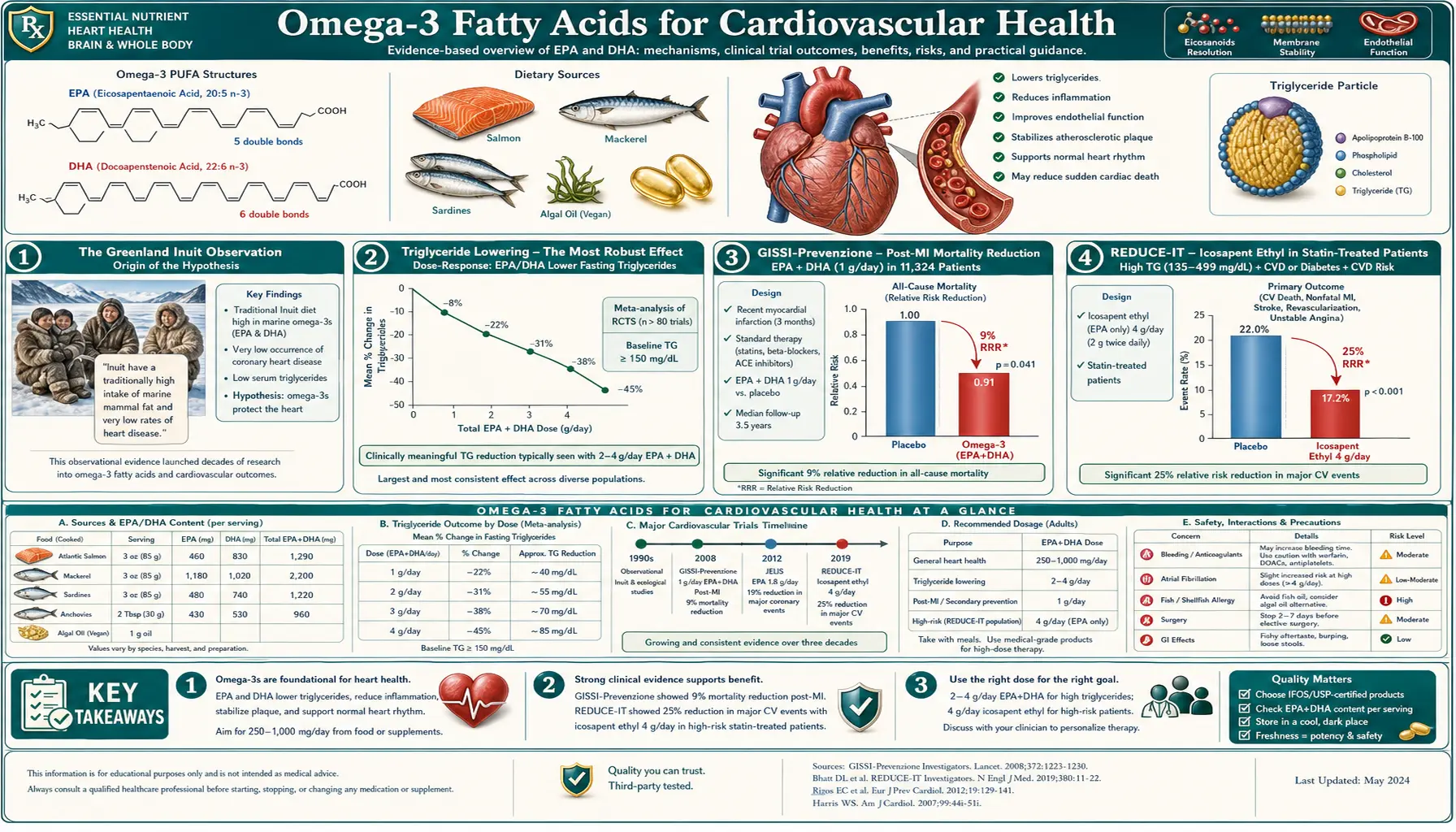
Cardiovascular disease was the first major clinical domain where omega-3 fatty acids showed clear benefit, beginning with the 1970s Dyerberg and Bang epidemiologic observations in Greenland Inuit populations consuming large quantities of marine mammal fat — a reported striking absence of myocardial infarction (MI, heart attack) despite high cholesterol intake (later reviews question this, as described below). Four decades of randomized trials later, the picture is more nuanced: high-dose prescription eicosapentaenoic acid (EPA) (icosapent ethyl, REDUCE-IT 2019) reduces cardiovascular events by 25% in statin-treated patients with elevated triglycerides; pharmacologic doses (2-4 g/day) of eicosapentaenoic acid+docosahexaenoic acid (DHA) reduce serum triglycerides by 20-50%; later meta-analyses differ on how far the GISSI-Prevenzione mortality benefit after myocardial infarction holds up (small reductions in a 2019 pooled analysis, little or no effect on all-cause death in the 2020 Cochrane review); but supplementation in low-risk primary-prevention populations (VITAL) shows only modest effect on hard cardiovascular endpoints. This page walks through what the trials actually show, why eicosapentaenoic acid and docosahexaenoic acid may have different cardiovascular signatures, and what the doses studied and the reported cautions are.
Table of Contents
- The Greenland Inuit Observation — Origin of the Hypothesis
- Triglyceride Lowering — The Most Robust Effect
- GISSI-Prevenzione — Mortality Reduction After Myocardial Infarction
- REDUCE-IT — Icosapent Ethyl in Statin-Treated Patients
- VITAL and STRENGTH — The Negative or Null Trials
- Antiplatelet, Antithrombotic, and Antiarrhythmic Effects
- Blood Pressure and Endothelial Function
- The Omega-3 Index as a Cardiovascular Biomarker
- Doses Described and Product Forms
- Cautions (Atrial Fibrillation Signal, Bleeding, Mercury)
- Key Research Papers
- Connections
- Featured Videos
The Greenland Inuit Observation — Origin of the Hypothesis
The omega-3 cardiovascular hypothesis began with field epidemiology rather than a laboratory mechanism. In 1970-1972, Danish physicians Hans Olaf Bang and Jorn Dyerberg traveled to the Umanak district of Greenland to collect blood and dietary data from Inuit populations consuming a traditional marine-mammal-based diet (seal, whale, fatty fish, with virtually no vegetables or grains). The expectation was to find a population with high atherosclerotic disease — the diet was approximately 70% fat by calories.
Instead, the reported death rate from ischemic heart disease in Greenland Inuit was 5.3 per 100,000 person-years versus 40.4 per 100,000 in age-matched Danish controls — roughly an 87% reduction. (No original source for these two figures was found in the abstracts of the 1980 Greenland papers listed below, and their rate units are uncertain.) Total cholesterol was similar to Danish controls, but the lipid profile differed dramatically: triglycerides were substantially lower, high-density lipoprotein (HDL) was higher, and the polyunsaturated fat composition of the blood was enriched in 20- and 22-carbon omega-3 species that were nearly absent in Western diets. Platelet aggregation testing showed markedly reduced response to standard agonists. Bleeding times were prolonged.
Dyerberg and Bang published a series of papers from 1971 through 1980 outlining what became the omega-3 hypothesis: that the long-chain omega-3 fatty acids eicosapentaenoic acid (20:5n-3) and docosahexaenoic acid (22:6n-3), abundant in marine food chains and nearly absent from Western terrestrial-animal diets, exert direct effects on platelet function, eicosanoid production, and atherosclerosis biology. This was decades before resolvins were discovered and before the molecular mechanisms were fully worked out. By 1978 Dyerberg, Bang and colleagues were already describing thromboxane A3 and a prostacyclin made from eicosapentaenoic acid, and proposing that this could lead to an antithrombotic state.
The Greenland Inuit hypothesis was later refined — subsequent re-analysis found the original mortality data may have understated cardiovascular disease in the Inuit (autopsy data were limited, hemorrhagic stroke rates were elevated) — while supporters of the hypothesis hold that the core observation about lipid profile, platelet function, and the cardio-protective role of long-chain omega-3 fatty acids has been confirmed across many subsequent populations. A 2014 review by Fodor and colleagues disputes the heart-disease part: most studies it found showed that Greenland Eskimos and Canadian and Alaskan Inuit have coronary artery disease as often as non-Eskimo populations, and Bang and Dyerberg's 1970s studies did not investigate how common it was.
Triglyceride Lowering — The Most Robust Effect
The single most reproducible cardiovascular effect of omega-3 fatty acids is triglyceride reduction. At pharmacologic doses (2-4 g/day of combined eicosapentaenoic acid+docosahexaenoic acid), serum triglycerides drop by 20-50%, with the magnitude of effect proportional to the baseline triglyceride level — patients with severe hypertriglyceridemia (triglycerides >500 mg/dL) get the largest absolute reduction.
The mechanism is multifaceted:
- Reduced hepatic very-low-density lipoprotein (VLDL) synthesis — eicosapentaenoic acid and docosahexaenoic acid reduce expression and activity of SREBP-1c, the master transcription factor for hepatic lipogenesis, decreasing de novo synthesis of fatty acids that would otherwise be packaged into very-low-density lipoprotein particles
- Increased hepatic fatty acid oxidation — via PPAR-alpha activation, omega-3 polyunsaturated fatty acids upregulate the beta-oxidation machinery that consumes fatty acids in the liver rather than packaging them for export
- Increased lipoprotein lipase activity — the enzyme that clears triglycerides from circulating chylomicrons and very-low-density lipoprotein
- Reduced apoB-100 secretion — the structural protein of very-low-density lipoprotein particles is produced at lower rates
This effect is the basis for the U.S. Food and Drug Administration (FDA) approval of prescription omega-3 products for severe hypertriglyceridemia. Omega-3-acid ethyl esters (eicosapentaenoic acid+docosahexaenoic acid) and icosapent ethyl (pure eicosapentaenoic acid) carry this indication for adults with triglycerides of 500 mg/dL or more on their current labels. A second omega-3-acid ethyl esters product and omega-3-carboxylic acids were also approved; the FDA's Drugs@FDA database now lists both as discontinued. The typical prescription dose is 4 g/day, with triglyceride reduction of 30-45% expected within 8-12 weeks.
Over-the-counter (OTC) fish oil supplements provide similar mechanism but require larger gram-amount intake to deliver the same eicosapentaenoic acid+docosahexaenoic acid payload (a typical 1 g over-the-counter capsule contains 300-400 mg eicosapentaenoic acid+docosahexaenoic acid, so 4 g/day prescription dose equivalent requires 10-13 over-the-counter capsules daily). For patients with severe hypertriglyceridemia, the prescription products are more practical and have predictable purity testing.
GISSI-Prevenzione — Mortality Reduction After Myocardial Infarction
The first large randomized trial demonstrating omega-3 mortality benefit was GISSI-Prevenzione, published in The Lancet in 1999. 11,324 Italian patients who had survived a recent myocardial infarction (within 3 months) were randomized in a 2×2 factorial design to omega-3 (1 g/day of eicosapentaenoic acid+docosahexaenoic acid ethyl esters, approximately 850 mg combined), vitamin E (300 mg/day), both, or neither, in addition to standard care after myocardial infarction.
After 3.5 years of follow-up, the omega-3 group had:
- 15% reduction in the primary composite endpoint (death, non-fatal myocardial infarction, non-fatal stroke), p=0.02
- 20% reduction in all-cause mortality, p=0.01
- 30% reduction in cardiovascular mortality, p=0.006
- 45% reduction in sudden cardiac death, p<0.001 (the largest single-cause reduction)
Those percentages for the primary endpoint, death and cardiovascular death come from the trial's four-way analysis. Its factorial (two-way) analysis gave smaller figures: 10% (95% confidence interval 1-18) for the primary endpoint, 14% (3-24) for death and 17% (3-29) for cardiovascular death.
The sudden-cardiac-death reduction was particularly striking and suggested an antiarrhythmic mechanism, since sudden cardiac death is dominantly an electrical event (ventricular fibrillation in vulnerable myocardium) rather than a thrombotic or atherosclerotic event. Animal models had previously shown that eicosapentaenoic acid and docosahexaenoic acid reduce inducible ventricular tachyarrhythmias and stabilize cardiomyocyte membrane potential.
Vitamin E showed no benefit. The dose of omega-3 was modest by current standards (~850 mg/day of eicosapentaenoic acid+docosahexaenoic acid combined) — achievable through 2-3 servings per week of oily fish, demonstrating that even physiological doses can be cardio-protective in high-risk patients.
Subsequent secondary-prevention trials (OMEGA in 2010, Alpha Omega in 2010) failed to replicate the GISSI-Prevenzione magnitude, likely because the background care had improved (much higher rates of statin, beta-blocker, angiotensin-converting enzyme inhibitor (ACE inhibitor), and antiplatelet use eroded the incremental benefit of omega-3 supplementation). In OMEGA, sudden cardiac death was 1.5% in both groups at one year. Later pooled analyses differ: a 2019 meta-analysis of 13 trials (127,477 participants) found small reductions (coronary death rate ratio 0.92, 95% confidence interval 0.86-0.98), while the 2020 Cochrane review found little or no effect on all-cause death (risk ratio 0.97, 0.93-1.01, high certainty) or arrhythmia (0.99, 0.92-1.06, low certainty), with cardiovascular death at 0.92 (0.86-0.99, moderate certainty). GISSI-Prevenzione remains historically important and the most-cited landmark study in cardiovascular omega-3 research.
REDUCE-IT — Icosapent Ethyl in Statin-Treated Patients
The most consequential modern omega-3 cardiovascular trial is REDUCE-IT, published in the New England Journal of Medicine in 2019. 8,179 statin-treated patients with established cardiovascular disease (70%) or diabetes with at least one additional risk factor (30%) and triglycerides 135-499 mg/dL were randomized to icosapent ethyl (pure eicosapentaenoic acid ethyl ester, 4 g/day) or mineral oil placebo. Follow-up was 4.9 years.
Results were impressive:
- 25% relative risk reduction in the primary composite (cardiovascular death, non-fatal myocardial infarction, non-fatal stroke, coronary revascularization, unstable angina), p<0.001
- 20% reduction in cardiovascular death, p=0.03
- 31% reduction in fatal or non-fatal myocardial infarction, p<0.001
- 28% reduction in fatal or non-fatal stroke, p=0.01
- Number needed to treat: approximately 21 patients over 4.9 years to prevent one event
REDUCE-IT led to U.S. Food and Drug Administration expanded labeling of icosapent ethyl for cardiovascular risk reduction in 2019 — the first omega-3 product approved for cardiovascular indication rather than just triglyceride lowering.
Two notable caveats emerged. First, the trial used mineral oil as placebo, which may have modestly raised low-density lipoprotein cholesterol (LDL-C) in the comparator group (mineral oil is now believed to interact with statin absorption), potentially inflating the apparent benefit of eicosapentaenoic acid. Second, the magnitude of triglyceride reduction (~18%) was insufficient to fully explain the cardiovascular benefit — the magnitude of event reduction was larger than would be predicted from triglycerides lowering alone, suggesting eicosapentaenoic acid has additional cardio-protective mechanisms beyond lipid effects (plaque stabilization, anti-inflammation, antiplatelet effects, possibly direct cardiomyocyte effects).
An earlier Japanese trial also tested eicosapentaenoic acid alone. JELIS (2007) gave 18,645 patients with high cholesterol, in a country where people eat a lot of fish, 1,800 mg a day of eicosapentaenoic acid with a statin or a statin alone. Major coronary events were 2.8% versus 3.5% (19% lower, p=0.011) at a mean of 4.6 years, while sudden cardiac death and coronary death did not differ. The trial was open-label, so patients knew which treatment they had. It is often brought into the debate below about eicosapentaenoic acid-only products.
A later Japanese trial was less clear-cut. RESPECT-EPA (2024) randomized 2,506 people with stable coronary artery disease on statins, and a low eicosapentaenoic acid to arachidonic acid ratio in the blood, to 1,800 mg a day of icosapent ethyl or no added treatment, for a median of 5 years. The primary endpoint was 9.1% versus 12.6% (hazard ratio 0.79, 95% confidence interval 0.62-1.00, P=0.055), which did not reach statistical significance. Coronary events, a secondary endpoint, were lower (6.6% versus 9.7%, hazard ratio 0.73), and new atrial fibrillation was higher (3.1% versus 1.6%, P=0.017). This trial was also open-label.
The subsequent STRENGTH trial (2020) tested eicosapentaenoic acid+docosahexaenoic acid carboxylic acid (omega-3 carboxylic acids) at 4 g/day in a similar population and was stopped early for futility. The contrast with REDUCE-IT has fueled debate about whether the eicosapentaenoic acid-only formulation specifically (rather than eicosapentaenoic acid+docosahexaenoic acid) is responsible for the cardiovascular benefit, or whether the placebo (corn oil in STRENGTH, mineral oil in REDUCE-IT) accounted for the difference. This remains an unresolved question.
VITAL and STRENGTH — The Negative or Null Trials
The VITAL trial (2018, New England Journal of Medicine) randomized 25,871 generally healthy US adults ≥50 to marine omega-3 (1 g/day fish oil providing 460 mg eicosapentaenoic acid + 380 mg docosahexaenoic acid) versus placebo, with a parallel vitamin D arm. After 5.3 years, the primary composite endpoint (cardiovascular death, non-fatal myocardial infarction, non-fatal stroke) was not significantly reduced (hazard ratio 0.92, 95% confidence interval (CI) 0.80-1.06, p=0.24). However, secondary analyses showed:
- Significant 28% reduction in myocardial infarction specifically (hazard ratio (HR) 0.72, 95% confidence interval 0.59-0.90)
- Larger benefit in participants with low fish intake at baseline (hazard ratio 0.81 if <1.5 servings/week)
- Larger benefit in Black participants (hazard ratio 0.77 for primary endpoint, exploratory)
The interpretation: in a generally healthy primary-prevention population with adequate background dietary omega-3 intake, 1 g/day fish oil does not reduce a composite cardiovascular endpoint, but may reduce myocardial infarction specifically, particularly in populations with low baseline intake. This is consistent with the broader observation that omega-3 cardiovascular benefit is concentrated in (a) high-risk patients with established disease (REDUCE-IT), (b) patients with elevated triglycerides who derive lipid benefit, and (c) patients with low baseline omega-3 status who are biochemically deficient.
STRENGTH enrolled 13,078 statin-treated patients at high cardiovascular risk and was halted early at 1,384 primary events, when an interim analysis showed a low probability of benefit. The primary endpoint occurred in 12.0% on omega-3 carboxylic acids versus 12.2% on corn oil (hazard ratio 0.99, 95% confidence interval 0.90-1.09), and gastrointestinal side effects were more common (24.7% versus 14.7%).
The largest review is the 2020 Cochrane review of 86 randomized trials and 162,796 people. It found little or no effect of long-chain omega-3 on all-cause death or cardiovascular events, and slightly fewer coronary heart disease events (one prevented for every 167 people treated, low-certainty evidence).
Fish oil in people free of heart disease has also been followed outside trials. In the UK Biobank (415,737 people aged 40-69, median 11.9 years), regular fish oil use in those without cardiovascular disease went with more new atrial fibrillation (hazard ratio 1.13, 95% confidence interval 1.10-1.17) and stroke (1.05, 1.00-1.11), but in people who already had atrial fibrillation it went with less progression to major cardiovascular events (0.92, 0.87-0.98). This was an observational study, so it cannot show cause.
Taken together, these results point to targeted rather than universal benefit. Healthy adults with adequate fish intake and normal triglycerides showed little cardiovascular benefit from supplementation; high-risk patients with low omega-3 index or elevated triglycerides are the group in which trials report measurable benefit.
Antiplatelet, Antithrombotic, and Antiarrhythmic Effects
Beyond lipid effects, omega-3 fatty acids exert direct effects on the hemostatic and electrical systems that contribute to cardio-protection.
Antiplatelet effect — eicosapentaenoic acid competes with arachidonic acid (AA) as substrate for platelet cyclooxygenase-1. The arachidonic acid-derived thromboxane A2 (TxA2) is a potent platelet aggregator and vasoconstrictor; the eicosapentaenoic acid-derived thromboxane A3 (TxA3) is essentially inactive. As eicosapentaenoic acid replaces arachidonic acid in platelet membrane phospholipids, the arachidonic acid-to-eicosapentaenoic acid ratio in liberated fatty acid shifts toward less aggregatory eicosanoid output. The clinically measurable result is modestly prolonged bleeding time and reduced platelet aggregation response to standard agonists. The effect is on the order of low-dose aspirin (not as potent as aspirin's irreversible cyclooxygenase-1 (COX-1) acetylation, but in the same direction).
Antiarrhythmic effect — eicosapentaenoic acid and docosahexaenoic acid stabilize cardiomyocyte membranes by integrating into membrane phospholipids and modulating multiple ion channels (sodium channels, L-type calcium channels, KATP channels). Animal models consistently show reduced inducibility of ventricular fibrillation in omega-3 fed animals. The sudden cardiac death reduction in GISSI-Prevenzione (45%) is mechanistically explained by this antiarrhythmic effect. The 2006 SOFA trial in 546 people with implantable cardioverter-defibrillators found no significant benefit (hazard ratio 0.86, 95% confidence interval 0.64-1.16), and its subgroups, including people with a prior myocardial infarction (0.76, 0.52-1.11), were not significant either. One proposed explanation is that the antiarrhythmic effect is most relevant in vulnerable ischemic myocardium rather than in already-damaged hearts with high arrhythmia burden.
Antithrombotic / atherosclerosis effect — chronic omega-3 intake reduces vascular inflammation markers (C-reactive protein, interleukin-6), improves endothelial nitric oxide synthase activity, and may stabilize atherosclerotic plaque by reducing macrophage matrix metalloproteinase activity. Imaging studies using intravascular ultrasound and computed tomography (CT) angiography have shown modest reductions in plaque volume and lipid-rich necrotic core with sustained high-dose eicosapentaenoic acid, though the effect size is small.
Blood Pressure and Endothelial Function
Omega-3 fatty acids produce modest blood pressure reduction. A 2014 meta-analysis of 70 randomized trials found that eicosapentaenoic acid+docosahexaenoic acid lowered blood pressure by 1.52 mmHg systolic and 0.99 mmHg diastolic overall. The effect was largest in untreated hypertensive patients (4.51 mmHg systolic, 3.05 mmHg diastolic) and smaller in normotensive subjects (1.25 mmHg systolic, 0.62 mmHg diastolic). A 2022 dose-response meta-analysis of 71 trials put the best reductions at 2-3 g/day, about 2.61 mmHg systolic and 1.64-1.80 mmHg diastolic.
The mechanism involves improved endothelial nitric oxide synthase (eNOS) activity, increased vascular nitric oxide bioavailability, and reduced vascular smooth muscle contractility. Endothelium-dependent vasodilation (measured as flow-mediated dilation of the brachial artery) is improved by omega-3 supplementation in patients with cardiovascular risk factors.
The blood pressure effect is modest in absolute terms but clinically meaningful as part of a multifactorial approach to hypertension. It is roughly equivalent to a low-dose angiotensin-converting enzyme inhibitor or one-quarter of the typical effect of moderate-dose thiazide.
The Omega-3 Index as a Cardiovascular Biomarker
The omega-3 index, introduced by William Harris and Clemens von Schacky in 2004, is the percentage of eicosapentaenoic acid+docosahexaenoic acid in red blood cell membrane fatty acids. Harris and von Schacky proposed it as a new risk factor for death from coronary heart disease that "may represent" a useful marker. Red blood cell fatty acid composition reflects long-term intake — unlike serum omega-3 which fluctuates with recent meals, the red blood cell index reflects intake over the prior 4 months (the lifespan of an erythrocyte).
Risk stratification by omega-3 index:
- >8% — cardiovascular-protective range, associated with lowest cardiovascular disease (CVD) risk (similar to Japanese populations with high fish intake)
- 4-8% — intermediate risk (typical of moderate fish consumers in Mediterranean populations)
- <4% — high-risk range, associated with elevated risk of sudden cardiac death (typical of low-fish Western diets)
The omega-3 index can be tested through commercial laboratories (cost approximately $50). It is described as more useful than serum cholesterol fractions for tracking response to omega-3 supplementation because (a) the effect is dose-dependent, (b) the test integrates over 4 months of intake, and (c) its authors found it inversely associated with risk of coronary death when they evaluated it in published prevention studies. What is not known: no trial cited on this page shows that treating people to a target index lowers cardiovascular events. For high-risk patients starting omega-3 supplementation, an initial omega-3 index followed by a repeat at 4-6 months allows direct monitoring of biochemical response.
Approximate target dosing: an individual with omega-3 index of 4% will typically need 1-2 g/day of combined eicosapentaenoic acid+docosahexaenoic acid from supplements (in addition to 1-2 servings/week of oily fish) to reach 8% over 4-6 months. Higher baseline intake from food shifts this lower.
Doses Described and Product Forms
The doses described differ by clinical indication:
- Primary prevention in healthy adults with adequate fish intake — VITAL found no significant drop in its composite endpoint in this kind of population. Two servings of oily fish per week (salmon, sardines, mackerel, herring) is the amount commonly described as supplying adequate eicosapentaenoic acid+docosahexaenoic acid
- Primary prevention in low-fish populations — 250-500 mg/day of eicosapentaenoic acid+docosahexaenoic acid is the maintenance amount commonly described
- Secondary prevention (established coronary artery disease) — 1 g/day of eicosapentaenoic acid+docosahexaenoic acid is the American Heart Association figure, the dose used in GISSI-Prevenzione; 2 g/day is also described when triglycerides or the omega-3 index are being targeted
- Hypertriglyceridemia (triglycerides 200-500 mg/dL) — 2-3 g/day eicosapentaenoic acid+docosahexaenoic acid is the amount described
- Severe hypertriglyceridemia (triglycerides >500 mg/dL) — 4 g/day of a prescription product (icosapent ethyl or omega-3-acid ethyl esters) is the labelled dose
- Statin-treated patients per REDUCE-IT criteria (triglycerides 135-499 mg/dL at entry) — 4 g/day icosapent ethyl was the trial dose for cardiovascular event reduction
Forms: triglyceride-form fish oil (re-esterified after molecular distillation purification) has slightly better bioavailability than ethyl ester form, particularly when taken without a fat-containing meal. With a fat-containing meal, the bioavailability difference largely disappears. Prescription omega-3-acid ethyl esters are the ethyl ester form; icosapent ethyl is the ethyl ester of pure eicosapentaenoic acid; omega-3-carboxylic acids are the free fatty acid form. Krill oil contains eicosapentaenoic acid and docosahexaenoic acid in phospholipid rather than triglyceride form, with proponents claiming superior bioavailability — the head-to-head trials have been mixed, and krill oil is more expensive per gram of eicosapentaenoic acid+docosahexaenoic acid. Algal docosahexaenoic acid is the vegetarian/vegan alternative; it provides only docosahexaenoic acid (no significant eicosapentaenoic acid) and is the source used by plant-based eaters seeking the brain/eye benefits of docosahexaenoic acid. For broader cardiovascular indications, eicosapentaenoic acid+docosahexaenoic acid from marine sources remains the standard.
Cautions (Atrial Fibrillation Signal, Bleeding, Mercury)
- Atrial fibrillation signal at high doses — REDUCE-IT (icosapent ethyl 4 g/day) showed a small but statistically significant increase in hospitalization for atrial fibrillation or flutter (3.1% vs 2.1% placebo over a median 4.9 years; hazard ratio 1.35, p=0.004). A 2021 meta-analysis in Circulation by Gencer and colleagues (7 trials, 81,210 patients) found a risk that rises with dose: hazard ratio 1.25 overall (95% confidence interval 1.07-1.46), 1.12 at 1 g/day or less, 1.49 above 1 g/day, and 11% higher per extra gram. At the low dose used in VITAL (840 mg/day), a separate randomized analysis by Albert and colleagues (JAMA 2021) found no significant difference (hazard ratio 1.09, 0.96-1.24). The mechanism is unclear. REDUCE-IT's primary composite still fell by 25% despite the signal. The icosapent ethyl label states that atrial fibrillation was more common in patients with a previous history of atrial fibrillation or flutter.
- Bleeding risk — mild prolongation of bleeding time is expected. In REDUCE-IT, serious bleeding occurred in 2.7% versus 2.1% (P=0.06). A 2024 meta-analysis of 11 randomized trials and 120,643 patients found no overall difference in bleeding (rate ratio 1.09, 95% confidence interval 0.91-1.31), though high-dose purified eicosapentaenoic acid raised bleeding risk by 50% in relative terms and 0.6% in absolute terms. Surgical guidelines vary — some recommend holding omega-3 supplements 7-14 days before major surgery, others find no clinically meaningful effect even continued through surgery. In that meta-analysis, bleeding risk tracked the eicosapentaenoic acid dose, not background antiplatelet treatment. For people on warfarin, direct oral anticoagulants or antiplatelet drugs, or with bleeding disorders, the interaction is described as usually mild.
- Mercury and persistent organic pollutants in fish — large predatory fish (king mackerel, swordfish, shark, tilefish from the Gulf of Mexico, bigeye tuna) accumulate methylmercury and are listed among the highest-mercury fish in the FDA and EPA advice on eating fish, which is aimed especially at pregnancy. Smaller, shorter-lived fish (sardines, anchovies, herring, wild salmon) have much lower contaminant burden. Quality omega-3 supplements are molecularly distilled to remove heavy metals and PCBs; independent third-party testing programs provide verification.
- Oxidative rancidity — omega-3 fatty acids are highly unsaturated and prone to peroxidation. Rancid fish oil (fishy aftertaste, "burping") provides oxidized lipids that may be pro-inflammatory rather than anti-inflammatory. Peroxide value and anisidine value on a certificate of analysis are the measures of this oxidation, with lower values meaning less of it; refrigeration after opening is the storage step commonly described.
- Drug interactions — potentiation of warfarin and antiplatelet drugs (additive antiplatelet effect); modest reduction in blood pressure may potentiate antihypertensive drugs.
- Low-density lipoprotein cholesterol shift — high-dose omega-3 may modestly raise low-density lipoprotein cholesterol while lowering triglycerides (the lipid shift is sometimes called "particle remodeling"). The 2019 American Heart Association science advisory reports this rise with eicosapentaenoic acid+docosahexaenoic acid products at 4 g/day in very high triglycerides, not with eicosapentaenoic acid alone, and no rise when either is used for hypertriglyceridemia, alone or with a statin. Patients on statin therapy are described as generally keeping their low-density lipoprotein goals; monitoring is the step described for people with elevated low-density lipoprotein.
Key Research Papers
- GISSI-Prevenzione Investigators (1999). Dietary supplementation with n-3 polyunsaturated fatty acids and vitamin E after myocardial infarction. The Lancet — PubMed PMID: 10465168
- Bhatt DL et al. (2019). Cardiovascular Risk Reduction with Icosapent Ethyl for Hypertriglyceridemia (REDUCE-IT). NEJM — PubMed PMID: 30415628
- Yokoyama M et al. (2007). Effects of eicosapentaenoic acid on major coronary events in hypercholesterolaemic patients (JELIS). The Lancet — PubMed PMID: 17398308
- Nicholls SJ et al. (2020). Effect of High-Dose Omega-3 Fatty Acids vs Corn Oil on Major Adverse Cardiovascular Events (STRENGTH). JAMA — PubMed PMID: 33190147
- Manson JE et al. (2019). Marine n-3 Fatty Acids and Prevention of Cardiovascular Disease and Cancer (VITAL). NEJM — PubMed PMID: 30415637
- Rauch B et al. (2010). OMEGA, a randomized, placebo-controlled trial of omega-3 fatty acids in patients with myocardial infarction. Circulation — PubMed PMID: 21060071
- Harris WS, Von Schacky C (2004). The Omega-3 Index: a new risk factor for death from coronary heart disease? Prev Med — PubMed PMID: 15208005
- Skulas-Ray AC et al. (2019). Omega-3 Fatty Acids for the Management of Hypertriglyceridemia: AHA Science Advisory. Circulation — PubMed PMID: 31422671
- Abdelhamid AS et al. (2020). Omega-3 fatty acids for the primary and secondary prevention of cardiovascular disease. Cochrane Database — PubMed PMID: 32114706
- Gencer B et al. (2021). Effect of Long-Term Marine ɷ-3 Fatty Acids Supplementation on the Risk of Atrial Fibrillation in Randomized Controlled Trials of Cardiovascular Outcomes: A Systematic Review and Meta-Analysis. Circulation — PubMed PMID: 34612056
- Albert CM et al. (2021). Effect of Marine Omega-3 Fatty Acid and Vitamin D Supplementation on Incident Atrial Fibrillation: A Randomized Clinical Trial. JAMA — PubMed PMID: 33724323
- Dyerberg J, Bang HO (1979). Haemostatic function and platelet polyunsaturated fatty acids in Eskimos. Lancet — PubMed PMID: 89498
- Hu Y et al. (2019). Marine Omega-3 Supplementation and Cardiovascular Disease: An Updated Meta-Analysis. J Am Heart Assoc — PubMed PMID: 31567003
- Miyauchi K et al. (2024). Randomized Trial for Evaluation in Secondary Prevention Efficacy of Combination Therapy-Statin and Eicosapentaenoic Acid (RESPECT-EPA). Circulation — PubMed PMID: 38873793
- Chen G et al. (2024). Regular use of fish oil supplements and course of cardiovascular diseases: prospective cohort study. BMJ Med — PubMed PMID: 38800667
- Javaid M et al. (2024). Bleeding Risk in Patients Receiving Omega-3 Polyunsaturated Fatty Acids: A Systematic Review and Meta-Analysis of Randomized Clinical Trials. J Am Heart Assoc — PubMed PMID: 38742535
- Brouwer IA et al. (2006). Effect of fish oil on ventricular tachyarrhythmia and death in patients with implantable cardioverter defibrillators: the Study on Omega-3 Fatty Acids and Ventricular Arrhythmia (SOFA) randomized trial. JAMA — PubMed PMID: 16772624
- Miller PE et al. (2014). Long-chain omega-3 fatty acids eicosapentaenoic acid and docosahexaenoic acid and blood pressure: a meta-analysis of randomized controlled trials. Am J Hypertens — PubMed PMID: 24610882
- Zhang X et al. (2022). Omega-3 Polyunsaturated Fatty Acids Intake and Blood Pressure: A Dose-Response Meta-Analysis of Randomized Controlled Trials. J Am Heart Assoc — PubMed PMID: 35647665
- Fodor JG et al. (2014). "Fishing" for the origins of the "Eskimos and heart disease" story: facts or wishful thinking? Can J Cardiol — PubMed PMID: 25064579
- Dyerberg J et al. (1978). Eicosapentaenoic acid and prevention of thrombosis and atherosclerosis? Lancet — PubMed PMID: 78322
- Kromann N, Green A (1980). Epidemiological studies in the Upernavik district, Greenland. Incidence of some chronic diseases 1950-1974. Acta Med Scand — PubMed PMID: 7457208
- Bang HO, Dyerberg J, Sinclair HM (1980). The composition of the Eskimo food in north western Greenland. Am J Clin Nutr — PubMed PMID: 7435433