⚠ Evidence warning: Clinical trials or other evidence do not support the claim that later trials have largely confirmed a benefit of omega-3 in attention-deficit/hyperactivity disorder. This page keeps it as a report of what people, websites or other media say.
Omega-3 Fatty Acids for Brain and Cognition
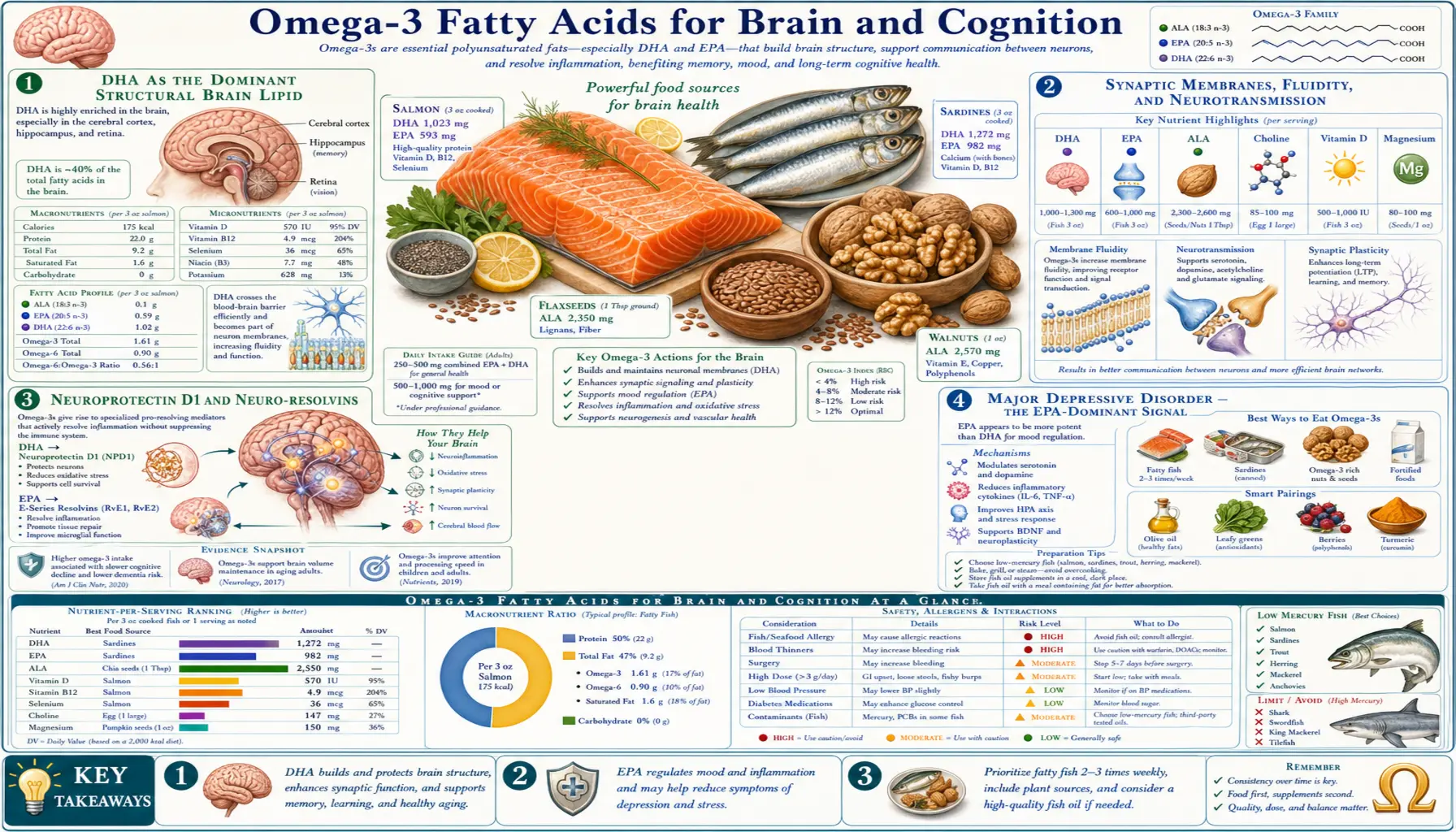
Docosahexaenoic acid (DHA) (docosahexaenoic acid, 22:6n-3) is the dominant structural lipid of the human brain — comprising approximately 30% of the phospholipid in cortical gray matter, 50% of the phospholipid in retinal photoreceptor outer segments, and the bulk of the membrane lipid in synaptic terminals where neurotransmitter vesicles dock and release. Eicosapentaenoic acid (EPA) (eicosapentaenoic acid, 20:5n-3) plays a complementary role as the dominant substrate for the resolvin-and-protectin family of inflammation-resolving mediators that protect against neuroinflammation. The therapeutic implications cut across mood disorders (where eicosapentaenoic acid-dominant supplementation has the most consistent antidepressant signal), age-related cognitive decline (mixed trial results), attention-deficit/hyperactivity disorder (ADHD) in children (modest but reproducible effect), and the lifelong docosahexaenoic acid-accretion biology that begins in the third trimester of pregnancy. This page walks through the structural, signaling, and clinical evidence for omega-3 effects on the brain.
Table of Contents
- Docosahexaenoic Acid as the Dominant Structural Brain Lipid
- Synaptic Membranes, Fluidity, and Neurotransmission
- Neuroprotectin D1 and Neuro-resolvins
- Major Depressive Disorder — the Eicosapentaenoic Acid-Dominant Signal
- Anxiety, Bipolar Disorder, and Perinatal Mood Disorders
- Age-Related Cognitive Decline and Dementia Prevention
- Attention-Deficit/Hyperactivity Disorder in Children and Adolescents
- Omega-3 Index, Brain Volume, and Magnetic Resonance Imaging Findings
- Dosing for Brain and Cognitive Indications
- Cautions and Drug Interactions
- Key Research Papers
- Connections
- Featured Videos
Docosahexaenoic Acid as the Dominant Structural Brain Lipid
The human brain is approximately 60% lipid by dry weight, of which roughly half is phospholipid. Within that phospholipid pool, docosahexaenoic acid occupies the sn-2 position of phosphatidylethanolamine and phosphatidylserine at extraordinarily high enrichment — up to 30% of all fatty acid in cortical gray matter, far higher than in any other organ system. Skeletal muscle has <1% docosahexaenoic acid in membrane fatty acids; the brain has 30%.
This enrichment is not arbitrary. Docosahexaenoic acid's 22-carbon chain with six cis double bonds creates a uniquely flexible, low-melting-point lipid — the chain folds into multiple low-energy conformations on the picosecond timescale, generating membrane fluidity that other fatty acids cannot provide. The membrane proteins embedded in docosahexaenoic acid-rich membranes (G-protein coupled receptors, ion channels, neurotransmitter transporters, rhodopsin in photoreceptors) require this fluidity for the conformational changes that constitute their signaling function. Replacing docosahexaenoic acid with shorter or less-unsaturated fatty acids (which happens in dietary docosahexaenoic acid deficiency) reduces membrane fluidity and impairs these signaling functions.
The body accretes docosahexaenoic acid into the brain across a defined developmental window. Docosahexaenoic acid accumulates in fetal brain primarily during the third trimester of pregnancy (when fetal brain growth accelerates), continues at high rates through the first two years of life (when the human brain triples in volume), and reaches roughly adult levels by school age. Adult brain docosahexaenoic acid content is then maintained over decades through a combination of dietary intake and slow turnover.
Across the lifespan, the average daily turnover of brain docosahexaenoic acid is small — perhaps 0.5-1% per day — so deficient intake does not produce rapid measurable cognitive change in adults. Severe deficiency over months to years can deplete brain docosahexaenoic acid modestly, particularly in conditions of accelerated turnover (chronic inflammation, alcohol use, or repeated pregnancies in nutritionally marginal mothers).
Synaptic Membranes, Fluidity, and Neurotransmission
Within the brain, docosahexaenoic acid is most highly concentrated in synaptic membranes — the specialized regions where presynaptic vesicles dock with the active zone and release neurotransmitter into the synaptic cleft. Synaptic vesicle fusion with the presynaptic membrane requires membrane curvature changes, lipid raft reorganization, and conformational changes in SNARE proteins, all of which depend on membrane fluidity provided by docosahexaenoic acid-rich phospholipids.
Experimentally reducing brain docosahexaenoic acid (in rodent models fed n-3-deficient diets across generations) produces:
- Reduced dopamine D2 receptor density in frontal cortex
- Altered serotonin receptor function
- Impaired long-term potentiation (the cellular correlate of learning)
- Reduced brain-derived neurotrophic factor (BDNF) expression
- Spatial-learning deficits in maze tasks
- Increased anxiety-like behavior
These effects can be partially reversed by reintroducing dietary docosahexaenoic acid, though the reversal is incomplete if deficiency occurred during the developmental docosahexaenoic acid-accretion window (third trimester through age two). The implication for human nutrition is that early-life docosahexaenoic acid adequacy has lifetime consequences that are not fully recoverable with later supplementation — the rationale for pregnancy and lactation docosahexaenoic acid recommendations.
Neuroprotectin D1 and Neuro-resolvins
Beyond its structural role, docosahexaenoic acid serves as the precursor to a family of bioactive lipid mediators with specifically neuroprotective and inflammation-resolving functions. The most studied is neuroprotectin D1 (NPD1), also called protectin D1, biosynthesized in retinal pigment epithelium and brain tissue from docosahexaenoic acid via 15-lipoxygenase.
NPD1 has been shown to:
- Protect retinal pigment epithelial cells against oxidative stress (relevant to age-related macular degeneration)
- Reduce neuronal apoptosis in cerebral ischemia models
- Modulate microglial activation toward a resolving phenotype
- Reduce beta-amyloid-induced neurotoxicity in cell culture models of Alzheimer's disease
- Suppress NF-kappaB activation and reduce neuroinflammatory cytokine production
The discovery of NPD1 (Bazan, Serhan, and colleagues, 2003-2005) reframed the understanding of why dietary docosahexaenoic acid matters for brain health: it is not just a passive membrane component but an active substrate for endogenous neuroprotective mediators. The implication is that docosahexaenoic acid inadequacy compromises both the brain's structural infrastructure and its capacity to resolve neuroinflammatory insults — a double hit relevant to age-related cognitive decline, stroke recovery, and neurodegenerative disease.
Companion D-series resolvins (RvD1, RvD2, etc.) are produced in the brain and central nervous system-adjacent tissues from docosahexaenoic acid via similar lipoxygenase pathways, with related neuroprotective and resolution-promoting actions.
Major Depressive Disorder — the Eicosapentaenoic Acid-Dominant Signal
Major depressive disorder (MDD) is the clinical domain with the most consistent omega-3 antidepressant signal. Two meta-analyses (Liao et al. Transl Psychiatry 2019, 26 studies with 2,160 participants; Mocking et al. Transl Psychiatry 2016, 13 studies with 1,233 participants) reported a statistically significant antidepressant effect of omega-3 supplementation, which Liao and colleagues described as a clinical benefit for eicosapentaenoic acid-dominant formulations. The 2021 Cochrane review, covered below, judged the overall effect unlikely to be clinically meaningful. The meta-analyses that found a benefit reported it as larger in these situations:
- Eicosapentaenoic acid-dominant formulations are used — products with eicosapentaenoic acid:docosahexaenoic acid ratio >2:1 (or pure eicosapentaenoic acid preparations) consistently outperform docosahexaenoic acid-dominant or pure-DHA preparations
- Eicosapentaenoic acid dose — the 2019 Liao meta-analysis found the benefit with formulations of at least 60% eicosapentaenoic acid at doses of 1 g/day or less
- Treatment duration is 8+ weeks — the antidepressant effect develops gradually similar to selective serotonin reuptake inhibitor (SSRI) timelines
- Used as adjunct to standard antidepressant — the effect size as monotherapy is modest, but as augmentation of selective serotonin reuptake inhibitor/serotonin-norepinephrine reuptake inhibitor (SNRI) it is larger
The two earliest well-known trials illustrate the eicosapentaenoic acid/docosahexaenoic acid split directly. Marangell and colleagues (American Journal of Psychiatry, 2003, PubMed 12727707) gave 2 g/day of pure docosahexaenoic acid or placebo as monotherapy to 36 depressed adults for 6 weeks; response rates were 27.8% on docosahexaenoic acid versus 23.5% on placebo, and the authors reported plainly that the trial failed to show any significant effect of docosahexaenoic acid monotherapy. Su and colleagues (European Neuropsychopharmacology, 2003, PubMed 12888186) instead gave an eicosapentaenoic acid-dominant 6.6 g/day (4.4 g eicosapentaenoic acid + 2.2 g docosahexaenoic acid) on top of usual treatment to 28 patients for 8 weeks, and saw a significantly larger fall in the 21-item Hamilton score than placebo (P < 0.001) — though the authors themselves labelled it preliminary, and 28 patients is a very small trial. Read together they are the clearest early hint that the form and the adjunctive design matter more than the omega-3 label. Later meta-analyses put the pooled effect at roughly 0.3–0.5 standard deviations, in the range of a mild-to-moderate antidepressant effect, with wide heterogeneity between trials.
The 2021 Cochrane review of omega-3 for depression in adults (Appleton and colleagues, 34 placebo-controlled studies with 1,924 participants) found a small-to-modest drop in depressive symptoms compared with placebo (standardised mean difference −0.40, 33 studies, 1,848 participants), but judged this effect unlikely to be clinically meaningful: it equals about 2.5 points on the 17-item Hamilton depression scale, where 3 points is the smallest change considered clinically important. The reviewers rated the evidence very low certainty, noted that the estimate may be biased towards a positive result, and found no difference from placebo in remission or response rates (PubMed 34817851).
The mechanism is multifactorial: (a) anti-inflammatory effect on the cytokine-driven inflammatory hypothesis of depression, (b) restoration of membrane phospholipid composition altered by chronic stress, (c) modulation of hypothalamic-pituitary-adrenal (HPA) axis reactivity, and (d) brain-derived neurotrophic factor upregulation. The eicosapentaenoic acid-dominance is consistent with eicosapentaenoic acid's greater role in eicosanoid competition and resolvin production versus docosahexaenoic acid's primarily structural role.
The formal guidance that exists comes from nutritional psychiatry rather than from mainstream psychiatric bodies. The International Society for Nutritional Psychiatry Research practice guidelines (Guu and colleagues, Psychotherapy and Psychosomatics, 2019, PubMed 31480057) recommend pure eicosapentaenoic acid or an eicosapentaenoic acid-dominant blend at 1–2 g/day of net eicosapentaenoic acid as an adjunctive option in major depression. The American Psychiatric Association's own major-depression practice guideline does not list omega-3 among its recommended treatments, and no U.S. regulator has approved fish oil for depression — so it remains an add-on option described in nutritional-psychiatry guidance, not a standard of care.
Anxiety, Bipolar Disorder, and Perinatal Mood Disorders
Anxiety disorders — the evidence for omega-3 in anxiety is thinner than for depression. A 2018 meta-analysis (Su and colleagues, JAMA Network Open, PubMed 30646157) pooled 19 studies — 1,203 treated and 1,037 control participants — and found a small-to-moderate reduction in anxiety symptoms (Hedges g 0.374, 95% confidence interval (CI) 0.081–0.666). Two limits matter: the benefit appeared only in the subgroups taking at least 2,000 mg/day and not below that, and it was concentrated in people with a diagnosed clinical condition rather than in generally anxious healthy volunteers. The authors' own conclusion was that omega-3s "might" help and that trials in populations whose main problem is anxiety are still needed.
Bipolar disorder — Stoll et al. 1999 published an early preliminary trial in 30 patients with bipolar disorder: 9.6 g/day of omega-3 fatty acids or an olive-oil placebo, added to usual treatment for 4 months. The omega-3 group stayed in remission significantly longer than the placebo group (P = .002) (PubMed 10232294). Subsequent trials have been mixed; current consensus is that omega-3 may be useful as adjunct to mood stabilizers in bipolar depression but not in mania.
Postpartum depression — observational studies have shown an inverse correlation between maternal seafood consumption in pregnancy and postpartum depression risk. The biological rationale is that the third-trimester fetal docosahexaenoic acid accretion depletes maternal docosahexaenoic acid pools, and women with marginal intake become deficient, exacerbating mood vulnerability. The trial evidence, however, points the opposite way from the popular "take fish oil in pregnancy to prevent postpartum depression" advice. A meta-analysis of 18 randomized trials in 4,052 women (Mocking and colleagues, Journal of Clinical Psychiatry, 2020, PubMed 32898343) found only a small overall benefit (standardized difference −0.24, P = .04) that was driven entirely by subgroups: supplementation during pregnancy had a negligible effect (−0.07) and no effect at all in women who were not depressed to begin with, and the authors explicitly advise against prescribing omega-3s to treat or prevent depressive symptoms during pregnancy. What signal there is sits in already depressed, postpartum women, where the point estimates were larger but the confidence intervals crossed zero — promising as an add-on treatment after delivery, not established as prevention before it.
Post-traumatic stress disorder (PTSD) — limited evidence; some animal data suggesting omega-3 may protect against fear-memory consolidation, but human trials are small and inconclusive.
Age-Related Cognitive Decline and Dementia Prevention
The age-related cognitive decline domain has produced mixed trial results despite strong observational evidence of association between higher fish intake / higher omega-3 index and lower dementia incidence. The mixed trials reflect difficulty of testing prevention strategies in chronic neurodegenerative disease where the brain pathology accumulates over decades.
Key trials:
- MIDAS (Yurko-Mauro 2010, Alzheimer's & Dementia) — 485 healthy adults age 55+ with age-related memory complaints randomized to 900 mg/day algal docosahexaenoic acid versus placebo for 24 weeks. The primary endpoint, Cambridge Neuropsychological Test Automated Battery (CANTAB) Paired Associate Learning errors, improved modestly but significantly (difference −1.63 errors, P = .03), as did immediate and delayed verbal recognition memory (P < .02); working memory and executive function did not improve. The investigators characterized the size of the benefit as roughly the performance of someone three years younger. This is the most positive of the docosahexaenoic acid-cognition trials — and it was designed, funded and co-authored by the manufacturer of the algal docosahexaenoic acid tested, so its result sits alongside, not above, the independent null trials below.
- OmegaAD (Freund-Levi 2006, Arch Neurol) — 174 patients with mild-to-moderate Alzheimer's disease randomized to 1.7 g docosahexaenoic acid + 0.6 g eicosapentaenoic acid daily versus placebo for 6 months. Overall no significant effect on Alzheimer's Disease Assessment Scale or Mini-Mental State Examination (MMSE), but a pre-specified subgroup with very mild Alzheimer's disease (MMSE >27) showed cognitive stabilization versus decline in placebo
- OPAL (Dangour 2010, AJCN) — 867 cognitively healthy adults 70-79 years randomized to 700 mg/day eicosapentaenoic acid+docosahexaenoic acid for 2 years. No significant cognitive benefit. Notably this population had relatively good baseline cognitive function and may have been below the threshold where omega-3 effects on cognition are detectable
- AREDS2 cognitive substudy (Chew 2015, JAMA) — of 3,741 older adults at risk of late age-related macular degeneration who consented, 3,501 (mean age 72.7) underwent cognitive testing by telephone every 2 years; they had been randomized to 1 g/day of long-chain omega-3 fatty acids or placebo (and, separately, to lutein/zeaxanthin or placebo). Over 5 years the yearly change in the composite cognitive score was −0.19 with omega-3 versus −0.18 without (P = .63) — no significant cognitive benefit (PubMed 26305649)
- VITAL-Cognition (Kang 2022, Alzheimer's & Dementia: TRCI) — the largest test to date: 3,424 community-dwelling adults aged 60+ in the VITAL trial randomized to 1 g/day marine omega-3 (840 mg eicosapentaenoic acid+docosahexaenoic acid) or placebo, cognition measured over 2–3 years, plus 794 assessed in person. No cognitive benefit whatsoever — the pooled difference in annual rate of cognitive change was −0.01 standard units (95% confidence interval −0.02 to 0.003), i.e. numerically favouring placebo and statistically indistinguishable from zero (PubMed 35415212)
The interpretation of this collection: omega-3 supplementation does not reverse established Alzheimer's disease and probably does not prevent progression once neurodegenerative pathology is well-established. It is also worth stating the balance plainly — the three large independent trials in cognitively healthy older adults (OPAL, AREDS2, VITAL-Cognition, together well over 8,000 people) were all null, and the one clearly positive trial was industry-run in a selected group with memory complaints. On current evidence, taking fish oil in later life to protect your memory is not supported. The MIDAS finding suggests a possible benefit in adults with memory complaints but normal cognitive screening — a hypothesis worth testing, not a demonstrated effect. Population epidemiology (fish consumption correlated with reduced dementia incidence over 10-30 years) suggests prevention may require lifetime intake rather than late-life supplementation.
Attention-Deficit/Hyperactivity Disorder in Children and Adolescents
Attention-deficit/hyperactivity disorder (ADHD) is associated with modestly lower red blood cell omega-3 status in cross-sectional studies. Earlier randomized trials of omega-3 supplementation in children with attention-deficit/hyperactivity disorder generally reported small-to-moderate improvement in attention and hyperactivity measures, with effect size approximately 0.2-0.3 standard deviations — smaller than first-line stimulant medications.
The 2011 Bloch & Qawasmi meta-analysis (JAACAP) of 10 trials with 699 children with attention-deficit/hyperactivity disorder found significant benefit, with effect size correlated with eicosapentaenoic acid content of the supplement. Subsequent trials have largely confirmed this pattern.
Later and larger evidence did not confirm a benefit. The 2023 Cochrane review (Gillies and colleagues, 37 trials with more than 2,374 children and teenagers, supplements given for 2 weeks to 6 months) found high-certainty evidence that omega-3 and omega-6 supplements made no difference to parent-rated total ADHD symptoms compared with placebo over the medium term (16 studies, 1,166 participants), and high-certainty evidence of no difference in inattention or hyperactivity/impulsivity. Low-certainty evidence suggested children on the supplements may be more likely to be rated as improved (3 studies, 191 participants). Side effects likely did not differ from placebo (PubMed 37058600).
How omega-3 is used in practice: it is described as an add-on in pediatric attention-deficit/hyperactivity disorder, mainly by (a) families seeking non-drug options, (b) children with a partial response to stimulants, or (c) children with sub-threshold symptoms not meeting full attention-deficit/hyperactivity disorder criteria but causing functional difficulty. Doses described are 1-2 g/day combined eicosapentaenoic acid+docosahexaenoic acid, with an eicosapentaenoic acid-dominant formulation, for at least 3 months. It is not a replacement for evidence-based behavioral or drug treatment of full-criteria attention-deficit/hyperactivity disorder.
Omega-3 Index, Brain Volume, and Magnetic Resonance Imaging Findings
The Pottala et al. 2014 study (Neurology) of 1,111 postmenopausal women from the Women's Health Initiative Memory Study found that higher omega-3 index (red blood cell (RBC) EPA+docosahexaenoic acid) was associated with larger total brain volume and larger hippocampal volume on magnetic resonance imaging (MRI) 8 years later. The effects were small and the statistics borderline: a 1 standard deviation higher omega-3 index corresponded to a 2.1 cm³ larger total brain volume (P = 0.048) and a 50 mm³ larger hippocampus (P = 0.036). Against a total brain volume near 1,000 cm³, that is a fraction of one percent — the investigators framed it as being on the order of one to two years of normal brain aging. The same study found no relationship at all between omega-3 status and ischemic lesion volume.
Other cohorts, including the Framingham Offspring study, have reported broadly similar associations between higher omega-3 status and larger gray-matter volumes or better white-matter integrity on diffusion imaging. The white-matter picture is not consistent, however: the WHIMS-MRI analysis above found no association with ischemic lesion volume, and reports of reduced white-matter hyperintensity burden have not reproduced reliably. The volumetric associations are suggestive and the vascular-lesion ones unsettled.
These observational magnetic resonance imaging findings are consistent with the structural role of docosahexaenoic acid in brain phospholipids and provide neuroimaging confirmation of the broader epidemiologic association between omega-3 status and cognitive aging. They do not prove causation — people who consume more fish typically have other healthy-lifestyle correlates — but together with the membrane-structural mechanism and the trial data on cognitive function in mild memory complaints, they support adequate omega-3 intake across the lifespan as part of brain-healthy nutrition.
Dosing for Brain and Cognitive Indications
The doses below are those used in trials and described in practice and expert guidance; they are reported, not prescribed.
- General brain-health maintenance in adults — 500-1000 mg/day combined eicosapentaenoic acid+docosahexaenoic acid, equivalent to 2 servings of oily fish per week. Algal docosahexaenoic acid 300-500 mg/day is the non-fish source used by plant-based eaters
- Major depressive disorder (adjunct to standard treatment) — eicosapentaenoic acid-dominant formulation with at least 1 g/day eicosapentaenoic acid. Total eicosapentaenoic acid+docosahexaenoic acid typically 1.5-2 g/day, eicosapentaenoic acid:docosahexaenoic acid ratio of 2:1 or higher. Pure eicosapentaenoic acid (icosapent ethyl) is the most studied form.
- Mild cognitive impairment in older adults — the MIDAS-style dose: 900 mg/day algal docosahexaenoic acid, or equivalent eicosapentaenoic acid+docosahexaenoic acid from fish oil (~1 g/day)
- Pediatric attention-deficit/hyperactivity disorder adjunct — 1-2 g/day combined eicosapentaenoic acid+docosahexaenoic acid, eicosapentaenoic acid-dominant, for at least 3 months
- Pregnancy and lactation (brain development) — minimum 200 mg/day docosahexaenoic acid per most expert consensus, with many sources recommending 300-500 mg/day docosahexaenoic acid. Algal docosahexaenoic acid is a non-fish source. See the pregnancy deep-dive page for detail
Form considerations for brain-health dosing: docosahexaenoic acid-enriched formulations (algal docosahexaenoic acid, or fish oil with higher docosahexaenoic acid fraction) are the forms generally used when the primary interest is membrane-structural (cognitive aging, pregnancy/infant development). Eicosapentaenoic acid-enriched formulations are the forms generally used when the interest is mood disorder, inflammation, or cardiovascular disease.
Cautions and Drug Interactions
- Bipolar mania — case reports describe a switch to mania with high-dose omega-3 in bipolar patients. The bipolar trials gave omega-3 alongside mood stabilizers, and these reports raise a concern for use during manic or hypomanic episodes
- Bleeding diatheses — mild antiplatelet effect, which adds to the effect of warfarin, direct oral anticoagulants (DOACs), or antiplatelet drugs. Generally well tolerated; the concern rises with high-dose use
- Selective serotonin reuptake inhibitor/serotonin-norepinephrine reuptake inhibitor augmentation — generally well tolerated. Theoretical concern about additive serotonin effect with high-dose eicosapentaenoic acid in patients on serotonergic drugs; serotonin syndrome has not been reported clinically
- Atrial fibrillation risk — a 2021 meta-analysis of 7 large cardiovascular trials (81,210 people, average follow-up 4.9 years) found marine omega-3 supplements raised the risk of atrial fibrillation (an irregular heartbeat) by 25% overall: by 49% in trials using more than 1 g/day (hazard ratio 1.49) and by 12% in trials using 1 g/day or less (hazard ratio 1.12), with risk rising about 11% for each extra gram per day (PubMed 34612056)
- Mercury and polychlorinated biphenyl (PCB) contamination — independent third-party testing programmes check fish-oil products for these contaminants. Algal docosahexaenoic acid and distilled fish oil are the forms commonly described for pregnant women and children
- Pediatric dosing caution — doses in young children are weight-based rather than adult doses, and the attention-deficit/hyperactivity disorder add-on doses above are not established for children under 6 years
- Surgery and procedures — it is commonly stopped 7 days before major surgery because of the antiplatelet effect; for minor procedures this is usually not done
Key Research Papers
- Yurko-Mauro K et al. (2010). Beneficial effects of docosahexaenoic acid on cognition in age-related cognitive decline (MIDAS). Alzheimer's & Dementia — PubMed PMID: 20434961
- Liao Y et al. (2019). Efficacy of omega-3 PUFAs in depression: A meta-analysis. Translational Psychiatry — PubMed PMID: 31383846
- Mocking RJT et al. (2016). Meta-analysis and meta-regression of omega-3 PUFAs in major depressive disorder. Translational Psychiatry — PubMed PMID: 26978738
- Salem N Jr et al. (2001). Mechanisms of action of docosahexaenoic acid in the nervous system. Lipids — PubMed PMID: 11724467
- Bloch MH, Qawasmi A (2011). Omega-3 fatty acid supplementation for the treatment of children with attention-deficit/hyperactivity disorder symptomatology. J Am Acad Child Adolesc Psychiatry — PubMed PMID: 21961774
- Schaefer EJ et al. (2006). Plasma phosphatidylcholine docosahexaenoic acid content and risk of dementia and Alzheimer disease. Arch Neurol — PubMed PMID: 17101822
- Pottala JV et al. (2014). Higher RBC EPA + DHA corresponds with larger total brain and hippocampal volumes. Neurology — PubMed PMID: 24453077
- Morris MC et al. (2003). Consumption of fish and n-3 fatty acids and risk of incident Alzheimer disease. Arch Neurol — PubMed PMID: 12873849
- Freund-Levi Y et al. (2006). Omega-3 fatty acid treatment in 174 patients with mild to moderate Alzheimer disease (OmegaAD). Arch Neurol — PubMed PMID: 17030655
- Su KP et al. (2003). Omega-3 fatty acids in major depressive disorder. A preliminary double-blind, placebo-controlled trial. Eur Neuropsychopharmacol — PubMed PMID: 12888186
- Bazan NG (2009). Neuroprotectin D1-mediated anti-inflammatory and survival signaling in stroke, retinal degenerations, and Alzheimer's disease. J Lipid Res — PubMed PMID: 19018037
- Su KP et al. (2018). Association of Use of Omega-3 Polyunsaturated Fatty Acids With Changes in Severity of Anxiety Symptoms. JAMA Netw Open — PubMed PMID: 30646157
- Marangell LB, Martinez JM, Zboyan HA, Kertz B, Kim HF, Puryear LJ (2003). A double-blind, placebo-controlled study of the omega-3 fatty acid docosahexaenoic acid in the treatment of major depression — a negative trial of DHA monotherapy. American Journal of Psychiatry — PubMed PMID: 12727707
- Kang JH, Vyas CM, Okereke OI, Ogata S, Albert M, Lee IM, D'Agostino D, Buring JE, Cook NR, Grodstein F, Manson JE (2022). Marine n-3 fatty acids and cognitive change among older adults in the VITAL randomized trial — a null result in 3,424 participants. Alzheimer's & Dementia: Translational Research & Clinical Interventions — PubMed PMID: 35415212
- Mocking RJT, Steijn K, Roos C, Assies J, Bergink V, Ruhé HG, Schene AH (2020). Omega-3 fatty acid supplementation for perinatal depression: a meta-analysis. Journal of Clinical Psychiatry — PubMed PMID: 32898343
- Guu TW, Mischoulon D, Sarris J, Hibbeln J, McNamara RK, Hamazaki K, Freeman MP, Maes M, Matsuoka YJ, Belmaker RH, Jacka F, Pariante C, Berk M, Marx W, Su KP (2019). International Society for Nutritional Psychiatry Research practice guidelines for omega-3 fatty acids in the treatment of major depressive disorder. Psychotherapy and Psychosomatics — PubMed PMID: 31480057
- Gencer B, Djousse L, Al-Ramady OT, Cook NR, Manson JE, Albert CM (2021). Effect of Long-Term Marine ɷ-3 Fatty Acids Supplementation on the Risk of Atrial Fibrillation in Randomized Controlled Trials of Cardiovascular Outcomes: A Systematic Review and Meta-Analysis. Circulation — PubMed PMID: 34612056
- Gillies D, Leach MJ, Perez Algorta G (2023). Polyunsaturated fatty acids (PUFA) for attention deficit hyperactivity disorder (ADHD) in children and adolescents. Cochrane Database Syst Rev — PubMed PMID: 37058600
- Appleton KM, Voyias PD, Sallis HM, Dawson S, Ness AR, Churchill R, Perry R (2021). Omega-3 fatty acids for depression in adults. Cochrane Database Syst Rev — PubMed PMID: 34817851
- Chew EY, Clemons TE, Agrón E, Launer LJ, Grodstein F, Bernstein PS; Age-Related Eye Disease Study 2 (AREDS2) Research Group (2015). Effect of Omega-3 Fatty Acids, Lutein/Zeaxanthin, or Other Nutrient Supplementation on Cognitive Function: The AREDS2 Randomized Clinical Trial. JAMA — PubMed PMID: 26305649
- Stoll AL, Severus WE, Freeman MP, Rueter S, Zboyan HA, Diamond E, Cress KK, Marangell LB (1999). Omega 3 fatty acids in bipolar disorder: a preliminary double-blind, placebo-controlled trial. Arch Gen Psychiatry — PubMed PMID: 10232294