Nattokinase for Stroke Prevention & Atherosclerosis
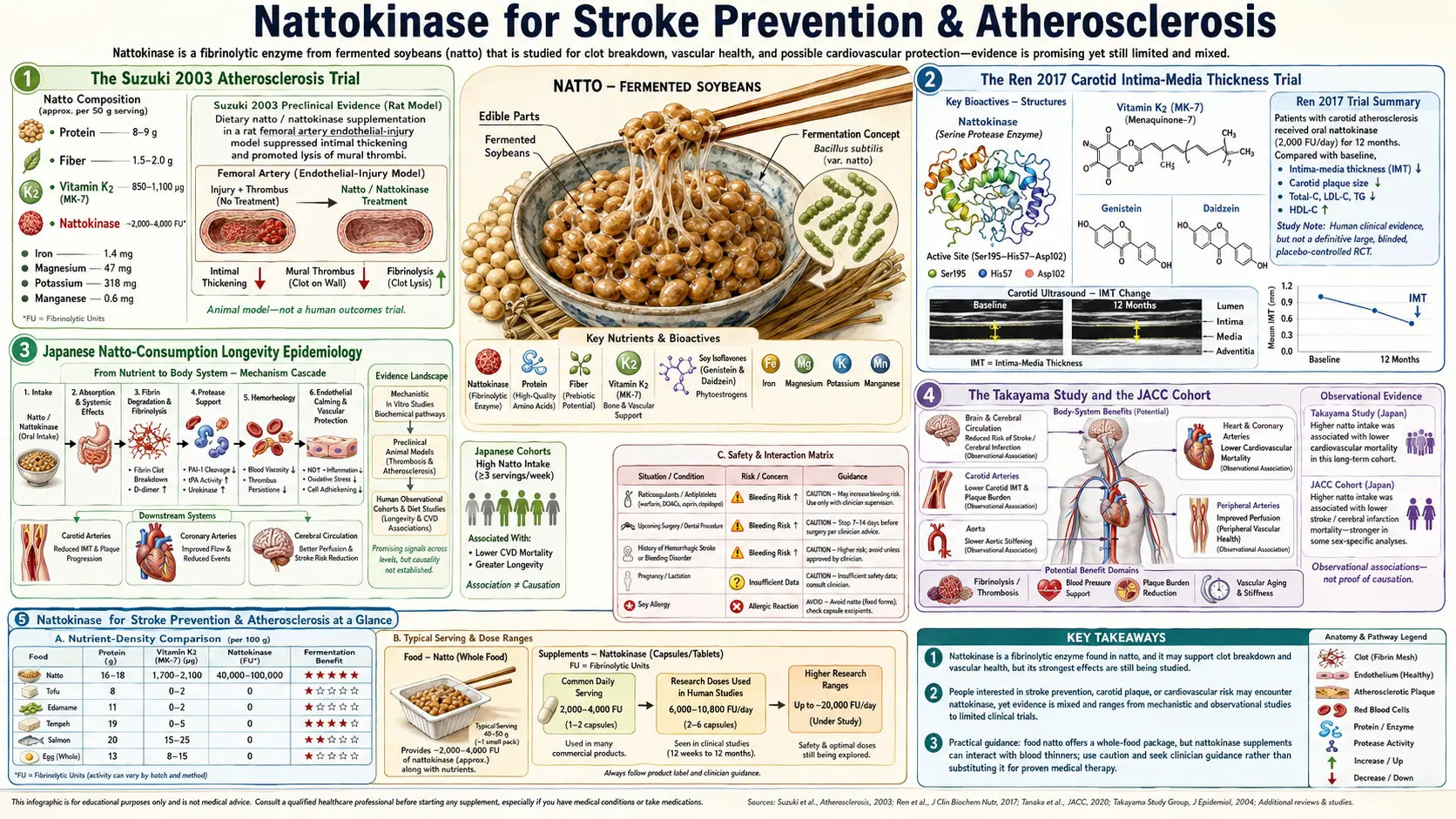
The case for nattokinase in stroke prevention rests on three converging lines of evidence: a rat artery-injury study (Suzuki 2003) and one small randomized comparison with a statin (Ren 2017) showing reduced artery-wall thickening and carotid plaque size; large Japanese prospective epidemiologic cohorts (the Takayama study and the Japan Public Health Center-based Prospective Study) linking higher natto consumption with lower cardiovascular mortality, and in the Takayama study lower stroke mortality; and a sustained-fibrinolysis mechanism that addresses one of the principal contributors to ischemic stroke (thrombus formation on atherosclerotic plaques). Against these, the largest and longest nattokinase trial so far (NAPS, 2021) found no effect on artery-wall thickening over a median of 3 years in healthy older adults. Since 2021 a separate controversy has emerged around claims that nattokinase can dissolve "spike protein clots" in post-COVID and post-vaccine patients — some practitioners and commentators have promoted high-dose nattokinase protocols for this indication, while mainstream regulatory and academic positions remain skeptical of both the underlying premise (the existence and clinical relevance of large amounts of persistent spike-protein-driven fibrinaloid microclots in symptomatic post-acute patients) and of the intervention. This deep-dive presents both the supportive evidence and the unresolved controversies honestly, and sets out what the research reports for primary and secondary stroke prevention.
Table of Contents
- The Suzuki 2003 Rat Artery-Injury Study
- The Ren 2017 Carotid Intima-Media Thickness Trial
- Japanese Natto-Consumption Longevity Epidemiology
- The Takayama Study and the JPHC Cohort
- Ischemic vs. Hemorrhagic Stroke — Mechanism and Risk
- The Post-COVID Spike-Protein-Fibrin Controversy
- Practitioner Protocol Claims (Contested)
- The Regulatory and Academic Counter-Position
- Where the Honest Uncertainty Lies
- Primary vs. Secondary Stroke Prevention — What the Research Reports
- Cautions, Bleeding Risk, and Hemorrhagic Stroke Contraindication
- Key Research Papers
- Connections
- Featured Videos
The Suzuki 2003 Rat Artery-Injury Study
The Suzuki 2003 paper in Life Sciences is the foundational animal study linking natto to atherosclerosis-relevant changes. It was done entirely in rats; it had no human component.
- Animal model: the inner lining of the rat femoral artery was injured by an injected dye (rose bengal) activated by green light shone into the vessel. Rats were fed a natto extract containing nattokinase (50 or 100 CU, units of enzyme activity, per animal) from 3 weeks before the injury until 3 weeks after it, or no extract.
- Results: thickening of the artery's inner layer was significantly suppressed in the natto-fed rats — the intima/media ratio was 0.09 in both natto groups against 0.16 in the controls. Mural thrombi (clots stuck to the vessel wall) formed in every group, but in the nattokinase groups the clots near the vessel wall showed breakdown and most had come away from the wall.
The Suzuki paper established, in an animal model, the proof-of-principle that dietary natto extract affects atherosclerosis-relevant endpoints. The authors suggested the effects may partly be due to nattokinase, which showed enhanced clot breakdown (fibrinolysis) near the vessel wall. The paper is small, exploratory, and far from definitive — but it set the agenda for the subsequent two decades of nattokinase atherosclerosis research.
The Ren 2017 Carotid Intima-Media Thickness Trial
The Ren 2017 trial published in Zhonghua Yi Xue Za Zhi (the National Medical Journal of China) is a randomized clinical study comparing nattokinase with a statin for carotid atherosclerosis. Design and results:
- Population: 82 adults with carotid atherosclerosis and hyperlipidaemia, documented by carotid ultrasound showing measurable intimal-medial thickness (CIMT > 1.0 mm) and plaque burden; 76 completed the study (39 nattokinase, 37 simvastatin).
- Design: Randomized to 6,000 fibrinolytic units (FU) a day of nattokinase or to 20 mg/day simvastatin (a standard low-dose statin) for 26 weeks. There were two arms and no placebo group.
- Endpoints: Carotid intima-media thickness (CIMT) measured by ultrasound at baseline and 26 weeks; carotid plaque size and morphology; lipid profile.
Results:
- Carotid plaque size fell in both groups. In the nattokinase group plaque area fell from 0.25 to 0.16 cm², a 36.6% reduction, compared with 11.5% in the simvastatin group.
- CIMT fell in both groups; in the nattokinase group the common carotid intima-media thickness fell from 1.13 to 1.01 mm. The reductions in plaque size and CIMT were significantly greater with nattokinase than with simvastatin (P<0.01). The study was not designed as a non-inferiority trial.
- Lipid profile improved in both arms: both lowered total cholesterol, low-density lipoprotein (LDL) cholesterol and triglycerides, but simvastatin lowered all three significantly more, triglycerides included. Nattokinase alone raised high-density lipoprotein (HDL) cholesterol. The lipid changes in the nattokinase group did not track the fall in artery thickness.
- Safety: the published abstract does not report adverse events.
The Ren trial is notable as the first head-to-head trial comparing nattokinase to a statin for an atherosclerosis endpoint. The result was a positive signal favoring nattokinase over simvastatin for the plaque-burden endpoint, though replication in larger populations is needed before this can be considered established. The mechanism proposed includes plaque-fibrin dissolution (reducing intra-plaque fibrin accumulation), reduced low-density lipoprotein oxidation, and improved endothelial function.
It is important to interpret this trial with appropriate caution — the population was Chinese, the trial was relatively small, and the imaging-based endpoint (CIMT, plaque size) is a surrogate marker for clinical events rather than the events themselves. It is also not the largest trial. The Nattokinase Atherothrombotic Prevention Study (NAPS, Hodis 2021), a double-blind trial, gave 265 people of median age 65 with no cardiovascular disease either 2,000 FU of nattokinase a day or a matching placebo. After a median of 3 years, the yearly rate of change in carotid intima-media thickness and carotid artery stiffness did not differ between the groups, and nattokinase had no significant effect on blood pressure or on any laboratory measure, including clotting, clot-breakdown and inflammation markers. The authors concluded that nattokinase had a null effect on the progression of early atherosclerosis in healthy people at low cardiovascular risk.
Japanese Natto-Consumption Longevity Epidemiology
Japan has one of the world's longest life expectancies and one of the lowest age-adjusted cardiovascular and stroke mortality rates among developed countries. This has been observed for decades and is partially attributed to genetic factors, partially to traditional dietary patterns including high fish/omega-3 intake and lower red meat consumption, and partially to lifestyle factors. In recent decades, attention has focused on whether traditional fermented foods including natto contribute to this cardiovascular longevity, on the theory that:
- Natto is uniquely high in two cardiovascular-relevant bioactive compounds: nattokinase (fibrinolytic enzyme) and vitamin K2 menaquinone-7 (which regulates arterial calcification via matrix Gla protein, see the vitamin K2 connection deep-dive)
- Regional variation within Japan in natto consumption — eastern Japan eats much more natto than western Japan — corresponds to regional variation in cardiovascular event rates
- Prospective cohort studies within Japan can quantify the association between natto consumption and cardiovascular endpoints while controlling for other dietary and lifestyle variables
The principal studies are the Takayama Study, the Japan Public Health Center-based Prospective Study (JPHC), and the Kaneki 2001 paper on circulating vitamin K2 differences. The two cohort studies are described in more detail below.
The Takayama Study and the JPHC Cohort
The Takayama Study (Nagata 2017) is a prospective cohort of 13,355 Japanese men and 15,724 women from Takayama City, followed from 1992 onward with detailed dietary questionnaires at baseline and outcome ascertainment through national death registries. Key findings on natto consumption:
- Higher natto consumption (highest vs. lowest quartile) was associated with approximately 25% lower cardiovascular mortality over the ~16-year follow-up period
- The association persisted after adjustment for total soy intake, total energy intake, smoking, alcohol, physical activity, hypertension status, diabetes status, body mass index (BMI), and other potential confounders
- The stroke-specific mortality reduction was approximately 32%
- The effect appeared to be specific to natto rather than general to soy — tofu and miso did not show the same magnitude of cardiovascular protection
The JPHC Study (Japan Public Health Center-based Prospective Study; Katagiri 2020, BMJ) followed 92,915 Japanese adults aged 45 to 74 for 14.8 years. Total soy intake was not linked to total mortality, but people eating the most fermented soy (natto and miso) had about 10% lower death rates from all causes than those eating the least (hazard ratio 0.90 in men, 0.89 in women), and natto was linked to lower cardiovascular death in both men and women. The authors cautioned that the link with fermented soy might be weakened by confounding they could not adjust for.
These prospective observational data are reasonably strong epidemiologic evidence for a natto-cardiovascular protection association in the Japanese population. They do NOT prove causation — observational data never can, and unmeasured confounding by socioeconomic, regional-cultural, or healthy-eater-bias variables cannot be fully excluded. But the consistency of the findings across multiple cohorts, the dose-response relationship, and the biological plausibility based on the nattokinase + vitamin K2 dual mechanism makes the inference of causal contribution reasonable.
It is important to note that the protective effect documented in these cohorts is from natto-the-food (which delivers both nattokinase AND vitamin K2 MK-7 AND fermented soy peptides AND fiber AND other unidentified bioactives), not from isolated nattokinase supplements. Whether isolated nattokinase capsule supplementation produces the same magnitude of cardiovascular benefit in Western populations who do not eat natto as a daily food is not directly addressed by these data.
Ischemic vs. Hemorrhagic Stroke — Mechanism and Risk
The distinction between ischemic and hemorrhagic stroke is crucial for any discussion of nattokinase in stroke prevention because the two stroke subtypes have fundamentally different pathophysiology and the intervention has opposite effects on each:
- Ischemic stroke (~87% of all strokes in the US) is caused by obstruction of arterial blood flow to the brain, most commonly by a thrombus or thromboembolus. Atrial fibrillation, large-vessel atherosclerosis, small-vessel disease, and patent foramen ovale with paradoxical embolism are the leading mechanisms. Nattokinase's fibrinolytic activity is mechanistically protective against this stroke subtype.
- Hemorrhagic stroke (~13% of all strokes in the US) is caused by rupture of an intracranial blood vessel, most commonly from chronic hypertension-driven small-vessel damage (intracerebral hemorrhage) or from cerebral aneurysm rupture (subarachnoid hemorrhage). Nattokinase's fibrinolytic activity is mechanistically HARMFUL in this stroke subtype — it would further impair the body's ability to clot off the rupture site.
The clinical implication drawn from the mechanism: nattokinase works in the protective direction for the dominant ischemic stroke subtype and is regarded as contraindicated after a hemorrhagic stroke — a personal history of intracerebral hemorrhage or subarachnoid hemorrhage is listed as a permanent contraindication. People with poorly controlled hypertension are at elevated risk of hemorrhagic stroke. A case report of a brain bleed in a man taking nattokinase with aspirin is described under Cautions below.
The Japanese natto-consumption epidemiology shows reduction in both ischemic AND overall stroke mortality, which suggests that the population-level protective effect (mediated by the food natto in its long-term dietary context) outweighs any potential hemorrhagic-stroke risk in healthy adults. These food data do not tell us about high-dose isolated nattokinase supplements in people with hypertension or fragile brain blood vessels.
For more on stroke mechanisms and risk assessment, see our pages on Hypertension and Atherosclerosis.
The Post-COVID Spike-Protein-Fibrin Controversy
Since 2021 a substantial parallel discussion has emerged around the use of nattokinase for what is variously called "post-COVID syndrome," "long COVID," "post-vaccine syndrome," "spike-protein-induced illness," or "microclot disease." This discussion has played out largely outside the conventional medical literature, in podcasts, integrative-medicine practices, telemedicine clinics, and supplement industry promotional materials, with periodic crossover into mainstream attention via specific advocates.
The clinical premise of the discussion, as articulated by its principal advocates, is roughly:
- SARS-CoV-2 spike protein has been demonstrated (in some published reports, notably the Pretorius and Kell laboratory at Stellenbosch University) to bind fibrinogen and induce the formation of unusually resistant "fibrinaloid microclots" in plasma
- These microclots may persist in symptomatic post-acute COVID and post-vaccination patients and contribute to symptoms including fatigue, cognitive dysfunction, exercise intolerance, and microvascular ischemic phenomena
- Standard fibrinolytic mechanisms (endogenous plasmin) may be ineffective at clearing these unusual fibrinaloid structures
- High-dose orally-administered nattokinase, possibly in combination with other proteolytic enzymes (serrapeptase, lumbrokinase) and antiplatelet agents, may dissolve these microclots and improve symptoms
This is a contested set of claims at multiple levels. The advocates' position is presented in this section; the regulatory/academic counter-position is presented in the section after this. The honest summary is that some elements of the underlying scientific framework have peer-reviewed support, other elements are speculative, and the specific therapeutic recommendation (high-dose nattokinase for these patients) does not yet have randomized controlled trial evidence either supporting or refuting it.
Practitioner Protocol Claims (Contested)
Several physicians and integrative-medicine practitioners have published or promoted specific nattokinase-containing protocols for post-COVID or post-vaccination symptomatology. These include:
- One widely shared "post-COVID spike protein detox" protocol — nattokinase 2,000 FU twice daily, bromelain 500 mg twice daily, and curcumin 500 mg twice daily, with a recommended duration of three months, circulated through podcasts, books, and conference talks. A 2023 review in Cureus set out a “base spike detoxification protocol” of oral nattokinase, bromelain and curcumin, and its authors wrote that large randomized, double-blind, placebo-controlled trials are needed to determine its risks and benefits. The protocol has not been validated in a randomized controlled trial.
- Chelation-based detox protocols — some practitioners combine nattokinase with EDTA (a chelating agent), pine-needle tea, and other components, both for general detoxification and specifically for post-vaccination symptoms. Neither the underlying premises nor the combined interventions have been tested in controlled trials.
- Functional-medicine protocols — some practitioners integrate nattokinase into broader protocols for chronic illness recovery.
- Broader post-vaccination protocols — other practitioners include nattokinase as one component among several.
The arguments offered in support of these protocols include the Pretorius laboratory's published findings on spike-protein-fibrinogen interaction and microclot formation, case-series reports of symptomatic improvement in patients treated with these protocols, and the established fibrinolytic mechanism of nattokinase. The arguments are biologically coherent in the sense that "if persistent microclots exist and contribute to symptoms, and if oral nattokinase can dissolve them, then nattokinase treatment should help."
The honest framing is that neither premise is established at the level of evidence that would normally precede a confident clinical recommendation. The Pretorius microclot work is real but contested; the clinical significance of the laboratory finding is not yet established; the efficacy of oral nattokinase for clearing such structures is plausible but not demonstrated in controlled trials.
For more on one practitioner's broader detox protocol framework, see Detox and Recovery.
The Regulatory and Academic Counter-Position
The mainstream regulatory and academic position on nattokinase for post-COVID or post-vaccination indications is generally skeptical. The principal points of skepticism include:
- The clinical relevance of fibrinaloid microclots in symptomatic post-acute patients is not established. While the Pretorius laboratory has published findings of unusual microclots in plasma, the relationship between these structures and patient symptoms is correlative rather than causal, the methodological reproducibility across other laboratories has been mixed, and the magnitude of the burden of such structures in typical symptomatic patients (vs. asymptomatic controls) is not consistently established.
- No randomized controlled trial has tested nattokinase for post-COVID or post-vaccination symptomatology. The supportive evidence is case series, individual patient anecdotes, and mechanistic reasoning. This evidence is suggestive but not definitive.
- The safety profile of high-dose nattokinase combined with other proteolytic enzymes and aspirin (as some of these protocols recommend) is not well-characterized. Bleeding risk is a real concern.
- Confirmation bias and placebo effect are particularly hard to exclude in a symptomatic patient population with high motivation to feel better and high financial commitment to a chosen treatment protocol.
The mainstream position is therefore that nattokinase for post-COVID or post-vaccination indications is an unproven intervention based on partially-validated underlying premises, and that the safety profile is generally acceptable in healthy adults but has real bleeding risks, particularly in combination protocols.
Where the Honest Uncertainty Lies
The post-COVID-microclot-nattokinase controversy remains open because the underlying scientific questions are genuinely unresolved. The honest summary of what is and isn't established:
What appears reasonably established:
- Nattokinase has documented fibrinolytic activity in vitro and modest pharmacodynamic effects in vivo after oral administration
- Nattokinase has a generally acceptable safety profile in healthy adults at standard doses (2,000–4,000 FU/day) when not combined with anticoagulants or antiplatelet drugs
- The Pretorius laboratory's findings on spike-protein-fibrinogen interaction in vitro have been published in peer-reviewed journals
- Some post-acute COVID patients have demonstrable hematologic and inflammatory abnormalities that may contribute to symptomatology
What remains genuinely uncertain:
- The clinical significance of fibrinaloid microclots in typical post-acute COVID patients
- Whether oral nattokinase achieves systemic concentrations sufficient to dissolve such structures in vivo
- Whether the symptomatic improvement reported in case series is attributable to nattokinase specifically or to other components of typical multi-intervention protocols or to natural recovery over time
- The magnitude of net clinical benefit vs. bleeding risk for high-dose combination protocols
What is clearly unsupported:
- Claims that nattokinase can "detox" or "remove" spike protein from the body in any straightforward biochemical sense. The only direct evidence is a 2022 laboratory study in which nattokinase broke down spike protein in cell lysates and on the surface of cultured cells (Tanikawa 2022); it has not been measured in people. How long spike protein persists is itself disputed: the 2023 review that proposed the nattokinase-bromelain-curcumin protocol reports spike protein detected for at least 6–15 months after vaccination and infection in people with post-acute symptoms.
- Claims that nattokinase is a substitute for medically-indicated treatment of established cardiovascular disease, stroke, or thromboembolism
- Claims that nattokinase produces dramatic and immediate symptomatic improvement — the documented effects are modest and develop over weeks to months
Primary vs. Secondary Stroke Prevention — What the Research Reports
On the question of where nattokinase sits in stroke prevention, the evidence lines up much as it does for cardiovascular prevention generally:
- Primary prevention in healthy adults with no atherosclerotic disease and low calculated cardiovascular risk. This is the group the NAPS trial studied: 2,000 FU/day for a median of 3 years made no difference to carotid wall thickening, artery stiffness or blood pressure compared with placebo. The risk/benefit calculation is similar to the question of low-dose aspirin in primary prevention — both have shifted toward "probably not routinely warranted" in recent years, with consideration for individual risk factors.
- Primary prevention in adults with elevated cardiovascular risk (Framingham 10-year ≥10%, atherosclerotic cardiovascular disease (ASCVD) 10-year risk ≥7.5%) but no established disease. The established measures for this group are lifestyle change, a statin (when indicated by ApoB and low-density lipoprotein), blood pressure control and other risk-factor management. Nattokinase has not been tested against clinical events in this group and has not been shown to replace any of these.
- Secondary prevention after established cardiovascular disease (after a heart attack (myocardial infarction), after a stroke, or with established coronary artery disease). Antiplatelet therapy (aspirin, clopidogrel) is evidence-based and life-saving, and nattokinase has not been tested as a substitute for it. Combining the two adds to bleeding risk: the case report under Cautions describes a cerebellar bleed in a man on aspirin after 7 days of nattokinase.
- Atrial fibrillation with elevated stroke risk (CHA₂DS₂-VASc score ≥ 2). Warfarin or a direct oral anticoagulant (DOAC) is the standard of care. Nattokinase has not been tested as a substitute for either.
- Post-hemorrhagic-stroke patients. Listed as a permanent contraindication, because of the bleeding mechanism described above.
A 2026 randomized, double-blind trial from China (Zhang 2026) gave 120 people with narrowed brain or neck arteries but no symptoms (asymptomatic intracranial or carotid stenosis; average age 58) either 8,000 FU of nattokinase a day or a placebo for 6 months; 88 took the capsules as required and completed follow-up. Overall memory-and-thinking scores (the Montreal Cognitive Assessment) did not differ between the groups. In an exploratory analysis, one sub-score — visuospatial function, the ability to judge shapes and space — declined less often in the nattokinase group.
The profile usually described for nattokinase use in prevention: a 50–70 year old with a family history of cardiovascular disease and one or two modifiable risk factors (mildly elevated blood pressure (BP), mildly elevated lipids, modest weight excess), no established cardiovascular or cerebrovascular disease, normal coagulation, not on any anticoagulant or antiplatelet medication, already making lifestyle changes, who wants an additional layer of pro-fibrinolytic and pro-cardiovascular support. The doses given in human trials were 2,000 FU/day for a median of 3 years (NAPS, healthy older adults, no effect on carotid wall thickening), 6,000 FU/day for 26 weeks (Ren 2017, compared with simvastatin) and 8,000 FU/day for 6 months (Zhang 2026, people with artery narrowing).
Cautions, Bleeding Risk, and Hemorrhagic Stroke Contraindication
- Personal history of hemorrhagic stroke (intracerebral hemorrhage or subarachnoid hemorrhage). Listed as a permanent contraindication: nattokinase breaks down fibrin, which works against the clotting that seals a ruptured vessel.
- Personal history of cerebral aneurysm or arteriovenous malformation. Regarded as a contraindication unless the lesion has been definitively treated and bleeding risk has normalized.
- Severe or poorly-controlled hypertension (>160/100 mmHg). Uncontrolled high blood pressure is itself a leading cause of hemorrhagic stroke, and a clot-dissolving supplement adds to that hemorrhagic stroke risk.
- Active anticoagulation (warfarin, apixaban, rivaroxaban, edoxaban, dabigatran) — nattokinase adds its own fibrin-dissolving action to the drug's anticlotting effect, which raises bleeding risk.
- Active antiplatelet therapy (aspirin, clopidogrel, ticagrelor, prasugrel) — the same concern. A 2008 case report (Chang 2008) describes a man taking aspirin after an earlier stroke who developed a bleed in the cerebellum (the back of the brain) after taking nattokinase 400 mg a day for 7 days; brain scans also showed many small old bleeds (cerebral microbleeds). The authors suggested nattokinase may raise the risk of bleeding inside the brain in people with bleeding-prone small brain vessels who take another anticlotting drug at the same time.
- Active bleeding disorders (hemophilia, von Willebrand disease, thrombocytopenia < 100k).
- Recent or planned surgery, dental extraction, or invasive procedure. Stopping at least 7 days before is the interval commonly given.
- Pregnancy and lactation. There is insufficient safety data.
- High-dose combination protocols (e.g., nattokinase + serrapeptase + lumbrokinase + bromelain + aspirin simultaneously) have not been well-characterized for safety and have higher cumulative bleeding risk than nattokinase alone.
- Soy allergy. Natto is a soybean food; preparations verified as soy-free are the ones relevant to people with soy allergy.
For more on related cardiovascular and cerebrovascular considerations, see Hypertension, Atherosclerosis, and Deep Vein Thrombosis.
Key Research Papers
- Suzuki Y et al. (2003). Dietary supplementation of fermented soybean, natto, suppresses intimal thickening and modulates the lysis of mural thrombi after endothelial injury in rat femoral artery. Life Sciences. — PubMed PMID: 12850244
- Ren NN et al. (2017). A clinical study on the effect of nattokinase on carotid artery atherosclerosis and hyperlipidaemia. Zhonghua Yi Xue Za Zhi. — PubMed PMID: 28763875
- Nagata C et al. (2017). Dietary soy and natto intake and cardiovascular disease mortality in Japanese adults: the Takayama study. Am J Clin Nutr. — PubMed PMID: 27927636
- Katagiri R et al. (2020). Association of soy and fermented soy product intake with total and cause specific mortality: prospective cohort study. BMJ. — PubMed PMID: 31996350
- Hodis HN et al. (2021). Nattokinase atherothrombotic prevention study: A randomized controlled trial. Clin Hemorheol Microcirc. — PubMed PMID: 33843667
- Zhang K et al. (2026). Nattokinase supplementation for cognitive enhancement in asymptomatic intracranial/carotid stenosis: A randomized controlled trial. J Stroke Cerebrovasc Dis. — PubMed PMID: 41325794
- Chang YY et al. (2008). Cerebellar hemorrhage provoked by combined use of nattokinase and aspirin in a patient with cerebral microbleeds. Intern Med. — PubMed PMID: 18310985
- Chen H et al. (2018). Nattokinase: a promising alternative in prevention and treatment of cardiovascular diseases. Biomark Insights. — PubMed PMID: 30013308
- Pretorius E et al. (2021). Persistent clotting protein pathology in long COVID/post-acute sequelae of COVID-19. Cardiovasc Diabetol. — PubMed PMID: 34425843
- Grobbelaar LM et al. (2021). SARS-CoV-2 spike protein S1 induces fibrin(ogen) resistant to fibrinolysis. Biosci Rep. — PubMed PMID: 34328172
- Kell DB, Pretorius E (2022). The potential role of ischaemia-reperfusion injury in chronic, relapsing diseases such as rheumatoid arthritis, Long COVID, and ME/CFS: evidence, mechanisms, and therapeutic implications. Biochem J. — PubMed PMID: 36043493
- Tanikawa T et al. (2022). Degradative Effect of Nattokinase on Spike Protein of SARS-CoV-2. Molecules. — PubMed PMID: 36080170
- Hulscher N et al. (2023). Clinical Approach to Post-acute Sequelae After COVID-19 Infection and Vaccination. Cureus. — PubMed PMID: 38024037
PubMed Topic Searches
Connections
- All Food
- Nattokinase Overview
- Nattokinase Benefits Hub
- Cardiovascular & Fibrinolysis
- Blood Pressure
- Vitamin K2 (Menaquinone-7) Connection
- Atherosclerosis
- Hypertension
- Deep Vein Thrombosis
- Natto (Food)
- Vitamin K
- Coronary Calcium Score
- Coagulation Panel
- ApoB
- Lipid Panel
- Aspirin
- Detox and Recovery
- Omega-3 Fatty Acids
- History