Vitamin K, Warfarin and Drug Interactions
If you take warfarin, somebody has almost certainly told you to avoid Brussels sprouts. That advice is well meant and it is wrong, and the correct version is not a minor refinement — it points in close to the opposite direction. The best available evidence says that patients whose anticoagulation is unstable eat less vitamin K than patients whose control is stable, and that giving unstable patients a small daily dose of vitamin K makes their international normalized ratio (INR) steadier rather than harder to manage. What destabilises warfarin is not vitamin K; it is variability in vitamin K. This page explains why, with the trials attached, and then covers the second and much less discussed interaction — the fact that Brussels sprouts measurably change how the liver processes certain drugs.
Table of Contents
- How Much Vitamin K Is in a Brussels Sprout
- What Vitamin K Actually Does
- How Warfarin Works, and Why Food Matters
- Consistency, Not Avoidance
- The Evidence for Consistency
- What a Big Plate of Sprouts Actually Does to an International Normalized Ratio
- What the Consistency Findings Mean for Warfarin Users
- If You Take a Direct Oral Anticoagulant (DOAC) Instead
- The Other Interaction: Sprouts and Drug Metabolism
- Who These Interactions Matter For
- And If You Take Nothing at All
- Key Research Papers
- Connections
- Featured Videos
How Much Vitamin K Is in a Brussels Sprout
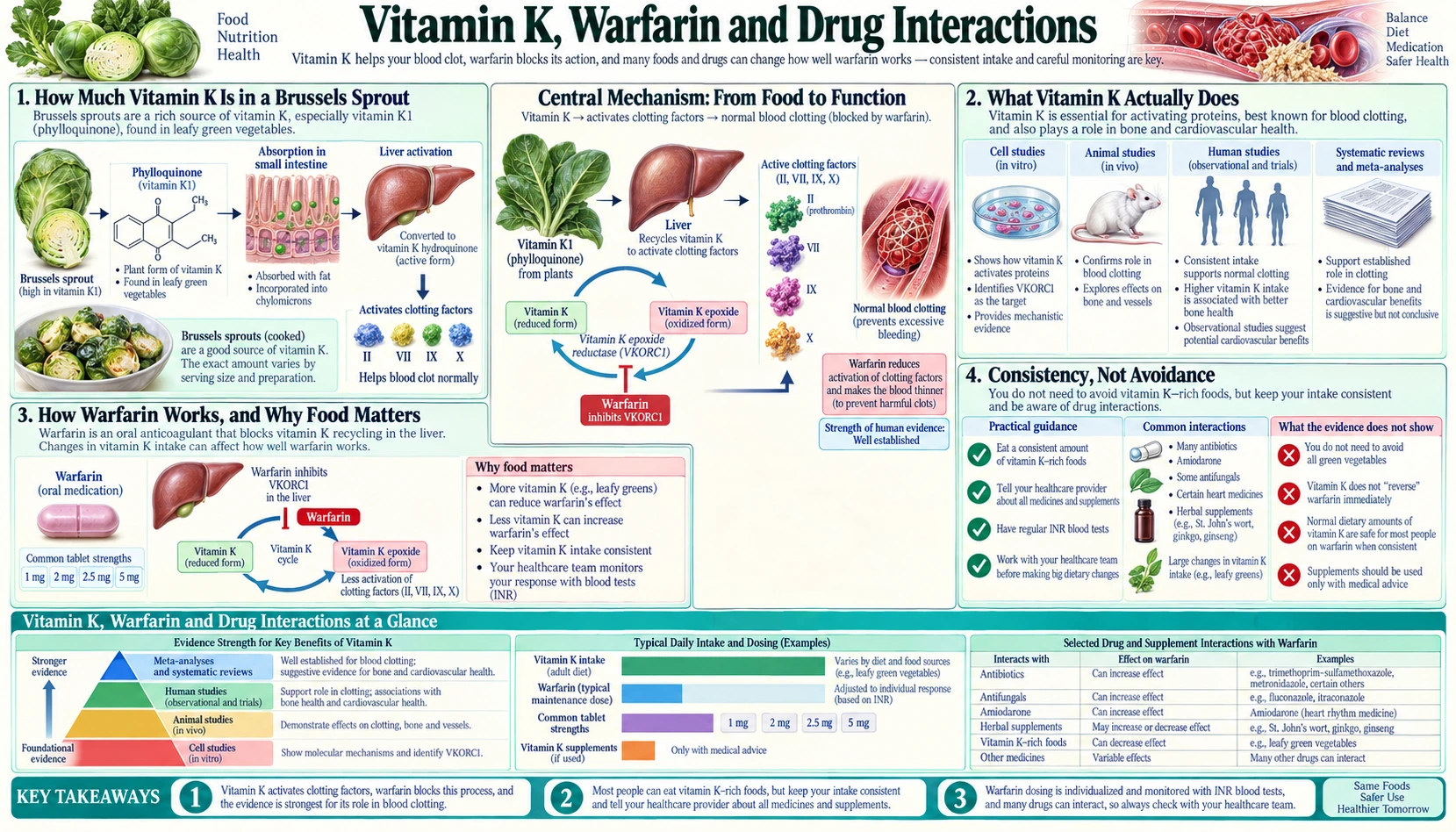
Brussels sprouts are one of the richest common sources of phylloquinone — vitamin K1, the plant form. Using the United States Department of Agriculture reference values, raw sprouts carry roughly 175 micrograms per 100 grams and boiled sprouts around 140 micrograms per 100 grams. A cup of cooked sprouts, about 155 grams, therefore delivers somewhere in the region of 200 micrograms.
For scale, the adequate intake for vitamin K in the United States is 120 micrograms a day for adult men and 90 for adult women. One cup of cooked sprouts is roughly double that. A side dish of sprouts comfortably meets the day's requirement from one vegetable.
It is worth being accurate about the ranking, because “the highest vitamin K vegetable” gets said a lot and is not quite true. Dark leafy greens beat sprouts substantially: raw spinach, kale and collard greens all carry considerably more per 100 grams. Sprouts sit in the tier just below — well above broccoli and far above cabbage — and they matter disproportionately because a serving of sprouts is heavier and more calorie-dense than a serving of raw leaves, so a realistic portion delivers a lot. The compositional work behind these numbers is Booth and colleagues' provisional vitamin K1 food table and the later vegetable-specific analysis by Damon, Zhang, Haytowitz and Booth.
Two practical notes. Vitamin K is fat-soluble and reasonably heat-stable, so roasting sprouts in oil does not destroy the vitamin — if anything the added fat improves absorption. And boiling reduces the concentration modestly, mostly through water uptake rather than destruction, so you cannot cook the vitamin K out of a sprout.
What Vitamin K Actually Does
Vitamin K is a cofactor for a single chemical reaction, performed by a single enzyme, on a specific set of proteins. The enzyme, gamma-glutamyl carboxylase, adds a carboxyl group to particular glutamate residues, converting them to gamma-carboxyglutamate — Gla — residues. A Gla residue can grip calcium ions, and gripping calcium is what makes these proteins work.
The proteins that need this treatment fall into two groups:
- Clotting factors — prothrombin (factor II) and factors VII, IX and X, plus the anticoagulant proteins C and S. Without carboxylation they are secreted in a form that cannot assemble on a membrane surface and cannot function, and blood does not clot properly.
- Calcium-handling proteins outside the blood — osteocalcin in bone, and matrix Gla protein in arteries and cartilage. Matrix Gla protein is the more interesting one: in its carboxylated form it actively inhibits calcification of soft tissue, which is why vitamin K status has become a topic in arterial health rather than only in clotting. The wider picture, including the bacterial and animal menaquinone forms, is on the vitamin K page and the vitamin K2 page.
The critical piece of chemistry for what follows: every time the carboxylase does its job, the vitamin K is oxidised to vitamin K epoxide, and it must be recycled back to the active form before it can be used again. The body carries only a small pool of vitamin K and depends heavily on this recycling loop.
How Warfarin Works, and Why Food Matters
Warfarin blocks the recycling enzyme, vitamin K epoxide reductase. With the loop broken, the small pool of active vitamin K is consumed and not replaced, the carboxylase runs out of cofactor, and the liver starts producing clotting factors that do not work. The international normalized ratio — the standardised measure of how long blood takes to clot — rises. Warfarin is not destroying anything; it is starving one reaction of its recycled cofactor.
That is exactly why dietary vitamin K matters. Vitamin K arriving from food enters the pool through a route warfarin does not block, partially restoring the carboxylase's supply. More dietary vitamin K pushes the international normalized ratio down; less pushes it up. The relationship is real, direct, and the reason the interaction exists at all.
Here is the step almost everybody skips. Because the effect depends on the size of the pool relative to the change, the same absolute swing in vitamin K intake matters far more to someone whose baseline intake is small. If you habitually eat 30 micrograms a day and then eat a plate of sprouts, you have multiplied your intake several-fold and your international normalized ratio will notice. If you habitually eat 150 micrograms a day, that same plate is a much smaller proportional change and the international normalized ratio barely moves. The person who avoids all green vegetables to protect their international normalized ratio has made themselves maximally sensitive to every accidental exposure.
Consistency, Not Avoidance
The pattern that follows from the biology, and that the studies below describe, is short:
Patients with a steady, adequate vitamin K intake had steadier control; a low intake and large swings in intake are what the studies link to instability, and none of them supports avoiding vitamin K.
Practically, that means Brussels sprouts are not forbidden on warfarin. The patterns that push an international normalized ratio around are eating none for three weeks and then having them every day over a holiday, starting a green-smoothie habit without telling the clinic, or cutting out all vegetables after a high international normalized ratio reading. Each of those is a large, sudden change in the input, and large sudden changes are what push an international normalized ratio out of range.
This reframing also removes a real harm that the avoidance advice causes. People on long-term warfarin are typically older, often with cardiovascular disease, and telling them to avoid the entire green-vegetable category costs them fibre, folate, potassium, carotenoids and the rest of what those foods carry. That is a bad trade for a rule that does not achieve its aim.
The Evidence for Consistency
Four studies carry most of the weight, and they are worth knowing individually because their findings are more specific than the summary above.
- Sconce and colleagues, 2005, Newcastle. Twenty-six warfarin patients with unstable anticoagulation control and twenty-six with stable control kept detailed diet records for two consecutive weeks. Mean daily vitamin K intake was 29 ± 17 micrograms in the unstable group and 76 ± 40 micrograms in the stable group — the unstable patients were eating less than half as much. Changes in vitamin K intake between week 1 and week 2 were negatively correlated with changes in the international normalized ratio among the unstable patients, but this failed to reach significance (r = −0.25; p = 0.22). The authors suggested that daily vitamin K supplementation might stabilise these patients, which is the opposite of what avoidance advice predicts.
- Sconce and colleagues, Blood, 2007. The same group tested that hypothesis properly. Seventy warfarin-treated patients with unstable control were randomised, double-blind, to 150 micrograms of oral vitamin K daily or placebo for six months. The vitamin K group showed a significantly greater fall in the standard deviation of their international normalized ratio and a significantly greater increase in time within the target range — a gain of about 28 percentage points versus about 15 in the placebo group. Anticoagulation control improved in 33 of 35 patients given vitamin K, and 19 of those met the study's criteria for stable control.
- Rombouts, Rosendaal and van der Meer, 2007 and 2010, Leiden. A double-blind randomised trial in 2007 gave 200 patients of the Leiden anticoagulation clinic, who took the vitamin K antagonist phenprocoumon rather than warfarin, either 100 micrograms of vitamin K once daily or placebo for 24 weeks. Its primary outcome, the percentage of time in the therapeutic range, was 89.5% with vitamin K and 85.5% with placebo (adjusted difference 3.6%; 95% confidence interval −0.8% to 8.0%), so the primary outcome did not reach statistical significance; the relative risk of maximal stability with vitamin K was 1.8 (95% confidence interval 1.1–2.7), and the authors concluded that the supplement improves stability. A nested case-control study in 2010 examined subtherapeutic international normalized ratio values in a Dutch anticoagulation clinic and found differences that were not statistically significant: compared with patients with a normal usual vitamin K intake, those with a high usual intake had a hazard ratio for a subtherapeutic international normalized ratio of 0.80 (95% confidence interval 0.56–1.16), and those with a low usual intake 1.33 (95% confidence interval 0.79–2.25). The mechanistic detail is the striking part: among patients whose usual intake was low, recent vitamin K intake was roughly twice as high in the cases as in the controls — 164 against 85 micrograms a day. Among patients whose usual intake was normal or high, no such difference appeared. In other words, a decent habitual intake buffers you against the occasional big green meal. The authors wrote that their findings support the recommendation for patients on vitamin K antagonists to eat a sufficient amount of vitamin-K-containing foods.
- Couris and colleagues, 2006, and Violi and colleagues, 2016. Couris and colleagues documented that variability in dietary vitamin K affects international normalized ratio indices: among 43 patients who had just started warfarin and completed five weeks of daily food records (60 were enrolled), a weekly change of 714 micrograms of dietary vitamin K altered the weekly international normalized ratio by 1 unit after adjustment for age, sex, weight, height and medicines known to interact with warfarin. Violi and colleagues reviewed the interaction between dietary vitamin K intake and anticoagulation by vitamin K antagonists across the literature. Both support the same conclusion: it is the variance, not the mean, that does the damage.
A note on how strong to call this. These are small studies from a handful of centres. The 2014 Cochrane systematic review of low-dose vitamin K for anticoagulation control in warfarin patients found only two trials, with 100 participants in total: one (70 participants) showed a significant improvement, while the smaller one (30 participants, published only in abstract form) suggested no overall benefit. The review's verdict was that “currently, there are insufficient data to suggest an overall benefit.” What is not in dispute is the direction: nothing in this literature supports telling a warfarin patient to avoid vitamin K, and several studies point the other way.
What a Big Plate of Sprouts Actually Does to an International Normalized Ratio
The clearest published illustration is a case report from 1983 in the New England Journal of Medicine, titled simply Warfarin resistance caused by broccoli. A patient's anticoagulation stopped responding adequately to warfarin; the cause turned out to be a large habitual intake of broccoli, and control returned when the vegetable was reduced. It is one patient, it is broccoli rather than sprouts, and it is forty years old — but it is a clean demonstration that a sustained, large intake of a high-vitamin-K vegetable can meaningfully oppose warfarin.
Read carefully, that case supports the consistency rule rather than the avoidance rule. The problem was a change that the dose had not been adjusted for. A patient who eats a similar amount of green vegetables every week has their warfarin dose titrated against that intake, and nothing goes wrong.
For a sense of proportion: a single cup of cooked Brussels sprouts contains roughly the amount of vitamin K that the Newcastle trial gave its patients daily for six months to stabilise them. That is not a dangerous quantity of anything. It is a quantity where consistency is what matters.
What the Consistency Findings Mean for Warfarin Users
- A steady weekly pattern of green vegetables is the easiest to dose against. Two or three servings a week, every week, is much easier to dose against than none for a month and then daily for a fortnight.
- The anticoagulation clinic doses against the diet it knows about. A warfarin dose is titrated to the patient's life, including the diet, and the clinic can only titrate to what it is told.
- Deliberate changes are easiest to manage when the clinic hears of them in advance. Starting a new eating pattern, going away over a holiday season, beginning or stopping a supplement — those are the moments when an extra international normalized ratio check can catch a shift.
- Stripping vegetables out of the diet after a single out-of-range international normalized ratio works against stability. That is the move that creates the low, erratic baseline the Newcastle data associate with instability.
- Multivitamins and green powders count, not just food. Supplements are where the largest unrecorded swings come from, because people do not think of them as vitamin K.
- Other things move an international normalized ratio far more than dinner. Antibiotics, antifungals, amiodarone, some antidepressants, alcohol, illness and diarrhoea all matter. Diet is one input among many and usually not the biggest.
- Changing one's own warfarin dose to compensate for a meal is where do-it-yourself goes badly wrong. Dose changes are the clinic's job.
If You Take a Direct Oral Anticoagulant (DOAC) Instead
The direct oral anticoagulants (DOACs) — apixaban, rivaroxaban, edoxaban and dabigatran — do not work through vitamin K at all. They inhibit factor Xa or thrombin directly. There is no dietary vitamin K interaction with these drugs, and no reason to restrict green vegetables because of them.
This is worth stating plainly because the avoidance advice has a long half-life. People switched from warfarin to a DOAC years ago often carry on avoiding sprouts and spinach, and nobody has told them that the vitamin K interaction does not apply to these drugs. For a DOAC user, sprouts and spinach are ordinary food.
The Other Interaction: Sprouts and Drug Metabolism
The vitamin K story gets all the attention. There is a second, better-documented-than-you-would-expect interaction, and Brussels sprouts are one of the foods it was actually demonstrated with.
In 1979, Pantuck and colleagues published a paper in Clinical Pharmacology & Therapeutics titled Stimulatory effect of brussels sprouts and cabbage on human drug metabolism. Feeding volunteers a diet containing these vegetables increased the rate at which the body processed a test drug — direct evidence that a common vegetable can induce human drug-metabolising enzymes.
The 1984 follow-up is more precise and is the one to quote. Ten healthy subjects were fed three diets for ten days each: a control diet, a diet containing cabbage and Brussels sprouts, and then the control diet again. On the sprouts-and-cabbage diet, paracetamol (acetaminophen) was cleared faster — mean plasma area under the curve (AUC, the total drug exposure over time) fell 16 percent and mean metabolic clearance rose 17 percent, with evidence that enhanced glucuronidation was responsible. Oxazepam, a benzodiazepine, behaved similarly: AUC down 17 percent, clearance up 19 percent. Everything drifted back toward baseline when the control diet was restored, which is the mark of a genuine dietary induction rather than a fluke.
The mechanism has two halves. Indole compounds derived from glucobrassicin induce CYP1A2, a Phase I cytochrome P450 enzyme; isothiocyanates and indoles also induce Phase II conjugating enzymes, including the UDP-glucuronosyltransferases that handled the paracetamol. Kall, Vang and Clausen demonstrated CYP1A2 induction by dietary broccoli in humans using caffeine as a probe, and Hakooz and Hamdan replicated the caffeine finding in a separate group.
How much this matters. For most people, it does not. Ordinary dietary amounts of cruciferous vegetables produce effects in the tens of percent, which is far less than the effect of, say, smoking — tobacco smoke is a powerful CYP1A2 inducer, which is why stopping smoking can require dose reductions of some medicines. But the interaction is worth knowing about if you take a drug that is both mainly cleared by CYP1A2 and has a narrow margin between an effective and a toxic dose. Theophylline is the classic example; clozapine, olanzapine and tizanidine are also substantially CYP1A2-dependent. For someone taking one of those, a dramatic change in vegetable intake — in either direction — is the point that matters, for the same reason as with warfarin: in the 1984 diet study, cabbage and Brussels sprouts raised the clearance of paracetamol by 17 percent and of oxazepam by 19 percent, and clearance drifted back when the diet stopped. It is the change, not the vegetable, that matters.
There is a pleasing symmetry here. The same indoles that make sprouts interesting for Phase II enzyme induction are what make them capable of nudging drug metabolism. It is one mechanism, described as a benefit in one context and an interaction in another.
Who These Interactions Matter For
- People on warfarin or another vitamin K antagonist (acenocoumarol, phenprocoumon). Consistency matters. Avoidance does not help and may hurt.
- People starting warfarin. The induction period is when the dose is being found, and a dose found on the usual diet matches the diet that will actually be kept.
- People on theophylline, clozapine, olanzapine or tizanidine who are making a large, sustained change in cruciferous vegetable intake.
- Newborns — who are given vitamin K at birth for reasons unrelated to diet, covered on the vitamin K page.
- People with significant fat malabsorption — coeliac disease, cystic fibrosis, cholestatic liver disease, or after some bariatric procedures — who may absorb fat-soluble vitamins poorly regardless of intake.
And If You Take Nothing at All
Then the high vitamin K content of Brussels sprouts is straightforwardly good news and needs no management. Frank vitamin K deficiency is rare in adults eating a normal diet, but there is a live and interesting question about whether intakes that are adequate for clotting are optimal for bone and arteries — matrix Gla protein and osteocalcin are carboxylated at lower priority than the clotting factors when vitamin K is short, so it is possible to have perfectly normal clotting alongside undercarboxylated proteins elsewhere.
That question is unsettled. What is not in doubt is that a cup of sprouts is one of the easiest, cheapest ways to be comfortably above the requirement, alongside a large helping of fibre, vitamin C, folate and potassium in the same forkful.
Key Research Papers
- Booth SL, Sadowski JA, Weihrauch JL, Ferland G. Vitamin K1 (phylloquinone) content of foods: a provisional table. Journal of Food Composition and Analysis. 1993;6(2):109-120. — doi:10.1006/jfca.1993.1014
- Damon M, Zhang NZ, Haytowitz DB, Booth SL. Phylloquinone (vitamin K1) content of vegetables. Journal of Food Composition and Analysis. 2005;18(8):751-758. — doi:10.1016/j.jfca.2004.07.004
- Sconce E, Khan T, Mason J, Noble F, Wynne H, Kamali F. Patients with unstable control have a poorer dietary intake of vitamin K compared to patients with stable control of anticoagulation. Thrombosis and Haemostasis. 2005;93(5):872-875. — doi:10.1160/th04-12-0773
- Sconce E, Avery P, Wynne H, Kamali F. Vitamin K supplementation can improve stability of anticoagulation for patients with unexplained variability in response to warfarin. Blood. 2007;109(6):2419-2423. — doi:10.1182/blood-2006-09-049262
- Rombouts EK, Rosendaal FR, van der Meer FJM. Daily vitamin K supplementation improves anticoagulant stability. Journal of Thrombosis and Haemostasis. 2007;5(10):2043-2048. — doi:10.1111/j.1538-7836.2007.02715.x
- Rombouts EK, Rosendaal FR, van der Meer FJM. Influence of dietary vitamin K intake on subtherapeutic oral anticoagulant therapy. British Journal of Haematology. 2010;149(4):598-605. — doi:10.1111/j.1365-2141.2010.08108.x
- Couris R, Tataronis G, McCloskey W, Oertel L, Dallal G, Dwyer J, Blumberg JB. Dietary vitamin K variability affects International Normalized Ratio (INR) coagulation indices. International Journal for Vitamin and Nutrition Research. 2006;76(2):65-74. — doi:10.1024/0300-9831.76.2.65
- Violi F, Lip GY, Pignatelli P, Pastori D. Interaction between dietary vitamin K intake and anticoagulation by vitamin K antagonists. Medicine. 2016;95(10):e2895. — doi:10.1097/md.0000000000002895
- Mahtani KR, Heneghan CJ, Nunan D, Roberts NW. Vitamin K for improved anticoagulation control in patients receiving warfarin. Cochrane Database of Systematic Reviews. 2014;2014(5). — doi:10.1002/14651858.CD009917.pub2
- Booth SL. Dietary vitamin K guidance: an effective strategy for stable control of oral anticoagulation? Nutrition Reviews. 2010;68(3):178-181. — doi:10.1111/j.1753-4887.2010.00274.x
- Kempin SJ. Warfarin resistance caused by broccoli. New England Journal of Medicine. 1983;308(20):1229-1230. — doi:10.1056/nejm198305193082016
- Pantuck EJ, Pantuck CB, Garland WA, Min BH, Wattenberg LW, Anderson KE, Kappas A, Conney AH. Stimulatory effect of brussels sprouts and cabbage on human drug metabolism. Clinical Pharmacology & Therapeutics. 1979;25(1):88-95. — doi:10.1002/cpt197925188
- Pantuck EJ, Pantuck CB, Anderson KE, Wattenberg LW, Conney AH, Kappas A. Effect of brussels sprouts and cabbage on drug conjugation. Clinical Pharmacology and Therapeutics. 1984;35(2):161-169. — doi:10.1038/clpt.1984.22
- Kall MA, Vang O, Clausen J. Effects of dietary broccoli on human in vivo drug metabolizing enzymes: evaluation of caffeine, oestrone and chlorzoxazone metabolism. Carcinogenesis. 1996;17(4):793-799. — doi:10.1093/carcin/17.4.793
- Hakooz N, Hamdan I. Effects of dietary broccoli on human in vivo caffeine metabolism: a pilot study on a group of Jordanian volunteers. Current Drug Metabolism. 2007;8(1):9-15. — doi:10.2174/138920007779315080
- Steinkellner H, Rabot S, Freywald C, Nobis E, Scharf G, Chabicovsky M, Knasmüller S, Kassie F. Effects of cruciferous vegetables and their constituents on drug metabolizing enzymes involved in the bioactivation of DNA-reactive dietary carcinogens. Mutation Research. 2001;480-481:285-297. — doi:10.1016/s0027-5107(01)00188-9
Connections
- Brussels Sprouts — the main topic page.
- Brussels Sprouts — Benefits Deep Dive — the hub for these four articles.
- Detox Enzymes and DNA Damage — the same indoles, described as a benefit.
- Cooking, Fibre and Digestive Tolerance — the goitrogen question, which is the other “should I worry” topic.
- Why Brussels Sprouts Stopped Tasting Bitter — the flavour story.
- Vitamin K — clotting, bone, arteries and the forms.
- Vitamin K2 — menaquinones, and why they are a different conversation.
- Spinach — a higher vitamin K vegetable still.
- Kale — the leafy end of the same question.
- Collard Greens — among the very highest per serving.
- Broccoli — the vegetable in the 1983 case report.
- Cabbage — the other half of the Pantuck test diet.
- Potassium — another reason not to strip vegetables out of a cardiac diet.
- Vitamin C — what else is in the same forkful.
- Folate — and the other thing green vegetables are for.
- History