Yogurt — Benefits Deep Dive
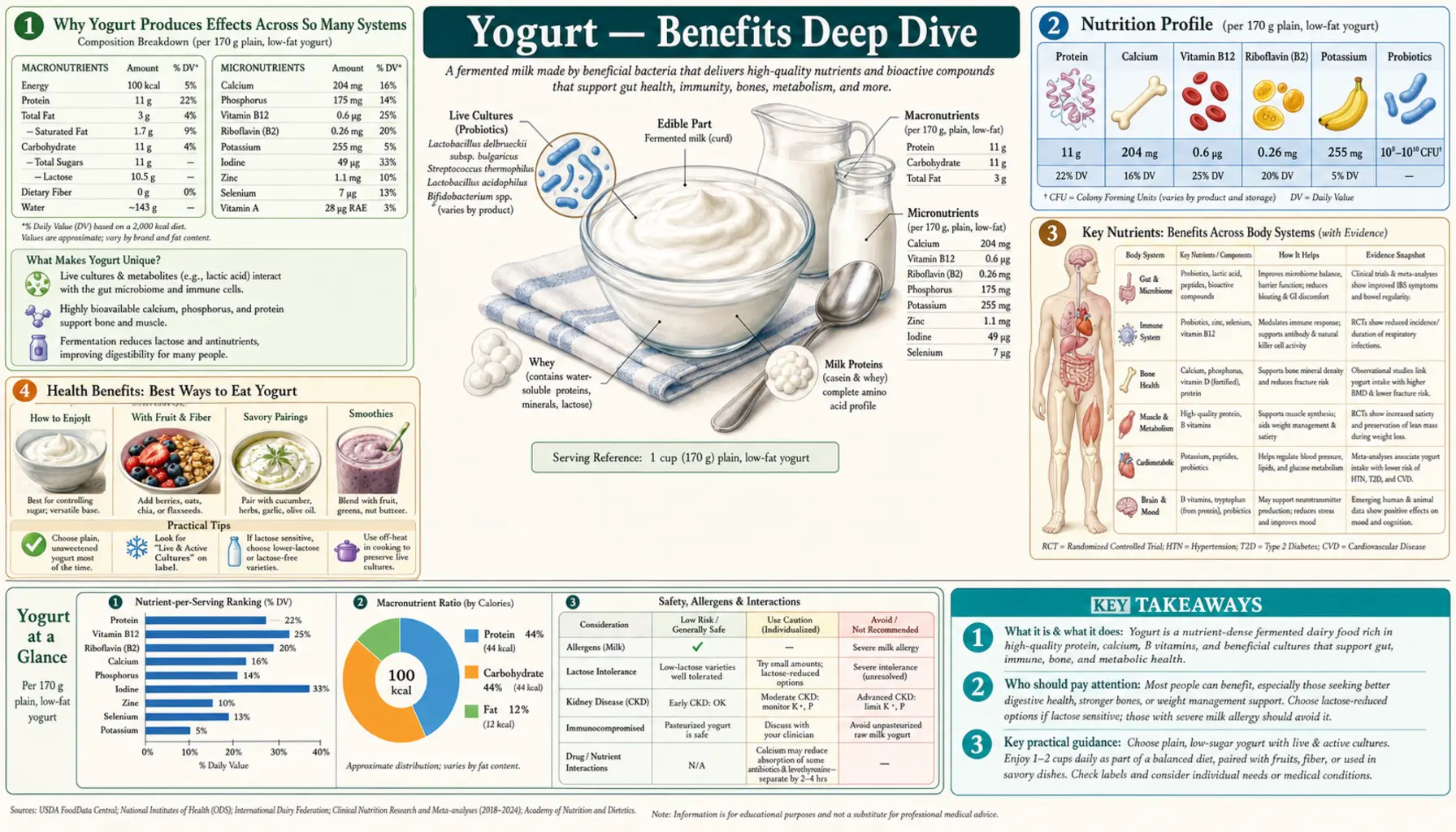
Yogurt is milk fermented with a culture that, under the US standard of identity, contains the lactic acid bacteria Lactobacillus delbrueckii subsp. bulgaricus and Streptococcus thermophilus (21 CFR 131.200). A 2021 systematic review of 108 studies concluded that a causal relationship exists between yogurt consumption and lactose digestion and tolerance. It also reported consistent associations between fermented milk consumption and reduced risk of breast and colorectal cancer and type 2 diabetes, improved weight maintenance, and improved cardiovascular, bone and gastrointestinal health, and an association between prostate cancer and dairy consumption in general, with no difference between fermented and unfermented products (Savaiano 2021). Apart from lactose digestion, these are associations from observational research. The four deep dives below cover the starter and added probiotic strains, strained (Greek) and regular yogurt, yogurt and bone, and how the yogurt bacteria help people who maldigest lactose.
Deep-Dive Articles
Probiotic Strains
The two bacteria named in the US standard of identity (Lactobacillus delbrueckii subsp. bulgaricus and Streptococcus thermophilus), added strains tested in trials (L. rhamnosus GG, L. casei strain Shirota, Bifidobacterium animalis DN-173 010, L. reuteri), the ISAPP definition of a probiotic, survival through the gut, live-culture counts on US labels, heat-treated yogurt, and the safety findings.
Read the deep dive →Greek vs Regular
How straining removes whey, and what the USDA data show for plain whole-milk and whole-milk Greek yogurt: more protein, fat, riboflavin and vitamin B12 in the Greek entry, less calcium, potassium and sodium, and total sugars that differ little. Also casein digestion, the satiety trials of yogurt snacks, skyr and fortified Greek-style products, acid whey, and the US milkfat standard.
Read the deep dive →Bone Density and Calcium
Yogurt and the skeleton: calcium and casein phosphopeptides, dietary protein and calcium absorption, the vitamin K2 (menaquinones) made by fermentation cultures, vitamin D fortification, and the Framingham Offspring data, in which yogurt intake was linked with hip bone mineral density but only a weak, non-significant trend for hip fracture.
Read the deep dive →Lactose Tolerance
Why many people who maldigest lactose tolerate yogurt even though it contains lactose: the yogurt bacteria carry their own lactase, which survives the stomach and digests lactose in the small intestine. Also the 1984 breath-hydrogen studies of live and pasteurized yogurt, the genetics of lactase persistence, the EU health claim, and what reviews report about tolerated amounts of lactose.
Read the deep dive →Table of Contents
- Deep-Dive Articles
- Three Features of Yogurt in the Research
- Research Papers: Probiotic Strains
- Research Papers: Greek vs Regular
- Research Papers: Bone Density and Calcium
- Research Papers: Lactose Tolerance
- Research Papers: Cross-Cutting (Metabolism, Cardiovascular, Immune)
- External Authoritative Resources
- Connections
- Featured Videos
Three Features of Yogurt in the Research
The research on yogurt follows three of its features. Each is covered in a deep dive.
- Bacterial cultures — under the US standard of identity, yogurt is made by culturing pasteurized dairy ingredients with a characterizing bacterial culture containing L. bulgaricus and S. thermophilus; other cultures may be added as optional ingredients (21 CFR 131.200). The standard does not require the cultures to be alive in the finished product: yogurt may be treated after culturing to inactivate viable microorganisms, and must then carry the phrase “does not contain live and active cultures” (21 CFR 131.200). Trials of added strains, survival through the gut and the safety findings are set out on the Probiotic Strains page.
- Nutrients — in the USDA FoodData Central SR Legacy data, 100 g of plain whole-milk yogurt provides 61 kcal, 3.47 g protein, 3.25 g fat, 121 mg calcium, 0.142 mg riboflavin and 0.37 µg vitamin B12, and 100 g of plain whole-milk Greek yogurt provides 97 kcal, 9 g protein, 5 g fat, 100 mg calcium, 0.278 mg riboflavin and 0.75 µg vitamin B12. Fermented dairy also contains vitamin K2 (menaquinones) made by bacteria: in 62 fermented dairy samples, contents ranged from undetectable to 1,100 ng/g and the major form was MK-9 (Manoury 2013); in US dairy foods, full-fat products contained menaquinones mainly as MK-9, MK-10 and MK-11, and reduced-fat or fat-free products contained about 5–22% of the vitamin K of their full-fat equivalents (Fu 2017). In three US cohorts, yogurt intake was inversely associated with type 2 diabetes (pooled hazard ratio 0.83 per daily serving), and a meta-analysis of 14 cohorts gave a relative risk of 0.82 per daily serving of yogurt, while total dairy intake was not associated with risk (Chen 2014). In the Framingham Offspring Study, yogurt intake was associated with trochanter bone mineral density, and showed a weak protective trend for hip fracture that was not statistically significant (Sahni 2013). See Bone Density and Calcium and Greek vs Regular.
- Bacterial lactase — yogurt still contains lactose, but the yogurt bacteria carry their own lactase. A 2014 review describes the bacterial lactase as surviving the acidic stomach, apparently protected within the bacterial cells and helped by the buffering capacity of yogurt, and then becoming active as the pH rises in the small intestine, where a slower transit lets it digest lactose sufficiently to prevent symptoms in lactose-intolerant people (Savaiano 2014). In a 1984 breath-hydrogen study, lactase-deficient subjects given 18 g of lactose in yogurt excreted only about one third as much hydrogen as after a similar load in milk or water, and reported less diarrhoea or flatulence (Kolars 1984). The European Union authorises the claim “Live cultures in yoghurt or fermented milk improve lactose digestion of the product in individuals who have difficulty digesting lactose” for products with at least 108 colony-forming units of live starter microorganisms per gram (Regulation (EU) No 432/2012). See Lactose Tolerance.
Three further points from the same sources:
- Styles differ — in the USDA whole-milk entries, Greek yogurt has more protein, energy, fat, phosphorus, riboflavin and vitamin B12 per 100 g than plain yogurt, and less calcium, potassium and sodium; total sugars are 4.66 g in plain whole-milk yogurt and 4 g in whole-milk Greek yogurt. The Greek vs Regular page works through these differences.
- Live and heat-treated yogurt — a US yogurt may state that it “contains live and active cultures” if it has at least 107 colony-forming units per gram (CFU/g) at the time of manufacture, with a reasonable expectation of 106 CFU/g through its assigned shelf life (21 CFR 131.200); the EU lactose-digestion claim requires at least 108 CFU/g (Regulation (EU) No 432/2012). In a 1984 study of nine lactase-deficient people, pasteurizing yogurt eliminated its enhanced lactose digestion and reduced its lactase activity 10-fold and its cell counts 100-fold, yet all subjects fed pasteurized yogurt were symptom-free, whereas eight of nine had gastrointestinal distress after cultured milk (Savaiano 1984). A 2014 review describes flavoured yogurts as having somewhat reduced lactase activity but still being well tolerated (Savaiano 2014).
- Milkfat and sweeteners — the US standard sets yogurt at not less than 3.25% milkfat; a yogurt with at least 2.44% but less than 3.25% milkfat must state its milkfat percentage with the name, and below 2.44% the product is treated as a modified food under 21 CFR 130.10. A yogurt with an added nutritive sweetener and no characterizing flavour must carry the word “sweetened” with its name (21 CFR 131.200). The USDA figures above are for plain whole-milk yogurt.
Decisions about diet in a medical condition belong with a clinician.
Research Papers: Probiotic Strains
- U.S. Food and Drug Administration. 21 CFR 131.200 — Yogurt (standard of identity) — eCFR: 21 CFR 131.200
- Hill C, Guarner F, Reid G, et al. (2014). Expert consensus document. The International Scientific Association for Probiotics and Prebiotics consensus statement on the scope and appropriate use of the term probiotic. Nature Reviews Gastroenterology & Hepatology 11(8):506-14 — PubMed PMID: 24912386
- Elli M, Callegari ML, Ferrari S, et al. (2006). Survival of yogurt bacteria in the human gut. Applied and Environmental Microbiology 72(7):5113-7 — PubMed PMID: 16820518
- Schnadower D, Tarr PI, Casper TC, et al. (2018). Lactobacillus rhamnosus GG versus placebo for acute gastroenteritis in children. New England Journal of Medicine 379(21):2002-2014 — PubMed PMID: 30462938
- Guo Q, Goldenberg JZ, Humphrey C, El Dib R, Johnston BC (2019). Probiotics for the prevention of pediatric antibiotic-associated diarrhea. Cochrane Database of Systematic Reviews 4:CD004827 — PubMed PMID: 31039287
- Marteau P, Cuillerier E, Meance S, et al. (2002). Bifidobacterium animalis strain DN-173 010 shortens the colonic transit time in healthy women: a double-blind, randomized, controlled study. Alimentary Pharmacology & Therapeutics 16(3):587-93 — PubMed PMID: 11876714
- Savaiano DA, AbouElAnouar A, Smith DE, Levitt MD (1984). Lactose malabsorption from yogurt, pasteurized yogurt, sweet acidophilus milk, and cultured milk in lactase-deficient individuals. American Journal of Clinical Nutrition 40(6):1219-23 — PubMed PMID: 6439026
PubMed Topic Searches
Research Papers: Greek vs Regular
- Karastamatis S, Zoidou E, Moatsou G, Moschopoulou E (2022). Effect of modified manufacturing conditions on the composition of Greek strained yogurt and the quantity and composition of generated acid whey. Foods 11(24):3953 — PubMed PMID: 36553693
- Gyawali R, Feng X, Chen YP, Lorenzo JM, Ibrahim SA (2022). A review of factors influencing the quality and sensory evaluation techniques applied to Greek yogurt. Journal of Dairy Research 89:213-219 — PubMed PMID: 35466900
- Douglas SM, Ortinau LC, Hoertel HA, Leidy HJ (2013). Low, moderate, or high protein yogurt snacks on appetite control and subsequent eating in healthy women. Appetite 60(1):117-122 — PubMed PMID: 23022602
- Boirie Y, Dangin M, Gachon P, Vasson MP, Maubois JL, Beaufrère B (1997). Slow and fast dietary proteins differently modulate postprandial protein accretion. Proceedings of the National Academy of Sciences of the USA 94(26):14930-5 — PubMed PMID: 9405716
- Lavoisier A, Morzel M, Chevalier S, et al. (2023). In vitro digestion of two protein-rich dairy products in the ageing gastrointestinal tract. Food & Function 14(20):9377-9390 — PubMed PMID: 37789767
- Simpson SJ, Raubenheimer D (2005). Obesity: the protein leverage hypothesis. Obesity Reviews 6(2):133-42 — PubMed PMID: 15836464
- Rocha-Mendoza D, Kosmerl E, Krentz A, et al. (2021). Invited review: Acid whey trends and health benefits. Journal of Dairy Science 104(2):1262-1275 — PubMed PMID: 33358165
- U.S. Department of Agriculture, Agricultural Research Service. FoodData Central, SR Legacy: Yogurt, plain, whole milk (FDC 171284); Yogurt, Greek, plain, whole milk (FDC 171304) — FoodData Central: FDC 171284, FDC 171304
PubMed Topic Searches
Research Papers: Bone Density and Calcium
- Sahni S, Tucker KL, Kiel DP, Quach L, Casey VA, Hannan MT (2013). Milk and yogurt consumption are linked with higher bone mineral density but not with hip fracture: the Framingham Offspring Study. Archives of Osteoporosis 8:119 — PubMed PMID: 23371478
- Kerstetter JE, O'Brien KO, Caseria DM, Wall DE, Insogna KL (2005). The impact of dietary protein on calcium absorption and kinetic measures of bone turnover in women. Journal of Clinical Endocrinology & Metabolism 90(1):26-31 — PubMed PMID: 15546911
- Manoury E, Jourdon K, Boyaval P, Fourcassié P (2013). Quantitative measurement of vitamin K2 (menaquinones) in various fermented dairy products using a reliable high-performance liquid chromatography method. Journal of Dairy Science 96(3):1335-46 — PubMed PMID: 23332840
- Fu X, Harshman SG, Shen X, et al. (2017). Multiple vitamin K forms exist in dairy foods. Current Developments in Nutrition 1(6):e000638 — PubMed PMID: 29955705
- Iuliano S, Poon S, Robbins J, et al. (2021). Effect of dietary sources of calcium and protein on hip fractures and falls in older adults in residential care: cluster randomised controlled trial. BMJ 375:n2364 — PubMed PMID: 34670754
- Rizzoli R, Biver E, Bonjour JP, et al. (2018). Benefits and safety of dietary protein for bone health — an expert consensus paper endorsed by the European Society for Clinical and Economical Aspects of Osteoporosis, Osteoarthritis, and Musculoskeletal Diseases and by the International Osteoporosis Foundation. Osteoporosis International 29(9):1933-1948 — PubMed PMID: 29740667
PubMed Topic Searches
Research Papers: Lactose Tolerance
- EFSA Panel on Dietetic Products, Nutrition and Allergies (NDA) (2010). Scientific Opinion on the substantiation of health claims related to live yoghurt cultures and improved lactose digestion (ID 1143, 2976) pursuant to Article 13(1) of Regulation (EC) No 1924/2006. EFSA Journal 8(10):1763 — doi:10.2903/j.efsa.2010.1763
- Commission Regulation (EU) No 432/2012 of 16 May 2012 establishing a list of permitted health claims made on foods, other than those referring to the reduction of disease risk and to children's development and health (Annex: live yoghurt cultures) — legislation.gov.uk: Regulation (EU) No 432/2012, Annex (as in force 31 December 2020)
- Kolars JC, Levitt MD, Aouji M, Savaiano DA (1984). Yogurt — an autodigesting source of lactose. New England Journal of Medicine 310(1):1-3 — PubMed PMID: 6417539
- Savaiano DA (2014). Lactose digestion from yogurt: mechanism and relevance. American Journal of Clinical Nutrition 99(5 Suppl):1251S-5S — PubMed PMID: 24695892
- Tishkoff SA, Reed FA, Ranciaro A, et al. (2007). Convergent adaptation of human lactase persistence in Africa and Europe. Nature Genetics 39(1):31-40 — PubMed PMID: 17159977
- Misselwitz B, Butter M, Verbeke K, Fox MR (2019). Update on lactose malabsorption and intolerance: pathogenesis, diagnosis and clinical management. Gut 68(11):2080-2091 — PubMed PMID: 31427404
- Shaukat A, Levitt MD, Taylor BC, et al. (2010). Systematic review: effective management strategies for lactose intolerance. Annals of Internal Medicine 152(12):797-803 — PubMed PMID: 20404262
- Hertzler SR, Savaiano DA (1996). Colonic adaptation to daily lactose feeding in lactose maldigesters reduces lactose intolerance. American Journal of Clinical Nutrition 64(2):232-6 — PubMed PMID: 8694025
PubMed Topic Searches
Research Papers: Cross-Cutting (Metabolism, Cardiovascular, Immune)
- Savaiano DA, Hutkins RW (2021). Yogurt, cultured fermented milk, and health: a systematic review. Nutrition Reviews 79(5):599-614 — PubMed PMID: 32447398
- Chen M, Sun Q, Giovannucci E, et al. (2014). Dairy consumption and risk of type 2 diabetes: 3 cohorts of US adults and an updated meta-analysis. BMC Medicine 12:215 — PubMed PMID: 25420418
- Dehghan M, Mente A, Rangarajan S, et al. (2018). Association of dairy intake with cardiovascular disease and mortality in 21 countries from five continents (PURE): a prospective cohort study. The Lancet 392(10161):2288-2297 — PubMed PMID: 30217460
- Mozaffarian D, Hao T, Rimm EB, Willett WC, Hu FB (2011). Changes in diet and lifestyle and long-term weight gain in women and men. New England Journal of Medicine 364(25):2392-404 — PubMed PMID: 21696306
- Wang H, Livingston KA, Fox CS, Meigs JB, Jacques PF (2013). Yogurt consumption is associated with better diet quality and metabolic profile in American men and women. Nutrition Research 33(1):18-26 — PubMed PMID: 23351406
- Khalesi S, Sun J, Buys N, Jayasinghe R (2014). Effect of probiotics on blood pressure: a systematic review and meta-analysis of randomized, controlled trials. Hypertension 64(4):897-903 — PubMed PMID: 25047574
- Nagata S, Asahara T, Wang C, et al. (2016). The effectiveness of Lactobacillus beverages in controlling infections among the residents of an aged care facility: a randomized placebo-controlled double-blind trial. Annals of Nutrition and Metabolism 68(1):51-9 — PubMed PMID: 26599038
- Su GL, Ko CW, Bercik P, et al. (2020). AGA clinical practice guidelines on the role of probiotics in the management of gastrointestinal disorders. Gastroenterology 159(2):697-705 — PubMed PMID: 32531291
PubMed Topic Searches
External Authoritative Resources
- FDA — 21 CFR 131.200 Yogurt Standard of Identity — the US standard of identity: the characterizing culture of L. bulgaricus and S. thermophilus, the optional “contains live and active cultures” statement (107 CFU/g at manufacture, 106 CFU/g through shelf life), the “does not contain live and active cultures” statement on yogurt heat-treated after culturing, and the 3.25% milkfat minimum
- EFSA Panel — Scientific Opinion on Yogurt Cultures and Lactose Digestion (2010) — the opinion behind the EU claim on live yoghurt cultures and lactose digestion
- legislation.gov.uk: Regulation (EU) No 432/2012, Annex (as in force 31 December 2020) — the authorised claim wording and its condition of at least 108 CFU of live starter microorganisms per gram
- ISAPP — International Scientific Association for Probiotics and Prebiotics
- PubMed — All research on yogurt health benefits