Salmon — Benefits Deep Dive
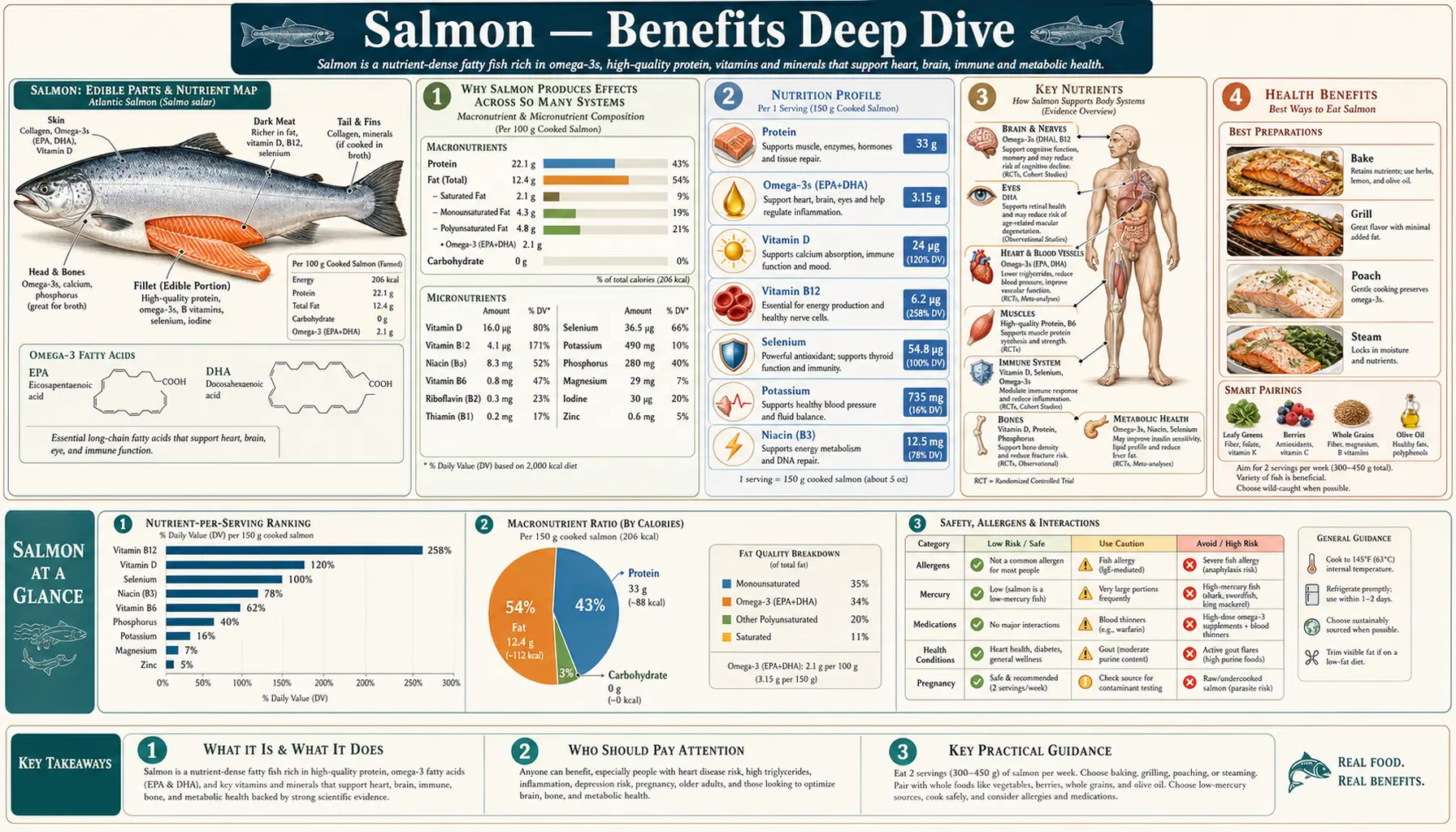
Salmon is one of the few whole foods that simultaneously delivers all four of the most under-consumed nutrients in the Western diet: long-chain omega-3 fatty acids (eicosapentaenoic acid (EPA) and docosahexaenoic acid (DHA)), bioavailable Vitamin D3 (cholecalciferol), high-quality complete protein with all nine essential amino acids, and the carotenoid antioxidant astaxanthin. Each pink-orange fillet is, at a molecular level, a concentrated package of marine-derived fat-soluble nutrients that humans evolved to obtain from cold-water fish. Four benefit pages below explore the conditions where salmon produces the largest measurable health effect — cardiovascular and cognitive protection from eicosapentaenoic acid/docosahexaenoic acid, skin photoprotection and antioxidant defense from astaxanthin, bone and immune support from natural Vitamin D, and the wild-versus-farmed quality question that determines what nutrient profile you actually get on the plate.
Deep-Dive Articles
Omega-3 Eicosapentaenoic Acid & Docosahexaenoic Acid
Why long-chain eicosapentaenoic acid (EPA) and docosahexaenoic acid (DHA) from oily fish outperform plant-source alpha-linolenic acid (ALA): the inefficient alpha-linolenic acid → eicosapentaenoic acid → docosahexaenoic acid elongation pathway, eicosapentaenoic acid's role in resolvin and protectin production, docosahexaenoic acid's structural role in neuronal membranes and the retina, the GISSI-Prevenzione and REDUCE-IT cardiovascular trials, dosing for cardiovascular prevention vs triglyceride lowering, and the American Heart Association (AHA) 2018 science advisory's 1 to 2 seafood meals a week for the general population.
Read the deep dive →Astaxanthin & Skin
The carotenoid pigment that gives salmon flesh its pink-red color is one of the most potent antioxidants in nature — roughly 6,000 times more effective than Vitamin C at quenching singlet oxygen. Mechanism of ultraviolet (UV) photoprotection, oral astaxanthin trials showing reduced wrinkle depth and improved skin elasticity, the lipophilic distribution that places astaxanthin in skin and eye tissues, anti-inflammatory effects on NF-kappa-B signaling, and dosing considerations (whole-food salmon vs concentrated Haematococcus pluvialis extract).
Read the deep dive →Vitamin D Content
Wild sockeye salmon delivers about 560-670 international units (IU) of Vitamin D3 per 100 g (3.5 oz), raw to cooked, in United States Department of Agriculture (USDA) data — one of the highest naturally occurring food sources of cholecalciferol. Why the form (D3 from animal tissue) is metabolically superior to plant-derived D2 (ergocalciferol), the seasonal advantage for northern-latitude populations who get inadequate ultraviolet B (UVB) sunlight in winter, the synergy with marine omega-3s for skeletal and immune effects, and the difference between wild and farmed salmon Vitamin D content (wild about 4 times higher in the samples one study measured, with wide variation even within a species).
Read the deep dive →Wild vs Farmed
Wild Pacific salmon (sockeye, king, coho, pink, chum) and farmed Atlantic salmon are nutritionally very different products. Wild fish has 3-5x more astaxanthin, about 4 times more Vitamin D in the samples one study measured (with wide variation even within a species), a leaner protein-to-fat ratio, and lower contaminant load. Farmed fish has more total omega-3 (because of fatty feed) but also more omega-6, more polychlorinated biphenyls (PCBs) and dioxins, and synthetic astaxanthin used as feed colorant. How labels describe wild and farmed fish, how genuine wild salmon is sold, and the cost-benefit math.
Read the deep dive →Table of Contents
- Deep-Dive Articles
- Why Salmon Produces Effects Across So Many Systems
- Research Papers: Omega-3 Eicosapentaenoic Acid & Docosahexaenoic Acid
- Research Papers: Astaxanthin & Skin
- Research Papers: Vitamin D Content
- Research Papers: Wild vs Farmed Quality
- Research Papers: Cross-Cutting (Protein, Brain, Mercury)
- External Authoritative Resources
- Connections
- Featured Videos
Why Salmon Produces Effects Across So Many Systems
Most "superfoods" earn the label on the strength of one or two nutrient peaks. Salmon is unusual because it delivers four genuinely scarce, biochemically distinct nutrients in a single whole-food matrix — each of which would be notable in a food on its own. The four mechanisms map to four different categories of clinical effect.
- Long-chain omega-3 fatty acids (eicosapentaenoic acid and docosahexaenoic acid) — the marine omega-3s drive the cardiovascular benefit (triglyceride reduction, modest blood pressure lowering, reduction in sudden cardiac death) and the cognitive/neurodevelopmental benefit (docosahexaenoic acid is approximately 30% of brain phospholipid and >50% of retinal phospholipid). Plant-source alpha-linolenic acid (ALA) from flax and chia is not a substitute — the human elongation pathway converts alpha-linolenic acid to eicosapentaenoic acid at <10% efficiency and to DHA at <1%. See our eicosapentaenoic acid/docosahexaenoic acid deep-dive page.
- Astaxanthin (3,3'-dihydroxy-beta-carotene-4,4'-dione) — the pink-red carotenoid pigment is among the most potent lipid-soluble antioxidants identified, with documented quenching activity against singlet oxygen, peroxyl radicals, and lipid peroxidation in cell membranes. Concentrated in salmon flesh because the fish accumulates it from krill and microalgae in the marine food chain. Drives skin photoprotection, eye health, and anti-inflammatory effects. See our astaxanthin deep-dive page.
- Vitamin D3 (cholecalciferol) — wild salmon is one of the few foods naturally rich in animal-form Vitamin D, the form humans synthesize in skin from ultraviolet B exposure. USDA data list wild sockeye at about 563 international units per 100 g (3.5 oz) raw and 670 cooked, roughly the daily Recommended Dietary Allowance (RDA). In one study's samples farmed salmon had about 25% of the vitamin D of wild salmon, and the vitamin D content of fish varied widely even within a species (Lu et al. 2007, listed under Research Papers: Vitamin D Content). Eating fish raises blood vitamin D, but modestly: a 2015 meta-analysis of randomized trials with 640 people found that fatty fish raised blood 25-hydroxyvitamin D by about 6.8 nmol/L on average compared with control diets, lean fish by a non-significant 1.9 nmol/L, and studies lasting about six months by 8.3 nmol/L; its authors concluded that recommended fish intakes alone cannot bring vitamin D status to an optimal level. For northern-latitude adults who cannot make adequate D from winter sun, dietary fatty fish is a primary natural source. See our Vitamin D content deep-dive.
- High-quality complete protein — a 3.5 oz serving of salmon delivers approximately 22 g of protein with a Protein Digestibility-Corrected Amino Acid Score (PDCAAS) of 1.0 (the maximum), all nine essential amino acids present, and a particularly favorable leucine content for muscle protein synthesis. The protein is highly digestible (>90%), lacks the antinutrient content of plant proteins, and comes packaged with the iron, B12, selenium, and iodine that are co-required for protein utilization.
The integration matters. Eating salmon is not the same as taking a fish oil capsule plus a Vitamin D capsule plus an astaxanthin capsule plus a whey protein scoop — the whole-food matrix delivers these nutrients in their natural ratios, with the cofactors and lipid carriers that optimize absorption. The decision tree therefore reduces to two questions: how often (a 2018 American Heart Association science advisory concluded that 1 to 2 seafood meals a week be included to reduce the risk of heart failure, coronary heart disease, ischemic stroke and sudden cardiac death, especially when seafood replaces less healthy foods), and which salmon (wild vs farmed has meaningful nutritional consequences explored in our wild vs farmed deep-dive).
Research Papers: Omega-3 Eicosapentaenoic Acid & Docosahexaenoic Acid
- GISSI-Prevenzione trial: omega-3 fatty acids and mortality after a heart attack (myocardial infarction) — PubMed: GISSI-Prevenzione
- REDUCE-IT trial: icosapent ethyl (EPA) for cardiovascular event reduction — PubMed: REDUCE-IT
- JELIS trial: EPA in Japanese hypercholesterolemic patients — PubMed: JELIS trial
- ALA to EPA / DHA conversion efficiency in humans — PubMed: ALA conversion efficiency
- DHA in brain phospholipid and neuronal membrane fluidity — PubMed: DHA brain membrane
- EPA-derived resolvins (E-series) in inflammation resolution (Serhan) — PubMed: E-series resolvins
- Omega-3 and triglyceride reduction meta-analysis — PubMed: Triglyceride meta-analysis
- Fish consumption and stroke risk (large prospective cohorts) — PubMed: Fish and stroke
- DHA supplementation and cognitive function in older adults — PubMed: DHA cognition trials
- Omega-3 in pregnancy and infant neurodevelopment — PubMed: Pregnancy and infant brain
Research Papers: Astaxanthin & Skin
- Astaxanthin antioxidant capacity vs other carotenoids and Vitamin C — PubMed: Astaxanthin antioxidant capacity
- Oral astaxanthin and skin wrinkle / elasticity trials (Tominaga et al.) — PubMed: Tominaga skin trial
- Astaxanthin and UV-induced skin damage / photoprotection — PubMed: UV photoprotection
- Astaxanthin and lipid peroxidation in cell membranes — PubMed: Lipid peroxidation
- Astaxanthin anti-inflammatory effects on NF-kappa-B — PubMed: Astaxanthin NF-kB
- Haematococcus pluvialis natural source of astaxanthin — PubMed: Haematococcus source
- Salmon astaxanthin content (wild vs farmed) — PubMed: Salmon astaxanthin levels
- Astaxanthin and eye health / asthenopia — PubMed: Eye health
- Astaxanthin and exercise-induced muscle damage — PubMed: Exercise recovery
- Comparative carotenoid bioavailability (astaxanthin vs beta-carotene vs lutein) — PubMed: Carotenoid bioavailability
Research Papers: Vitamin D Content
- Vitamin D content of fatty fish (USDA database analysis) — PubMed: Vitamin D in fatty fish
- Lu Z, Chen TC, Zhang A, et al. An evaluation of the vitamin D3 content in fish: Is the vitamin D content adequate to satisfy the dietary requirement for vitamin D? J Steroid Biochem Mol Biol. 2007;103(3-5):642-644. — PubMed PMID: 17267210
- D3 (cholecalciferol) vs D2 (ergocalciferol) bioactivity — PubMed: D3 vs D2 bioactivity
- Vitamin D and seasonal status in northern-latitude populations — PubMed: Seasonal Vitamin D
- Dietary Vitamin D from fish vs fortified milk — PubMed: Diet sources of D
- Lehmann U, Gjessing HR, Hirche F, et al. Efficacy of fish intake on vitamin D status: a meta-analysis of randomized controlled trials. Am J Clin Nutr. 2015;102(4):837-847. — PubMed PMID: 26354531
- Vitamin D and bone density / fracture prevention — PubMed: D and fracture prevention
- Vitamin D and respiratory infection prevention (Martineau meta-analysis) — PubMed: Martineau meta-analysis
- Vitamin D synergy with K2 in calcium metabolism — PubMed: D and K2 synergy
- Cod liver oil as combined Vitamin A / D historical reference — PubMed: Cod liver oil history
Research Papers: Wild vs Farmed Quality
- Hites RA, Foran JA, Carpenter DO, et al. Global assessment of organic contaminants in farmed salmon. Science. 2004;303(5655):226-229. — PubMed PMID: 14716013
- PCB and dioxin levels in farmed vs wild salmon — PubMed: PCB and dioxin levels
- A synthetic astaxanthin feed additive in salmon aquaculture — PubMed: Synthetic astaxanthin feed
- Fatty acid profile differences wild vs farmed salmon — PubMed: Fatty acid profile differences
- Omega-6 to omega-3 ratio shift in farmed salmon — PubMed: Omega-6 to omega-3 ratio in farmed fish
- Antibiotic use in salmon aquaculture and resistance concerns — PubMed: Aquaculture antibiotics
- Pacific salmon species (sockeye, king, coho, pink, chum) nutritional comparison — PubMed: Pacific species comparison
- Atlantic farmed salmon (Salmo salar) production and nutritional analysis — PubMed: Atlantic salmon analysis
- Mercury content in salmon species (typically very low) — PubMed: Mercury in salmon
- Sustainability and Marine Stewardship Council certification — PubMed: Marine Stewardship Council certification
Research Papers: Cross-Cutting (Protein, Brain, Mercury)
- Salmon protein digestibility (PDCAAS = 1.0) and leucine content — PubMed: Salmon protein quality
- Fish consumption and dementia / Alzheimer's risk reduction — PubMed: Fish and dementia
- Selenium-mercury interaction in oceanic fish — PubMed: Selenium-mercury interaction
- Rimm EB, Appel LJ, Chiuve SE, et al. Seafood long-chain n-3 polyunsaturated fatty acids and cardiovascular disease: a science advisory from the American Heart Association. Circulation. 2018;138(1):e35-e47. — PubMed PMID: 29773586
- FDA / EPA mercury advisory for pregnant women on fish choice — PubMed: FDA-EPA pregnancy advisory
- B12 content of salmon (one of richest dietary sources) — PubMed: Salmon B12
- Iodine content of marine fish vs freshwater fish — PubMed: Iodine in marine fish
- Fish oil vs whole fish: are isolated omega-3 capsules equivalent? — PubMed: Capsule vs whole fish
- Mediterranean diet and oily fish: PREDIMED trial — PubMed: PREDIMED
- Linus Pauling Institute essential fatty acids review — PubMed: Linus Pauling Institute fatty acids
External Authoritative Resources
- Linus Pauling Institute — Essential Fatty Acids — the most authoritative scientific summary of omega-3 biology
- U.S. National Institutes of Health (NIH) Office of Dietary Supplements — Omega-3 Fatty Acids Fact Sheet
- American Heart Association — Fish and Omega-3 Recommendations
- U.S. Food and Drug Administration (FDA) — Advice About Eating Fish (Mercury Guidance)
- Monterey Bay Aquarium Seafood Watch — salmon sustainability ratings
- PubMed — All research on salmon nutrition