Pork Liver
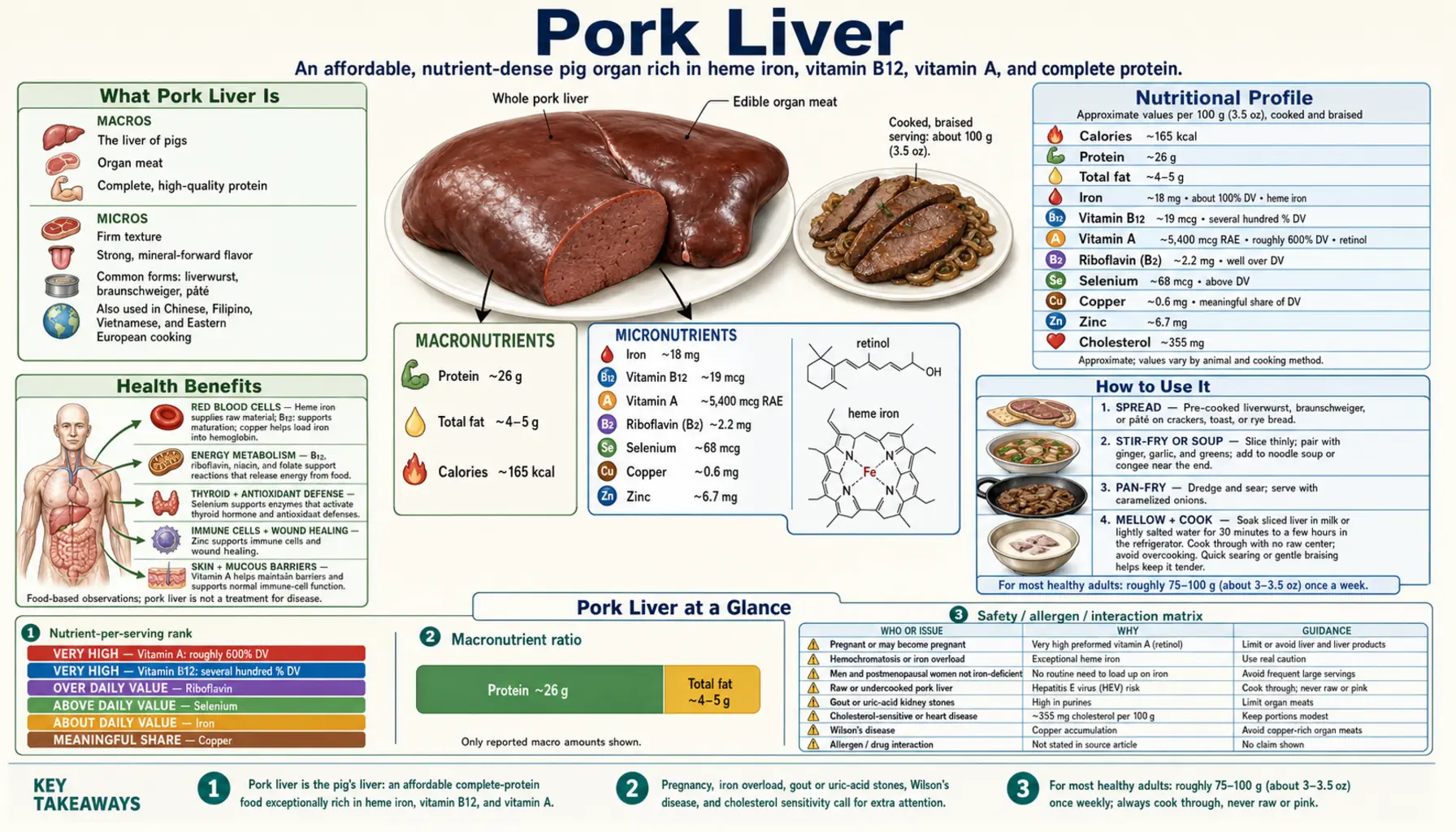
Pork liver is one of the most nutrient-dense and affordable foods you can buy, yet most Americans only ever eat it without realizing it — blended into liverwurst, braunschweiger, or a smooth pâté. Its standout feature is iron: per 100 grams, cooked pork liver supplies roughly 18 mg of iron, far more than beef or chicken liver, alongside very high vitamin B12, a large dose of vitamin A, plus copper, riboflavin, selenium, zinc, and about 26 grams of protein. That density is also why a little goes a long way and why a few sensible cautions apply, especially around pregnancy, iron overload, and cooking pork thoroughly.
Table of Contents
- What Pork Liver Is
- Nutritional Profile
- Health Benefits
- How to Use It
- How Much, How Often
- Cautions
- Research Papers
- Connections
- Featured Videos
What Pork Liver Is
Pork liver is exactly what it sounds like — the liver of pigs — and yes, it is widely eaten around the world. In the United States and Europe, most people consume it without thinking of it as "liver" at all, because it is the backbone of liverwurst, braunschweiger, and many pâtés. If you have ever spread a soft, savory liver sausage on rye bread, you have eaten pork liver.
Beyond the deli case, pork liver is an everyday ingredient in many cuisines. It appears in Chinese stir-fries and soups, in Filipino dishes (it thickens and flavors some styles of menudo and certain adobo preparations), in Vietnamese cooking, and throughout Eastern Europe in sausages, spreads, and pan-fried preparations.
Compared with chicken liver, pork liver has a firmer texture and a noticeably stronger, more mineral-forward flavor — part of why it is so often ground and blended with fat and spices rather than served as a plain slab. It is also one of the least expensive animal foods at the butcher counter, which historically made it a staple in thrifty, whole-animal cooking.
Nutritional Profile
The figures below are approximate values for about 100 grams (3.5 oz) of cooked, braised pork liver, drawn from USDA FoodData Central. Exact numbers vary with the animal and cooking method, so treat these as close estimates rather than precise measurements.
- Calories: ~165 kcal
- Protein: ~26 g — a complete, high-quality protein
- Total fat: ~4–5 g
- Iron: ~18 mg (about 100% of the Daily Value) — and importantly this is heme iron, the form the body absorbs most efficiently
- Vitamin B12: ~19 mcg (several hundred percent of the Daily Value)
- Vitamin A (retinol): ~5,400 mcg RAE (roughly 600% of the Daily Value) — this is preformed, ready-to-use vitamin A
- Riboflavin (B2): ~2.2 mg (well over the Daily Value)
- Selenium: ~68 mcg (above the Daily Value)
- Copper: ~0.6 mg (a meaningful share of the Daily Value)
- Zinc: ~6.7 mg
- Cholesterol: ~355 mg
The headline distinction is iron. Among the common livers, pork liver is in a class of its own: per 100 grams cooked it provides roughly 18 mg of iron, versus about 12 mg in chicken liver and only about 6–7 mg in beef liver. So while beef liver is famous as a "superfood," pork liver actually delivers two to three times its iron. Beef liver pulls ahead on a few other nutrients — notably vitamin B12 and copper, where it is dramatically higher — but for sheer iron, pork liver is the champion of the everyday livers.
Health Benefits
Pork liver's benefits flow directly from its nutrient density. These are food-based observations, not claims that liver treats any disease.
Outstanding for iron-deficiency anemia
Iron-deficiency anemia — low red blood cells from too little iron — is one of the most common nutritional problems worldwide, and pork liver is arguably the single best whole-food answer to it. It is exceptionally rich in heme iron, which the body absorbs far more readily than the non-heme iron in plants. Just as importantly, pork liver pairs that iron with the two other nutrients red-blood-cell production depends on: vitamin B12 and copper. Iron supplies the raw material, B12 is required to mature red blood cells, and copper helps load iron into hemoglobin. Getting all three from one food is part of why liver has long been used to rebuild people after blood loss, heavy periods, or pregnancy.
Energy and metabolism
The dense package of B vitamins — B12, riboflavin, niacin, and folate — supports the everyday machinery that turns food into usable energy. Riboflavin and niacin in particular are central to the cellular reactions that release energy from carbohydrates, fats, and protein, and pork liver delivers generous amounts of both.
Immune function and thyroid support
Pork liver is a strong source of selenium and zinc. Selenium is essential for the enzymes that activate thyroid hormone and for the body's antioxidant defenses, while zinc is a workhorse mineral for immune cells and wound healing. Its supply of vitamin A also matters here, since vitamin A helps maintain the skin and mucous-membrane barriers that keep pathogens out and supports normal immune-cell function.
How to Use It
For most people, the easiest and tastiest entry point is the form they already know:
- Liverwurst, braunschweiger, and pâté. These spreadable, pre-cooked products are pork liver's most common Western form. They are mild, rich, and ready to eat on crackers, toast, or rye bread — a low-effort way to get liver's nutrition.
- Stir-fries and Asian soups. Thinly sliced pork liver cooks in minutes. It shines in quick, high-heat stir-fries with ginger, garlic, and greens, and in noodle soups and congee where it is added at the end.
- Pan-fried, the classic way. Like the traditional "liver and onions," pork liver can be dredged and seared, then served with caramelized onions to balance its strong flavor.
A few practical tips make fresh pork liver much more enjoyable:
- Soak it first to mellow the flavor. Soaking sliced liver in milk (or lightly salted water) for 30 minutes to a few hours in the refrigerator tames the strong, metallic edge that puts some people off.
- Cook it through — but do not overcook it. Pork liver should be cooked thoroughly for food safety (see Cautions), with no raw center. At the same time, liver turns tough, grainy, and bitter when overcooked, so the goal is fully done but still tender — quick searing or gentle braising hits that balance better than prolonged high heat.
How Much, How Often
Because pork liver is so concentrated, more is not better. A modest serving — roughly 75 to 100 grams (about 3 to 3.5 oz) once a week — is a sensible rhythm for most healthy adults. That cadence lets you capture liver's remarkable iron, B12, and vitamin A while staying well clear of the levels where its vitamin A and iron density become a concern. The same once-a-week logic applies to liverwurst and pâté: enjoy them regularly, but as a rich addition rather than an everyday staple. People who are pregnant, who have an iron-overload condition, or who are not iron-deficient should read the cautions below before making it a habit.
Cautions
Pork liver is genuinely health-giving, but its very strengths create a handful of situations where care is warranted.
- Vitamin A in pregnancy. Pork liver is extremely high in preformed vitamin A (retinol), the form that, in large amounts, can cause birth defects. A landmark study found that high intakes of preformed vitamin A in early pregnancy were associated with a higher risk of certain malformations. For this reason, public-health guidance is that people who are pregnant or may become pregnant should limit or avoid liver and liver products like pâté and liverwurst. (This caution is specific to preformed vitamin A from animal foods and supplements — not to beta-carotene from colorful vegetables, which the body converts safely.)
- Iron overload and hemochromatosis. The same exceptional heme-iron content that makes pork liver so valuable for anemia makes it risky for people who accumulate too much iron. Anyone with hemochromatosis or another iron-overload disorder should treat iron-dense liver with real caution. More broadly, men and postmenopausal women who are not iron-deficient have no routine need to load up on iron and should be mindful of frequent large servings, since the body has no efficient way to excrete excess iron.
- Cook pork thoroughly — food-safety risk from raw or undercooked liver. Pig liver can carry pathogens, most notably the hepatitis E virus (HEV), which has been repeatedly detected in commercial pig livers and in raw pork-liver sausages. HEV is inactivated by proper cooking, so pork liver should always be cooked through to a safe internal temperature, never eaten raw or pink in the middle. This is also why raw or barely-cured liver products carry more risk than fully cooked or thoroughly heat-treated ones.
- Purines and gout. Like other organ meats, pork liver is high in purines, which the body converts to uric acid. People with gout or a history of uric-acid kidney stones are generally advised to limit organ meats.
- Cholesterol context. Pork liver is high in dietary cholesterol (~355 mg per 100 g). For most people, dietary cholesterol has a smaller effect on blood cholesterol than once believed, but those who have been told they are cholesterol-sensitive, or who have heart disease, may want to keep portions modest.
- Copper and Wilson's disease. Pork liver contributes a fair amount of copper. That is a benefit for most people, but individuals with Wilson's disease — a rare disorder of copper accumulation — must avoid copper-rich organ meats.
Research Papers
- U.S. Department of Agriculture, FoodData Central. Pork, fresh, liver, cooked, braised (FDC ID 167863). fdc.nal.usda.gov — Authoritative U.S. nutrient data showing pork liver's iron (~18 mg), vitamin B12 (~19 mcg), and vitamin A (~5,400 mcg RAE) per 100 g.
- Kalman DS, Hewlings S, et al. Dietary heme iron: a review of efficacy, safety and tolerability. Nutrients. 2025;17(13):2132. doi:10.3390/nu17132132 — Reviews why heme iron from animal foods (like liver) is absorbed far more efficiently than plant non-heme iron.
- Feagins AR, Opriessnig T, Guenette DK, Halbur PG, Meng XJ. Detection and characterization of infectious hepatitis E virus from commercial pig livers sold in local grocery stores in the USA. J Gen Virol. 2007;88(Pt 3):912–917. doi:10.1099/vir.0.82613-0 — Found infectious HEV in 14 of 127 store-bought pig livers — the basis for cooking pork liver thoroughly.
- Di Bartolo I, Angeloni G, Ponterio E, Ostanello F, Ruggeri FM. Detection of hepatitis E virus in pork liver sausages. Int J Food Microbiol. 2015;193:29–33. doi:10.1016/j.ijfoodmicro.2014.10.005 — Detected HEV in 22.2% of raw pork-liver sausages, underscoring the risk of undercooked liver products.
- Rothman KJ, Moore LL, Singer MR, et al. Teratogenicity of high vitamin A intake. N Engl J Med. 1995;333(21):1369–1373. doi:10.1056/NEJM199511233332101 — The pivotal study linking high preformed vitamin A in early pregnancy to birth defects — the reason for the liver-in-pregnancy caution.