Pears — Benefits Deep Dive
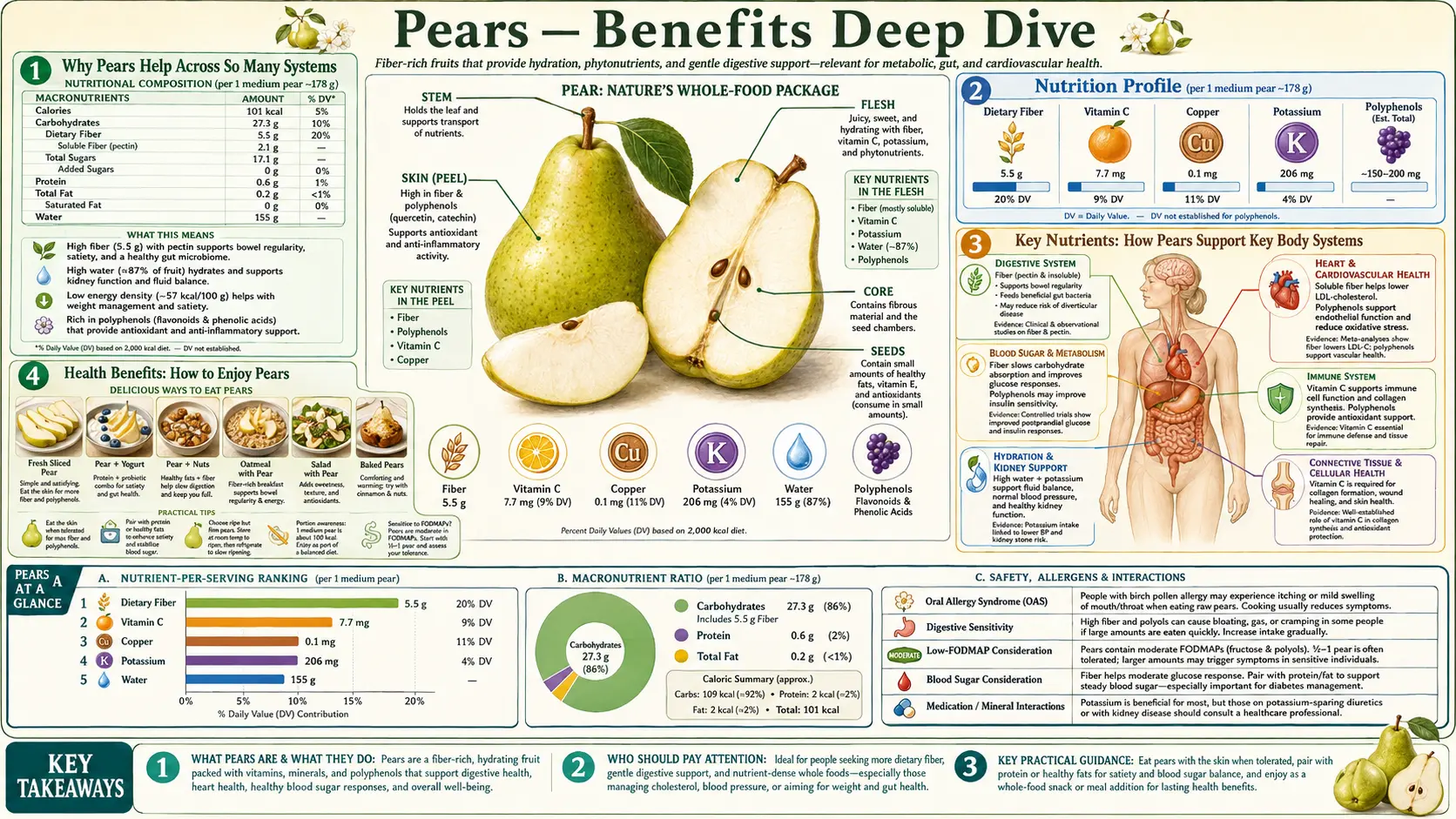
The pear (Pyrus communis and its Asian cousin Pyrus pyrifolia) is one of the gentlest natural tools for keeping you regular. A single medium pear delivers a rare three-part combination — sorbitol (a sugar alcohol that pulls water into the gut), several grams of dietary fiber (much of it in the skin), and a generous dose of fructose and water — that together soften stool and encourage a comfortable bowel movement, which is why pears are so often recommended for constipation and everyday regularity as a food-first, gentle natural laxative. Beyond digestion, the same pear feeds your gut health (its pectin is a prebiotic), nudges cholesterol downward, helps steady blood sugar, supports weight management because it is filling for few calories, and supplies skin-bound antioxidants. The four deep-dive pages below cover where the evidence is strongest — honestly, without overclaiming: pears are a healthy whole fruit, not a cure.
Deep-Dive Articles
Digestion, Bowel Movements & Constipation Relief
The pear's best-known effect, explained. Sorbitol — the main driver — is a sugar alcohol the gut absorbs slowly, so it draws water into the intestine osmotically, softening stool and helping trigger a bowel movement. Fiber adds bulk and the fructose and high water content add to the gentle natural-laxative effect. How to actually use pears for constipation (and in children), plus the flip side: the same sorbitol and fructose are FODMAPs that can cause gas or loose stools in sensitive people.
Gut Health & the Microbiome
Pears are a quietly excellent prebiotic food. The pectin concentrated in pear flesh and skin is a fermentable fiber that your gut bacteria feast on, turning it into short-chain fatty acids — especially butyrate — that nourish the colon lining, help calm inflammation, and support a healthier, more diverse microbiome over time.
Heart Health & Cholesterol
The soluble fiber (pectin) in pears binds bile acids and gently nudges LDL cholesterol down, while their potassium-to-sodium ratio supports healthy blood pressure. The skin carries polyphenols and flavonoids with anti-inflammatory activity, and pears belong to the white-fleshed-fruit group that one large cohort linked to a notably lower risk of stroke.
Blood Sugar & Weight Management
Despite their natural sweetness, whole pears have a low glycemic impact: their fiber slows sugar absorption so glucose rises gently rather than spiking. Eaten whole (not as juice), a pear is very filling for few calories, which makes it a smart snack for weight management — and it brings antioxidants and vitamins along for the ride.
Table of Contents
- Deep-Dive Articles
- Why Pears Help Across So Many Systems
- Research Papers: Digestion & Constipation
- Research Papers: Gut Health & the Microbiome
- Research Papers: Heart Health & Cholesterol
- Research Papers: Blood Sugar & Weight
- External Authoritative Resources
- Connections
- Featured Videos
Why Pears Help Across So Many Systems
Most of the pear's benefits trace back to a handful of components packaged together in one piece of fruit. Each maps to a different category of measurable benefit, and several reinforce one another — which is why a pear helps digestion, the gut, the heart, and blood sugar at once.
- Sorbitol — a naturally occurring sugar alcohol that the small intestine absorbs only slowly. The unabsorbed portion draws water into the bowel by osmosis, softening stool and helping produce a comfortable bowel movement. This is the main reason pears are recommended for constipation relief and regularity. See Digestion, Bowel Movements & Constipation Relief.
- Dietary fiber — roughly 5–6 grams in a medium pear, much of it in the skin. It is a mix of soluble pectin (which forms a gel, binds bile acids, and ferments in the colon) and insoluble fiber (which adds bulk). This single component drives regularity, the cholesterol benefit, steadier blood sugar, and the prebiotic effect. See Heart Health & Cholesterol and Blood Sugar & Weight Management.
- Fructose — pears are relatively high in fructose, a share of which is incompletely absorbed and adds to the osmotic, gentle laxative effect alongside the sorbitol. (This same feature is the high-FODMAP caveat covered on the Digestion page — in sensitive people it can mean gas or loose stools.)
- Water — a pear is about 84% water, which helps keep stool soft and gives the fruit a low energy density: a lot of volume and chew for relatively few calories, useful for weight management.
- Potassium with very little sodium — this favorable mineral ratio supports healthy blood pressure, part of the heart-health picture. See Heart Health & Cholesterol.
- Vitamin C, vitamin K, and copper — modest but real amounts that contribute to antioxidant defenses, normal blood clotting, and ordinary day-to-day body functions.
- Polyphenols — plant antioxidant and anti-inflammatory compounds (including flavonoids) concentrated in the pear's skin, which is why peeling a pear discards some of its benefit. These contribute to the effects seen on the Heart Health and Blood Sugar & Weight pages.
The honest bottom line: a pear is a healthy, fiber-rich whole fruit, best eaten skin-on so you keep its fiber and polyphenols. It is a sensible everyday food and a gentle first step for constipation — but it is a food, not a medicine or a cure, and people prone to gas or with IBS may need to introduce it gradually.
Research Papers: Digestion & Constipation
- Reiland H, Slavin J. Systematic Review of Pears and Health. Nutrition Today. 2015. doi:10.1097/NT.0000000000000112 — a comprehensive review of pears' nutrient profile, fiber and sorbitol content, and their documented digestive and metabolic effects.
- Lederle FA, et al. Cost-effective treatment of constipation in the elderly: a randomized double-blind comparison of sorbitol and lactulose. The American Journal of Medicine. 1990. doi:10.1016/0002-9343(90)90177-f — the classic trial showing sorbitol (the sugar alcohol abundant in pears) relieves constipation as effectively as a standard laxative.
- Yang J, et al. Effect of dietary fiber on constipation: a meta analysis. World Journal of Gastroenterology. 2012. doi:10.3748/wjg.v18.i48.7378 — pooled trial evidence that increasing dietary fiber raises stool frequency in people with constipation.
- Lever E, et al. Systematic review: the effect of prunes on gastrointestinal function. Alimentary Pharmacology & Therapeutics. 2014. doi:10.1111/apt.12913 — the closest analog, showing fiber-plus-sorbitol fruit improves stool frequency and consistency; pears share the same active components.
- Fedewa A, Rao SSC. Dietary fructose intolerance, fructan intolerance and FODMAPs. Current Gastroenterology Reports. 2014. doi:10.1007/s11894-013-0370-0 — explains the flip side: pears' fructose and sorbitol are FODMAPs that can cause gas, bloating, or loose stools in sensitive people.
Research Papers: Gut Health & the Microbiome
- Slavin J. Fiber and prebiotics: mechanisms and health benefits. Nutrients. 2013. doi:10.3390/nu5041417 — how fermentable fibers such as pear pectin feed beneficial gut bacteria and produce health-promoting short-chain fatty acids.
- Gibson GR, et al. Expert consensus document: the ISAPP consensus statement on the definition and scope of prebiotics. Nature Reviews Gastroenterology & Hepatology. 2017. doi:10.1038/nrgastro.2017.75 — the authoritative definition of a prebiotic, the category pear pectin and other fermentable fibers fall into.
- Koutsos A, et al. Apples and cardiovascular health—is the gut microbiota a core consideration? Nutrients. 2015. doi:10.3390/nu7063959 — on pectin-rich pome fruit (apples, the pear's close relative): how their fiber and polyphenols act through the gut microbiome.
Research Papers: Heart Health & Cholesterol
- Oude Griep LM, et al. Colors of fruit and vegetables and 10-year incidence of stroke. Stroke. 2011. doi:10.1161/STROKEAHA.110.611152 — the large Dutch cohort that linked white-fleshed fruit (apples and pears) to a substantially lower risk of stroke.
- Threapleton DE, et al. Dietary fibre intake and risk of cardiovascular disease: systematic review and meta-analysis. BMJ. 2013. doi:10.1136/bmj.f6879 — higher dietary fiber intake is associated with lower cardiovascular disease risk, supporting fiber-rich foods like pears.
- Kim Y, Je Y. Flavonoid intake and mortality from cardiovascular disease and all causes: a meta-analysis of prospective cohort studies. Clinical Nutrition ESPEN. 2017. doi:10.1016/j.clnesp.2017.03.004 — higher intake of flavonoids, the polyphenols found in pear skin, tracks with lower cardiovascular and all-cause mortality.
Research Papers: Blood Sugar & Weight
- Muraki I, et al. Fruit consumption and risk of type 2 diabetes: results from three prospective longitudinal cohort studies. BMJ. 2013. doi:10.1136/bmj.f5001 — eating whole fruit (pears specifically among them) was linked to lower type-2-diabetes risk, while fruit juice raised it.
- Bertoia ML, et al. Changes in intake of fruits and vegetables and weight change in United States men and women followed for up to 24 years. PLOS Medicine. 2015. doi:10.1371/journal.pmed.1001878 — increasing intake of high-fiber fruits such as pears was associated with less long-term weight gain.
- Flood-Obbagy JE, Rolls BJ. The effect of fruit in different forms on energy intake and satiety at a meal. Appetite. 2009. doi:10.1016/j.appet.2008.12.001 — whole fruit eaten before a meal increased fullness and reduced calorie intake more than juice, illustrating why whole pears are filling.
- Reynolds A, et al. Carbohydrate quality and human health: a series of systematic reviews and meta-analyses. The Lancet. 2019. doi:10.1016/S0140-6736(18)31809-9 — higher fiber intake and low-glycemic-index foods, the category whole pears belong to, are linked to better metabolic outcomes.
- Anderson JW, et al. Health benefits of dietary fiber. Nutrition Reviews. 2009. doi:10.1111/j.1753-4887.2009.00189.x — a broad review of how dietary fiber improves blood sugar, cholesterol, weight, and bowel function.
External Authoritative Resources
- USDA FoodData Central — the authoritative per-100 g nutrient profile for pears (fiber, sorbitol, fructose, potassium, vitamins).
- Harvard T.H. Chan School of Public Health — The Nutrition Source — evidence-based guidance on fruit, fiber, and a healthy diet.
- PubMed — research on pears (Pyrus), fiber, and sorbitol.
Connections
- All Food
- Pears (Main Page)
- Pears for Digestion & Constipation Relief
- Pears for Gut Health & the Microbiome
- Pears for Heart Health & Cholesterol
- Pears for Blood Sugar & Weight Management
- Apples
- Constipation
- Fermented Foods