Pears for Blood Sugar and Weight Management
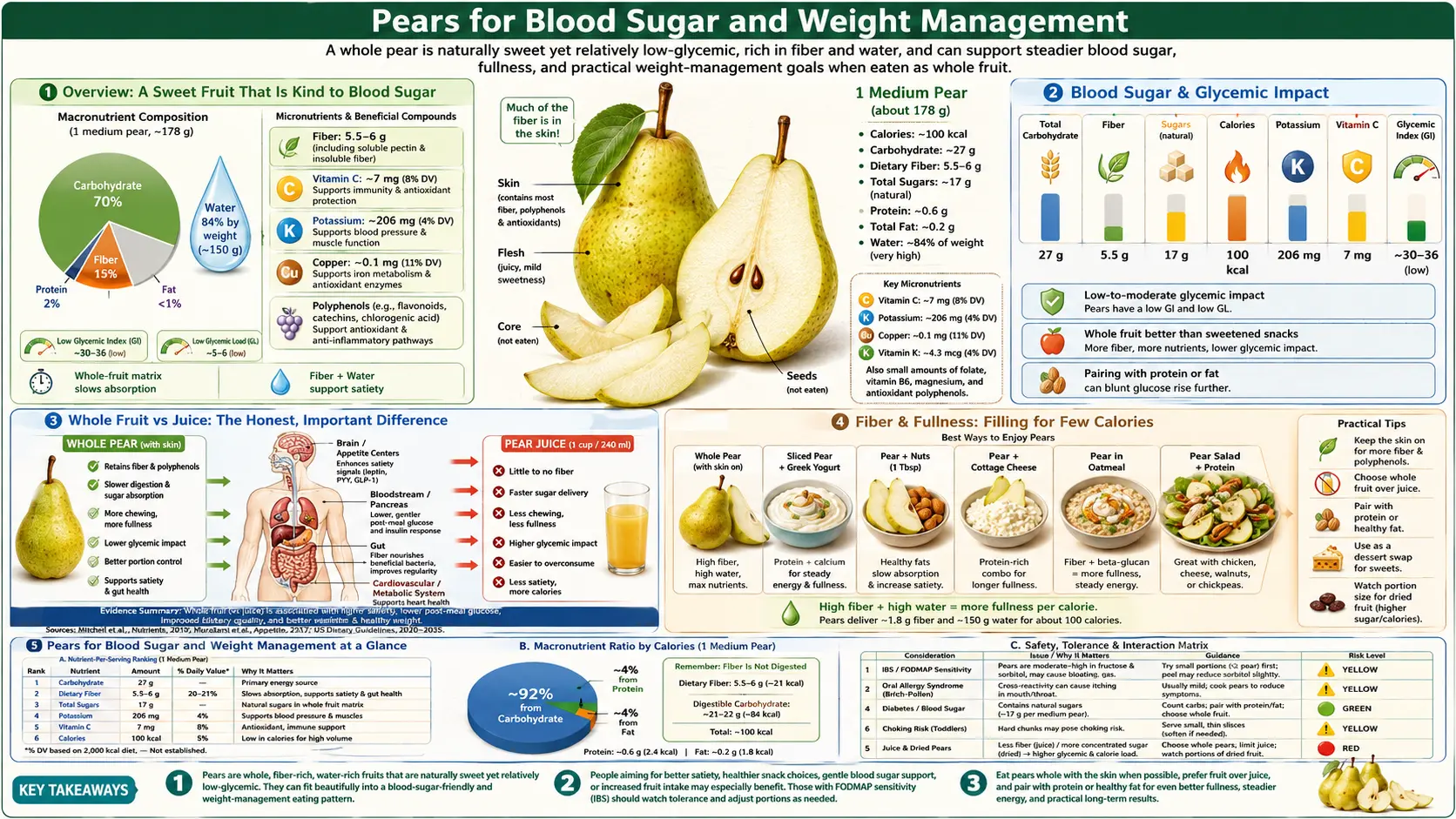
A ripe pear is sweet, which makes a lot of people with blood-sugar worries assume they should avoid it. The reality is more reassuring: a whole pear is one of the more blood-sugar-friendly fruits you can eat. Its sweetness comes mostly from fructose, but it is wrapped in roughly five to six grams of fiber and about 84% water, so the sugar is absorbed slowly and the fruit fills you up for very few calories. The catch — and it is an important, honest one — is that this gentle effect belongs to the whole fruit. Squeeze a pear into juice and you strip out the fiber and concentrate the sugar, turning a friend into something closer to a sweetened drink. This page explains, in plain language, how whole pears affect blood sugar and weight, what the research actually shows, and how to get the benefit without the pitfalls.
Table of Contents
- Overview: A Sweet Fruit That Is Kind to Blood Sugar
- Blood Sugar & Glycemic Impact
- Whole Fruit vs Juice: The Honest, Important Difference
- Fiber & Fullness: Filling for Few Calories
- Weight Management: Appetite, Satiety, and the Evidence
- Antioxidants, Vitamins & Anti-Inflammatory Compounds
- Practical How-To: Getting the Benefit
- Honest Caveats: Sugar, Portions, and Sensitivity
- Key Research Papers
- Connections
- Featured Videos
Overview: A Sweet Fruit That Is Kind to Blood Sugar
Pears land in an interesting place for anyone watching their blood sugar or their weight. They taste sweet and they genuinely contain a fair amount of sugar — yet because of how that sugar is packaged, a whole pear behaves very gently in the body. A medium pear has only around 100 calories, is about 84% water, and delivers roughly five to six grams of fiber, more than most fruits its size. That combination — lots of water, lots of fiber, modest calories — is exactly what makes a food both low calorie for its volume and slow to raise blood sugar.
The single most useful idea on this page is the difference between the form of the fruit. The fiber in a pear is what slows sugar absorption and what fills you up. Eat the pear whole, skin and all, and that fiber does its job. Remove it — as juicing does — and the same sugars are absorbed fast and the fullness mostly disappears. So the headline is simple and honest: whole pears are friendly to blood sugar and helpful for weight; pear juice is not the same thing.
A second honest note runs through everything below. Pears are almost always studied as part of a fruit group, not on their own, and most of the human evidence is observational — it watches what people eat and what happens to them, rather than randomly assigning pears. That kind of evidence can show strong, consistent associations, but it cannot by itself prove that pears alone cause the benefit. Where we lean on it, we will say so plainly.
Blood Sugar & Glycemic Impact
The glycemic index (GI) is a scale that ranks foods by how quickly and how much they raise blood glucose after eating, compared with pure glucose. Foods are loosely grouped as low (55 or under), medium (56–69), or high (70 and above). Whole pears sit firmly in the low glycemic range — typically reported around the upper 30s — which is low for any food and notably low for something this sweet.
Why does a sweet fruit have a low GI? Several features work together:
- Fiber slows everything down. The soluble fiber in a pear (much of it pectin, concentrated near the skin) forms a soft gel in the gut that slows how fast sugar is released and absorbed. Instead of a sharp spike, blood sugar rises gently and falls gently.
- The sugar is mostly fructose. A large share of a pear's sweetness comes from fructose, which is absorbed and handled differently from glucose and has a smaller immediate effect on blood-glucose readings than the same amount of glucose would. (This is a double-edged feature, as the caveats section explains — it is good for the post-meal glucose curve but is the reason juice is a problem.)
- Water dilutes the load. Because a pear is mostly water, the actual amount of available carbohydrate per bite is modest, which keeps the real-world blood-sugar load low.
For someone managing blood sugar — including many people with or at risk of type 2 diabetes — this matters in practice. A whole pear can satisfy a craving for something sweet without the rapid rise that refined snacks cause, and the broader research on carbohydrate quality is clear that choosing higher-fiber, lower-glycemic foods is associated with better blood-sugar control and lower risk of several chronic conditions (Reynolds 2019). A pear is a textbook example of a higher-quality, fiber-rich carbohydrate. For more on the condition itself, see Diabetes.
Whole Fruit vs Juice: The Honest, Important Difference
This is the most important section on the page, and it is one where being honest matters more than being flattering. Pears are fairly high in fructose. In the whole fruit, that is not a problem — the fiber is intact, so the sugar is absorbed slowly and you feel full. But the moment you turn a pear into juice, two things change at once: the fiber is removed, and the sugar from several pears is concentrated into a single glass you can drink in seconds. What was a slow, filling, low-glycemic food becomes a fast-absorbing, easy-to-overconsume sugar source. The same fruit, in a different form, has nearly the opposite effect.
The most-cited evidence here is a large study by Muraki and colleagues (2013), which pooled three long-running prospective cohorts following many thousands of adults over time. The findings were striking and went in opposite directions depending on form. Eating more whole fruit — and pears were specifically among the whole fruits examined — was associated with a lower risk of developing type 2 diabetes. Drinking more fruit juice was associated with a higher risk. The researchers even estimated that swapping fruit juice for whole fruit was linked to lower diabetes risk. Pears, apples, and blueberries were among the whole fruits most strongly associated with the protective effect.
Two cautions keep this accurate. First, this is an observational study: it shows a strong, consistent association across three big cohorts, but it cannot by itself prove that whole pears cause lower diabetes risk or that juice causes higher risk — people who drink a lot of juice may differ in other dietary and lifestyle ways. Second, pears were studied within the whole-fruit group, not isolated, so the cleanest takeaway is about form and pattern, not a single fruit. Even with those caveats, the practical lesson is solid and worth acting on: eat the pear, do not drink it. If you love the taste of pear in liquid, infuse water with slices rather than reaching for juice.
Fiber & Fullness: Filling for Few Calories
The same fiber that steadies blood sugar is also what makes a pear so filling for its calories — the quality that makes it useful for weight. A medium pear carries roughly five to six grams of fiber, which is a lot for a single fruit, alongside about 84% water and only about 100 calories. Nutritionists call this combination low energy density: a large, satisfying volume of food for relatively few calories. Low-energy-density foods tend to fill you up before you have eaten many calories, which is one of the most reliable, least restrictive ways to manage weight.
The fiber contributes to satiety — the feeling of being full and satisfied — in a few concrete ways:
- It slows stomach emptying. The soluble fiber's gel keeps food in the stomach a little longer, so fullness lasts and the urge to snack soon after is blunted.
- It adds bulk and chewing. A whole pear takes time and effort to eat, and that volume physically stretches the stomach, which is part of how the body registers "enough." A glass of juice does none of this.
- It steadies blood sugar. Because a pear's effect on blood sugar is gentle, you avoid the spike-and-crash that can trigger hunger an hour or two after a sugary snack. Steadier blood sugar tends to mean steadier appetite.
The broader science backs the everyday experience. Reviews of dietary fiber and body weight (Slavin 2005) find that higher fiber intake is consistently associated with lower body weight and better appetite control — fiber-rich foods are simply more filling per calorie. A pear is an easy, portable way to put that principle to work, and its fiber also supports digestion and regularity, which is covered in the companion page on Digestion & Constipation Relief.
Weight Management: Appetite, Satiety, and the Evidence
Put the pieces together — low calorie, high fiber, very filling, gentle on blood sugar — and you have a fruit that fits naturally into sensible weight management. The mechanism is appetite control rather than anything metabolic or magical: a pear satisfies hunger and a sweet craving for around 100 calories, so it can displace richer, more calorie-dense snacks. That is the whole story, and it is a genuinely useful one.
Two strands of human research are worth knowing, and both deserve honest framing.
The first is about form again. A controlled feeding experiment by Flood-Obbagy and Rolls (2009) compared eating fruit in different forms before a meal. Eating whole fruit was more filling and reduced how much people ate at the following meal more than the same fruit as juice did. This reinforces the central theme of the page: the fiber and the act of eating whole fruit drive fullness, and juicing throws that away. It is a small, short-term study, but it is a randomized comparison, and its lesson lines up neatly with the larger observational findings.
The second is about weight change over time. A large cohort analysis by Bertoia and colleagues (2015) followed many thousands of US men and women for up to 24 years and looked at how changes in fruit and vegetable intake tracked with changes in weight. Increasing fruit intake was associated with less weight gain over the years — and among individual fruits, those rich in fiber and lower in glycemic load, including pears and apples, were among those most strongly associated with weight loss or reduced weight gain. The honest caveat is the familiar one: this is an observational study and cannot prove that eating more pears causes weight loss, since people who increase fruit intake often improve other habits at the same time. But it is a long, large, carefully adjusted study, and pears specifically stood out within it.
The fair summary: whole pears are a sensible, evidence-supported choice for people trying to manage their weight — not because any fruit melts fat, but because a filling, low-calorie, fiber-rich food makes it easier to eat less without feeling deprived.
Antioxidants, Vitamins & Anti-Inflammatory Compounds
Blood sugar and weight are not the only reasons a pear earns its place. The fruit also delivers a quiet package of antioxidants, vitamins, and a useful mineral — and, importantly, the most valuable of these are concentrated in the part many people throw away.
- Vitamin C. Pears supply a modest amount of vitamin C, a water-soluble antioxidant that helps protect cells from oxidative damage and supports the immune system and the body's production of collagen. It is not a standout source the way citrus is, but every bit adds to a day's total.
- Vitamin K. Pears contain vitamin K, which the body needs for normal blood clotting and for bone health. (People taking the blood-thinning medication warfarin should keep their vitamin-K intake steady rather than swinging up and down, but ordinary servings of pear are not a concern for most people.)
- Copper. A pear provides a small amount of copper, a trace mineral involved in iron handling, energy production, and the body's own antioxidant defenses.
- Polyphenols in the skin. The most interesting compounds in a pear are its polyphenols — plant antioxidants including flavonoids and chlorogenic acid that have anti-inflammatory properties. These are concentrated in and just under the skin. Studies that compare peeled and unpeeled pears consistently find that the skin holds a large share of the fruit's antioxidant capacity and fiber.
The practical message that follows from this is simple and worth repeating: eat pears with the skin on. Peeling a pear removes much of its fiber and a large fraction of its antioxidants and anti-inflammatory polyphenols in one stroke. The skin is also where the gentle, blood-sugar-steadying pectin is richest — so eating skin-on serves the antioxidant story and the blood-sugar story at the same time. A good review of the fruit's nutrition and health links (Reiland & Slavin 2015) summarizes pears as a fiber-rich, antioxidant-containing fruit whose benefits are best captured by eating it whole and unpeeled.
Practical How-To: Getting the Benefit
Capturing the blood-sugar and weight benefits of pears is mostly about two habits: eat them whole with the skin on, and use them where their fullness does the most good.
- Choose whole, ripe pears — skin on. A ripe pear yields slightly to gentle pressure near the stem. Rinse it and eat it as it is. The skin carries fiber, pectin, and most of the antioxidants, so leaving it on is the single best thing you can do.
- Use it as a snack between meals. A pear is the ideal portable, low calorie, sweet snack — satisfying for about 100 calories and far gentler on blood sugar than crackers, candy, or a granola bar. Keep one in your bag for the mid-afternoon dip when refined snacks usually win.
- Eat one before a meal. Because whole fruit is so filling (Flood-Obbagy & Rolls), having a pear shortly before a meal can take the edge off your appetite and help you eat a little less overall.
- Pair it with protein or fat. Pear slices with a small handful of nuts, a little cheese, or a spoon of nut butter slows sugar absorption even further and makes the snack more satisfying and steadier on blood sugar.
- Limit juice — strongly. This is the most important rule. Skip pear juice (and most fruit juices) for blood sugar and weight purposes; the fiber is gone and the sugar is concentrated. If you want flavor in a drink, add a few fresh pear slices to a glass of water instead.
For the fruit's broader nutrition and other benefits, see the main Pears page and the Benefits hub.
Honest Caveats: Sugar, Portions, and Sensitivity
Pears are a healthy choice for the great majority of people, but an honest account includes the limits.
- A pear still contains sugar and calories. "Low glycemic" and "filling" do not mean "free." A medium pear has around 100 calories and roughly 17 grams of natural sugar. For most people that is a wholesome part of the day, but it still counts — eating several pears on top of everything else adds up. Portion sense applies to fruit too, especially for anyone counting carbohydrates for diabetes, where a pear is a real serving of carbohydrate to be worked into the day's plan.
- Juice is not a free pass — and neither is "dried." Pear juice removes the fiber and concentrates the fructose, which is exactly what makes it blood-sugar-unfriendly; treat it like a sugary drink, not like fruit. Dried pears are also concentrated — small, sweet, and easy to overeat — so keep dried-fruit portions modest.
- FODMAP sensitivity. Pears are high in fructose and in a sugar alcohol called sorbitol, both of which are FODMAPs — fermentable carbohydrates that can cause gas, bloating, or loose stools in people with irritable bowel syndrome (IBS) or fructose sensitivity. For most people this is harmless (and the gentle laxative effect can even help with constipation), but those who are sensitive may need to limit pears to small portions. This is an individual matter best worked out with a clinician or dietitian rather than by blanket avoidance.
None of these caveats changes the broad picture. Eaten whole, with the skin, in sensible portions, a pear is a sweet-tasting, low calorie, fiber-rich food that is genuinely kind to blood sugar and helpful for weight. The pitfalls are specific and easy to avoid: do not drink it, do not peel it, and remember it is still food, not a free snack.
Key Research Papers
- Muraki I, et al. Fruit consumption and risk of type 2 diabetes: results from three prospective longitudinal cohort studies. BMJ. 2013. doi:10.1136/bmj.f5001 — whole fruit (incl. pears) linked to lower diabetes risk, fruit juice to higher risk.
- Bertoia ML, et al. Changes in intake of fruits and vegetables and weight change in United States men and women followed for up to 24 years. PLOS Medicine. 2015. doi:10.1371/journal.pmed.1001878 — increasing fruit intake (pears/apples among the standouts) associated with less weight gain.
- Flood-Obbagy JE, Rolls BJ. The effect of fruit in different forms on energy intake and satiety at a meal. Appetite. 2009. doi:10.1016/j.appet.2008.12.001 — whole fruit was more filling and cut later intake more than juice.
- Slavin JL. Dietary fiber and body weight. Nutrition. 2005. doi:10.1016/j.nut.2004.08.018 — review linking higher fiber intake to lower body weight and better appetite control.
- Reynolds A, et al. Carbohydrate quality and human health: a series of systematic reviews and meta-analyses. The Lancet. 2019. doi:10.1016/S0140-6736(18)31809-9 — higher-fiber, lower-glycemic carbohydrates tied to better health outcomes.
- Reiland H, Slavin J. Systematic Review of Pears and Health. Nutrition Today. 2015. doi:10.1097/NT.0000000000000112 — overview of pears as a fiber- and antioxidant-rich fruit, best eaten whole and unpeeled.
PubMed Topic Searches
- PubMed: Whole fruit vs juice & type 2 diabetes
- PubMed: Dietary fiber, satiety & body weight
- PubMed: Low-glycemic-index fruit & blood glucose
- PubMed: Fruit polyphenols & anti-inflammatory effects
Connections
- All Food
- Pears (Main Page)
- Pears Benefits Hub
- Pears for Digestion & Constipation Relief
- Pears for Gut Health & the Microbiome
- Pears for Heart Health & Cholesterol
- Diabetes
- Apples