Wheat Germ Oil
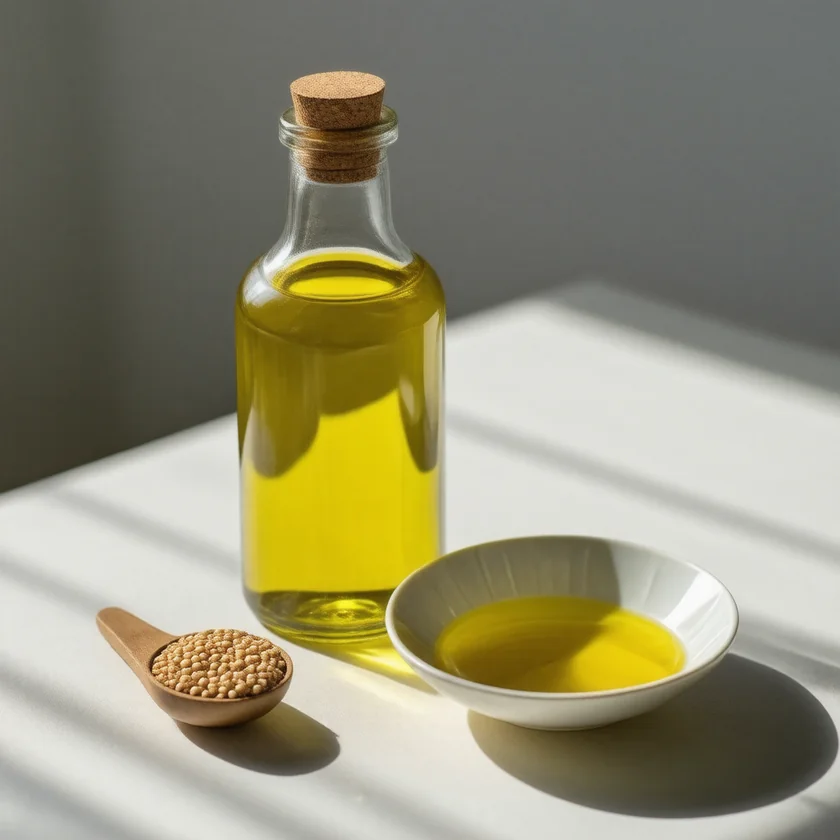
Wheat germ oil is pressed from the germ — the tiny embryo inside a wheat kernel — and on one point the popular videos are right: by USDA's analysis a single tablespoon holds about 20 mg of natural vitamin E, more than the 15 mg an adult needs in a day. Almost everything else promised for it — octacosanol for endurance, balanced hormones, better skin, lower cholesterol — rests on rat studies, a handful of tiny, days-long trials, and human trials that found nothing. It is also more than half linoleic acid, a fragile omega-6 fat that goes rancid easily, so it earns a place as a fresh, cold, teaspoon-sized vitamin E food — not as a cooking oil, and not as a cure.
Table of Contents
- What Wheat Germ Oil Is
- A Short History: Fertility Factor, Then Fitness Supplement
- What Is Actually in a Spoonful
- Vitamin E: The Claim That Holds Up
- Octacosanol and Endurance
- Cholesterol and Heart Health
- Skin and Hormones
- Omega-6, Rancidity and the Seed-Oil Question
- How to Use It: Amounts, Storage and Whole-Food Options
- Myths, Safety and Who Should Avoid It
- Key Research Papers
- Connections
- Featured Videos
What Wheat Germ Oil Is
A wheat kernel has three parts. The bran is the outer skin; the endosperm is the starchy bulk that becomes white flour; and the germ is the embryo — the part that would sprout into a new wheat plant. The germ is small, only about 2.5–3.8% of the kernel's weight, but it is the most concentrated part of the grain: roughly 10–15% fat and 26–35% protein, with notable amounts of vitamin E (tocopherols) and B vitamins such as thiamin and riboflavin (Brandolini & Hidalgo, 2012).
That fat is also the germ's weakness. Enzymes in the germ start breaking down and oxidising its oil as the grain is milled, so mills take the germ out to give white flour a long shelf life — and the separated germ is left with a very short shelf life of its own (Marzocchi and colleagues, 2022). Wheat germ oil is one of the ways that by-product gets used.
The oil is recovered in one of two main ways. Mechanical pressing squeezes out about half of the germ's fat; solvent extraction recovers about 90%; extraction with pressurised (supercritical) carbon dioxide is a newer alternative (Brandolini & Hidalgo, 2012). Oil sold as “cold-pressed” or “unrefined” is the pressed kind; refined oil has been through further processing. The arithmetic of pressing is unforgiving: with the germ only 10–15% oil and about half of that recovered, it takes somewhere around 13 to 20 kilograms of germ to press one kilogram of oil.
The oil is not the germ. USDA lists raw wheat germ at about 23 g of protein and 13 g of fibre per 100 g, along with thiamin, folate, zinc, magnesium, manganese and selenium. Pressing keeps the fat-soluble part — the vitamin E, the plant sterols and a trace of waxy alcohols — and leaves the rest behind: USDA lists zero protein, fibre, B vitamins and minerals in the oil. If you want what the germ offers as a food, the germ itself is the whole-food version (see Wheat).
A Short History: Fertility Factor, Then Fitness Supplement
Wheat germ oil sits at the very start of the vitamin E story. In 1922, researchers at the University of California, Berkeley, found that rats raised on a purified diet became infertile, and that something in lettuce and wheat germ oil restored their fertility — an unknown dietary “factor” that became vitamin E (the full story is on our Vitamin E History page). In 1936 the same Berkeley group isolated the pure vitamin from wheat germ oil and named it alpha-tocopherol, a word built from Greek roots for bearing offspring (Evans, Emerson & Emerson, 1936).
That origin gave the oil two reputations it still carries. Because vitamin E was first known as a fertility factor, wheat germ oil was studied for reproduction through the mid-twentieth century: in golden hamsters (PubMed PMID: 13914748), in pigs (PubMed PMID: 5851446), and as a concentrate in the care of pregnant women (PubMed PMID: 13733366). It then found a second life in sport. Wheat germ oil “has been reported to improve human physical fitness,” an effect credited to its octacosanol, a waxy alcohol (Irmak & Dunford, 2005; PubMed PMID: 15998118).
Both reputations ran ahead of the evidence. The fertility work was done in animals, and the fitness idea rests mainly on rodents and a few very small human studies of purified supplements. The sections below go through them one at a time.
What Is Actually in a Spoonful
These figures come from USDA FoodData Central, entry “Oil, wheat germ” (FDC 171014), which weighs a tablespoon at 13.6 g and a teaspoon at 4.5 g.
In one tablespoon (13.6 g)
- Calories: about 120, all from fat.
- Vitamin E (alpha-tocopherol): about 20 mg — roughly 135% of the adult RDA of 15 mg.
- Linoleic acid (omega-6): about 7.5 g.
- Alpha-linolenic acid (plant omega-3): about 0.9 g.
- Saturated fat: about 2.6 g; monounsaturated fat: about 2.1 g.
- Plant sterols (phytosterols): about 75 mg.
- Vitamin K: about 3 µg — a trace.
- Protein, fibre, B vitamins and minerals: none.
In one teaspoon (4.5 g)
About 40 calories, 6.7 mg of vitamin E (about 45% of the RDA), 2.5 g of linoleic acid and 25 mg of plant sterols.
How it compares
- Vitamin E: 149 mg per 100 g in USDA's data — about three and a half times sunflower oil (41 mg). Per tablespoon that is about 20 mg, against about 2 mg for olive oil and about 1 mg for soybean oil. It is also the form that counts: the RDA is set only for alpha-tocopherol, while most of the vitamin E in soybean and corn oil is gamma-tocopherol (Linus Pauling Institute).
- Fat profile: linoleic acid is about 55% of the oil by weight in USDA's data — slightly more than soybean oil (51%). Published analyses give ranges of roughly 53–58% linoleic, 18–23% oleic, 13–17% palmitic and 3–6% alpha-linolenic acid (Marzocchi and colleagues, 2022). Omega-6 outweighs omega-3 by about 8 to 1.
- Plant sterols: USDA's 553 mg per 100 g is about two and a half times olive oil's 221 mg. Beta-sitosterol is the largest single sterol, about a third of the total (Marzocchi and colleagues, 2022).
- Octacosanol and the other policosanols: only traces. A review of wheat germ's make-up puts policosanols at about 10 mg per kilogram of germ (Brandolini & Hidalgo, 2012), and the cold-pressed oil used in a Russian study (described under Cholesterol below) was analysed at 1.5–8 mg per 100 g — roughly 0.2 to 1 mg in a tablespoon, of which octacosanol is only one part.
Two caveats. These are averages: the extraction method changes the vitamin E and sterol content while leaving the fatty-acid make-up much the same (Marzocchi and colleagues, 2022), and wheat varieties differ. And vitamin E is the oil's own antioxidant — it is used up protecting the oil as the oil ages, so an old or badly stored bottle carries less than a fresh one. Vitamin E is also a family rather than one molecule, made up of tocopherols and tocotrienols; USDA reports alpha-tocopherol, the form your body holds on to and the RDA counts.
Vitamin E: The Claim That Holds Up
“One tablespoon covers all your vitamin E” is, on USDA's numbers, true: about 20 mg against an adult RDA of 15 mg (19 mg while breastfeeding). And it is a nutrient people genuinely run short of. The average American adult gets about 7.2 mg a day from food — under half the RDA (Linus Pauling Institute, Oregon State University). A single teaspoon of wheat germ oil, at about 6.7 mg, nearly doubles a typical day's intake.
What vitamin E does: alpha-tocopherol is the body's main fat-soluble antioxidant. It stops chain reactions of fat oxidation in cell membranes and in the fat-carrying particles of the blood. Outright deficiency is rare and usually comes from fat-malabsorption disorders or inherited defects in vitamin E transport rather than from diet, but marginal intake is common (Linus Pauling Institute). For the full picture see our Vitamin E page and the ranked Vitamin E food sources.
More is not better. Reaching the RDA is the goal; the large trials of high-dose vitamin E pills found no protection against heart disease or cancer, and some harm (see Safety below). A teaspoon or a tablespoon of the oil is a food amount. A 400 IU capsule carries the vitamin E of roughly 9 to 13 tablespoons.
Natural (RRR) versus synthetic vitamin E
The vitamin E in wheat germ oil is the natural form, RRR-alpha-tocopherol (“d-alpha-tocopherol” on supplement labels). Synthetic vitamin E, all-rac-alpha-tocopherol (“dl-alpha-tocopherol”), is a mixture of eight mirror-image versions of the molecule, and only the four “2R” versions count toward the RDA. In the liver, a transfer protein preferentially loads alpha-tocopherol into the particles that carry it through the blood (Linus Pauling Institute).
That preference shows up in people. When volunteers swallowed equal amounts of natural and synthetic vitamin E, each tagged with a different form of heavy hydrogen so the two could be told apart, the natural form reached roughly twice the level of the synthetic one in the blood, and it also came out ahead in the body tissues of two patients who took the mixture for a year or more (Burton and colleagues, 1998). In line with this, 15 mg of natural vitamin E is treated as equal to about 30 mg of synthetic (Linus Pauling Institute), and the U.S. Food and Drug Administration moved food labels to a 2:1 ratio in 2016 (Ranard & Erdman, 2018).
What that does not show is that the natural form protects health better. A 2018 review found that no studies had compared the two forms head to head for preventing or treating disease, and that no firm conclusion about their relative health effects could be drawn (Ranard & Erdman, 2018). So the honest version of the “whole-food vitamin E beats synthetic” claim is this: milligram for milligram, natural vitamin E counts about double; whether that changes health outcomes is unknown; and the dose matters more than the source — the long HOPE trial of natural-source vitamin E pills found no benefit and more heart failure (Lonn and colleagues, 2005).
Evidence tier: the vitamin E content — food-composition analysis (solid); natural-versus-synthetic potency — human studies (solid); a health advantage for either form — never tested head to head.
Octacosanol and Endurance
The claim: wheat germ oil builds stamina because it contains octacosanol, a waxy 28-carbon alcohol. Octacosanol belongs to the policosanols, a family of long-chain alcohols (20 to 36 carbons) found in plant waxes (Irmak & Dunford, 2005). One irony worth knowing: when those researchers analysed 31 wheat varieties, the bran carried more policosanol than the germ.
The dose problem
A tablespoon of wheat germ oil supplies roughly 0.2 to 1 mg of all policosanols combined (see above). The human trials below used purified octacosanol or policosanol at 3.6 to 40 mg a day. Matching even the smallest of those doses would take somewhere between about 3 and 18 tablespoons of oil a day; matching the larger ones, dozens to hundreds. Whatever octacosanol does, a spoonful of this oil is not a meaningful way to take it.
Animal evidence
Trained rats fed a diet containing 0.75% octacosanol for four weeks ran 46% longer before exhaustion than trained rats on the plain diet, with signs of greater oxidative capacity in their muscles (Kim and colleagues, 2003). That is a real finding — in rats, at a dose far beyond anything a spoonful of oil could supply.
Human evidence
- Reaction time, one week: in a double-blind, placebo-controlled study of 30 healthy, sedentary students, 3.6 mg a day of octacosanol or a related policosanol for seven days shortened reaction times in both active groups, while the placebo group did not change (Fontani and colleagues, 2000). A small pilot — and reaction time is not endurance.
- Blood fats and oxidative stress, six days: 26 male taekwondo athletes cutting weight under hard training took 40 mg of octacosanol or a placebo for six days. The octacosanol group ended with lower LDL cholesterol and triglycerides, higher HDL and better oxidative-stress markers (Lee and colleagues, 2019). The study reported no measure of performance.
- Endurance itself: we found no controlled human trial that measured endurance after octacosanol or wheat germ oil.
Evidence tier: animal (endurance), plus two small, days-long human pilots of purified supplements (reaction time and blood markers). Nothing tests wheat germ oil in kitchen amounts.
Cholesterol and Heart Health
Three different ingredients in wheat germ oil get the credit for lowering cholesterol: the policosanols, the plant sterols and the linoleic acid. They are worth taking one at a time, because the evidence is different for each.
Policosanols: tested, and null
The most direct test used policosanol extracted from wheat germ itself, 67% of it octacosanol. In a double-blind, placebo-controlled trial, 58 adults with normal to mildly raised cholesterol took 20 mg a day or a placebo for four weeks. Total cholesterol, LDL, HDL and triglycerides did not change, and the authors concluded that long-chain alcohols of this kind seem unlikely to lower cholesterol at all (Lin and colleagues, 2004). A larger trial reached the same verdict for sugar-cane policosanol: 143 patients with high cholesterol took 10, 20, 40 or 80 mg a day or a placebo for 12 weeks, and no dose lowered LDL more than placebo — even though more than 80 earlier trials, performed mostly by a single research institute, had suggested statin-like effects (Berthold and colleagues, 2006). The six-day taekwondo study above pointed the other way, but it was tiny and very short.
Plant sterols: real, but far too few
Plant sterols genuinely lower LDL cholesterol by competing with cholesterol for absorption in the gut. A small human study showed this with wheat germ itself: when the sterols were extracted from 80 g of wheat germ baked into test muffins, cholesterol absorption from the meal, measured with a tracer, came out about 43% higher (PubMed PMID: 12791614). But dose matters. A meta-analysis of 124 studies found that 0.6 to 3.3 g of plant sterols a day lowers LDL by an average of 6–12% (Ras and colleagues, 2014; PubMed PMID: 24780090). A tablespoon of wheat germ oil carries about 75 mg. Reaching even the bottom of that range would take about 8 tablespoons — nearly 1,000 calories of oil.
Linoleic acid: the contested one
Linoleic acid is the ingredient at the centre of the seed-oil argument. Whether replacing saturated fat with it prevents heart attacks is genuinely contested, and our Seed Oils page sets out the trials on both sides. For this oil the point is simpler: a teaspoon added on top of what you already eat replaces nothing, so it is not a cholesterol treatment in any sense a trial has tested.
The oil itself
The only human study of the oil itself on blood fats that we found is a Russian report in which university staff and students took 3.5 g (about three-quarters of a teaspoon) of cold-pressed wheat germ oil a day for 30 days. It describes total cholesterol falling 6–8%, LDL 4–21% and triglycerides 12–24% (PubMed PMID: 29376309). It mentions a comparison group, but its summary does not describe how people were assigned or whether anyone was blinded — exactly what is needed to tell an effect of the oil from people simply eating more carefully while being watched.
Evidence tier: policosanols — human RCTs, null; plant sterols — strong human evidence, but the dose in a spoonful is trivial; the oil itself — one pilot of uncertain design. If lowering LDL is your goal, start with our Cholesterol Management page and a lipid panel, not with this oil.
Skin and Hormones
Skin
Rubbed on, wheat germ oil is an emollient like other plant oils: it softens and seals dry skin. The bigger claims rest on its vitamin E, and vitamin E on the skin has been tested. In a double-blind study of 15 patients after skin-cancer surgery, each scar was split in half: one half got a plain emollient ointment, the other the same ointment with vitamin E added, twice a day for four weeks. Vitamin E did not improve the scars; in 90% of cases it had no effect or made the scar look worse, and one patient in three developed contact dermatitis from it (Baumann & Spencer, 1999). The wound-healing experiments with wheat germ oil itself that we found were done in rats (PubMed PMID: 34486347).
Hormones and fertility
The hormone story comes straight from the history: vitamin E was discovered as something rats needed in order to reproduce, and wheat germ oil was later tried for fertility in hamsters and pigs. None of that is evidence about human hormones, and we found no human trial showing that wheat germ oil raises, lowers or “balances” sex hormones. The closest thing to a test is accidental. In a 1990 double-blind crossover study of 26 men, ten wheat germ oil capsules a day for 30 days served as the placebo in a fish-oil trial — and total and free testosterone did not change while the men were taking them (Hughes and colleagues, 1990). That study was not designed to test wheat germ oil, but it is a month of heavy use with no shift in testosterone.
Severe vitamin E deficiency in people causes mainly nerve and muscle problems — poor balance and coordination, nerve damage, muscle weakness and damage to the retina (Linus Pauling Institute) — not a hormone disorder that a spoon of oil would correct.
Evidence tier: topical vitamin E for scars — small human RCT, negative; wheat germ oil for wound healing — animal only; hormones — animal history only, with one human placebo arm showing no change in testosterone.
Omega-6, Rancidity and the Seed-Oil Question
Plainly: wheat germ oil is a high-omega-6 polyunsaturated oil. At about 55% linoleic acid it carries slightly more of it, gram for gram, than soybean oil. If you avoid industrial seed oils because of their linoleic acid, wheat germ oil does not get a pass on chemistry.
Where it differs is in how it is made and used — and those are the differences the seed-oil debate turns on. Our Seed Oils page concludes that the clearest problem is repeated high-heat frying and the ultra-processed foods these oils end up in, not a little seed oil in an otherwise whole-food diet.
- Amount. A teaspoon of wheat germ oil adds about 2.5 g of linoleic acid. Frying oils, and the packaged and fried foods made with them, are eaten by the tablespoon, often every day, often without anyone deciding to.
- Heat. Wheat germ oil is meant to be used cold. Frying oils are heated, often again and again, which is when polyunsaturated fats break down into aldehydes and other oxidation products.
- Processing. Cold-pressed wheat germ oil is squeezed out and bottled; commodity cooking oils are usually solvent-extracted, then refined, bleached and deodorised (see Processed Seed Oils). Wheat germ oil can be solvent-extracted and refined too, so read the label to know which you have.
- Freshness. This is where wheat germ oil is at its weakest.
Why it goes rancid
Every double bond in a polyunsaturated fat is a place where oxygen can attack, and heat, light and time all speed that up. Wheat germ starts at a disadvantage: its own enzymes, such as lipase and lipoxygenase, begin breaking down and oxidising the fat during milling, and researchers describe the germ's shelf life after milling as “incredibly short” (Marzocchi and colleagues, 2022). The oil's high vitamin E slows oxidation, but it is used up in the process. Rancid oil smells sharp, like paint, putty or old crayons, and tastes bitter. It belongs in the bin, not on your salad.
The bottom line on seed oils: a fresh, cold-pressed germ oil taken cold by the teaspoon is a different exposure from frying oils eaten by the tablespoon in processed food — but it is the same kind of fat, and it deserves the same respect for heat, light and age.
How to Use It: Amounts, Storage and Whole-Food Options
How much
- 1 teaspoon (about 40 calories) gives about 6.7 mg of vitamin E — nearly half the RDA.
- 1 tablespoon (about 120 calories) gives about 20 mg — the whole RDA and a bit more.
- There is no evidence that going well past the RDA helps, and you do not need to reach the full RDA from this one food: nuts, seeds and other plant foods count too.
How to eat it
- Whisk it into a salad dressing with olive oil and vinegar or lemon juice.
- Drizzle it over vegetables, soup or a bowl of brown rice after cooking.
- Stir it into yogurt, oatmeal or a smoothie.
- Do not fry, sauté or bake with it — heat speeds the oxidation of its fat and uses up the vitamin E you bought it for.
How to keep it
- Buy a small bottle, in dark glass, that you will finish well before its date.
- Keep it in the refrigerator once opened, with the cap tight.
- Smell it before you use it. If it smells like paint or crayons, throw it out.
- Capsules are a convenience, not an upgrade. Check how much vitamin E the label actually declares, and whether synthetic vitamin E (“dl-alpha-tocopherol”) has been added.
Whole-food options
If the goal is vitamin E, whole foods do the job and bring more besides. An ounce of sunflower seeds gives about 7.4 mg and an ounce of almonds about 7.3 mg (Linus Pauling Institute) — see Sunflower Seeds and Almonds. And raw wheat germ, the food the oil comes from, brings protein, fibre, thiamin, folate, zinc and magnesium along with its fat. Sprinkle a spoonful over oatmeal or yogurt, and keep the jar in the refrigerator, because the germ goes rancid too.
Myths, Safety and Who Should Avoid It
Myth check: what the popular videos get wrong
- “One tablespoon covers all your vitamin E.” — True, by USDA's numbers: about 20 mg against an RDA of 15 mg, as long as the oil is fresh.
- “The healthiest oil you aren't consuming.” — Overclaim. It has one outstanding nutrient, and it is a fragile, high-omega-6 oil with almost no human outcome research behind it. For everyday use, olive oil has a far deeper base of human research.
- “Octacosanol boosts your endurance.” — Not shown in people. The endurance data are from rats; the two human trials were tiny, lasted days, used purified supplements and did not measure endurance; and a spoonful of oil holds a milligram or less.
- “It balances your hormones.” — No evidence. The fertility history comes from rats, hamsters and pigs; in men taking ten capsules a day for a month, testosterone did not move.
- “Rub it on for scars and glowing skin.” — Not supported. Topical vitamin E did nothing for surgical scars and gave a third of patients a rash.
- “Natural vitamin E is safe; synthetic is the problem.” — Half right. Natural vitamin E counts about double per milligram, but high-dose natural vitamin E pills did not protect the heart either and were linked to more heart failure. The dose is the problem.
- “It lowers cholesterol.” — Not shown. Wheat germ policosanol failed in a controlled trial, the plant sterols are too few, and the one study of the oil itself did not describe proper controls.
Safety and interactions
- Wheat allergy and celiac disease. Gluten and the other wheat proteins behind allergy are proteins, not fat. U.S. allergen law exempts only highly refined oils from counting as a major food allergen (21 U.S.C. 321(qq)); a cold-pressed or unrefined wheat germ oil gets no such exemption and may carry traces of wheat protein. If you have a wheat allergy or celiac disease, treat unrefined wheat germ oil as a wheat product unless its maker states it is tested gluten-free (more on wheat, coeliac disease and allergy).
- Blood thinners. High-dose vitamin E supplements can raise the risk of bleeding in people taking warfarin or other anticoagulants, antiplatelet drugs, or NSAIDs such as aspirin (Linus Pauling Institute). The vitamin E in a teaspoon or tablespoon of oil is a food-level amount; concentrated capsules are the concern, so tell whoever manages your blood thinner if you take them. The oil's vitamin K is a trace, about 3 µg per tablespoon.
- High-dose pills, natural or synthetic. In the HOPE trial, 400 IU a day of natural-source vitamin E for a median of seven years did not prevent cancer or major cardiovascular events and raised the risk of heart failure by 13% (Lonn and colleagues, 2005). In SELECT, 400 IU a day of synthetic vitamin E raised prostate cancer risk by 17% in healthy men — 1.6 extra cases for every 1,000 men followed for a year (Klein and colleagues, 2011). Each of those daily capsules carried the vitamin E of roughly 9 to 13 tablespoons of wheat germ oil. See Vitamin E Toxicity.
- The upper limit. The tolerable upper intake level for supplemental vitamin E is 1,000 mg a day (Linus Pauling Institute). Reaching that with wheat germ oil would take about 50 tablespoons — some 6,000 calories — so the oil itself is not a vitamin E overdose risk.
- Calories. 120 per tablespoon, which adds up when it comes on top of everything else.
- Rancid oil. Do not eat oil that smells off; oxidised fat is the opposite of what you bought.
- On the skin. Patch-test a small area first: vitamin E applied to the skin can cause contact dermatitis (Baumann & Spencer, 1999).
Who should skip it or check first
- People with wheat allergy or celiac disease, unless the oil is refined or tested gluten-free.
- Anyone on a blood thinner who is thinking of adding vitamin E capsules on top.
- Anyone who cannot keep it cold and use it up while fresh — nuts and seeds are the easier vitamin E.
Key Research Papers
- Evans HM, Emerson OH, Emerson GA (1936). The isolation from wheat germ oil of an alcohol, α-tocopherol, having the properties of vitamin E. Journal of Biological Chemistry. — doi:10.1016/s0021-9258(18)74918-1
- Brandolini A, Hidalgo A (2012). Wheat germ: not only a by-product. International Journal of Food Sciences and Nutrition. — PubMed PMID: 22077851
- Marzocchi S, Caboni MF, Greco Miani M, Pasini F (2022). Wheat germ and lipid oxidation: an open issue. Foods. — PubMed PMID: 35407119
- Kim H, Park S, Han DS, Park T (2003). Octacosanol supplementation increases running endurance time and improves biochemical parameters after exhaustion in trained rats. Journal of Medicinal Food. — PubMed PMID: 14977443
- Fontani G, Maffei D, Lodi L (2000). Policosanol, reaction time and event-related potentials. Neuropsychobiology. — PubMed PMID: 10754431
- Lee SH, Scott SD, Pekas EJ, Lee JG, Park SY (2019). Improvement of lipids and reduction of oxidative stress with octacosanol after taekwondo training. International Journal of Sports Physiology and Performance. — PubMed PMID: 30958045
- Lin Y, Rudrum M, van der Wielen RP, et al. (2004). Wheat germ policosanol failed to lower plasma cholesterol in subjects with normal to mildly elevated cholesterol concentrations. Metabolism: Clinical and Experimental. — PubMed PMID: 15375787
- Berthold HK, Unverdorben S, Degenhardt R, Bulitta M, Gouni-Berthold I (2006). Effect of policosanol on lipid levels among patients with hypercholesterolemia or combined hyperlipidemia: a randomized controlled trial. JAMA. — PubMed PMID: 16705107
- Burton GW, Traber MG, Acuff RV, et al. (1998). Human plasma and tissue alpha-tocopherol concentrations in response to supplementation with deuterated natural and synthetic vitamin E. The American Journal of Clinical Nutrition. — PubMed PMID: 9537614
- Ranard KM, Erdman JW Jr (2018). Effects of dietary RRR α-tocopherol vs all-racemic α-tocopherol on health outcomes. Nutrition Reviews. — PubMed PMID: 29301023
- Lonn E, Bosch J, Yusuf S, et al. (2005). Effects of long-term vitamin E supplementation on cardiovascular events and cancer: a randomized controlled trial. JAMA. — PubMed PMID: 15769967
- Klein EA, Thompson IM Jr, Tangen CM, et al. (2011). Vitamin E and the risk of prostate cancer: the Selenium and Vitamin E Cancer Prevention Trial (SELECT). JAMA. — PubMed PMID: 21990298
- Baumann LS, Spencer J (1999). The effects of topical vitamin E on the cosmetic appearance of scars. Dermatologic Surgery. — PubMed PMID: 10417589
- Hughes GS, Ringer TV, Watts KC, et al. (1990). Fish oil produces an atherogenic lipid profile in hypertensive men. Atherosclerosis. — PubMed PMID: 2282101