Almonds: Soaking and Phytic Acid
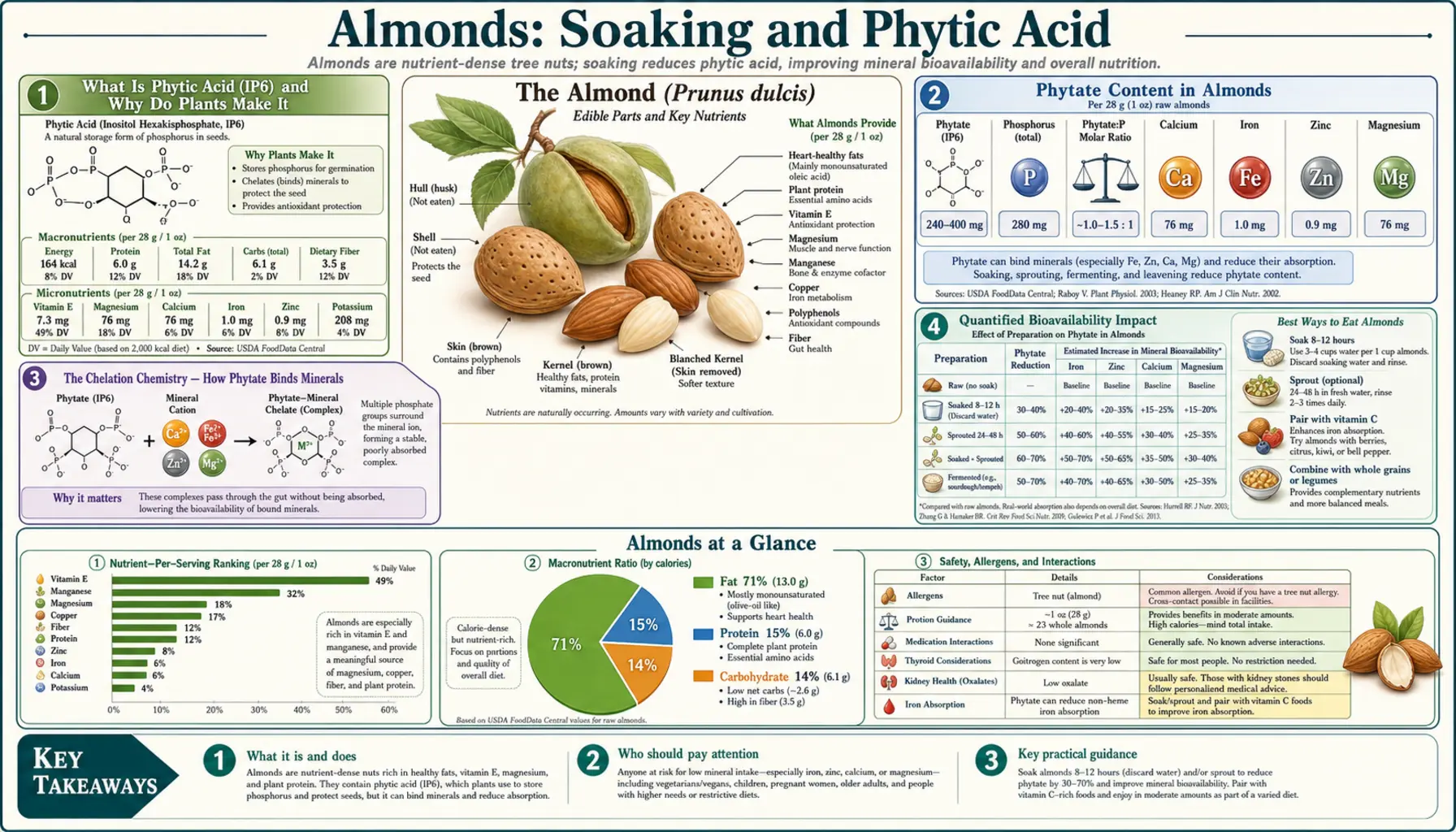
Soaking almonds overnight, sometimes followed by drying them at a low temperature, is widely promoted in the popular press and in traditional-foods writing as a way to “activate” the nuts: to break down phytic acid (inositol hexaphosphate, IP6), the seed's phosphorus store, which binds iron and zinc in the gut and can reduce their absorption. Studies that measured almonds directly found that soaking changed their phytate very little. A New Zealand trial measured 531 mg/100 g of phytate in whole unsoaked almonds and 563 mg/100 g in whole soaked almonds; a US analysis found a 4.75% decrease, and only after 24 hours of soaking; and a study of four nut types found differences from −12% to +10%, lower mineral concentrations after soaking, and no improvement in phytate:mineral molar ratios. This page covers phytate chemistry, what is known about phytate and mineral absorption, what the almond soaking studies measured, other preparation methods, the reported benefits of phytate itself, and what remains unknown.
Table of Contents
- What Is Phytic Acid (IP6) and Why Do Plants Make It
- Phytate Content in Almonds
- The Chelation Chemistry — How Phytate Binds Minerals
- What Is Known About Mineral Absorption
- What Soaking Studies on Almonds Measured
- Sprouting, Roasting, Fermentation and Added Phytase
- The “Activated Nuts” Claims
- The Other Side: Phytate as Antioxidant and Possible Anti-Cancer Agent
- Who the Phytate Research Concerns Most
- The Almond Skin Question (Polyphenols vs Phytate)
- What the Studies Tested and What Remains Unknown
- Key Research Papers
- Connections
- Featured Videos
What Is Phytic Acid (IP6) and Why Do Plants Make It
Phytic acid (myo-inositol hexakisphosphate, IP6) is the main storage form of phosphorus in cereals, legumes, oilseeds and nuts (Gupta 2015; Pujol 2023). The molecule is a six-carbon inositol ring with a phosphate group on each carbon. At the pH of the gut it carries a strong negative charge, which is what lets it bind positively charged minerals such as iron and zinc. Together, phytic acid and its magnesium, potassium and calcium salts are termed “phytate” (Gibson 2018).
When a seed germinates, phytase enzymes break phytate down step by step into lower inositol phosphates (IP5, IP4, IP3, IP2, IP1), free inositol and phosphate, releasing the phosphorus and minerals for the seedling. Gibson and colleagues (2018) describe two ways traditional food processing lowers phytate: loss of water-soluble phytate, and phytase hydrolysis to lower inositol phosphate forms that no longer inhibit iron and zinc absorption. Soaking almonds is meant to start this process; Lee and Mitchell (2019) describe the hypothesis that hydrating the seed triggers IP6 breakdown, through released phytase or passive diffusion of IP6 into the soaking water.
Published phytate values for the same food vary widely. The 2009 review by Schlemmer and colleagues discusses problems with the phytate figures in food composition tables and argues that phytic acid analysis in foods needs standardisation, which is why this page reports measured values from named studies rather than a single table of foods.
Phytate Content in Almonds
Measured values for almonds differ between studies and analytical methods. In the New Zealand trial by Taylor and colleagues (2018), high-performance liquid chromatography (HPLC) gave a phytate concentration of 531 mg/100 g for whole unsoaked almonds. Lee and Mitchell (2019), using anion-exchange chromatography with tandem mass spectrometry, measured IP6 in raw pasteurized almonds at 14.71 µmol per gram.
The studies located for this page did not measure how phytate is distributed between the brown skin and the kernel, or how blanching, roasting or home toasting changes almond phytate. Those questions are not answered here.
The Chelation Chemistry — How Phytate Binds Minerals
In the gut, phytate forms complexes with minerals that are poorly absorbed. Hurrell's 2003 review reports that in adults phytic acid has been shown to inhibit the absorption of iron, zinc, calcium and manganese, but not copper. It describes phytic acid as a strong inhibitor of iron absorption in both infants and adults, its influence on zinc absorption in infants as modest (perhaps most important in children recovering from infection), and its influence on calcium and magnesium absorption as of minor importance.
Dietary phytate-to-iron and phytate-to-zinc molar ratios are used to estimate iron and zinc bioavailability and to set iron and zinc requirements by diet type (Gibson 2018). Published reference points include:
- Phytate:iron: Hurrell (2003) states that when complete enzymatic degradation of phytic acid is not possible, it recommends a molar ratio of phytic acid to iron in an iron-fortified food below 1, preferably below 0.5.
- Desirable ratios used in a complementary-food review: Gibson and colleagues (2010) used phytate:iron below 1, phytate:zinc below 18 and phytate:calcium below 0.17 as suggested desirable levels for mineral absorption.
- Zinc modelling: Hambidge and colleagues (2010) report that modelling zinc absorption from dietary zinc and phytate accounts for more than 80% of the variability in the quantity of zinc absorbed, and that the average estimated dietary zinc requirement doubles with 1000 mg of dietary phytate per day.
- Zinc requirements by phytate intake: the European Food Safety Authority has set adult dietary zinc requirements for four levels of phytate intake (Gibson 2018).
No study located for this page reported phytate:zinc or phytate:iron molar ratios for a serving of almonds. Kumari and colleagues (2020) calculated phytate:mineral molar ratios for raw and soaked almonds, hazelnuts, peanuts and walnuts and found that soaking did not improve them.
What Is Known About Mineral Absorption
No isotope-labelled study measuring how much zinc, iron, calcium or magnesium people absorb from almonds was located for this page, so absorption percentages for almonds are not reported here. The quantified findings on phytate and absorption come from cereal and legume foods:
- Iron from high-phytate porridge: Hurrell (2003) reports that iron absorption may be as low as 2-3% from porridge based on whole-grain cereals and legumes (phytic acid about 1 g/100 g), even in iron-deficient subjects. Decreasing phytic acid by 90% would be expected to increase absorption about twofold, and complete degradation perhaps fivefold or more; the review states that more modest reductions may not usefully improve iron absorption.
- Legume-based diets: Sandberg (2002) reports that iron and zinc absorption have been shown to be low from legume-based diets, and that nutritional iron deficiency is most prevalent in populations subsisting on cereal- and legume-based diets. The same review states that in a balanced diet containing animal protein, a high intake of legumes is not considered a risk in terms of mineral supply.
Almonds' magnesium content is covered in the Magnesium and Bone deep-dive; Hurrell's review describes phytate's influence on magnesium and calcium absorption as of minor importance.
What Soaking Studies on Almonds Measured
Lee and Mitchell (2019) define “activated” almonds as raw almonds soaked in water for 12-24 hours at room temperature, sometimes followed by a 24-hour drying period at a low temperature (50 ± 5 °C). Three studies measured what soaking does to almond phytate:
- Taylor and colleagues (2018), New Zealand: an 8-week randomised crossover trial in which 76 participants ate 30 g/day of four almond preparations for 12 days each: whole unsoaked, whole soaked, sliced unsoaked and sliced soaked. Phytate was 531 mg/100 g in whole unsoaked almonds and higher, 563 mg/100 g, in whole soaked almonds (P = 0.016); sliced soaked almonds measured 548 mg/100 g, with no evidence of a difference from whole unsoaked.
- Lee and Mitchell (2019), United States: at least 24 hours of soaking at ambient temperature was required to reduce IP6 in raw pasteurized almonds from 14.71 to 14.01 µmol per gram. The reduction was statistically significant but, in the authors' words, represents only a 4.75% decrease from the unsoaked almonds.
- Kumari and colleagues (2020), New Zealand: whole and chopped almonds, hazelnuts, peanuts and walnuts were tested raw, soaked for 12 hours in salt solution, soaked for 4 hours in salt solution, or soaked for 12 hours in water. Differences in phytate between treated and untreated nuts were small, ranging from −12% to +10%. Soaking resulted in lower mineral concentrations overall, especially for chopped nuts, and did not improve phytate:mineral molar ratios. The authors concluded that the research does not support claims that “activating” nuts results in greater nutrient bioavailability.
In these studies neither a salt solution nor a longer soak produced a large drop in almond phytate. The larger percentage reductions often quoted for soaked nuts in popular writing were not found in the almond studies located for this page.
For legumes and cereals the picture is different. Sandberg (2002) lists soaking, germination, hydrothermal treatment and fermentation as processes that increase the activity of the plant's own phytases, and Kumari and colleagues note that research on legumes and grains indicates soaking reduces phytate. The almond and nut studies above did not find a comparable effect.
Soaking also changed how the almonds were received. In the Taylor trial all four preparations were rated acceptable, but sliced soaked almonds were rated lowest on all three acceptance scales; digestive symptoms were minimal overall, flatulence was rated higher for soaked whole almonds than for unsoaked whole almonds, and the authors concluded that soaking did not improve gastrointestinal tolerance or acceptance. On food safety, a 2023 survey of 981 US consumers who soaked nuts or made nut-based dairy alternatives at home found almonds were the most commonly soaked tree nut (54%); soaking and drying practices varied widely, and the authors state that the safety of many of these practices has not been adequately investigated (Swinehart 2023).
Sprouting, Roasting, Fermentation and Added Phytase
- Sprouting (germination): germination is one of the processes that raise native phytase activity in legumes and cereals (Sandberg 2002), and Egli and colleagues (2002) studied how soaking and germination change phytase activity and phytic acid in grains and seeds considered for complementary feeding. No study measuring phytate in sprouted almonds was located for this page.
- Roasting: no study measuring the effect of roasting on almond phytate was located for this page.
- Soaking followed by drying: the “activated” preparation described by Lee and Mitchell (2019) includes an optional 24-hour drying step; the phytate results in the section above cover the soaking itself.
- Fermentation: fermentation is listed with soaking, germination and phytase treatment among methods developed to reduce phytic acid in food grains (Gupta 2015) and among the processes that raise native phytase activity in legumes (Sandberg 2002). No almond fermentation data were located for this page.
- Added phytase: Sandberg (2002) reports that adding microbial enzyme preparations seems to be the most efficient way to degrade phytate completely during processing, and Hurrell (2003) recommends complete enzymatic degradation of phytic acid in complementary foods.
For almonds specifically, no study comparing these methods side by side was located, so this page does not rank them for almonds. The general point from Hurrell's review is that the size of the reduction matters: large reductions were expected to change iron absorption, while modest ones may not.
The “Activated Nuts” Claims
Soaking nuts, often in salted water, and then drying them at a low temperature is promoted in traditional-foods cookbooks and in the popular press under names such as “activated” or “crispy” nuts. Taylor and colleagues (2018) note that recommendations to soak nuts to reduce phytate and improve gastrointestinal tolerance had received much attention in the popular press despite no supporting scientific evidence for the practice at the time. The claims commonly made, and what the almond studies found:
- Lower phytate: the measured changes were small or absent (Taylor 2018; Lee and Mitchell 2019; Kumari 2020), as set out above.
- Better mineral availability: soaking lowered mineral concentrations, especially in chopped nuts, and did not improve phytate:mineral molar ratios (Kumari 2020).
- Salt in the soaking water: two of the three soaking regimes in the Kumari study used a salt solution; differences in phytate across all treatments stayed within −12% to +10%.
- Easier digestion: in the Taylor trial soaking did not improve gastrointestinal tolerance, and flatulence was rated higher for soaked whole almonds.
- Neutralised enzyme inhibitors: the claim that soaking neutralises trypsin or other protease inhibitors in almonds was not tested in the studies located for this page.
The Other Side: Phytate as Antioxidant and Possible Anti-Cancer Agent
Reviews describe phytate as more than an anti-nutrient. Grases and Costa-Bauza (2019) note that its anti-nutrient effect was first described in 1940 and that researchers have identified many health benefits over the past 30 years; they report that phytate and its breakdown products inhibit calcium salt crystallisation in vitro, and that oral or topical phytate significantly decreases pathological calcifications in vivo, although the mechanism is uncertain. Schlemmer and colleagues (2009) review reported effects on calcification, kidney stone formation and lowering of blood glucose and lipids, and briefly survey its antioxidant and potential anticancer activity.
Pujol and colleagues (2023) summarise in vitro, animal, epidemiological and clinical evidence that phytate reduces vascular calcifications, calcium kidney stones and soft-tissue calcifications, inhibits lipid peroxidation through iron chelation, and improves markers of lipid and carbohydrate metabolism; they also note that phytate is classified by the US Food and Drug Administration as Generally Recognized As Safe.
The cancer research is mostly experimental. Vucenik and Shamsuddin (2006) describe a striking anticancer action of IP6 in experimental models, with reduced cell proliferation and differentiation of malignant cells, and report that preliminary studies in humans suggest IP6 with inositol may enhance the effect of conventional chemotherapy. The same review states that there is enough evidence to justify starting full-scale clinical trials in humans; in other words, a cancer benefit had not been established in such trials. Shamsuddin's 2002 review, “Anti-cancer function of phytic acid,” addresses the same question.
Whether these effects outweigh phytate's effect on mineral absorption for a given diet has not been settled in trials. Sandberg (2002) states that in a balanced diet containing animal protein a high intake of legumes is not considered a risk for mineral supply.
Who the Phytate Research Concerns Most
- People at risk of iron deficiency: Hurrell (2003) describes phytic acid as a strong inhibitor of iron absorption in infants and adults, and Sandberg (2002) reports that nutritional iron deficiency is most prevalent in populations subsisting on cereal- and legume-based diets.
- People at risk of zinc deficiency: Hambidge and colleagues (2010) identify phytate as the principal dietary factor known to impair zinc bioavailability; their model indicates the average estimated zinc requirement doubles with 1000 mg of dietary phytate per day.
- Infants and young children: Hurrell (2003) describes the bioavailability of iron and zinc from complementary foods as a major concern where these deficiencies are widespread. Gibson and colleagues (2010) found that 62% (16/26) of indigenous and 37% (10/27) of processed plant-based complementary foods in low-income countries had at least two phytate:mineral molar ratios above suggested desirable levels, and concluded that dephytinisation probably cannot by itself make up the shortfalls without enrichment with animal-source foods or mineral fortification.
- Plant-based diets: Gibson and colleagues (2018) note that plant-based diets in low-income countries have a high phytate content and that some traditional processing practices reduce the need for high-dose iron fortificants.
- Calcium and magnesium: Hurrell (2003) describes phytate's influence on calcium and magnesium absorption as of minor importance.
None of these findings come from almond studies. The almond soaking studies measured phytate, mineral concentrations, acceptance and digestive symptoms; none measured mineral absorption or mineral status in people, and none studied pregnancy or infants.
The Almond Skin Question (Polyphenols vs Phytate)
The brown almond skin (pellicle) carries much of the nut's polyphenol content. Milbury and colleagues (2006) measured total phenols ranging from 127 to 241 mg gallic acid equivalents per 100 g across seven California almond varieties, identified isorhamnetin glycosides, catechin, kaempferol and quercetin glycosides and epicatechin among the predominant flavonoids, and reported values for both whole and blanched almonds. The polyphenols are discussed further in the Heart Health and Vitamin E deep-dives; phytate's effect on minerals is the subject of this page.
Blanching removes the skin and its polyphenols. Whether it also lowers almond phytate was not measured in the studies located for this page, so the trade-off between skin polyphenols and phytate cannot be put into numbers from this evidence.
What the Studies Tested and What Remains Unknown
- Soaking regimes tested: 4 hours in salt solution, 12 hours in salt solution and 12 hours in water, for whole and chopped nuts (Kumari 2020); whole and sliced almonds, soaked and unsoaked, eaten at 30 g/day for 12 days each (Taylor 2018); soaking at ambient temperature for up to 24 hours (Lee and Mitchell 2019).
- What was measured: phytate by HPLC or by anion-exchange chromatography with tandem mass spectrometry, minerals by inductively coupled plasma mass spectrometry, phytate:mineral molar ratios, consumer acceptance and digestive symptoms.
- What was not measured: mineral absorption or mineral status in people eating soaked versus raw almonds, phytate in sprouted, roasted or blanched almonds, and protease-inhibitor activity in almonds before and after soaking.
- Food safety: home soaking and drying practices vary, and their safety has not been adequately investigated (Swinehart 2023).
- Where the strong phytate findings come from: cereal- and legume-based diets and complementary foods (Hurrell 2003; Sandberg 2002; Gibson 2010), not almonds.
Decisions about diet and mineral deficiencies belong with a clinician.
Key Research Papers
- Reddy NR, Sathe SK, Salunkhe DK (1982). Phytates in legumes and cereals. Advances in Food Research — PubMed PMID: 6299067
- Schlemmer U, Frølich W, Prieto RM, Grases F (2009). Phytate in foods and significance for humans: food sources, intake, processing, bioavailability, protective role and analysis. Molecular Nutrition & Food Research — PubMed PMID: 19774556
- Hurrell RF (2003). Influence of vegetable protein sources on trace element and mineral bioavailability. Journal of Nutrition — PubMed PMID: 12949395
- Hambidge KM, Miller LV, Westcott JE, Sheng X, Krebs NF (2010). Zinc bioavailability and homeostasis. American Journal of Clinical Nutrition — PubMed PMID: 20200254
- Gibson RS, Bailey KB, Gibbs M, Ferguson EL (2010). A review of phytate, iron, zinc, and calcium concentrations in plant-based complementary foods used in low-income countries and implications for bioavailability. Food and Nutrition Bulletin — PubMed PMID: 20715598
- Shamsuddin AM (2002). Anti-cancer function of phytic acid. International Journal of Food Science and Technology — doi:10.1046/j.1365-2621.2002.00620.x
- Vucenik I, Shamsuddin AM (2006). Protection against cancer by dietary IP6 and inositol. Nutrition and Cancer — PubMed PMID: 17044765
- Pujol A, Sanchis P, Grases F, Masmiquel L (2023). Phytate intake, health and disease: “let thy food be thy medicine and medicine be thy food.” Antioxidants — PubMed PMID: 36671007
- Sandberg AS (2002). Bioavailability of minerals in legumes. British Journal of Nutrition — PubMed PMID: 12498628
- Egli I, Davidsson L, Juillerat MA, Barclay D, Hurrell RF (2002). The influence of soaking and germination on the phytase activity and phytic acid content of grains and seeds potentially useful for complementary feeding. Journal of Food Science — doi:10.1111/j.1365-2621.2002.tb09609.x
- Mandalari G, Bisignano C, Filocamo A, et al. (2013). Bioaccessibility of pistachio polyphenols, xanthophylls, and tocopherols during simulated human digestion. Nutrition — PubMed PMID: 23237656
- Grases F, Costa-Bauza A (2019). Key aspects of myo-inositol hexaphosphate (phytate) and pathological calcifications. Molecules — PubMed PMID: 31817119
- Taylor H, Webster K, Gray AR, et al. (2018). The effects of ‘activating’ almonds on consumer acceptance and gastrointestinal tolerance. European Journal of Nutrition — PubMed PMID: 28956139
- Lee LY, Mitchell AE (2019). Determination of d-myo-inositol phosphates in ‘activated’ raw almonds using anion-exchange chromatography coupled with tandem mass spectrometry. Journal of the Science of Food and Agriculture — PubMed PMID: 29808577
- Kumari S, Gray AR, Webster K, et al. (2020). Does ‘activating’ nuts affect nutrient bioavailability? Food Chemistry — PubMed PMID: 32199146
- Gibson RS, Raboy V, King JC (2018). Implications of phytate in plant-based foods for iron and zinc bioavailability, setting dietary requirements, and formulating programs and policies. Nutrition Reviews — PubMed PMID: 30010865
- Gupta RK, Gangoliya SS, Singh NK (2015). Reduction of phytic acid and enhancement of bioavailable micronutrients in food grains. Journal of Food Science and Technology — PubMed PMID: 25694676
- Milbury PE, Chen CY, Dolnikowski GG, Blumberg JB (2006). Determination of flavonoids and phenolics and their distribution in almonds. Journal of Agricultural and Food Chemistry — PubMed PMID: 16819912
- Swinehart M, Harris LJ, Anderson NM, Feng Y (2023). U.S. consumer practices of homemade nut-based dairy analogs and soaked nuts. Journal of Food Protection — PubMed PMID: 37468108
PubMed Topic Searches
Connections
- All Food
- Almonds Overview
- Almonds Benefits Hub
- Almonds for Heart Health & LDL
- Almonds for Magnesium & Bone
- Almonds for Vitamin E & Skin
- Zinc
- Iron
- Calcium
- Magnesium
- Vitamin C (Iron Absorption Enhancer)
- Iron Deficiency Anemia
- Ferritin (Iron Stores)
- Lentils
- Beans
- Soaking, Sprouting and Fermenting (Weston A. Price)
- History
- Nutrients