Arsenic in Brown Rice: What the Evidence Actually Says
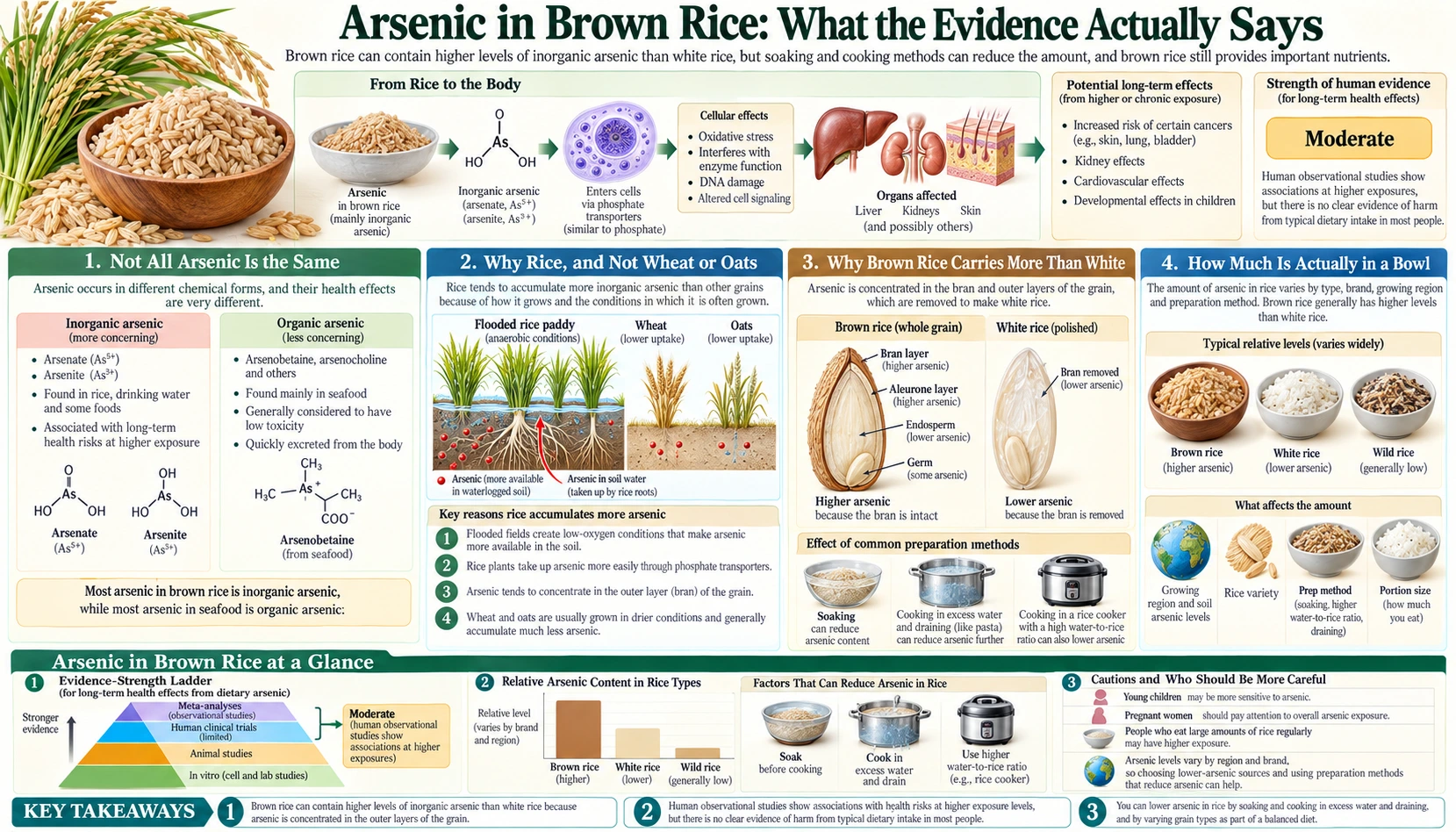
This is the one genuine caveat about brown rice, and it deserves a straight answer rather than either reassurance or alarm. Rice takes up arsenic from soil and water far more readily than any other cereal, because of how flooded paddy fields behave chemically. The arsenic that matters most — the inorganic form — concentrates in the bran, which is exactly the layer that makes brown rice worth eating. So brown rice carries roughly one and a half to two times the inorganic arsenic of white rice grown in the same field. That is a real trade-off, and pretending otherwise would be dishonest. What follows is what is actually measured, how much the growing region changes the answer, where the genuine concern sits (infant foods and rice syrup, far more than an adult's dinner), and the cooking methods that, in published tests, removed from about a third of it up to 85% for some rices — most of them simple and close to free.
Table of Contents
- Not All Arsenic Is the Same
- Why Rice, and Not Wheat or Oats
- Why Brown Rice Carries More Than White
- How Much Is Actually in a Bowl
- Where It Was Grown Changes the Answer
- What the Health Evidence Shows — and What It Does Not
- Babies, Rice Cereal and Brown Rice Syrup
- The Legal Limits, and What They Mean
- Cooking It Out: Three Methods That Work
- Rinsing, Soaking and Rotating Your Grains
- Who the Research Raises Concerns For
- The Honest Conclusion
- Key Research Papers
- Connections
- Featured Videos
Not All Arsenic Is the Same
Arsenic is an element. It is in rock, in soil and in groundwater everywhere on earth, and it has been in the human diet for as long as there has been a human diet. What matters is not whether arsenic is present — it always is — but which chemical form it is in.
Inorganic arsenic means arsenic bonded to oxygen and nothing else: arsenite (the more toxic, more mobile form) and arsenate. This is the form the International Agency for Research on Cancer classifies as a Group 1 human carcinogen, on evidence from populations drinking contaminated well water in Bangladesh, West Bengal, Taiwan, Chile and Argentina. Long-term exposure at those levels causes skin lesions and skin, lung and bladder cancer, and is associated with cardiovascular disease and diabetes.
Organic arsenic means arsenic bound into a carbon-containing molecule. In rice the main one is dimethylarsinic acid (DMA), produced partly by soil microbes and partly by the plant itself. DMA is far less toxic than the inorganic forms, and arsenobetaine — the form that makes up almost all the arsenic in fish and shellfish — is essentially harmless and passes straight through you.
This is why a headline about "arsenic in rice" is nearly meaningless without speciation. A laboratory that measures only total arsenic cannot tell you whether a sample is a problem. Every number in this article refers specifically to inorganic arsenic unless it says otherwise.
Why Rice, and Not Wheat or Oats
Rice accumulates roughly ten times the arsenic of other cereal grains grown on similar land. Two things drive it, and both are unavoidable features of how rice is grown.
Flooded soil changes arsenic's chemistry. In a dry field, soil arsenic is mostly arsenate, which sticks tightly to iron oxide particles and stays put. Flood the field and the soil goes anaerobic: bacteria strip oxygen from those iron oxides, the particles dissolve, and the arsenate they were holding is released and reduced to arsenite. Arsenite is soluble and mobile, so in a paddy it is free in the soil water where roots can reach it. A wheat field never does this.
Rice's silicon transporters carry arsenite by mistake. Rice is a silicon accumulator — silica is what stiffens the stem and the leaf edges. It has unusually powerful root transporters (Lsi1 and Lsi2) built to pull silicic acid out of soil water. Arsenite happens to be almost the same size and shape as silicic acid, so those transporters carry it too. Rice is, in effect, equipped with a very efficient arsenic pump it never asked for.
Williams and colleagues established the speciation picture across paddy rice in 2005, and it has held up: the arsenic in rice is a mixture of inorganic forms and DMA, in proportions that vary enormously by region.
Why Brown Rice Carries More Than White
Arsenic taken up by the roots moves into the grain and is deposited preferentially in the outer layers — the pericarp, the aleurone and the germ — which together are what we call the bran. Sun and colleagues measured this directly in 2008 and found inorganic arsenic in rice bran and bran products was an order of magnitude higher than in the bulk grain.
The arithmetic follows straightforwardly. Bran and germ are roughly eight to ten percent of the weight of the grain. If that fraction carries about ten times the concentration of the starchy endosperm, then whole brown rice ends up at roughly:
- 0.09 of the weight at 10× concentration — that is 0.9 "units" of arsenic;
- 0.91 of the weight at 1× concentration — that is 0.91 units;
- total about 1.8 units, against 0.91 for the milled white grain alone.
So brown rice sits at roughly one and a half to two times the inorganic arsenic of white rice from the same paddy. Retail surveys by the US Food and Drug Administration have repeatedly landed in that range. It is not a tenfold difference, and it is not nothing.
Rice bran sold on its own, and rice bran solubles, sit at the top of the range because they are the concentrated layer with the endosperm removed. Sun and colleagues found inorganic arsenic in rice bran reaching approximately 1 mg/kg dry weight, around 10–20 fold higher than in bulk grain, and 0.61–1.9 mg/kg in five rice bran solubles products — which matters for anyone who takes rice bran as a fibre supplement.
Being straight about this matters, because the same bran layer is where brown rice's magnesium, manganese, thiamine, fibre and vitamin E live. You cannot keep one and discard the other by choosing a different brand. You can, however, change how much arsenic survives to the plate, and that is what the cooking section below is for.
How Much Is Actually in a Bowl
Useful scale-setting: Gilbert-Diamond and colleagues measured urinary arsenic in pregnant women in the United States and found that eating about half a cup of cooked rice a day produced urinary arsenic comparable to drinking about a litre of water at the US drinking-water limit of 10 micrograms per litre. That is a real, measurable exposure. It is also an exposure well below the levels at which the cancer evidence was built, which came from populations drinking water at ten to fifty times that limit, every day, for decades.
The European Food Safety Authority's 2009 opinion did not set a safe intake, because for a genotoxic carcinogen there isn't one. Instead it identified a benchmark dose range of roughly 0.3 to 8 micrograms per kilogram of body weight per day associated with a 1% increase in the risk of lung, skin and bladder cancer — and noted that dietary exposure in Europe overlapped the bottom of that range.
In 2024 the authority published an update of that risk assessment. It now uses a much lower reference point — 0.06 micrograms of inorganic arsenic per kilogram of body weight per day, taken from a study on skin cancer (the BMDL05, the lower confidence limit of the dose linked to a 5% relative increase in the background rate) — and compares it with dietary exposure as a "margin of exposure". For adults the margins are low: between 2 and 0.4 for average consumers and between 0.9 and 0.2 at the 95th percentile of exposure, which the panel concluded "raise a health concern despite the uncertainties".
Menon and colleagues ran the same question for the United Kingdom in 2020 and reached a similar conclusion — typical exposures modest, with the high-consuming groups (people for whom rice is the daily staple, and infants) the ones that actually matter.
Where It Was Grown Changes the Answer
Meharg's 2009 survey of 901 polished rice samples from 10 countries found that median total arsenic varied 7-fold between countries, from 0.04 mg/kg in Egypt and 0.07 mg/kg in India to 0.25 mg/kg in the United States and 0.28 mg/kg in France — a bigger difference than the one between brown and white. Just as important, the survey found that the proportion that is inorganic also varies by region, so a total-arsenic figure on its own is a poor guide to risk.
Broad patterns that repeat across surveys:
- Rice grown on former cotton land in the south-central United States (Arkansas, Louisiana, Texas, Missouri) tends to run higher. Arsenical pesticides were used heavily on cotton for decades and the arsenic is still in the soil.
- Californian rice tends to run lower than south-central US rice, on soils without that legacy.
- Basmati from India and Pakistan, and rice from parts of Southeast Asia, are consistently among the lower-arsenic imports in retail testing.
- Rice from areas irrigated with arsenic-contaminated groundwater — parts of Bangladesh and West Bengal above all — can be much higher, and those are also the populations already exposed through their drinking water.
Most packets tell you the country of origin, and many tell you the state. That single line on the bag is a bigger lever than almost anything else on this page.
What the Health Evidence Shows — and What It Does Not
Here is where the honest picture diverges from the alarming one.
What is firmly established: chronic exposure to inorganic arsenic at drinking-water concentrations causes cancer of the skin, lung and bladder, skin lesions, and is associated with cardiovascular disease, type 2 diabetes and impaired development in children. Naujokas and colleagues' 2013 review is the standard summary of that literature.
What is measured but of unclear consequence: rice consumption raises urinary arsenic in a dose-dependent way in adults, children and pregnant women. Urinary arsenic is a biomarker of exposure, not of harm.
What has not been shown: that eating rice — brown or white — at ordinary Western frequencies causes any of those outcomes. There is no cohort study demonstrating that brown rice eaters get more bladder cancer. Studies looking for associations between rice intake and cancer in populations without contaminated drinking water have been inconsistent and generally null.
That does not make the exposure irrelevant. Arsenic is a carcinogen with no threshold, exposure is cumulative over a lifetime, and the mitigations are close to free. It does mean that "brown rice contains arsenic, therefore avoid brown rice" gets the risk arithmetic backwards — it trades a small, reducible, unproven risk for the loss of a whole-grain food with well-documented benefits.
Babies, Rice Cereal and Brown Rice Syrup
This is where the concern is real and specific, and it is not really about brown rice at dinner.
Infants are the wrong body for this exposure. They are small, so the same micrograms are a much larger dose per kilogram. They eat a narrow range of foods, so one food can dominate. And the developing nervous system is the tissue arsenic affects most. Karagas and colleagues found in 2016 that, among 12-month-old American infants who did not eat fish or seafood, the geometric mean urinary arsenic was 9.53 µg/L in those who ate infant rice cereal and 4.97 µg/L in those who ate rice snacks, against 2.85 µg/L in those who ate no rice or rice products — and rice cereal has for decades been the default first solid food in the English-speaking world, for no nutritional reason at all.
Brown rice syrup is a hidden route. Jackson and colleagues reported in 2012 that products sweetened with organic brown rice syrup — including a toddler formula and several cereal bars marketed as health foods — carried many times the arsenic of comparable products made without it. The syrup is made from the whole grain and concentrated, so it concentrates what the grain carried. "Organic" says nothing about arsenic: arsenic is an element in the soil, not a pesticide residue.
Signes-Pastor and colleagues surveyed rice-based products for infants and young children in 2016 and found inorganic arsenic across the category, with some products above the levels since set as limits.
The Karagas study, in a New Hampshire birth cohort, obtained dietary data on 759 infants: an estimated 80% were introduced to rice cereal during their first year, and the infant rice snacks tested contained 5 to 201 ng/g of inorganic arsenic. A 2020 survey of 55 types of rice sold in the United Kingdom found that brown rice contained significantly more inorganic arsenic than white or wild rice, and that 28 samples exceeded the EU maximum of 0.1 mg/kg for rice used in food for infants.
What these measurements point to:
- Rice cereal does not have to be a first food. Oat, barley and buckwheat porridges, mashed vegetables, pureed fruit, egg yolk and full-fat yoghurt all work and carry no comparable arsenic load.
- Rice cereal given as one food among several, rather than daily, makes up a smaller share of a baby's diet and of its arsenic.
- Labels list "brown rice syrup" or "rice syrup" where it is used in bars, toddler snacks and sweetened products.
- Rice milk as a small child's staple drink raises the same concern, for the same reason.
- None of this is a reason to keep whole grains away from children — it is a reason to spread them across several grains.
The Legal Limits, and What They Mean
Both major regulators moved on this in the last decade, and the shape of the rules tells you where they think the risk is.
The European Union has set maximum levels for inorganic arsenic in rice since 2016, now carried in the contaminants regulation. There are separate limits for milled (white) rice, husked (brown) rice, parboiled rice, rice waffles and crackers, and — the strictest of the set — rice destined for food for infants and young children, at 0.10 milligrams per kilogram. The limit for husked brown rice is deliberately set higher than for milled white rice, which is the regulator conceding in law exactly what this article says in the bran section.
The United States has no maximum level for rice generally, but the Food and Drug Administration finalised an action level of 100 parts per billion (0.10 mg/kg) of inorganic arsenic in infant rice cereal in 2020 — the same number, aimed at the same group.
Read those together and the regulatory judgement is clear: ordinary rice for adults is managed, not restricted; rice for babies is the part that needed a hard number.
Cooking It Out: Three Methods That Work
Arsenic in rice is substantially water-soluble, which means the cooking pot is a genuine intervention. Three approaches have been tested and published, and they trade off differently against nutrient loss.
1. Excess water, drained — the simple one
This method cooks brown rice like pasta: six to ten parts water to one part rice, boiled until tender (around 25–35 minutes for most brown rice), then the excess drained and the rice left to steam dry for a few minutes off the heat. Raab and colleagues showed in 2009 that cooking at a high water-to-rice ratio (6:1) with the water discarded cut total arsenic by 35% and inorganic arsenic by 45%; those results were reported for long-grain and basmati rice. It costs nothing but a colander, and the texture is excellent — separate grains rather than sticky.
The trade-off is that some water-soluble B vitamins and some potassium leave with the water. For someone eating a varied diet this is a minor loss against a real gain.
2. Percolating water — the most effective
Carey and colleagues published a percolating method in 2015 in which near-boiling water runs continuously through the rice rather than sitting on it, so the dissolved arsenic is carried away instead of reaching equilibrium. They tested two versions. In a laboratory set-up that recycled the cooking water as steam, it removed on average 59±8% of the inorganic arsenic from polished rice and 69±10% from wholegrain rice, and up to 85% from individual rice types. In a home version, tap water run through rice held in an off-the-shelf coffee percolator removed 49±7% on average, with no difference between wholegrain and polished rice. For comparison, ordinary cooking at 12 parts water to 1 part rice removed 57±5% in the same study.
3. Parboiling with absorption — the best compromise
Menon and colleagues published a method in 2021 designed specifically to strip arsenic without stripping minerals. Bring water to the boil first, add the rice, boil it briefly, drain that water off, then add fresh water at a normal absorption ratio and cook it through so nothing is poured away at the end. In their tests this removed 54% of the inorganic arsenic from brown rice and 73% from white rice, raising the margin of exposure 2.2 times for brown rice and 3.7 times for white. The nutrients measured were phosphorus, potassium, magnesium, zinc and manganese: there was no significant loss of zinc, and the loss of the others was similar to or less than the losses reported for rice cooked in excess water. The other home methods in the study — unwashed, washed or pre-soaked rice cooked by absorption — lowered inorganic arsenic in white rice only.
The authors judged parboiling with absorption the best of the approaches they assessed.
Rinsing, Soaking and Rotating Your Grains
- Rinsing until the water runs clear. Modest on its own — Raab and colleagues measured circa 10% removal of total and inorganic arsenic from basmati rice, and rinsing was less effective for other rice types — but free, and it also removes dust and loose bran fragments. In the 2021 parboiling study, washing before absorption cooking lowered inorganic arsenic in white rice only.
- Soaking overnight, then discarding the soaking water and rinsing again. This does three useful things at once: it pulls out more arsenic, it starts breaking down phytate so the grain's own minerals absorb better, and it cuts the cooking time by a third. In the 2021 study, though, pre-soaking followed by absorption cooking lowered inorganic arsenic in white rice only, not in brown.
- Cooking in the soaking water, or in a rice cooker set to absorb every drop, keeps the arsenic in the pot. Absorption cooking, by design, keeps everything the water dissolved.
- Rotating grains. The single most effective thing on this list. Oats, barley, buckwheat, quinoa, millet and whole wheat carry a small fraction of rice's arsenic. Eating brown rice three or four times a week instead of twice a day cuts exposure more than any cooking method, and improves the diet on every other axis too.
- Lower-arsenic origins, where the label states them — see the geography section above.
- Well water. Private wells, particularly in New England, the upper Midwest and the western United States, can carry arsenic that only a test of the water shows. Well water is a far bigger exposure route than food for the people it affects, and rice cooked in that water absorbs it.
Who the Research Raises Concerns For
- Infants and young children — the group both regulators singled out. The measures described above are varied grains, and keeping rice syrup and rice milk out of the staple role.
- People for whom rice is the staple at every meal, especially South Asian and East and Southeast Asian households in which rice is eaten two or three times a day. Here the cooking methods above make the largest difference, and grain rotation is harder but still lowers exposure.
- Pregnant women — not because rice is dangerous in pregnancy, but because the developing nervous system is the sensitive tissue and the mitigations cost nothing.
- Anyone drinking arsenic-containing well water, whose total exposure is already elevated before food is counted.
- People eating rice bran or rice bran products as a supplement, which is the concentrated layer by definition.
- Coeliac and gluten-free eaters, a group that quietly ends up eating far more rice than average because rice flour is the backbone of gluten-free baking. Buckwheat, oats (certified gluten-free), quinoa and millet are gluten-free grains for that rotation.
The Honest Conclusion
Brown rice contains more inorganic arsenic than white rice, because the bran holds most of it and brown rice is the grain with the bran left on. That is a genuine cost, and it sits against genuine benefits — the fibre, magnesium, manganese, thiamine, vitamin E and the whole-grain association with lower cardiovascular and diabetes risk that the rest of this section covers.
The evidence does not support avoiding brown rice. It points to four things:
- Cooking it in plenty of water and pouring some of it away removes a large share of the inorganic arsenic.
- Eating rice at fewer meals lowers exposure more than any single cooking method.
- Rice cereal, rice syrup and rice milk matter most when they become a baby's staple.
- The growing region changes the arsenic content, and many labels state it.
Together these remove most of the extra arsenic and keep all of the bran. That is the whole answer, and it is a better answer than either "brown rice is dangerous" or "don't worry about it".
Key Research Papers
- Sun G, Williams PN, Carey A, et al. Inorganic arsenic in rice bran and its products are an order of magnitude higher than in bulk grain. Environmental Science & Technology. 2008;42(19):7542–7546. — doi:10.1021/es801238p
- Meharg AA, Williams PN, Adomako E, et al. Geographical variation in total and inorganic arsenic content of polished (white) rice. Environmental Science & Technology. 2009;43(5):1612–1617. — doi:10.1021/es802612a
- Williams PN, Price AH, Raab A, Hossain SA, Feldmann J, Meharg AA. Variation in arsenic speciation and concentration in paddy rice related to dietary exposure. Environmental Science & Technology. 2005;39(15):5531–5540. — doi:10.1021/es0502324
- Raab A, Baskaran C, Feldmann J, Meharg AA. Cooking rice in a high water to rice ratio reduces inorganic arsenic content. Journal of Environmental Monitoring. 2009;11(1):41–44. — doi:10.1039/b816906c
- Carey M, Jiujin X, Gomes Farias J, Meharg AA. Rethinking rice preparation for highly efficient removal of inorganic arsenic using percolating cooking water. PLOS ONE. 2015;10(7):e0131608. — doi:10.1371/journal.pone.0131608
- Menon M, Dong W, Chen X, Hufton J, Rhodes EJ. Improved rice cooking approach to maximise arsenic removal while preserving nutrient elements. Science of the Total Environment. 2021;755:143341. — doi:10.1016/j.scitotenv.2020.143341
- Gilbert-Diamond D, Cottingham KL, Gruber JF, et al. Rice consumption contributes to arsenic exposure in US women. Proceedings of the National Academy of Sciences. 2011;108(51):20656–20660. — doi:10.1073/pnas.1109127108
- Karagas MR, Punshon T, Sayarath V, Jackson BP, Folt CL, Cottingham KL. Association of rice and rice-product consumption with arsenic exposure early in life. JAMA Pediatrics. 2016;170(6):609–616. — doi:10.1001/jamapediatrics.2016.0120
- Jackson BP, Taylor VF, Karagas MR, Punshon T, Cottingham KL. Arsenic, organic foods, and brown rice syrup. Environmental Health Perspectives. 2012;120(5):623–626. — doi:10.1289/ehp.1104619
- Signes-Pastor AJ, Carey M, Meharg AA. Inorganic arsenic in rice-based products for infants and young children. Food Chemistry. 2016;191:128–134. — doi:10.1016/j.foodchem.2014.11.078
- EFSA Panel on Contaminants in the Food Chain (CONTAM). Scientific opinion on arsenic in food. EFSA Journal. 2009;7(10):1351. — doi:10.2903/j.efsa.2009.1351
- EFSA Panel on Contaminants in the Food Chain (CONTAM), Schrenk D, Bignami M, Bodin L, et al. Update of the risk assessment of inorganic arsenic in food. EFSA Journal. 2024;22(1):e8488. — PubMed PMID: 38239496
- Menon M, Sarkar B, Hufton J, Reynolds C, Reina SV, Young S. Do arsenic levels in rice pose a health risk to the UK population? Ecotoxicology and Environmental Safety. 2020;197:110601. — doi:10.1016/j.ecoenv.2020.110601
- Naujokas MF, Anderson B, Ahsan H, et al. The broad scope of health effects from chronic arsenic exposure: update on a worldwide public health problem. Environmental Health Perspectives. 2013;121(3):295–302. — doi:10.1289/ehp.1205875
Authoritative Sources and Live Searches
- US FDA — Arsenic in Food and Dietary Supplements (retail survey data and the infant rice cereal action level)
- EU Regulation 2023/915 on maximum levels for certain contaminants in food
- IARC Monograph 100C — Arsenic and Inorganic Arsenic Compounds (PDF)
- WHO — Arsenic fact sheet
- PubMed: inorganic arsenic rice cooking removal
- PubMed: arsenic rice infant exposure
- PubMed: brown rice arsenic bran speciation
Connections
- Brown Rice — the main page, with the full nutrient profile and cooking guide.
- White Rice — the same grain milled; lower arsenic, lower everything else.
- Brown Rice: History and Origins — why the world ended up polishing its rice in the first place.
- Arsenic — the toxicology in full, including drinking water.
- Toxic Minerals — the heavy metals section.
- Phytate, Soaking and Germination — soaking helps here too, for a different reason.
- Fibre, Magnesium and Manganese — what the bran gives you in exchange.
- Quinoa — a rotation grain with no comparable arsenic load.
- Buckwheat — gluten-free and not a rice substitute in name only.
- Oats — the obvious replacement for infant rice cereal.
- Barley — another low-arsenic whole grain worth rotating in.
- Brown Rice: Nutrient Profile — the U.S. Department of Agriculture (USDA) numbers in full.