Pomegranate: Nutrient Profile
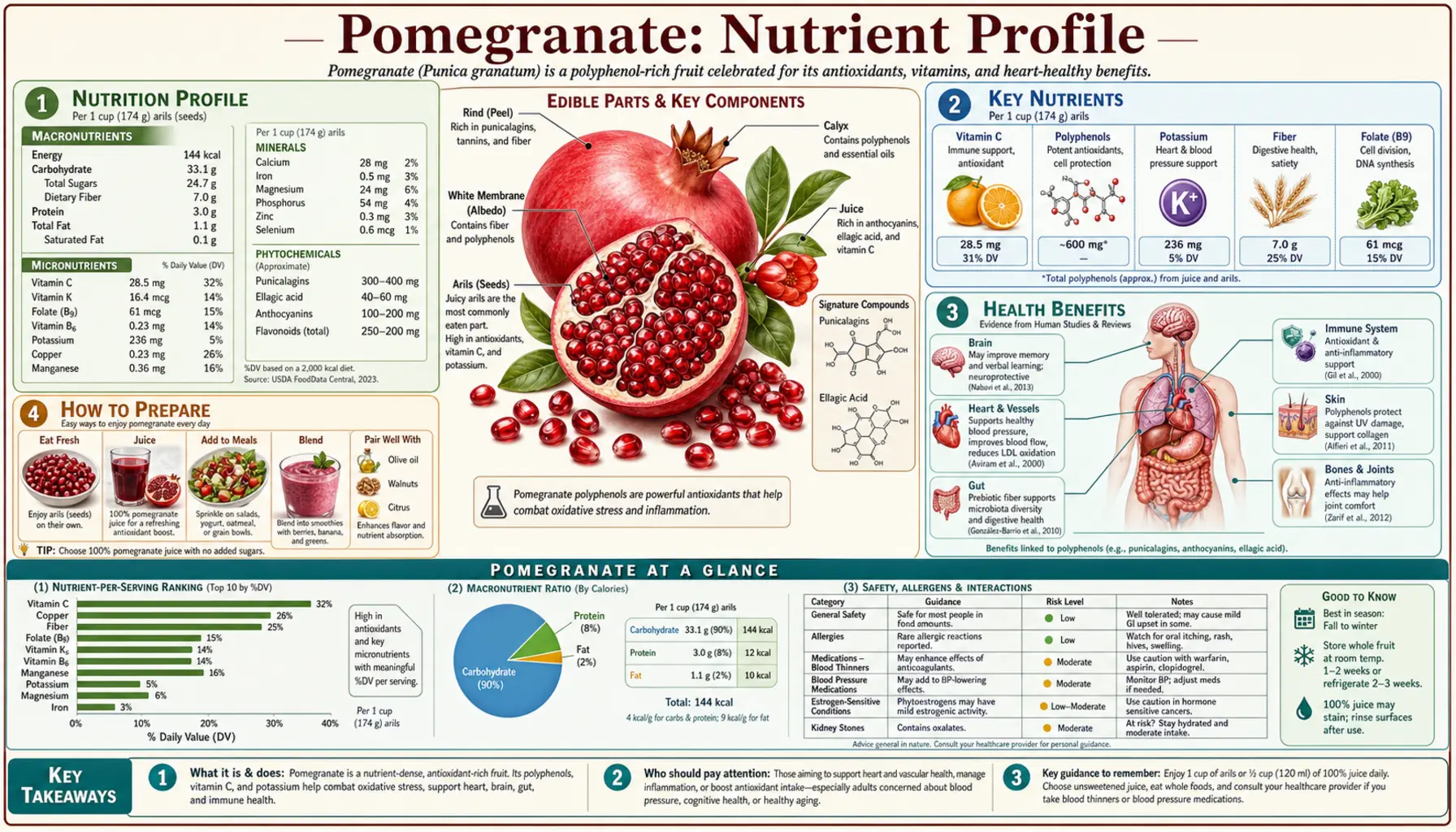
What is Pomegranate richest in? Below are the vitamins, minerals and amino acids that 100 g of Pomegranate delivers in the highest amounts. Each one links to that nutrient’s own page listing the best foods to get it from.
| Pomegranate: Richest Nutrients (per 100 g) | ||||
|---|---|---|---|---|
| Rank | Nutrient | Per 100 g | %DV / 100g | Purpose |
| Vitamins | ||||
| 1 | Vitamin K | 16 mcg | 🟡 14% | Blood clotting & bone |
| 2 | Vitamin C | 10 mg | 🟡 11% | Antioxidant; builds collagen |
| Minerals | ||||
| 1 | Copper | 0.2 mg | 🟡 18% | Iron use; connective tissue |
Values are per 100 g of the U.S. Department of Agriculture (USDA) FoodData Central record FDC 169134, “Pomegranates, raw” (SR Legacy). %DV is the amount per 100 g divided by the adult Daily Value in 21 CFR 101.9.
The table lists vitamins and minerals only. The same USDA record also lists, per 100 g of raw pomegranate: 83 kcal, 4.0 g of dietary fiber, 13.7 g of total sugars and 38 µg of folate. USDA’s portion weight for half a cup of arils (the seed and juice sacs) is 87 g.
Beyond vitamins and minerals, a 2024 meta-analysis by Bahari and colleagues pooled 22 randomized trials in adults who ate or drank pomegranate in different forms. Pomegranate lowered systolic blood pressure (weighted mean difference −7.87 mmHg; 95% CI −10.34 to −5.39) and diastolic blood pressure (−3.23 mmHg; 95% CI −5.37 to −1.09), with a greater fall in systolic pressure in people whose starting systolic pressure was above 130 mmHg. The results varied a great deal between studies (heterogeneity I² 90.0% for systolic and 91.8% for diastolic pressure), and the authors call for further high-quality studies.
Key Research Papers
- Bahari H, Omidian K, Goudarzi K, Rafiei H, Asbaghi O, Hosseini Kolbadi KS, Naderian M, Hosseini A (2024). The effects of pomegranate consumption on blood pressure in adults: a systematic review and meta-analysis. Phytotherapy Research 38(5):2234-2248 — PubMed PMID: 38410857