Avocado — Benefits Deep Dive
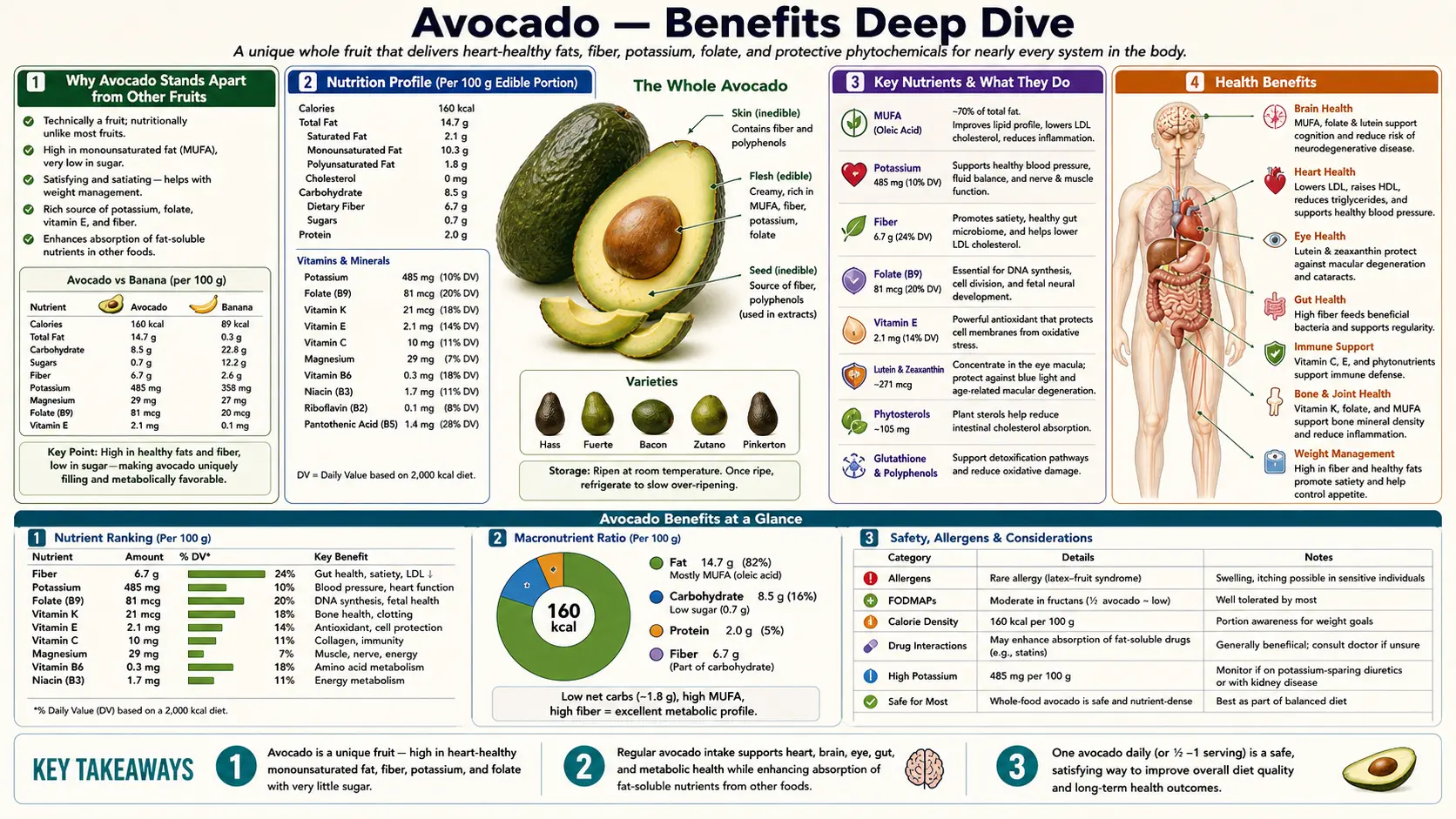
Avocado (Persea americana) is the rare whole-food fruit whose macronutrient profile is dominated by fat rather than carbohydrate — approximately 77% of its calories come from lipids, with most of that as oleic acid, the same monounsaturated fatty acid that defines the Mediterranean diet. The benefits cluster into four distinct mechanisms: (1) a lipid profile that, in pooled trials, modestly lowered total cholesterol (by about 5 mg/dL across 9 trials in a 2024 meta-analysis, with low-density lipoprotein (LDL) cholesterol falling only in people with high cholesterol) and raised high-density lipoprotein (HDL) cholesterol by 2.84 mg/dL in a 2018 meta-analysis of 7 studies, (2) one of the densest dietary potassium sources in the supermarket — 507 mg per 100 g of flesh (USDA FoodData Central 171706) — with direct blood-pressure-lowering action through the sodium-potassium-renin axis, (3) the unusual viscous-fiber and monounsaturated-fat combination that produces sustained satiety and reduces postprandial glucose excursion, and (4) the role of avocado's fat content as a vehicle that dramatically increases absorption of fat-soluble carotenoids (lutein, zeaxanthin, beta-carotene) from co-eaten vegetables.
Deep-Dive Articles
Monounsaturated Fats
Oleic acid (the dominant fatty acid in avocado and olive oil) and the changes in blood lipids reported when avocado is substituted for saturated fat or refined carbohydrate. The PREDIMED Mediterranean diet trial, the Wang 2015 JAHA avocado-a-day trial, the mechanism of cholesterol-ester reshuffling, and the comparison of avocado to extra virgin olive oil and nuts as monounsaturated-fat sources.
Read the deep dive →Potassium and Blood Pressure
Why avocado, at 507 mg of potassium per 100 g of flesh, counts among the densest potassium sources outside leafy greens. The DASH diet, the WHO 3,510 mg/day potassium target, the sodium-potassium ratio as a stronger predictor of cardiovascular events than sodium alone, and the renal mechanism by which dietary potassium suppresses sodium reabsorption.
Read the deep dive →Fiber and Satiety
The 10 g of total fiber per medium avocado (roughly 70% insoluble, 30% soluble) and its action on gut transit, the microbiome, satiety hormones (cholecystokinin, glucagon-like peptide-1 (GLP-1), PYY), and postprandial glucose excursion. The Wien 2013 Nutrition Journal half-avocado-at-lunch satiety trial, and the practical use of avocado in weight-stability and glycemic-control diets.
Read the deep dive →Skin and Carotenoid Absorption
Avocado fat dramatically increases the absorption of fat-soluble carotenoids from co-eaten vegetables — Unlu 2005 found that adding avocado to salsa gave 4.4× the lycopene and 2.6× the beta-carotene absorption, and adding it to salad gave 15.3× the beta-carotene, 7.2× the alpha-carotene and 5.1× the lutein absorption. The skin benefits of lutein and zeaxanthin (the same retinal pigments that protect the macula also concentrate in skin), the dermatological topical-oil literature, and the vitamin E content.
Read the deep dive →Table of Contents
- Deep-Dive Articles
- Why Avocado Stands Apart from Other Fruits
- Research Papers: Monounsaturated Fats & Lipids
- Research Papers: Potassium & Blood Pressure
- Research Papers: Fiber & Satiety
- Research Papers: Skin & Carotenoid Absorption
- Research Papers: Cross-Cutting (Cardiometabolic, Weight, Diabetes)
- External Authoritative Resources
- Connections
- Featured Videos
Why Avocado Stands Apart from Other Fruits
The avocado is botanically a fruit (specifically, a single-seeded berry of the laurel family, Lauraceae — closely related to cinnamon and bay laurel), but its macronutrient profile is unlike any other commonly consumed fruit. A typical Hass avocado (the most-traded cultivar) delivers approximately 240 kcal per medium fruit (~136 g edible flesh), distributed as roughly 22 g of fat, 12 g of total carbohydrate (of which 10 g is fiber, leaving only 2 g of net digestible carbohydrate), and 3 g of protein. Sugar content is negligible (~0.5 g per fruit). This profile — very-low-sugar, very-high-fat, very-high-fiber — is closer to a nut or an olive than to a banana or an apple.
- Fat composition (oleic-acid-dominant) — approximately 67% of avocado fat is monounsaturated (predominantly oleic acid, C18:1 omega-9, the same fatty acid that dominates olive oil). About 15% is saturated (mostly palmitic acid), and a smaller share is polyunsaturated (mostly linoleic acid) (USDA FoodData Central, FDC 171705, per 100 g: 14.7 g total fat, of which 9.8 g monounsaturated, 2.13 g saturated and 1.82 g polyunsaturated). This lipid signature is the basis for the cardiovascular and lipid effects that have been demonstrated in randomized controlled trials including the Wang 2015 avocado-a-day trial. Pooled together, the trials show a real but small effect: a 2024 meta-analysis of 9 randomized trials (503 people) found that avocado diets lowered total cholesterol by about 5 mg/dL (−5.08 mg/dL) compared with control diets, with no overall change in LDL cholesterol, HDL cholesterol or triglycerides; LDL cholesterol fell (by 9.4 mg/dL) only in the trials of people with high cholesterol, and the authors graded the certainty of the evidence as low to very low. An earlier 2018 meta-analysis found a rise in HDL cholesterol of 2.84 mg/dL across 7 studies and no difference in total or LDL cholesterol.
- Mineral density (potassium-rich) — avocado flesh contains 507 mg of potassium per 100 g (USDA FoodData Central, FDC 171706), and one medium Hass fruit gives about 136 g of flesh, approaching the daily-target densities of leafy greens. Potassium has independent blood-pressure-lowering effects through the renal sodium-potassium exchange mechanism, and the sodium-potassium ratio of the diet is now considered a stronger predictor of cardiovascular events than sodium alone. This is the basis for the blood pressure benefit.
- Fiber density (high total fiber, slow-digesting matrix) — 10 g of fiber per medium fruit is roughly 36% of the daily target (Daily Value (DV) 28 g) in a single serving. Approximately 70% is insoluble (cellulose, hemicellulose, lignin from the cell walls) and 30% soluble (predominantly the heteropolysaccharide complex unique to the avocado fruit pulp). The fiber, combined with the high fat content, slows gastric emptying and produces measurable satiety and glycemic-stabilization effects.
- Carotenoid carrier (the food-matrix synergy effect) — fat-soluble carotenoids from vegetables (lutein, zeaxanthin, beta-carotene, alpha-carotene, lycopene) require dietary fat for intestinal absorption. Avocado's fat content acts as an absorption vehicle: Unlu 2005 documented 2.6 to 15.3 times higher absorption of carotenoids from salsa and salad when avocado was added to the same meal (150 g in the salsa study; 75 or 150 g in the salad study, with no difference between the two amounts). This converts avocado from a passive food item into an active nutritional amplifier for any plant-rich meal it accompanies.
Two large studies add to this picture. The Habitual Diet and Avocado Trial (HAT, 2022) gave 1,008 adults with a large waist either one large avocado a day or their usual diet for 6 months: it found no difference in visceral (belly) fat, liver fat or the parts of the metabolic syndrome, body weight changed about the same in both groups, and total and LDL cholesterol fell modestly (nominally significant) in the avocado group. In two large US cohorts followed for 30 years (68,786 women and 41,701 men), people who ate 2 or more servings of avocado a week had a 16% lower risk of cardiovascular disease (hazard ratio 0.84) and a 21% lower risk of coronary heart disease (hazard ratio 0.79) than people who ate none, with no link to stroke; replacing half a serving a day of margarine, butter, egg, yogurt, cheese or processed meat with avocado was linked to a 16–22% lower risk. That study is observational, so it shows a link, not cause and effect.
What avocado lacks: vitamin C is modest (~10 mg per fruit), it is not a meaningful source of any of the B vitamins except folate (~120 mcg) and pantothenic acid, and the protein content is too low to count as a meaningful protein source. The strengths are concentrated in lipids, minerals (potassium, magnesium, copper), fiber, and the absorption-enhancing fat matrix.
Research Papers: Monounsaturated Fats & Lipids
- Wang L et al. (2015). Effect of a moderate fat diet with and without avocados on lipoprotein particle number, size and subclasses. JAHA. — PubMed: Wang JAHA 2015
- Estruch R et al. (2018). PREDIMED — Primary prevention of cardiovascular disease with a Mediterranean diet supplemented with extra virgin olive oil or nuts. NEJM. — PubMed: PREDIMED 2018
- Mahmassani HA, Avendano EE, Raman G, Johnson EJ (2018). Avocado consumption and risk factors for heart disease: a systematic review and meta-analysis. Am J Clin Nutr 107(4):523-536. — PubMed PMID: 29635493
- Heskey C, Oda K, Sabaté J (2019). Avocado Intake, and Longitudinal Weight and Body Mass Index Changes in an Adult Cohort. Nutrients 11(3):691. — PubMed PMID: 30909592
- Lichtenstein AH et al. (2021). AHA dietary guidance: monounsaturated fat substitution. Circulation. — PubMed: AHA 2021 guidance
- Pacheco LS et al. (2022). Avocado consumption and risk of cardiovascular disease in US adults. JAHA. — PubMed: Avocado CVD US
- Lopez-Ledesma R et al. (1996). Monounsaturated fatty acid (avocado) rich diet for mild hypercholesterolemia. Archives of Medical Research. — PubMed: Lopez-Ledesma 1996
- Alvizouri-Munoz M et al. (1992). Effects of avocado as a source of monounsaturated fatty acids on plasma lipid levels. Archives of Medical Research. — PubMed: Alvizouri 1992
- Carranza-Madrigal J et al. (1997). Effects of a vegetarian diet vs. a vegetarian diet enriched with avocado in hypercholesterolemic patients. Archives of Medical Research. — PubMed: Carranza 1997
Research Papers: Potassium & Blood Pressure
- Appel LJ et al. (1997). DASH (Dietary Approaches to Stop Hypertension) trial. NEJM. — PubMed: DASH trial
- WHO (2012). Guideline: Potassium intake for adults and children (3,510 mg/day target). — PubMed: WHO potassium guideline
- Aburto NJ et al. (2013). Effect of increased potassium intake on cardiovascular risk factors and disease: systematic review and meta-analyses. BMJ. — PubMed: Aburto BMJ 2013
- Yang Q et al. (2011). Sodium and potassium intake and mortality among US adults: NHANES analysis. Archives of Internal Medicine. — PubMed: Yang Na/K mortality
- Whelton PK et al. (2017). ACC/AHA hypertension guideline. Hypertension. — PubMed: ACC/AHA HTN 2017
- Filippini T et al. (2020). Potassium intake and blood pressure: dose-response meta-analysis of trials. JAHA. — PubMed: Filippini 2020
- Stone MS et al. (2016). Potassium intake, bioavailability, hypertension, and glucose control. Nutrients. — PubMed: Stone Nutrients 2016
- Dreher ML, Davenport AJ (2013). Hass avocado composition and potential health effects. Critical Reviews in Food Science and Nutrition. — PubMed: Dreher 2013
- O'Donnell M et al. (PURE Study, 2014). Urinary sodium and potassium excretion and risk of cardiovascular events. NEJM. — PubMed: PURE NEJM 2014
- Cogswell ME et al. (2012). Sodium and potassium intakes among US adults: NHANES 2003-2008. AJCN. — PubMed: NHANES Na/K
Research Papers: Fiber & Satiety
- Wien M et al. (2013). A randomized 3×3 crossover study to evaluate the effect of Hass avocado on post-ingestive satiety and glucose/insulin responses. Nutrition Journal. — PubMed: Wien 2013 satiety
- Reynolds A et al. (2019). Carbohydrate quality and human health: a series of systematic reviews and meta-analyses. Lancet. — PubMed: Reynolds Lancet 2019
- Slavin J (2013). Fiber and prebiotics: mechanisms and health benefits. Nutrients. — PubMed: Slavin Nutrients
- Zhu L, Huang Y, Edirisinghe I, et al. (2019). Using the Avocado to Test the Satiety Effects of a Fat-Fiber Combination in Place of Carbohydrate Energy in a Breakfast Meal in Overweight and Obese Men and Women: A Randomized Clinical Trial. Nutrients 11(5). — PubMed PMID: 31035472
- Henning SM, Yang J, Woo SL, et al. (2019). Hass Avocado Inclusion in a Weight-Loss Diet Supported Weight Loss and Altered Gut Microbiota: A 12-Week Randomized, Parallel-Controlled Trial. Curr Dev Nutr 3(8):nzz068. — PubMed PMID: 31367691
- Thompson SV, Bailey MA, Taylor AM, et al. (2021). Avocado Consumption Alters Gastrointestinal Bacteria Abundance and Microbial Metabolite Concentrations among Adults with Overweight or Obesity: A Randomized Controlled Trial. J Nutr 151(4):753-762. — PubMed PMID: 32805028
- Park E et al. (2018). Avocado fruit on postprandial markers of cardio-metabolic risk: randomized clinical trial. Nutrients. — PubMed: Park 2018
- James-Martin G, Brooker PG, Hendrie GA, Stonehouse W (2024). Avocado Consumption and Cardiometabolic Health: A Systematic Review and Meta-Analysis. J Acad Nutr Diet 124(2):233-248.e4. — PubMed PMID: 36565850
- Fulgoni VL et al. (2013). Avocado consumption is associated with better diet quality and nutrient intake. Nutrition Journal. — PubMed: Fulgoni 2013
- Dreher ML, Cheng FW, Ford NA (2021). A Comprehensive Review of Hass Avocado Clinical Trials, Observational Studies, and Biological Mechanisms. Nutrients 13(12):4376. — PubMed PMID: 34959933
Research Papers: Skin & Carotenoid Absorption
- Unlu NZ, Bohn T, Clinton SK, Schwartz SJ (2005). Carotenoid absorption from salad and salsa by humans is enhanced by the addition of avocado or avocado oil. J Nutr 135(3):431-6. — PubMed PMID: 15735074
- Brown MJ et al. (2004). Carotenoid bioavailability is higher from salads ingested with full-fat than with fat-reduced salad dressings. AJCN. — PubMed: Brown 2004
- Stahl W, Sies H (2012). Beta-carotene and other carotenoids in skin protection from sunlight. AJCN. — PubMed: Stahl skin carotenoids
- Roberts RL, Green J, Lewis B (2009). Lutein and zeaxanthin in eye and skin health. Clin Dermatol 27(2):195-201. — PubMed PMID: 19168000
- Dreher ML, Davenport AJ (2013). Hass avocado composition and potential health effects. Critical Reviews in Food Science and Nutrition. — PubMed: Dreher 2013
- Werman MJ, Neeman I, Mokady S (1991). Avocado oils and hepatic lipid metabolism in growing rats. Food Chem Toxicol 29(2):93-9. — PubMed PMID: 2010146
- Henning SM, Guzman JB, Thames G, et al. (2022). Avocado Consumption Increased Skin Elasticity and Firmness in Women - A Pilot Study. J Cosmet Dermatol 21(9):4028-4034. — PubMed PMID: 35037373
- Lin TK et al. (2017). Anti-inflammatory and skin barrier repair effects of topical avocado and olive oil. International Journal of Molecular Sciences. — PubMed: Topical avocado oil
- Rosenblat G et al. (2011). Polyhydroxylated fatty alcohols derived from avocado suppress inflammatory response. Archives of Dermatological Research. — PubMed: Avocado PFA
Research Papers: Cross-Cutting (Cardiometabolic, Weight, Diabetes)
- Pacheco LS, Li Y, Rimm EB, et al. (2022). Avocado Consumption and Risk of Cardiovascular Disease in US Adults (Nurses' Health Study + Health Professionals Follow-up Study). J Am Heart Assoc 11(7):e024014. — PubMed PMID: 35352568
- Lichtenstein AH, Kris-Etherton PM, Petersen KS, et al. (2022). Effect of Incorporating 1 Avocado Per Day Versus Habitual Diet on Visceral Adiposity: A Randomized Trial (HAT). J Am Heart Assoc 11(14):e025657. — PubMed PMID: 35861827
- Li Y, Hruby A, Bernstein AM, et al. (2015). Saturated Fats Compared With Unsaturated Fats and Sources of Carbohydrates in Relation to Risk of Coronary Heart Disease: A Prospective Cohort Study. J Am Coll Cardiol 66(14):1538-1548. — PubMed PMID: 26429077
- Trichopoulou A et al. (2003). Adherence to a Mediterranean diet and survival in a Greek population. NEJM. — PubMed: Trichopoulou 2003
- Jenkins DJ, Wong JM, Kendall CW, et al. (2009). The effect of a plant-based low-carbohydrate ("Eco-Atkins") diet on body weight and blood lipid concentrations in hyperlipidemic subjects. Arch Intern Med 169(11):1046-54. — PubMed PMID: 19506174
- Ros E (2010). Health benefits of nut consumption. Nutrients. — PubMed: Ros nuts review
- Papadaki A, Martínez-González MÁ, Alonso-Gómez A, et al. (2017). Mediterranean diet and risk of heart failure: results from the PREDIMED randomized controlled trial. Eur J Heart Fail 19(9):1179-1185. — PubMed PMID: 28133855
- Hu FB (2003). Plant-based foods and prevention of cardiovascular disease: an overview. AJCN. — PubMed: Hu plant-based 2003
- Dreher ML (2018). Whole fruits and fruit fiber: emerging health effects. Nutrients. — PubMed: Dreher fiber 2018
- Khan NA, Edwards CG, Thompson SV, et al. (2021). Avocado Consumption, Abdominal Adiposity, and Oral Glucose Tolerance Among Persons with Overweight and Obesity. J Nutr 151(9):2513-2521. (In 105 adults over 12 weeks, the control group lost more subcutaneous belly fat; only among women did the avocado group lose more visceral fat.) — PubMed PMID: 34191028
External Authoritative Resources
- U.S. Department of Agriculture (USDA) FoodData Central — Avocados, raw, all commercial varieties — the authoritative macronutrient and micronutrient profile
- Linus Pauling Institute — Fruit and Vegetables
- American Heart Association — Monounsaturated Fats Position
- NHLBI — DASH Eating Plan (the high-potassium, blood-pressure-lowering dietary pattern)
- PubMed — All research on avocado and health