Kimchi — Benefits Deep Dive
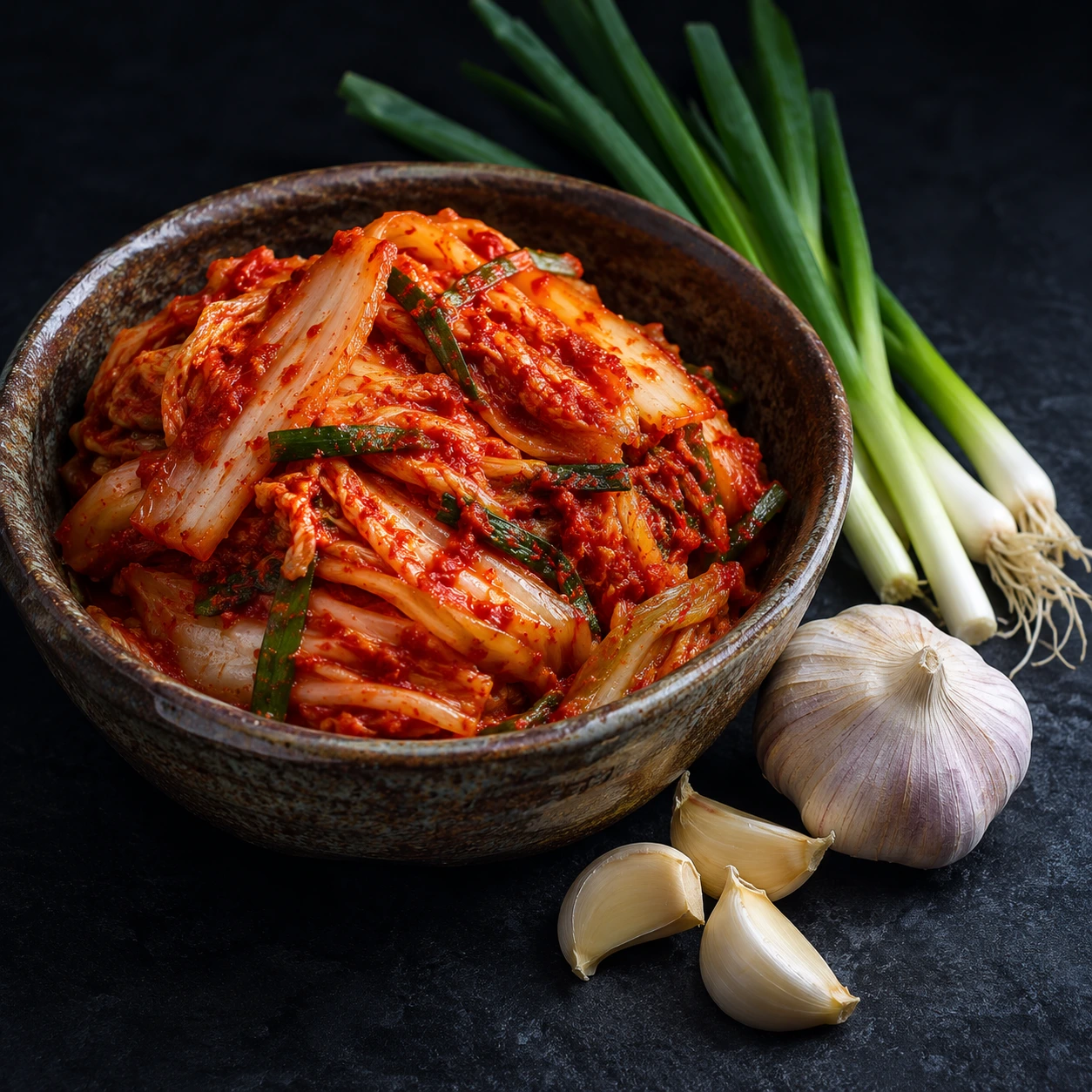
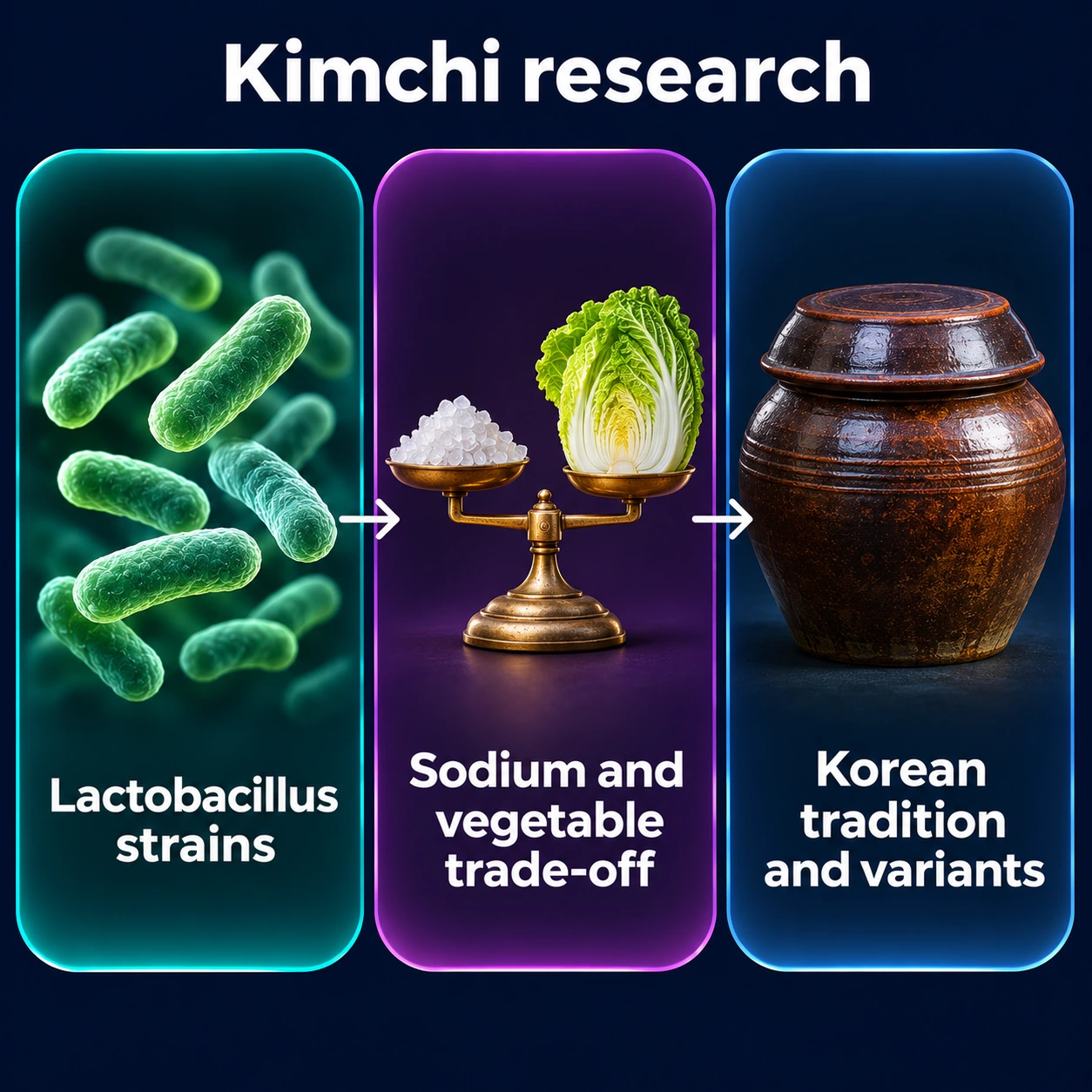

Kimchi is the rare food that sits at the intersection of three actively researched nutritional categories at the same time. As a spontaneously fermented vegetable, it delivers a dense, viable, lactic-acid-bacteria community dominated by Lactobacillus, Leuconostoc, and Weissella. As a Brassica-family preparation, the napa cabbage base contributes glucosinolates, sulfur compounds whose breakdown products include isothiocyanates; a 2022 analysis of kimchi found glucoraphanin (the sulforaphane precursor) present but not among the major ones, and most glucosinolates are broken down as kimchi ferments. As a traditional Korean staple, it has been eaten at every meal in Korea for roughly two millennia, providing one of the longest-running observational nutrition signals in any culture. The four deep-dive pages below cover the live microbial ecology, the Brassica chemistry, the sodium-vs-vegetable trade-off that makes kimchi controversial, and the regional Korean variants — from baechu kimchi to kkakdugi, dongchimi, and the seafood-rich southern styles.
Deep-Dive Articles
Lactobacillus Strains
The viable bacterial community in finished kimchi: Lactobacillus sakei, Lactobacillus plantarum, Leuconostoc mesenteroides, Weissella koreensis, the succession from heterofermentative Leuconostoc early to homofermentative Lactobacillus at peak ripeness, viability through the stomach, the documented effects on intestinal microbiome composition, and the candidate probiotic strains that have advanced to randomized controlled trials.
Read the deep dive →Sulforaphane and Cabbage
How napa cabbage delivers glucoraphanin and other glucosinolates, why fermentation accelerates the myrosinase reaction to produce free sulforaphane, Nrf2 activation by isothiocyanates, the documented chemoprotective effects in epithelial tissues, and the comparison to raw cabbage, sauerkraut, and broccoli sprouts as alternative sulforaphane sources.
Read the deep dive →Sodium and Vegetable Trade-off
The single largest controversy in kimchi research: high sodium (roughly 500-1,200 mg per 100 g; USDA lists 498 mg) is associated with the elevated gastric cancer incidence in northeast Asia, but the same food provides probiotics, sulforaphane, and a large vegetable serving. What the Korean cohort data show, why total dietary pattern matters more than single-food sodium, and the lower-sodium home-fermented and commercial variants now on the market.
Read the deep dive →Korean Tradition and Variants
The historical evolution of kimchi over ~2,000 years, the introduction of chili pepper from the Americas in the 17th century, the annual kimjang winter-preparation festival (UNESCO Intangible Cultural Heritage), and the major regional variants: baechu kimchi (napa cabbage), kkakdugi (radish cube), dongchimi (white water kimchi), nabak kimchi, oi sobagi (stuffed cucumber), and the seafood-rich southern Jeolla styles.
Read the deep dive →Table of Contents
- Deep-Dive Articles
- Why Kimchi Produces Effects Across So Many Systems
- What Human Studies of Kimchi Found
- Research Papers: Microbiome and Lactobacillus
- Research Papers: Brassica Chemistry and Sulforaphane
- Research Papers: Sodium, Gastric Cancer, and Cardiovascular
- Research Papers: Clinical Trials and Metabolic Effects
- Research Papers: Cross-Cutting (Tradition, Variants, Food Science)
- External Authoritative Resources
- Connections
- Featured Videos
Why Kimchi Produces Effects Across So Many Systems
Most fermented foods produce one principal class of clinical effect — yogurt provides live bacteria, sauerkraut provides probiotic acidified cabbage, miso provides protein-rich legume fermentation. Kimchi is unusual because it operates through at least four distinct mechanisms simultaneously, and any honest evaluation of "is kimchi good for you?" has to account for all of them at once.
- Live lactic-acid-bacteria community — finished, properly ripened kimchi contains 107 to 109 CFU per gram of viable Lactobacillus, Leuconostoc, and Weissella. The dominant strains differ across batches and as fermentation progresses, but the ecological succession is reproducible enough that several strains have been isolated, characterized, and tested as standalone probiotics. Since a 2020 reclassification split the old genus Lactobacillus into 23 new genera plus a smaller Lactobacillus, two of the main kimchi species carry new names: Latilactobacillus sakei (formerly Lactobacillus sakei) and Lactiplantibacillus plantarum (formerly Lactobacillus plantarum); newer papers use the new names. See the Lactobacillus Strains deep-dive for the species-level detail and the clinical trial evidence.
- Brassica isothiocyanates from cabbage fermentation — napa cabbage (the Brassica species Brassica rapa subsp. pekinensis) contributes glucosinolates that can be converted to bioactive isothiocyanates during the chopping, salting, and fermentation steps. A 2022 laboratory analysis of kimchi found that the major glucosinolates were 4-methoxyglucobrassicin, glucobrassicanapin and gluconapin, while glucoraphanin, the precursor of sulforaphane, was present but not among the major compounds; total glucosinolates fell by 31-97% in moderately fermented kimchi and by 91-100% in over-fermented kimchi compared with unfermented samples. A 2023 survey of 60 Chinese cabbage lines likewise found gluconapin the most abundant, followed by glucobrassicanapin and progoitrin. Sulforaphane is an Nrf2 activator implicated in chemoprevention, antioxidant induction, and detoxification enzyme upregulation. See the Sulforaphane and Cabbage deep-dive for the biochemistry.
- Bioactive secondary ingredients — the standard kimchi recipe includes garlic, ginger, chili pepper, scallions, and (in most styles) fermented seafood (jeotgal — salted shrimp, anchovy sauce, or oyster). Each of these contributes its own bioactives: allicin from garlic, gingerol and shogaol from ginger, capsaicin from chili, organosulfur compounds from scallion, and a glutamate-rich umami pool from the fermented seafood. The flavor complexity that distinguishes kimchi from sauerkraut maps to a similarly broader bioactive profile.
- Vegetable bulk with low caloric density — a typical 100 g serving of cabbage kimchi provides roughly 15-25 kcal and 1-2 g of fiber, while displacing higher-calorie sides at the meal. Korean meal pattern often includes 50-100 g kimchi per meal, three meals per day — cumulatively 150-300 g of low-calorie fermented vegetable per day, equivalent to a substantial fraction of the recommended daily vegetable intake.
The therapeutic complication is sodium. Kimchi contains roughly 500-1,200 mg sodium per 100 g — USDA FoodData Central lists 498 mg per 100 g for cabbage kimchi, and many commercial products are 1.5-3% salt by weight, before the additional sodium contributed by fermented seafood and soy ingredients. Daily intake at Korean traditional levels can contribute 1,500-3,000 mg sodium per day from kimchi alone — before any sodium from rice, soup, or other accompaniments. Korea has one of the highest gastric-cancer incidence rates in the developed world, and the epidemiology consistently identifies high-salt fermented foods (kimchi, salted fish, fermented soybean pastes) as the principal dietary risk factor. A meta-analysis of studies in the Korean population (Woo 2014) found salt and kimchi linked to higher gastric-cancer risk (odds ratios 1.92 and 2.21), while high intakes of soy foods, green onion, garlic, onion, fruits and mushrooms were linked to lower risk. The Sodium and Vegetable Trade-off deep-dive walks through how to think about this honestly.
What Human Studies of Kimchi Found
A 2025 systematic review and meta-analysis (Ahn and colleagues) pooled 5 intervention studies with 205 participants that used plain fermented kimchi, with no added ingredients or added bacteria. Eating fermented kimchi lowered fasting blood glucose by about 1.9 mg/dL. After the studies that disagreed most with the rest were set aside, triglycerides fell by about 29 mg/dL and blood pressure by about 3.5/2.7 mmHg. The 4 prospective cohort studies it reviewed (42,455 people) linked higher kimchi intake with a lower incidence of cancer and metabolic syndrome. The authors wrote that, because the number of studies is small, the findings need to be interpreted cautiously.
In a cross-sectional analysis of 115,726 Korean adults aged 40-69 (the Health Examinees study, published 2024), men who ate 1-3 servings of kimchi a day had lower odds of obesity than men eating less than one serving a day (odds ratios 0.875 for 1-2 servings and 0.893 for 2-3 servings). The association was J-shaped: it did not hold at the highest intakes, and the authors suggested limiting excessive kimchi intake. A cross-sectional study shows an association at one point in time, not cause and effect.
Research Papers: Microbiome and Lactobacillus
- Jung JY, Lee SH, Kim JM, et al. Metagenomic analysis of kimchi, a traditional Korean fermented food. Applied and Environmental Microbiology. 2011;77(7):2264-2274. — PubMed PMID: 21317261
- Lactobacillus sakei dominance in mature kimchi — PubMed: L. sakei in kimchi
- Weissella koreensis isolation and characterization from kimchi — PubMed: W. koreensis from kimchi
- Kimchi consumption and gut microbiome composition in humans — PubMed: Kimchi and gut microbiome
- Lactobacillus plantarum from kimchi as candidate probiotic — PubMed: L. plantarum kimchi probiotic
- Viability of kimchi lactic acid bacteria through simulated gastric transit — PubMed: Kimchi LAB gastric survival
- Park KY, Jeong JK, Lee YE, Daily JW 3rd. Health benefits of kimchi (Korean fermented vegetables) as a probiotic food. Journal of Medicinal Food. 2014;17(1):6-20. — PubMed PMID: 24456350
- Kimchi bacteriocins and antimicrobial activity — PubMed: Kimchi bacteriocins
- Leuconostoc mesenteroides as early heterofermentative driver — PubMed: Leuconostoc in kimchi
- Kimchi versus yogurt as live-culture food source — PubMed: Kimchi vs yogurt
- Zheng J, Wittouck S, Salvetti E, et al. A taxonomic note on the genus Lactobacillus: description of 23 novel genera, emended description of the genus Lactobacillus Beijerinck 1901, and union of Lactobacillaceae and Leuconostocaceae. International Journal of Systematic and Evolutionary Microbiology. 2020;70(4):2782-2858. — PubMed PMID: 32293557
Research Papers: Brassica Chemistry and Sulforaphane
- Glucoraphanin in napa cabbage and Brassica rapa varieties — PubMed: Glucoraphanin in napa cabbage
- Myrosinase activity during cabbage fermentation — PubMed: Myrosinase in fermentation
- Sulforaphane Nrf2 / Keap1 pathway activation — PubMed: Sulforaphane Nrf2 pathway
- Isothiocyanate chemoprevention in epithelial cancers — PubMed: Isothiocyanate chemoprevention
- Indole-3-carbinol and diindolylmethane from Brassica — PubMed: I3C/DIM from Brassica
- Cabbage glucosinolate stability during salting and fermentation — PubMed: Glucosinolate fermentation stability
- Broccoli sprout sulforaphane as concentrated source — PubMed: Broccoli sprout sulforaphane
- Sulforaphane and Helicobacter pylori in vivo — PubMed: Sulforaphane and H. pylori
- Brassica vegetable intake and gastric cancer risk — PubMed: Brassica and gastric cancer
- Sauerkraut versus kimchi as Brassica-fermented foods — PubMed: Sauerkraut vs kimchi
- Kim SY, Yang J, Dang YM, Ha JH. Effect of fermentation stages on glucosinolate profiles in kimchi: quantification of 14 intact glucosinolates using ultra-performance liquid chromatography-tandem mass spectrometry. Food Chemistry: X. 2022;15:100417. — PubMed PMID: 36211768
- Kim SH, Lee GA, Subramanian P, Hahn BS. Quantification and diversity analyses of major glucosinolates in conserved Chinese cabbage (Brassica rapa L. ssp. pekinensis) germplasms. Foods. 2023;12(6):1243. — PubMed PMID: 36981169
Research Papers: Sodium, Gastric Cancer, and Cardiovascular
- Korean sodium intake and dietary sources (KNHANES) — PubMed: KNHANES sodium intake
- Kimchi sodium content variability and reduction strategies — PubMed: Kimchi sodium reduction
- Salted fermented foods and gastric cancer in Korea / Japan — PubMed: Salt fermented food and gastric cancer
- High kimchi intake and gastric cancer risk — case control studies — PubMed: Kimchi and gastric cancer
- Kimchi sodium and hypertension in Korean cohorts — PubMed: Kimchi and blood pressure
- Korean dietary pattern and total sodium — PubMed: Korean diet sodium balance
- Helicobacter pylori, high-salt diet, and gastric mucosal damage — PubMed: H. pylori salt synergy
- Potassium-rich fermented vegetables and blood pressure offset — PubMed: Potassium offset
- Low-sodium kimchi prototypes and sensory acceptance — PubMed: Low-sodium kimchi
- Salt substitution with potassium chloride in fermented vegetables — PubMed: KCl salt substitute
- Woo HD, Park S, Oh K, et al. Diet and cancer risk in the Korean population: a meta-analysis. Asian Pacific Journal of Cancer Prevention. 2014;15(19):8509-8519. — PubMed PMID: 25339056
Research Papers: Clinical Trials and Metabolic Effects
- Kimchi intake and metabolic syndrome (Korean cohort, KMS) — PubMed: Kimchi and metabolic syndrome
- An SY, Lee MS, Jeon JY, et al. Beneficial effects of fresh and fermented kimchi in prediabetic individuals. Annals of Nutrition and Metabolism. 2013;63(1-2):111-119. — PubMed PMID: 23969321
- Fresh vs fermented kimchi: differential effects on metabolic markers — PubMed: Fresh vs fermented kimchi
- Kimchi and lipid profile (LDL, HDL, triglycerides) in overweight adults — PubMed: Kimchi lipid profile
- Kimchi and weight in obese adults: 8-week trial — PubMed: Kimchi and weight
- Kimchi and atopic dermatitis intervention — PubMed: Kimchi and atopic dermatitis
- Kimchi and inflammatory bowel disease: animal-model and human pilot — PubMed: Kimchi and IBD
- Kimchi capsaicin and thermogenesis — PubMed: Kimchi capsaicin thermogenesis
- Kimchi and colorectal cancer cell line studies — PubMed: Kimchi and colorectal cancer
- Kimchi and constipation / bowel transit in healthy adults — PubMed: Kimchi and bowel transit
- Ahn S, Darooghegi Mofrad M, Nosal BM, Chun OK, Joung H. Effects of fermented kimchi consumption on anthropometric and blood cardiometabolic indicators: a systematic review and meta-analysis of intervention studies and prospective cohort studies. Nutrition Reviews. 2025;83(7):e1441-e1457. — PubMed PMID: 39545368
- Jung H, Yun YR, Hong SW, Shin S. Association between kimchi consumption and obesity based on BMI and abdominal obesity in Korean adults: a cross-sectional analysis of the Health Examinees study. BMJ Open. 2024;14(2):e076650. — PubMed PMID: 38290970
Research Papers: Cross-Cutting (Tradition, Variants, Food Science)
- Historical evolution of kimchi over 2,000 years — PubMed: Kimchi history
- Capsicum chili pepper introduction to Korea (17th century) — PubMed: Capsicum to Korea
- Kimjang UNESCO Intangible Cultural Heritage documentation — PubMed: Kimjang heritage
- Regional kimchi varieties and microbial diversity — PubMed: Regional kimchi diversity
- Kkakdugi (radish kimchi) microbial and chemical profile — PubMed: Kkakdugi profile
- Dongchimi (water kimchi) and white-broth fermentation — PubMed: Dongchimi fermentation
- Jeotgal salted seafood ingredients in kimchi — PubMed: Jeotgal in kimchi
- Onggi (traditional fermentation jar) and microbial ecology — PubMed: Onggi fermentation
- Kimchi refrigerator (kimchi-naengjango) and modern fermentation control — PubMed: Kimchi refrigerator control
- Vegan kimchi without fermented seafood: microbial and nutritional comparison — PubMed: Vegan kimchi
External Authoritative Resources
- Wikipedia — Kimchi — well-referenced overview of history, varieties, and food science
- UNESCO — Kimjang, making and sharing kimchi in the Republic of Korea (Intangible Cultural Heritage)
- World Institute of Kimchi (WiKim) — Korean government research institute dedicated to kimchi science
- PubMed — All research on kimchi (2,301 records in a PubMed search on 13 November 2026)
- PubMed — Lactobacillus sakei (kimchi-derived probiotic candidate)