Fermented Foods: History and Origins
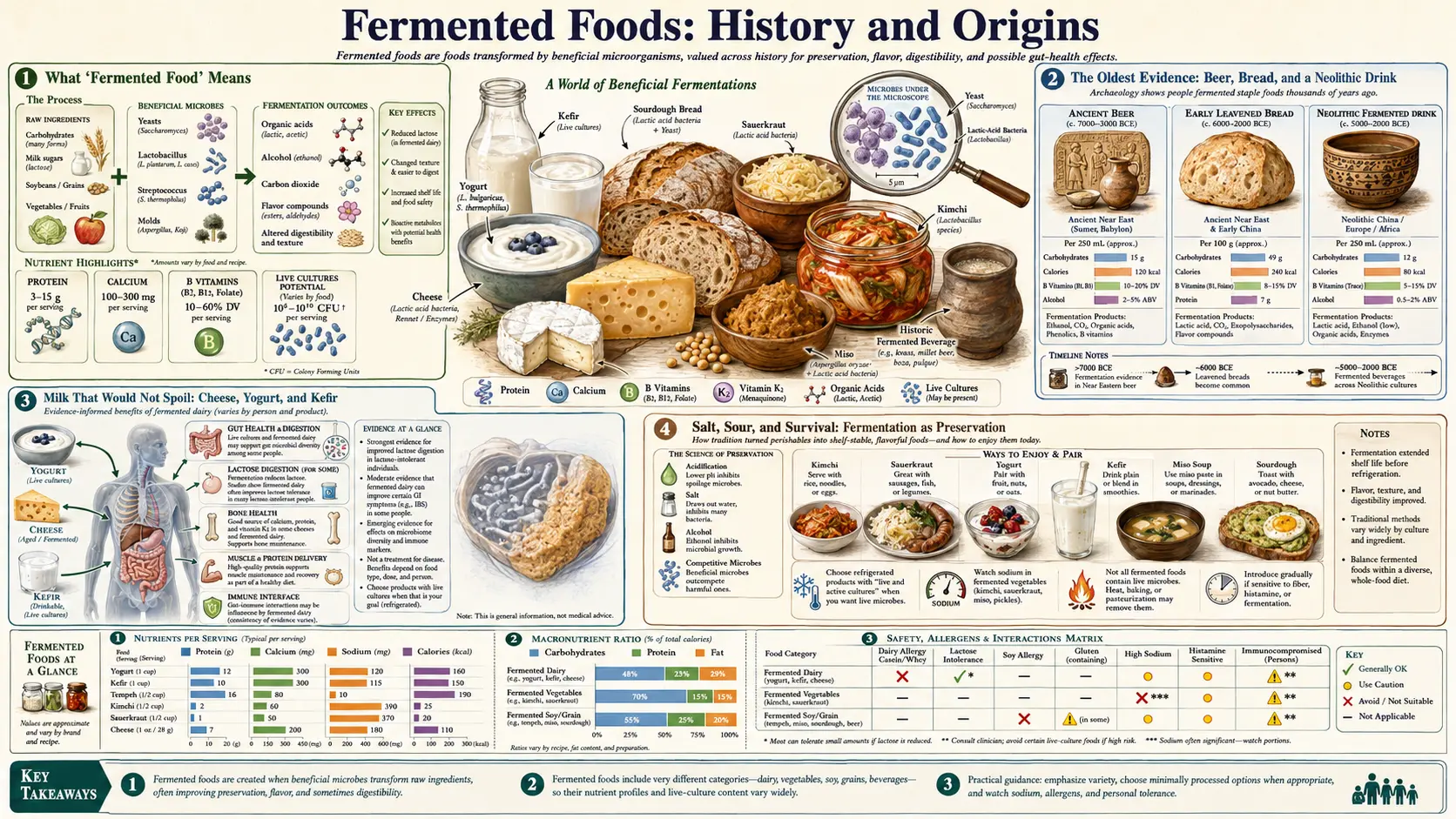
Fermentation is one of the oldest things people know how to do with food, and nobody invented it. Long before anyone understood that invisible microbes were doing the work, humans across the world had noticed that milk left to curdle, grain and fruit left to bubble, and vegetables packed in salt did not simply rot — they turned into something tangy, lasting, and good to eat. This article traces what the archaeological and historical record actually supports: the oldest physical evidence of fermentation (a roughly 13,000-year-old beer residue in a cave in present-day Israel, and a 9,000-year-old fermented rice-honey-fruit drink in Neolithic China); how dairy fermentation shows up on 7,000-year-old pottery in Europe; the way the Columbian Exchange reshaped foods such as kimchi; and the handful of genuine, dateable scientific milestones inside this very old story — Metchnikoff's yogurt-and-longevity hypothesis of around 1907, his 1908 Nobel Prize, and Dr. Hiroyuki Sumi's 1980 discovery of the natto enzyme nattokinase. Where the record is firm we say so; where a claim is legend or popular tradition, we name it as such.
Table of Contents
- What "Fermented Food" Means
- The Oldest Evidence: Beer, Bread, and a Neolithic Drink
- Milk That Would Not Spoil: Cheese, Yogurt, and Kefir
- Salt, Sour, and Survival: Fermentation as Preservation
- East Asia: Soy, Rice, and the Ferments of the Far East
- Kimchi and the Columbian Exchange
- Sauerkraut, Ships, and the Legends Around It
- Metchnikoff, Yogurt, and the Birth of the Probiotic Idea (c. 1907)
- A Real Discovery: Nattokinase (1980)
- From Ancient Practice to Modern Science
- Key Research Papers
- Connections
- Featured Videos
What "Fermented Food" Means
Before tracing the history it helps to be clear about the word. Fermentation, in the food sense, is the transformation of food by the controlled activity of microbes — bacteria, yeasts, and molds — and by the enzymes they produce. In 2021 an expert panel convened by the International Scientific Association for Probiotics and Prebiotics (ISAPP) settled on a deliberately broad working definition: fermented foods are "foods made through desired microbial growth and enzymatic conversions of food components." That definition is useful for history because it captures the whole sweep of the practice — from a pot of soured milk to a loaf of sourdough — without requiring that the people doing it knew any microbiology at all.
That last point is the heart of the story. For almost the entire history of fermented food, no one knew why it worked. The microbes responsible are invisible, and the idea that living organisms cause fermentation was not established until the nineteenth century, through the work of Louis Pasteur. Everything before that was discovery by observation and habit: people noticed that certain ways of handling milk, grain, fruit, fish, or vegetables produced a safe, sour, storable result, and they repeated and refined those methods over thousands of years. Fermented food is therefore not an invention with a date and an inventor but a vast body of inherited practical knowledge, arrived at independently by cultures on every inhabited continent.
The Oldest Evidence: Beer, Bread, and a Neolithic Drink
How far back does fermentation go? The honest answer is "further than the written record, and we are still finding out." The oldest direct physical evidence yet reported comes from a cave at Raqefet, near Haifa in present-day Israel, where archaeologists identified residues interpreted as a cereal-based beer — thick, more like a gruel than a modern lager — associated with the Natufian culture and dated to roughly 13,000 years ago. That finding is significant because it predates settled farming: it suggests fermented drink was part of human life even among late hunter-gatherers, possibly tied to feasting and ritual. As with all very old residue studies, the interpretation is debated at the edges, but it stands as the current earliest candidate.
A second landmark sits in early Neolithic China. At the village of Jiahu, in Henan province, the archaeochemist Patrick McGovern and colleagues chemically analysed residues absorbed into pottery jars and found the signature of a mixed fermented beverage of rice, honey, and fruit (hawthorn and/or wild grape), produced as early as the seventh millennium BC — roughly 9,000 years ago. This is one of the best-documented examples of ancient fermentation anywhere, precisely because it rests on laboratory chemistry rather than on guesswork about old pots.
Bread belongs in this chapter too. Leavened bread depends on yeast fermentation, and charred crumbs of bread-like food found at a Natufian site in northeastern Jordan have been dated to around 14,000 years ago, again predating agriculture. Whether that particular bread was deliberately leavened is uncertain, but the broader point is firm: the raw ingredients of fermentation — grain, fruit, honey, and the wild microbes that settle on them — were being turned into bubbling, transformed foods and drinks at the very dawn of the human story.
Milk That Would Not Spoil: Cheese, Yogurt, and Kefir
Once people began keeping animals for milk, dairy fermentation became almost inevitable. Raw milk sours quickly as naturally present lactic acid bacteria convert its sugar into acid — and that souring, far from being spoilage, was the first form of dairy preservation. The archaeological evidence here is unusually clear. A 2013 study led by Mélanie Salque and Richard Evershed at the University of Bristol identified milk-fat residues on perforated pottery — almost certainly cheese strainers — from the Kujawy region of Neolithic Poland, in the sixth millennium BC, around 7,000 years ago. Straining curds from whey is a cheese-making step, so this is direct evidence of cheese production in northern Europe at that early date.
Cheese-making also solved a biological problem. Many adults in early farming populations could not digest lactose well, but fermentation breaks much of the lactose down — so soured milk, cheese, and similar products let people get the nourishment of dairy without the discomfort of fresh milk. That practical advantage helps explain why fermented dairy spread so widely and took so many forms.
Yogurt and kefir grew out of the same world of herders and their milk. Yogurt is traditionally associated with Central Asia, the Middle East, and the Balkans, where soured, cultured milk has been a dietary staple for thousands of years; the modern English word itself comes from Turkish. Kefir is tied by tradition to the Caucasus mountains, where the prized "kefir grains" a living, reusable community of bacteria and yeast — were handed down within families and, by legend, guarded jealously. Precise dates for the origin of yogurt and kefir are not securely known, so they are best described as ancient pastoral foods of these regions rather than pinned to a year; their detailed stories are told on the dedicated Yogurt and Kefir pages.
Salt, Sour, and Survival: Fermentation as Preservation
For most of history, the central reason to ferment food was not health — it was survival through the lean season. Before refrigeration and canning, fermentation was one of humanity's most important ways of keeping food edible. The mechanism is the same across cultures even though the foods differ: helpful microbes, especially lactic acid bacteria, consume the sugars in a food and flood it with acid (and sometimes alcohol), lowering the pH until the organisms that cause rot and food poisoning can no longer survive. A barrel of cabbage, a crock of soured milk, or a jar of salted fish could thus be carried through a winter or a long voyage when fresh food was impossible.
This is why nearly every traditional cuisine has its own ferments, shaped by local crops and climate. Northern and central Europe leaned on soured cabbage and rye; the Korean peninsula on salted, fermented vegetables and seafood; Japan and much of East Asia on fermented soybeans, rice, and fish; the Middle East and Central Asia on cultured dairy; and the cold reaches of Scandinavia on fermented fish, where some of the world's oldest evidence of deliberate fish fermentation has been reported. Fermented and salted fish sauces were so central to the ancient Mediterranean diet that the Romans manufactured one, garum, on an industrial scale and traded it across their empire.
It is worth being careful here. Traditional cultures valued ferments above all because they lasted and tasted good, and because, in hindsight, they delivered calories, vitamins made by the microbes, and a safer product than spoiled food. The richer health claims now attached to fermented foods are a modern overlay on this older, practical foundation, and the move from "this food keeps" to "this food is good for you in measurable ways" is the subject of the final sections.
East Asia: Soy, Rice, and the Ferments of the Far East
East Asia developed one of the world's deepest fermentation traditions, built especially around the soybean. On its own the soybean is hard to digest and not particularly palatable; fermentation transformed it into a family of foods that became dietary cornerstones. Fermented soybean pastes and sauces — the ancestors of today's miso and soy sauce — have a long history in China, Korea, and Japan, where they provided savory flavor (what we now call umami), salt, and protein in cuisines built largely on rice and vegetables.
Two Japanese soy ferments deserve special mention because they recur elsewhere on this site. Natto — whole soybeans fermented with the bacterium Bacillus subtilis var. natto into a sticky, strong-smelling food — is a traditional Japanese dish with a history reaching back centuries; the most-repeated origin accounts are folk traditions rather than documented events, so they are best treated as legend. Natto matters to the modern story because of a real twentieth-century discovery made from it, covered below. Tempeh, by contrast, comes from Indonesia, where cooked soybeans are bound into a firm cake by the mold Rhizopus; it is a centuries-old food of the island of Java. Across the region, rice itself was fermented into vinegars, wines, and the mold-cultured starters (such as koji, built on Aspergillus oryzae) that drive miso, soy sauce, and sake. The dedicated Natto page carries the fuller account of that food.
Kimchi and the Columbian Exchange
Kimchi is one of the clearest examples of how a global event reshaped a traditional food — and a useful corrective to the assumption that ancient foods always looked the way they do now. Fermented vegetables have a very long history on the Korean peninsula: a Chinese text of the third century AD already notes that the people of the region were skilled at making fermented foods, and early Korean kimchi was a simple affair of vegetables — often radish — salted or brined, sometimes with fermented seafood (jeotgal) mixed in. Crucially, this early kimchi was not red and was not spicy.
The reason is the chili pepper, and the reason for the chili pepper is the Columbian Exchange — the vast transfer of crops, animals, and people between the Americas and the rest of the world that followed Christopher Columbus's 1492 voyage. Chili peppers are native to the Americas and were unknown in Korea until they arrived in East Asia, carried along Portuguese and other trade routes, in roughly the late sixteenth century. Even then, red, chili-laced kimchi did not appear overnight; the practice of building kimchi around ground red pepper (gochugaru) spread gradually, and recipes resembling today's familiar fiery kimchi are documented only from about the nineteenth century onward.
So the dish now treated as the very emblem of Korean food owes its defining color and heat to a New World plant that reached Korea only a few centuries ago — a textbook case of the Columbian Exchange transforming a cuisine. The same exchange remade kitchens everywhere it touched: it is why so much of the world's "traditional" spicy cooking, from India to Thailand to Hungary, postdates 1492. The fuller cultural story of kimchi lives on the dedicated Kimchi page.
Sauerkraut, Ships, and the Legends Around It
Sauerkraut — cabbage fermented in its own brine by lactic acid bacteria — carries a famous origin story that needs careful handling. A popular legend, repeated in many food histories, holds that fermented cabbage originated in China, was eaten by laborers on the Great Wall, and was carried west into Europe by the Mongol armies of Genghis Khan in the thirteenth century. This is a good story, but it is best treated as legend: the documentary evidence for that specific chain of transmission is thin, and historians are not agreed on it. What is better supported is simpler and older — fermenting and pickling cabbage was practised in the ancient world, and the Romans are a plausible source of the European tradition of preserving cabbage by souring. The German name "sauerkraut" ("sour cabbage") reflects where the food became iconic, not where it was first made.
One sauerkraut episode is solid history, and it is a striking one. In the eighteenth century the British explorer Captain James Cook carried large quantities of sauerkraut on his long Pacific voyages, and his crews suffered remarkably little from scurvy — the deadly vitamin-C-deficiency disease that devastated sailors of the age. Cook had no concept of vitamin C, which would not be identified until the twentieth century; he was working from the practical observation that certain foods kept his men healthy at sea. Sauerkraut does retain meaningful vitamin C, so the benefit was real even though the explanation came two centuries later — a neat illustration of the whole theme of this article: people used fermented foods to good effect long before science could say why.
Metchnikoff, Yogurt, and the Birth of the Probiotic Idea (c. 1907)
The shift from fermented food as preservation to fermented food as medicine has a real beginning, and a real person attached to it. The Russian-born biologist Élie Metchnikoff (Ilya Mechnikov), working at the Pasteur Institute in Paris, is widely credited as the father of the modern idea behind probiotics. Around 1907, in his book The Prolongation of Life: Optimistic Studies, Metchnikoff advanced a now-famous hypothesis: he had noted reports that Bulgarian peasants who ate large amounts of soured milk seemed to live unusually long lives, and he proposed that the lactic acid bacteria in that fermented milk suppressed harmful, putrefactive bacteria in the gut and so slowed the "autointoxication" he believed drove aging.
It is important to frame this precisely. Metchnikoff won the Nobel Prize in Physiology or Medicine in 1908 (shared with Paul Ehrlich), but it was awarded for his work on immunity — his discovery of phagocytosis, the process by which certain cells engulf invaders — not for the yogurt hypothesis. The longevity-through-soured-milk idea was a separate, more speculative proposal. The specific bacterium he championed had been described by the Bulgarian physician Stamen Grigorov in 1905 and is known today as Lactobacillus delbrueckii subsp. bulgaricus, the classic yogurt organism.
Metchnikoff's hypothesis was, in important respects, ahead of its evidence: his sweeping claims about gut putrefaction and lifespan were never proven, and the simple notion that swallowed yogurt bacteria permanently colonise the gut is now known to be largely incorrect. Yet his core intuition — that the microbes living in our intestines matter to health, and that fermented foods might shift that balance for the better — opened an entire field. The very word probiotic and the modern science of the gut microbiome descend, conceptually, from this moment around 1907. He is properly credited as the originator of the idea, not as someone who proved it.
A Real Discovery: Nattokinase (1980)
If most of fermentation's history has no inventor, one genuine, dateable discovery stands out — and it came from natto. In 1980, the Japanese researcher Dr. Hiroyuki Sumi, then working at the University of Chicago, was screening foods for substances that might dissolve blood clots. According to his own account, he dropped natto onto an artificial clot (fibrin) in a laboratory dish and watched the clot break down. The active substance turned out to be an enzyme he named nattokinase — a fibrinolytic (clot-dissolving) enzyme produced by the Bacillus subtilis bacteria that ferment the soybeans.
Sumi and colleagues published the finding in 1987 in the journal Experientia, in a paper titled "A novel fibrinolytic enzyme (nattokinase) in the vegetable cheese Natto." This is a real scientific milestone with named scientists and a firm date, and it sits at an interesting junction: a centuries-old traditional food, used for generations without anyone isolating its components, yielded a specific, named molecule that modern medicine could study. The traditional food came first; the discovery of nattokinase in 1980 was something different and specific — the identification of one active compound within it.
A note of caution belongs here, because nattokinase is now sold as a supplement with strong cardiovascular marketing. The 1980–1987 work established that the enzyme exists and can break down fibrin in the laboratory; that is a discovery, not a clinical endorsement. The strength of the human evidence, dosing, and safety questions are matters for current research and a physician, not for a history page. What history can say is simply that nattokinase was discovered by Dr. Hiroyuki Sumi from natto in 1980.
From Ancient Practice to Modern Science
The modern chapter of this story is the meeting of a very old practice with new tools. The microbial basis of fermentation became clear only in the nineteenth century with Pasteur; the gut-health idea was launched by Metchnikoff around 1907; and in the twenty-first century the explosion of microbiome research finally gave scientists ways to study what fermented foods actually do inside the human body. A widely noted example is a 2021 Stanford study led by researchers including Hannah Wastyk and Justin Sonnenburg, which reported that a diet high in fermented foods increased the diversity of subjects' gut microbes and lowered markers of inflammation — the kind of measured result Metchnikoff could only have dreamed of.
The throughline from a Natufian beer gruel and a Neolithic Chinese rice-honey drink, through Roman garum and Caucasian kefir grains, to a capsule of standardized probiotic or nattokinase, is genuinely unbroken — but it is also a story in which the food vastly predates the explanation. That gap is the most honest lesson of the history: traditional cultures got an enormous amount right by observation, preserving food and, often, improving it, long before anyone could measure why. Their inherited methods raise good questions; modern research is the slow work of testing the answers. The mechanisms, the clinical evidence, and the practical guidance on eating these foods today are covered in the companion Fermented Foods Benefits articles and on the main Fermented Foods page; this history is concerned only with where the practice came from.
Two closing cautions fit any history like this. First, a long tradition of use is a reason to investigate a food, not proof that it cures anything — and nothing here is medical advice. Second, fermented foods are not right for everyone: people who are severely immunocompromised, who have histamine intolerance, or who take certain medications should be careful, as the main page explains. Knowing the history is valuable precisely because it lets us separate what is securely documented from what is legend, marketing, or hope — and that separation is the whole point of telling the story carefully.
Key Research Papers
The list below combines key peer-reviewed and archaeological sources on the history and science of fermented foods with curated PubMed topic-search links. Historical episodes named in the article — the Raqefet Natufian beer, Roman garum, Captain Cook's voyages, and Metchnikoff's writings — are described as historical record rather than cited as modern clinical sources. Author names, titles, and journals are given as plain text; only the stable DOI or PMID is hyperlinked, and each opens in a new tab.
- Marco ML, Sanders ME, Gänzle M, et al. The International Scientific Association for Probiotics and Prebiotics (ISAPP) consensus statement on fermented foods. Nature Reviews Gastroenterology & Hepatology. 2021;18(3):196-208. — doi:10.1038/s41575-020-00390-5
- McGovern PE, Zhang J, Tang J, et al. Fermented beverages of pre- and proto-historic China. Proceedings of the National Academy of Sciences. 2004;101(51):17593-17598. — doi:10.1073/pnas.0407921102
- Salque M, Bogucki PI, Pyzel J, et al. Earliest evidence for cheese making in the sixth millennium BC in northern Europe. Nature. 2013;493(7433):522-525. — doi:10.1038/nature11698
- Selhub EM, Logan AC, Bested AC. Fermented foods, microbiota, and mental health: ancient practice meets nutritional psychiatry. Journal of Physiological Anthropology. 2014;33(1):2. — doi:10.1186/1880-6805-33-2
- Sumi H, Hamada H, Tsushima H, Mihara H, Muraki H. A novel fibrinolytic enzyme (nattokinase) in the vegetable cheese Natto; a typical and popular soybean food in the Japanese diet. Experientia. 1987;43(10):1110-1111. — doi:10.1007/BF01956052
- Wastyk HC, Fragiadakis GK, Perelman D, et al. Gut-microbiota-targeted diets modulate human immune status. Cell. 2021;184(16):4137-4153.e14. — PubMed PMID: 34256014
- Fermented foods — history and traditional use — PubMed: fermented foods history and traditional culture
- Fermentation, archaeology, and the origins of food preservation — PubMed: fermentation archaeology and ancient food
External Authoritative Resources
Connections
- All Food
- Fermented Foods
- Fermented Foods Benefits
- Kimchi
- Kefir
- Yogurt
- Natto
- Probiotics
- Covered in depth on its own page: Fermented Foods