Bee Pollen: History and Origins
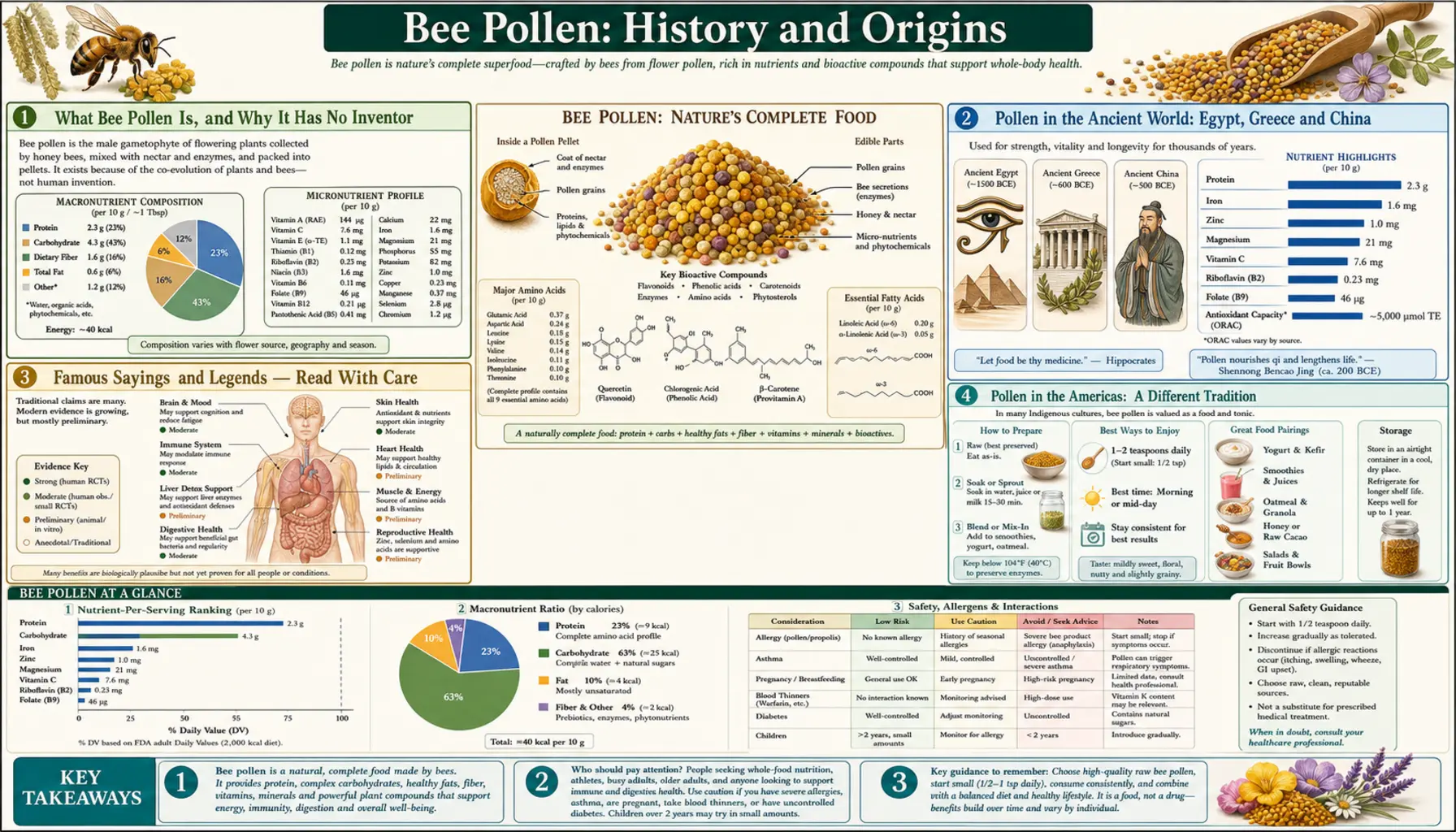
Bee pollen has no inventor and no single homeland. It is not a recipe or a crop but a by-product of one of the oldest partnerships on Earth — flowering plants and honeybees — and humans have been gathering it, in one form or another, for as far back as the written record reaches. Wherever people kept bees or robbed wild nests, they eventually noticed the bright pellets the foragers carried home on their legs, and many cultures came to treasure them as a strengthening food. This article traces what the historical record actually supports: how bees make these pellets, the genuinely ancient references to pollen as food and medicine in Egypt, Greece, China and beyond, the famous sayings and legends (marked here as legends), how Native American peoples used plant pollens, the twentieth-century shift from wild-gathered curiosity to harvested commodity, the Olympic anecdote that turned bee pollen into a modern "superfood," and the careful line between a long tradition of use and proven medical benefit. Where the record is firm we say so; where a claim is folklore or promotion, we name it as such.
Table of Contents
- What Bee Pollen Is, and Why It Has No Inventor
- Pollen in the Ancient World: Egypt, Greece and China
- Famous Sayings and Legends — Read With Care
- Pollen in the Americas: A Different Tradition
- From Robbing Nests to Pollen Traps
- The Twentieth Century: Pollen Becomes a Product
- The Olympic Story and the "Superfood" Era
- Tradition Versus Evidence: An Honest Close
- Research Papers and References
- Connections
- Featured Videos
What Bee Pollen Is, and Why It Has No Inventor
To tell the history of bee pollen honestly, it helps to be clear about what it is — because that is the reason it has no discoverer. Flower pollen is the fine, powdery material that seed plants produce to fertilise their flowers; in evolutionary terms it is far older than humanity. Honeybees gather this pollen as their main source of protein. As a foraging bee works a blossom, it brushes loose pollen onto its body, then combs it down and packs it — moistened with a little nectar and saliva — into dense pellets held in a fringe of stiff hairs on its hind legs called the corbiculae, or pollen baskets. These are the colourful granules a beekeeper sees arriving at the hive entrance, and these granules are what we call bee pollen.
So bee pollen is, strictly, flower pollen that has been gathered and lightly processed by bees — a mixture of plant pollen with small amounts of nectar and bee secretions, as the scientific reviews put it. No person designed it; the bees were making it long before anyone watched them do it. What humans did, over many separate cultures, was notice it, learn to take a share of it, and decide it was worth eating. That is the proper shape of this history: not an invention with a date, but a natural product that one society after another independently came to value. For the same reason there is no single "place of origin." Honeybees and the plants they forage are spread across most of the warm and temperate world, so the story of bee pollen is really many local stories that converge on the same bright pellets.
One small but important distinction runs through everything below. Bee pollen (the leg-pellets) is not the same as honey (concentrated nectar), nor the same as bee bread (pollen packed and fermented inside the comb to feed the colony), nor the same as royal jelly or propolis. Older sources sometimes blur these together under "bee products," and some celebrated quotations about "pollen" may originally have meant honey or wild-gathered plant pollen rather than the leg-pellets specifically. Keeping the categories straight is part of telling the story accurately.
Pollen in the Ancient World: Egypt, Greece and China
Bees and their products appear early and often in the records of the great ancient civilisations, and bee pollen — or pollen and honey together — is part of that picture. Modern scientific reviews of bee pollen routinely open by noting that bee products "were widely used in medicine" in ancient societies, "mainly in Greece, China, and Egypt," and that the ancient Egyptians described pollen as a kind of life-giving dust. These statements come from the introductions of peer-reviewed papers such as the 2021 Nutrients review by Khalifa and colleagues and the 2015 review by Komosinska-Vassev and colleagues, and they reflect a genuine, long-standing association between humans, bees, and pollen in the ancient world.
The honest caveat is that these ancient references are usually broad and hard to pin to bee pollen in the narrow sense. Egyptian medical papyri and tomb offerings show that bees, honey, and beeswax were deeply woven into Egyptian life, medicine, and ritual; whether a given ancient mention of "pollen" meant the bee-gathered leg-pellets, plant pollen, or honey-with-pollen is often impossible to recover at this distance. What we can say with confidence is the larger truth the reviews are pointing at: across Egypt, the Greek world, and China, the hive and its products were prized as both food and remedy for thousands of years, and pollen had a recognised place within that esteem.
In the Greek and Roman world, pollen and honey were associated with strength, vitality, and even immortality — the realm of ideas that surrounds the mythological "food of the gods." In China, bee products feature in the long tradition of medicinal foods. None of this proves a specific clinical use of bee pollen by the standards we would demand today, and this page does not present it as such. But the breadth of the association is itself the historical fact: pollen was never an obscure substance. From very early on, in several unrelated civilisations, it sat among the foods people reached for when they wanted nourishment and recovery.
Famous Sayings and Legends — Read With Care
A handful of vivid claims circulate in nearly every popular article about bee pollen, and they are worth examining precisely because they are repeated so confidently. Treated as tradition and folklore rather than verified history, they are genuinely interesting; treated as established fact, they overreach.
The most common is that the ancient Greeks called pollen ambrosia, "the food of the gods," believed to confer immortality and eternal youth. Ambrosia is a real and central idea in Greek mythology — the food (or drink) of the gods that kept them deathless — but ancient sources do not give a single, settled recipe for it, and the neat equation "ambrosia = bee pollen" is a modern interpretation layered onto the myth, not something the Greeks themselves recorded. It belongs in the history as a legend about pollen's prestige, which is real, rather than as a literal ancient definition.
A second favourite is a saying attributed to Hippocrates — the famous Greek physician of the fifth to fourth century BCE — to the effect that honey and pollen "cause warmth, clean sores and ulcers… and heal running sores." Hippocrates and the writings gathered under his name do indeed discuss honey extensively as a wound dressing and remedy, so the spirit of the quotation fits the genuine Hippocratic interest in honey. But exact wordings of this kind, passed hand to hand through supplement marketing, should be treated as traditional attribution rather than a precisely sourced quotation, and the original may well have concerned honey more than the leg-pellets. The related claim that the philosopher Pythagoras prescribed bee pollen, and that Roman soldiers carried "pollen cakes" on campaign, falls in the same category: colourful, widely repeated, and best presented with a clear label of folklore.
The point of flagging these stories is not to dismiss them — they capture something true, which is that many ancient and traditional cultures held pollen and honey in unusually high regard. The point is that a free public-health page should not launder folklore into fact. Where a claim is a legend, naming it as a legend is the most respectful thing one can do with it.
Pollen in the Americas: A Different Tradition
One of the better-documented chapters of pollen's human history comes not from bees at all, but from the Americas, where several Indigenous peoples gathered plant pollen directly and used it as food and medicine. This tradition is recorded in the ethnobotanical literature, including the 1997 review "Pollen as food and medicine" by Hans Linskens and Wilhelm Jorde in the journal Economic Botany, which draws together observations made by field researchers.
According to that review, twentieth-century researchers observed Navajo (Diné) families gathering maize (corn) pollen from the tassels of their plants on warm summer mornings, then sifting it and kneading it into a dough for baking — a direct culinary use of pollen. Maize pollen also holds deep ceremonial and sacred significance in Navajo and other Southwestern cultures, used in blessing and ritual; this page notes that significance with respect and does not attempt to detail sacred practices it cannot properly represent. The same literature records that Apache people were observed — in accounts from the late nineteenth century and again in the late twentieth — carrying pouches of cattail pollen, used among other things as a remedy for fatigue.
This American tradition is valuable to the history for two reasons. First, it is comparatively well-attested: it rests on field observation rather than on a contested ancient quotation. Second, it shows that the human appetite for pollen did not depend on beekeeping. People who gathered pollen straight from corn tassels and cattail heads arrived at the same intuition that bee-keeping cultures did — that this golden dust was concentrated nourishment worth the trouble of collecting. It is a reminder that "the history of bee pollen" is really a corner of the much larger, older history of pollen as human food.
From Robbing Nests to Pollen Traps
For most of human history, getting bee pollen meant getting it the hard way: by raiding wild honeybee nests for comb, which carried stored pollen (bee bread) along with honey. Rock art and ancient records show honey-hunting reaching back many thousands of years, and any pollen people ate this way came as part of the comb, not as a separate harvested product. Even after beekeeping in fixed hives developed across the ancient Mediterranean, Egypt, and Asia, the prize was overwhelmingly honey and wax; pollen was incidental.
The decisive technical change — the one that made bee pollen as we buy it today possible — was the invention of the pollen trap. A pollen trap is a simple device fitted at the hive entrance: returning foragers squeeze through a grid or mesh sized so that some of the pellets are gently scraped from their legs and fall into a collecting tray below, while the bees pass through unharmed. This lets a beekeeper harvest clean, loose pollen granules directly, rather than digging fermented bee bread out of the comb. Scientific reviews describe exactly this method — that bee pollen "can be gathered at the entrance of the hives with the aid of traps" — and it is the foundation of the entire modern bee-pollen trade.
This is the quiet turning point in the story. Ancient peoples admired pollen but could only take it as a minor fraction of the comb. The pollen trap, a modern beekeeping refinement, turned pollen from an incidental by-product into a standalone harvest that could be dried, stored, weighed, sold, and studied. Almost everything in the chapters that follow — commercial pollen, athletic supplements, clinical research — depends on that one practical idea.
The Twentieth Century: Pollen Becomes a Product
In the twentieth century pollen moved from traditional food to industrial commodity, and one strand of that story is well documented. In Sweden in the 1950s, the company Cernelle (founded in 1953) set out to extract usable material from pollen on a large scale. Rather than relying on bee-trapped pollen, Cernelle worked largely with machine-harvested flower pollen from a few defined cultivated plants, developing methods to break open the tough pollen grains and obtain purified extracts — marketed under the name Cernitin. Products derived from this work were sold in Sweden from the late 1950s, and a tablet form known as Cernilton was later registered in Japan (in 1969) for use in conditions of the prostate.
Two cautions keep this accurate. First, the Cernelle/Cernitin line is properly described as a flower-pollen extract, not bee pollen in the leg-pellet sense; it is part of pollen's history but is a cousin of the granules a beekeeper traps, not the same thing. Second, the prostate indications attached to these extracts belong to the products' regulatory and research history; this page records that they exist, not that they are endorsed. The reason the episode matters here is what it represents: by the mid-twentieth century, pollen had become something scientists and companies tried to standardise, purify, and bottle — a decisive break from the spoon-of-granules tradition.
Alongside this industrial thread, ordinary trapped bee pollen also became a widely traded health food through the second half of the twentieth century, sold by beekeepers and natural-food shops as dried granules, capsules, and tablets. The same period saw the rise of the language now attached to it — "superfood," "nature's most complete food" — marketing terms rather than scientific categories, but ones that reflect pollen's genuinely dense and varied nutritional makeup. It is against this commercial backdrop that bee pollen acquired its modern fame, helped enormously by a single sporting story.
The Olympic Story and the "Superfood" Era
If one episode is responsible for bee pollen's modern reputation, it is an athletic one from the 1970s. The widely repeated account holds that members of the highly successful Finnish distance-running team around the time of the 1972 Munich Olympics — the era of the celebrated runner Lasse Virén — used pollen supplements, and that a team coach publicly credited pollen with improving the athletes' performance and recovery. From there the idea spread quickly: through the 1970s and 1980s bee pollen became a fashionable supplement among athletes, and the "Olympic pollen" story has been retold in countless articles ever since.
This page presents that account as a historically influential anecdote, not a proven result. The Finnish team's success is real history; the claim that pollen caused it is a coach's assertion, and the exact names and wordings vary from one retelling to another, which is why this article does not pin them down. Later attempts to test pollen's athletic benefits in controlled studies have produced mixed and largely unconvincing results — a point covered in the companion Benefits articles. What is beyond doubt is the anecdote's effect: it, more than any laboratory finding, drove bee pollen into the popular imagination as a performance food and helped launch the late-twentieth-century "superfood" framing the substance still carries.
It is worth seeing this clearly as a historical pattern. An ancient food, admired for centuries on the strength of tradition, was relaunched for a modern audience on the strength of a sports story — and in both eras the enthusiasm ran ahead of the evidence. That is not a reason to scorn bee pollen, which is a real and nutritionally rich food. It is a reason to read its history with the same care one would read any product's promotional past.
Tradition Versus Evidence: An Honest Close
The thread running from an Egyptian papyrus, to a Navajo corn-pollen cake, to a Swedish extraction plant, to an Olympic training table is unbroken: in every age, people have looked at pollen and seen concentrated life and strength. That long, cross-cultural admiration is the genuine heart of bee pollen's history, and it is reason enough to find the substance interesting and to study it seriously.
But a history is not a health claim. A tradition of use — even a very old and very widespread one — tells us that people valued something, not that it does what they hoped. Much of the modern marketing around bee pollen (the "complete food," the immortality of the gods, the medal-winning runners) is best understood as the latest layer in a centuries-long habit of praising pollen, and the actual clinical evidence is far more modest and mixed than the folklore. The substance also carries real cautions — most importantly, that people with pollen or bee allergies can react badly to it — which is why the practical guidance belongs on the main page and the Benefits articles rather than in a history.
So the fair conclusion is the one this whole article has been building toward: bee pollen is an ancient, natural, genuinely nutrient-dense food with a rich and well-traveled cultural story, and that story is worth knowing for its own sake. Where the past offers a flat health promise, modern readers should treat it as a hypothesis to be tested, not a fact already proven. For the chemistry, the studied benefits, the dosing, and the safety cautions, see the main Bee Pollen page and the Bee Pollen Benefits articles; this page has been concerned only with where the food came from and how it earned its reputation.
Research Papers and References
The list below combines peer-reviewed reviews of bee pollen — whose introductions document its ancient and traditional use — with an ethnobotanical review of pollen as human food and curated PubMed topic searches. Author names, titles, and journals are given as plain text; only the stable DOI, PMID, or archive link is hyperlinked, and each opens in a new tab. Popular sayings attributed to Hippocrates, Pythagoras, and the Greek idea of ambrosia are discussed in the article as tradition and folklore, not as sourced primary citations.
- Khalifa SAM, Elashal MH, Yosri N, Du M, Musharraf SG, Nahar L, Sarker SD, Guo Z, Cao W, Zou X, Abd El-Wahed AA, Xiao J, Omar HA, Hegazy MF, El-Seedi HR. Bee pollen: current status and therapeutic potential. Nutrients. 2021;13(6):1876. — doi:10.3390/nu13061876 Search PubMed
- Komosinska-Vassev K, Olczyk P, Kazmierczak J, Mencner L, Olczyk K. Bee pollen: chemical composition and therapeutic application. Evidence-Based Complementary and Alternative Medicine. 2015;2015:297425. — doi:10.1155/2015/297425 Search PubMed
- Denisow B, Denisow-Pietrzyk M. Biological and therapeutic properties of bee pollen: a review. Journal of the Science of Food and Agriculture. 2016;96(13):4303-4309. — doi:10.1002/jsfa.7729 · PMID: 27013064
- Kocot J, Kielczykowska M, Luchowska-Kocot D, Kurzepa J, Musik I. Antioxidant potential of propolis, bee pollen, and royal jelly: possible medical application. Oxidative Medicine and Cellular Longevity. 2018;2018:7074209. — doi:10.1155/2018/7074209 · PMID: 29854089
- Linskens HF, Jorde W. Pollen as food and medicine — a review. Economic Botany. 1997;51(1):78-86. — doi:10.1007/BF02910407
- Bee pollen history, ethnobotany, and traditional use PubMed: bee pollen history and traditional use
- Bee pollen composition and biological properties PubMed: bee pollen composition and biological properties
External Authoritative Resources
- PMC — Bee Pollen: Current Status and Therapeutic Potential (full text)
- Springer — Linskens & Jorde, Pollen as Food and Medicine
- PubMed — All research on bee pollen