Beans
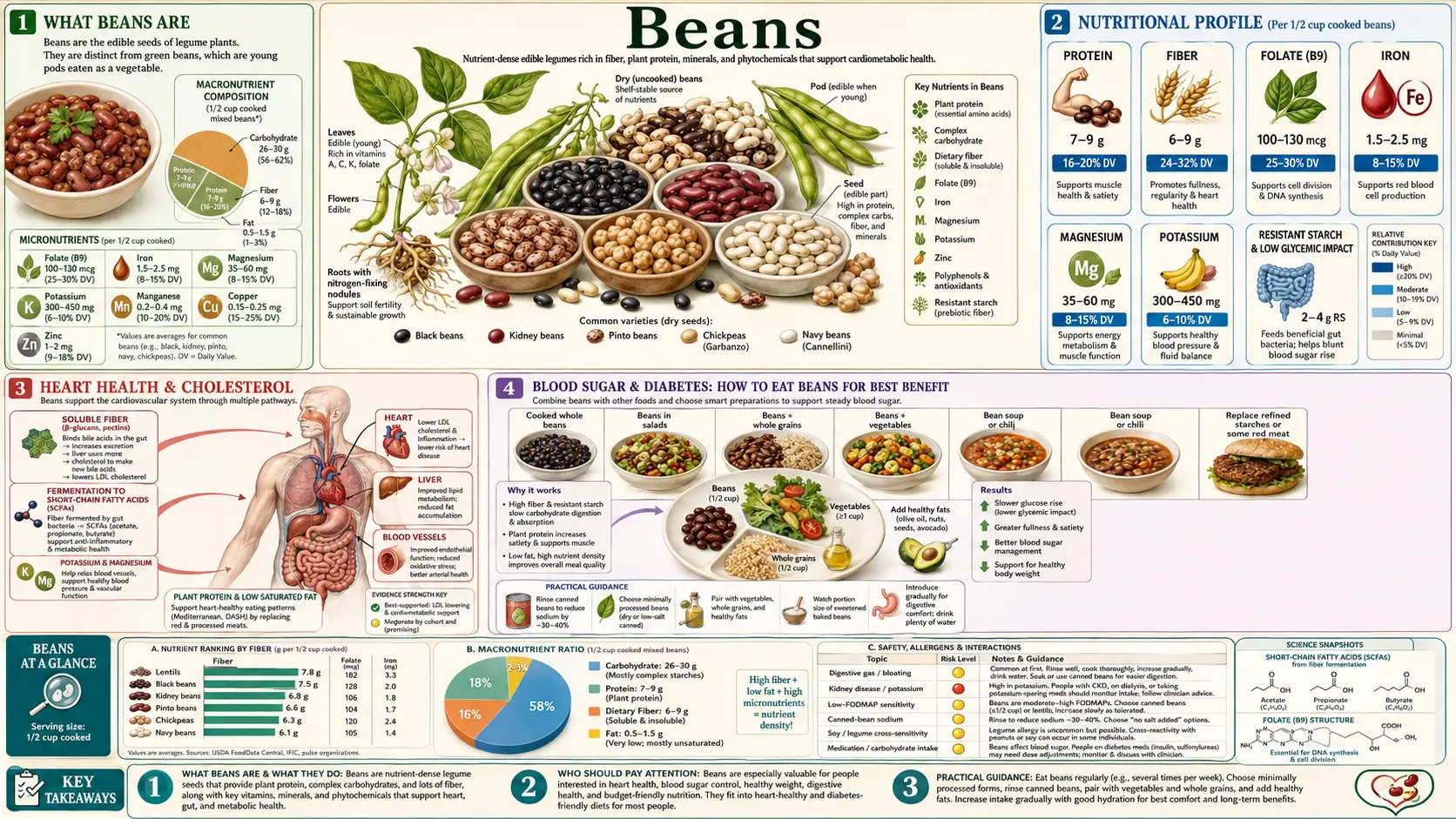
Beans are one of the cheapest, most nutritious, and most widely eaten foods on Earth — a shelf-stable bag of dried beans costs little, lasts for months, and delivers a rare combination of plant protein and fiber that few other foods match. Decades of research tie regular bean eating to lower cholesterol, steadier blood sugar, better gut health, and longer life, which is why beans are a quiet staple in nearly every traditional long-life diet. This page explains what beans are, what's in them, the evidence behind their health benefits, how to cook them, and the one genuine safety rule worth knowing.
Table of Contents
- What Beans Are
- Nutritional Profile
- Heart Health & Cholesterol
- Blood Sugar & Diabetes
- Gut Health, Weight & Longevity
- How to Use Them
- Considerations
- Research Papers
- Connections
- Featured Videos
What Beans Are
Beans are the edible seeds of plants in the legume family. The everyday "beans" most people eat — black, kidney, pinto, navy, cannellini, great northern, and many others — are nearly all varieties of a single species, Phaseolus vulgaris, the common bean. A few familiar "beans" come from close relatives: lima beans (Phaseolus lunatus) and fava beans (Vicia faba), for example.
When beans are harvested dried rather than eaten fresh in the pod, they belong to a group called pulses — the dried, edible seeds of legumes. Lentils and chickpeas are also pulses, and they share most of beans' nutritional strengths; we cover lentils separately. The practical difference is mostly culinary: lentils cook quickly and need no soaking, while most beans are larger, firmer, and benefit from soaking before cooking.
Beans are a true global staple. Black beans and pinto beans anchor Latin American cooking, navy and kidney beans show up in North American chili and baked beans, cannellini and borlotti beans run through Italian soups, and beans of every kind feature across African, Middle Eastern, and South Asian cuisines. They store for a year or more dry, cost a fraction of meat per gram of protein, and need no refrigeration — which makes them one of the most accessible nutritious foods anywhere.
Nutritional Profile
Beans stand out because they deliver two things that are hard to get together in one food: substantial plant protein and a large amount of fiber. A typical one-cup (about 170–180 g) cooked serving provides roughly 13–15 grams of protein and 11–15 grams of fiber, along with complex carbohydrates that release energy slowly.
The fiber comes in both forms the body needs. Soluble fiber dissolves into a gel that helps lower cholesterol and slows digestion; insoluble fiber adds bulk and supports regularity. Beans also contain a meaningful amount of resistant starch — starch that resists digestion in the small intestine and behaves much like fiber. Beans contain notably more resistant starch than most other starchy foods, and a sizable share of their starch never turns into blood sugar at all, instead traveling to the colon to feed beneficial bacteria.
On the micronutrient side, beans are rich in folate (important in pregnancy for healthy fetal development), iron, magnesium, potassium, and zinc, plus smaller amounts of other minerals and B vitamins. They also carry polyphenols — plant antioxidant compounds, especially concentrated in darker beans like black and red kidney beans.
One practical caveat: the iron in beans is non-heme iron, the plant form, which the body absorbs less efficiently than the heme iron in meat. You can improve absorption considerably by eating beans alongside a source of vitamin C — for example tomatoes, peppers, citrus, or a squeeze of lime in your chili or salad.
Heart Health & Cholesterol
Beans have one of the better-supported "food as medicine" track records for the heart, and the evidence comes from controlled trials, not just observation. A 2014 systematic review and meta-analysis of randomized controlled trials, published in the Canadian Medical Association Journal, pooled results from trials of dietary pulses (beans, lentils, chickpeas, and peas) and found that eating about one serving a day meaningfully lowered LDL cholesterol — the so-called "bad" cholesterol that drives artery disease. An earlier 2011 meta-analysis focused specifically on non-soy legumes reached the same conclusion: regular legume eating lowered total and LDL cholesterol.
This effect makes biological sense. The soluble fiber in beans binds cholesterol-rich bile acids in the gut and carries them out of the body, prompting the liver to pull more cholesterol from the blood to make replacement bile. Beans' plant protein and the steadier blood sugar they produce likely contribute as well.
That cholesterol benefit appears to translate into real-world heart protection. A large U.S. cohort study (NHANES I follow-up) found that people who ate legumes four or more times a week had a notably lower risk of coronary heart disease than those who ate them less than once a week. Beans are not a magic bullet, but as a routine part of the diet they are one of the simplest, cheapest changes shown to nudge cholesterol and heart risk in the right direction.
Blood Sugar & Diabetes
Beans are close to ideal for blood-sugar control. They have a low glycemic index, meaning they raise blood sugar slowly and modestly rather than causing the sharp spike-and-crash that refined carbohydrates do. Their combination of fiber, resistant starch, and protein slows the digestion and absorption of carbohydrate, flattening the post-meal glucose rise.
The clinical evidence is genuinely good. A 2009 systematic review and meta-analysis of randomized trials in Diabetologia found that pulses, eaten on their own or as part of a low-glycemic or high-fiber diet, improved markers of glycemic control in people both with and without diabetes — including lower fasting blood glucose and lower HbA1c (a measure of average blood sugar over months). Population studies likewise link higher pulse and bean intake with a lower risk of developing type 2 diabetes.
For anyone managing blood sugar — whether living with diabetes, prediabetes, or just wanting steadier energy — swapping some refined carbohydrate (white rice, white bread, potatoes) for beans is one of the most evidence-backed dietary moves available.
Gut Health, Weight & Longevity
The fiber and resistant starch in beans are prebiotic — they aren't digested by you, but they feed the beneficial bacteria in your large intestine. Those bacteria ferment them into short-chain fatty acids, especially butyrate, which nourishes the cells lining the colon, helps calm inflammation, and supports the gut barrier. A well-fed, diverse gut microbiome is increasingly linked to better metabolic and immune health.
Beans are also exceptionally filling for their calories. The protein and fiber slow stomach emptying and blunt hunger, so bean-heavy meals tend to keep you satisfied longer — which is why beans show up repeatedly in studies and diets aimed at healthy weight management. They add bulk and nutrition without the calorie density of many other protein sources.
Finally, beans are a shared thread among the world's longest-lived populations. In the "Blue Zones" — regions such as Okinawa (Japan), Sardinia (Italy), Nicoya (Costa Rica), and Loma Linda (California) noted for exceptional longevity — legumes are a daily dietary staple. A multi-country study of older adults found that, among food groups examined, higher legume intake was the dietary factor most strongly associated with survival, with each small daily increase linked to a meaningful drop in mortality risk. It's worth being clear about what this evidence is: these are observational, dietary-pattern findings. They show a consistent association between bean-rich diets and long, healthy life, not proof that beans alone cause longevity — long-lived people also tend to be physically active, socially connected, and to eat plenty of vegetables. Still, beans are a common denominator, and there's no downside to making them a regular habit.
How to Use Them
Beans come two main ways, and both are good choices. Canned beans are the convenient option — already cooked, ready in seconds. Their main drawback is added sodium, but you can remove a large share of it: draining and then rinsing canned beans under running water cuts their sodium by roughly 40%, and is also thought to wash away some of the gas-causing carbohydrates. Dried beans are cheaper still and let you control salt completely; the trade-off is time. Most need a soak (overnight, or a quick hot-soak) followed by simmering until tender.
Beans are endlessly versatile. Add them to soups, stews, and chili; toss them cold into salads and grain bowls; mash them into dips and spreads; or fold them into pasta, tacos, and curries. A classic pairing is beans plus grains — rice and beans, hummus and pita, beans on toast. Grains are a little low in the amino acid lysine and high in methionine, while beans are the reverse, so eating them together (even across the same day, not necessarily the same plate) gives you a more complete protein.
If you're not used to beans, introduce them gradually. Start with a half-cup serving a few times a week and build up. This gives your digestive system — and your gut bacteria — time to adjust, which markedly reduces gas.
Considerations
The most common complaint about beans is gas and bloating. This comes mainly from oligosaccharides — fermentable carbohydrates (such as raffinose) that human enzymes can't break down, so gut bacteria ferment them, producing gas. The good news is that this is manageable and temporary: soaking dried beans and discarding the soak water, rinsing canned beans, cooking beans thoroughly, and increasing your intake slowly all help. Most importantly, the body adapts — people who eat beans regularly produce far less gas over time as the gut microbiome adjusts.
Important safety note about red kidney beans. Raw and undercooked red kidney beans contain high levels of a natural toxin called phytohaemagglutinin (a lectin). According to the U.S. FDA, eating as few as four or five raw or improperly cooked kidney beans can trigger severe nausea, vomiting, and diarrhea within one to three hours. The critical point is that the toxin is destroyed by thorough boiling, but not by gentle heat: the FDA specifically warns that beans cooked only at low temperatures — as in a slow cooker or crock pot — may not reach a high enough temperature to inactivate the toxin. The safe method for dried kidney beans is to soak them, then boil them vigorously at a full boil (100°C / 212°F) for at least 10 minutes before any longer, slower simmering. Properly boiled beans — and all canned beans, which are pre-cooked — are completely safe; this warning is only about raw or undercooked dried beans. Other beans contain far less of this lectin, but boiling is good practice for all dried beans.
Finally, beans contain phytates (phytic acid), plant compounds that can modestly bind minerals such as iron and zinc and reduce how much you absorb. In a varied diet this is rarely a real concern, and soaking, cooking, and sprouting all lower phytate levels. Pairing beans with vitamin C–rich foods further offsets any effect on iron.
Research Papers
- Ha V, Sievenpiper JL, de Souza RJ, et al. Effect of dietary pulse intake on established therapeutic lipid targets for cardiovascular risk reduction: a systematic review and meta-analysis of randomized controlled trials. CMAJ. 2014;186(8):E252–E262. doi:10.1503/cmaj.131727 — Pooled randomized trials show eating about one serving of pulses a day significantly lowers LDL ("bad") cholesterol.
- Bazzano LA, Thompson AM, Tees MT, Nguyen CH, Winham DM. Non-soy legume consumption lowers cholesterol levels: a meta-analysis of randomized controlled trials. Nutr Metab Cardiovasc Dis. 2011;21(2):94–103. doi:10.1016/j.numecd.2009.08.012 — Trials of non-soy legumes (including beans) confirm reductions in total and LDL cholesterol.
- Sievenpiper JL, Kendall CWC, Esfahani A, et al. Effect of non-oil-seed pulses on glycaemic control: a systematic review and meta-analysis of randomised controlled experimental trials in people with and without diabetes. Diabetologia. 2009;52(8):1479–1495. doi:10.1007/s00125-009-1395-7 — Pulses improve blood-sugar control, lowering fasting glucose and HbA1c.
- Bazzano LA, He J, Ogden LG, et al. Legume consumption and risk of coronary heart disease in US men and women: NHANES I Epidemiologic Follow-up Study. Arch Intern Med. 2001;161(21):2573–2578. doi:10.1001/archinte.161.21.2573 — Eating legumes four or more times a week was associated with substantially lower coronary heart disease risk.
- Darmadi-Blackberry I, Wahlqvist ML, Kouris-Blazos A, et al. Legumes: the most important dietary predictor of survival in older people of different ethnicities. Asia Pac J Clin Nutr. 2004;13(2):217–220. PMID:15228991 — Across five long-lived populations, higher legume intake was the food factor most strongly linked to survival in older adults (an observational dietary-pattern finding).
- U.S. Food & Drug Administration. Bad Bug Book: Phytohaemagglutinin (Kidney Bean Lectin). 2nd ed. fda.gov — Raw or undercooked red kidney beans can cause poisoning from as few as 4–5 beans; the toxin is destroyed by vigorous boiling but not by slow-cooker temperatures.
Connections
- All Food
- Beans Benefits (Deep Dive)
- Beans for Kidney Health
- Beans for Heart Health & Cholesterol
- Beans for Blood Sugar & Diabetes
- Beans for Gut Health & Longevity
- Lentils
- Resistant Starches
- Cholesterol Management