U.S. Food and Drug Administration (FDA) Requires Boxed Warnings on JAK Inhibitors for Heart Events, Cancer, Blood Clots and Death (2021)

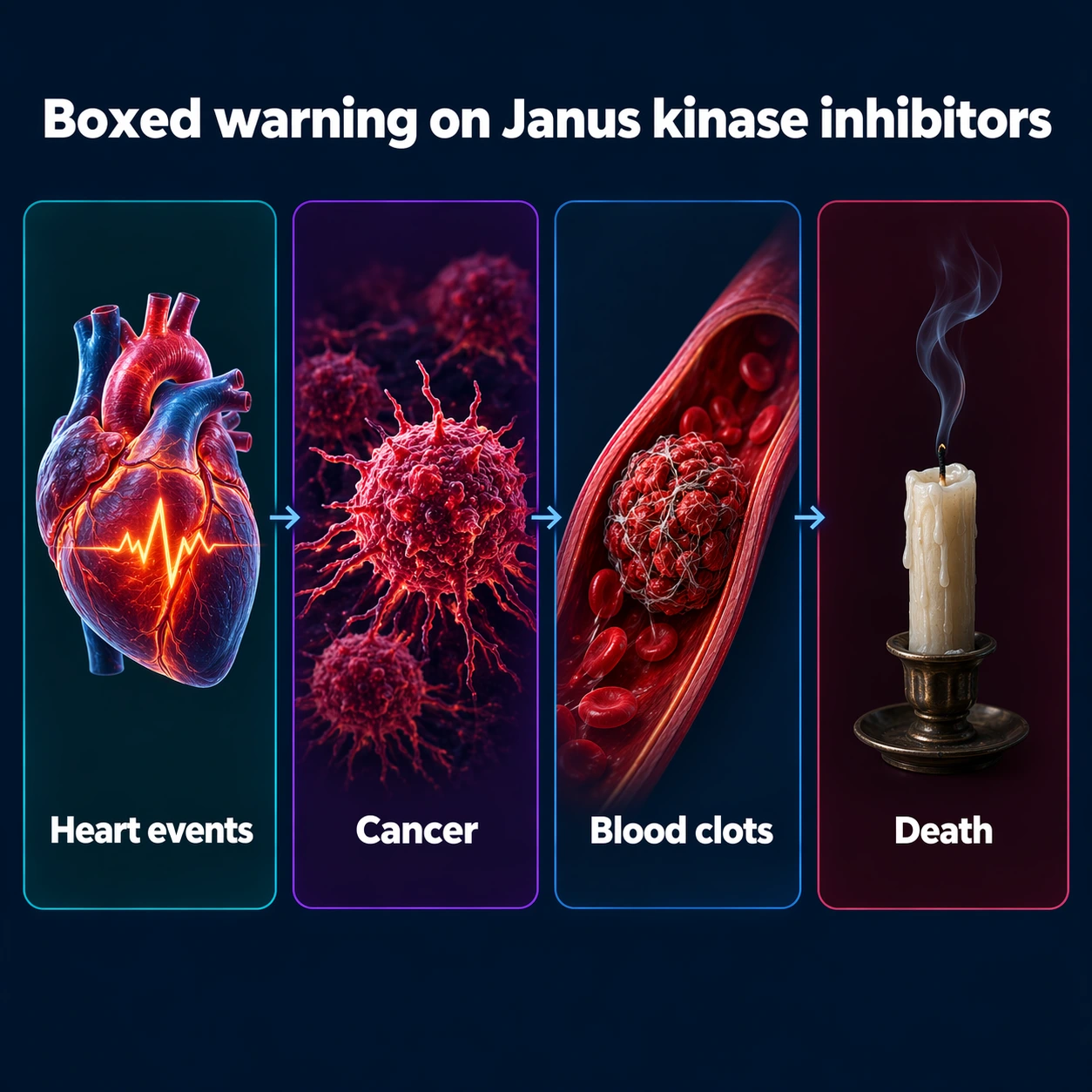

On September 1, 2021, the U.S. Food and Drug Administration (FDA) announced that it was requiring its most prominent warning, the Boxed Warning, on three Janus kinase (JAK) inhibitor medicines used for rheumatoid arthritis and other chronic inflammatory conditions: tofacitinib, baricitinib and upadacitinib. The warning covers an increased risk of serious heart-related events such as heart attack or stroke, cancer, blood clots and death. At the same time the U.S. Food and Drug Administration limited every approved use of the three medicines to certain patients who have not responded to, or cannot tolerate, one or more tumor necrosis factor (TNF) blockers. The action followed a large safety trial of tofacitinib that the U.S. Food and Drug Administration had required, whose first results the agency announced on February 4, 2021.
This page reports what the U.S. Food and Drug Administration’s two Drug Safety Communications of 2021 say: what the agency did and when, the medicines involved, the trial and its results, what the new warnings change, why two medicines that were not in the trial were included, the advice the U.S. Food and Drug Administration gave, what the action does not do, its status as of October 18, 2026, and how it fits the U.S. Food and Drug Administration’s earlier warnings. Medicines are named by their generic names only; no brand or manufacturer is named here.
Table of Contents
- What the U.S. Food and Drug Administration Did in February and September 2021
- The Medicines Involved
- The Safety Trial the U.S. Food and Drug Administration Required
- What the Final Trial Results Showed
- What the New Warnings and Limits Change
- Why Two Medicines Outside the Trial Were Included
- What the U.S. Food and Drug Administration Told Patients and Health Care Professionals
- What the Action Does Not Do
- Dates and Legal Status as of October 18, 2026
- How It Fits Earlier U.S. Food and Drug Administration Warnings
- Primary Documents
- Key Research Papers
- Connections
- Featured Videos
1. What the U.S. Food and Drug Administration Did in February and September 2021
The U.S. Food and Drug Administration issued two Drug Safety Communications, its public safety notices on medicines, on this subject in 2021.
- February 4, 2021 – first results. The U.S. Food and Drug Administration alerted the public that “preliminary results from a safety clinical trial show an increased risk of serious heart-related problems and cancer” with tofacitinib compared with tumor necrosis factor inhibitors. The agency noted that the trial, which it had required, also investigated other potential risks, including blood clots in the lungs and death, and that “Those final results are not yet available.” It said it would evaluate the results and communicate its final conclusions when its review was complete.
- September 1, 2021 – final conclusions. “Based on a completed U.S. Food and Drug Administration (FDA) review of a large randomized safety clinical trial,” the agency wrote, “we have concluded there is an increased risk of serious heart-related events such as heart attack or stroke, cancer, blood clots, and death” with tofacitinib. It required revisions to the Boxed Warning for tofacitinib, baricitinib and upadacitinib, and limited all approved uses of the three medicines to certain patients who have not responded to, or cannot tolerate, one or more tumor necrosis factor blockers.
- December 2021 – labeling updated. A note added to the top of the September communication states: “The issues described below have been addressed in product labeling.” The page is marked content current as of December 7, 2021.
These were labeling actions taken through the U.S. Food and Drug Administration’s drug-safety program, announced on its website. They were not Federal Register rules, so there is no rulemaking docket.
2. The Medicines Involved
The U.S. Food and Drug Administration describes tofacitinib, baricitinib and upadacitinib as members of “a class called Janus kinase (JAK) inhibitors,” used “to treat certain serious, chronic, and progressive inflammatory conditions.” According to the September communication:
- All three are approved, alone or with other medicines, to treat rheumatoid arthritis (RA), “a condition in which the body attacks its own joints, causing pain, swelling, joint damage, and loss of function.”
- Tofacitinib is also approved to treat psoriatic arthritis, a condition that causes joint pain and swelling; ulcerative colitis, “a chronic, inflammatory disease affecting the colon”; and polyarticular course juvenile idiopathic arthritis, “a type of childhood arthritis.”
- The three medicines “work by decreasing the activity of the immune system; an overactive immune system contributes to” these conditions.
- They are taken by mouth, as immediate-release tablets, extended-release tablets or a solution.
- Common side effects the U.S. Food and Drug Administration lists include upper respiratory tract infections such as the common cold and sinus infections, bronchitis, headache, cough, increased cholesterol levels, high blood pressure, increased muscle enzyme levels, rash, nausea, diarrhea, acne, cold sores and shingles.
The February communication adds the approval history of tofacitinib: first approved in 2012 for adults with rheumatoid arthritis who did not respond well to methotrexate; in 2017 for psoriatic arthritis; and in 2018 for ulcerative colitis. The September communication states that tofacitinib “was the first to be approved in 2012.”
A tumor necrosis factor blocker (also called a tumor necrosis factor inhibitor) is, in the U.S. Food and Drug Administration’s words, “another type of medicine used to treat serious inflammatory conditions.” It was the comparison treatment in the safety trial.
3. The Safety Trial the U.S. Food and Drug Administration Required
The U.S. Food and Drug Administration states that when it first approved tofacitinib, it required the manufacturer to conduct a safety clinical trial in patients with rheumatoid arthritis who were taking methotrexate, to evaluate the risk of serious heart-related events, cancer and infections. The September communication’s Data Summary describes the trial as follows:
- Design: multicenter, randomized, open-label (patients and doctors knew which treatment was given).
- Treatments compared: tofacitinib 5 mg twice daily, “which is the approved dosage for rheumatoid arthritis” (1,455 patients); tofacitinib 10 mg twice daily (1,456 patients); and a tumor necrosis factor blocker (1,451 patients).
- Who took part: patients with rheumatoid arthritis aged 50 or older with at least one cardiovascular risk factor. The mean age was 61 and the median 60 (range 50–88 years); 78 percent were female and 77 percent Caucasian.
- What it measured: two co-primary endpoints – major adverse cardiovascular events (MACE), defined as cardiovascular death, nonfatal heart attack (myocardial infarction) and nonfatal stroke; and cancer other than nonmelanoma skin cancer.
- Length: median follow-up of 4 years.
The trial was a noninferiority trial: it was designed to exclude a prespecified risk margin of 1.8 for the hazard ratio of the combined tofacitinib doses compared with the tumor necrosis factor blocker. In plain terms, it set out to show that the rate of each outcome on tofacitinib was not as much as 1.8 times the rate on a tumor necrosis factor blocker. A hazard ratio compares how often an event happens in one group with how often it happens in another; 1.0 means the same rate.
4. What the Final Trial Results Showed
The U.S. Food and Drug Administration’s Data Summary reports that the noninferiority criterion “was not met” for either co-primary endpoint, because the upper limit of each 95% confidence interval exceeded 1.8:
- MACE: hazard ratio 1.33 (95% confidence interval 0.91 to 1.94) for the combined tofacitinib doses compared with tumor necrosis factor blockers.
- Cancer other than nonmelanoma skin cancer: hazard ratio 1.48 (95% confidence interval 1.04 to 2.09).
The agency’s further findings:
- “There was an increased risk of death, MACE, malignancies, and thrombosis associated with both regimens” of tofacitinib. (Thrombosis means blood clots, such as deep vein thrombosis and pulmonary embolism.)
- The data showed “a dose-dependent increased risk for MACE, all-cause mortality, and thrombosis at both doses” compared with tumor necrosis factor blockers, and “a non-dose-dependent increased risk for malignancy excluding NMSC at both doses.”
- “Importantly, a higher rate of blood clots and death was seen with both doses” of tofacitinib compared with tumor necrosis factor blockers, “whereas previous interim results showed the risk only with the higher dose.”
- Lymphomas and lung cancers were observed at a higher rate at both doses. “In particular, a higher rate of lung cancers was observed in current or past smokers treated with” tofacitinib, and “Current or past smokers had an additional increased risk of overall cancers.”
5. What the New Warnings and Limits Change
The U.S. Food and Drug Administration calls the Boxed Warning “U.S. Food and Drug Administration’s most prominent warning.” The September 2021 communication lists three changes:
- Revised Boxed Warning. For tofacitinib, baricitinib and upadacitinib, the Boxed Warning was to include “information about the risks of serious heart-related events, cancer, blood clots, and death.”
- Narrower approved uses. “To ensure the benefits of these three medicines outweigh the risks in patients who receive them,” the U.S. Food and Drug Administration limited “all approved uses to certain patients who have not responded or cannot tolerate one or more tumor necrosis factor blockers.”
- Other label sections. “Changes will also be made to several sections of the prescribing information and to the patient Medication Guide.” The U.S. Food and Drug Administration describes the Medication Guide as the patient leaflet received with each prescription, which “explains the important things that you need to know,” including side effects and what the medicine is used for.
The U.S. Food and Drug Administration’s December 2021 note states that these issues “have been addressed in product labeling” for all three medicines. The exact approval dates of the revised labels are held in the U.S. Food and Drug Administration’s drug-approval database, which was not read for this page; the U.S. Food and Drug Administration’s own note places the completed labeling by December 2021.
6. Why Two Medicines Outside the Trial Were Included
Only tofacitinib was studied in the safety trial. The U.S. Food and Drug Administration explains why the warnings were extended to baricitinib and upadacitinib anyway: they “have not been studied in trials similar to the large safety clinical trial” with tofacitinib, “so the risks have not been adequately evaluated. However, since they share mechanisms of action” with tofacitinib, “U.S. Food and Drug Administration considers that these medicines may have similar risks as seen in the” tofacitinib safety trial.
Two other JAK inhibitors, ruxolitinib and fedratinib, were left out of these updates. The U.S. Food and Drug Administration states that they “are not indicated for the treatment of arthritis and other inflammatory conditions,” are “used to treat blood disorders and require different updates to their prescribing information.” The agency added that if it becomes aware of additional safety information that warrants updates to their labels, “we may take further action and will alert the public.”
7. What the U.S. Food and Drug Administration Told Patients and Health Care Professionals
Both communications carry the U.S. Food and Drug Administration’s own advice. It is reported here as the agency’s statements; decisions about any medicine belong with a clinician.
The U.S. Food and Drug Administration’s statements to patients
- In February 2021, the U.S. Food and Drug Administration stated that patients “should not stop taking tofacitinib without first consulting with your health care professionals, as doing so may worsen your condition.”
- In September 2021, the U.S. Food and Drug Administration asked people taking or starting any of the three medicines to tell their health care professional if they are a current or past smoker, or have had a heart attack, other heart problems, stroke or blood clots in the past, “as these may put you at higher risk for serious problems with the medicines.”
- The U.S. Food and Drug Administration listed symptoms that may signal a heart attack, stroke or blood clot and asked patients to seek emergency help if they occur. They include chest discomfort lasting more than a few minutes or coming and going; severe tightness, pain, pressure or heaviness in the chest, throat, neck or jaw; shortness of breath; a cold sweat; nausea or vomiting; light-headedness; weakness on one side of the body; slurred speech; drooping on one side of the mouth; and swelling, pain, tenderness or red or discolored skin in a leg or arm.
- Because the medicines are associated with an increased risk of certain cancers, including lymphoma and lung cancer, the U.S. Food and Drug Administration asked patients to tell their health care professional about signs such as swollen lymph nodes in the neck, armpits or groin, constant tiredness, fever, night sweats, a persistent or worsening cough, difficulty breathing, hoarseness or wheezing, or unexplained weight loss.
The U.S. Food and Drug Administration’s statements to health care professionals
- The U.S. Food and Drug Administration asked prescribers to “Reserve these medicines for patients who have had an inadequate response or intolerance to one or more tumor necrosis factor blockers.”
- It asked them to weigh the benefits and risks for the individual patient before starting or continuing therapy, “particularly in patients who are current or past smokers, those with other cardiovascular risk factors, those who develop a malignancy, and those with a known malignancy other than a successfully treated nonmelanoma skin cancer.”
- Both communications ask patients and health care professionals to report side effects to the U.S. Food and Drug Administration’s MedWatch program.
8. What the Action Does Not Do
- It does not withdraw any of the three medicines. They remain approved; the action changes their warnings and narrows the patients they are approved for.
- It does not cover every JAK inhibitor. Ruxolitinib and fedratinib, used for blood disorders, were excluded from these updates and, according to the U.S. Food and Drug Administration, require different label changes.
- It does not show that baricitinib and upadacitinib carry the same risks. The U.S. Food and Drug Administration states that their risks “have not been adequately evaluated” and that it “considers that these medicines may have similar risks” because of their shared mechanism.
- It does not predict any one person’s risk. The U.S. Food and Drug Administration writes that because people respond differently to medicines, “we cannot determine how likely it is that someone will experience these side effects” when taking these medicines. The trial reports rates in groups of patients.
- It is not a Federal Register rule. The change was made through each medicine’s prescribing information, not through a regulation with a public comment period.
9. Dates and Legal Status as of October 18, 2026
- 2012: tofacitinib is first approved, for adults with rheumatoid arthritis; the U.S. Food and Drug Administration requires a safety clinical trial at the same time.
- February and July 2019: the U.S. Food and Drug Administration warns that interim trial results show an increased risk of blood clots and death with the 10 mg twice-daily dose and approves a Boxed Warning for tofacitinib.
- February 4, 2021: Drug Safety Communication on the trial’s preliminary results – increased risk of serious heart-related problems and cancer with tofacitinib compared with tumor necrosis factor inhibitors.
- September 1, 2021: Drug Safety Communication on the completed review – revised Boxed Warnings for tofacitinib, baricitinib and upadacitinib, and all approved uses limited to patients who have not responded to, or cannot tolerate, one or more tumor necrosis factor blockers.
- December 2021: the U.S. Food and Drug Administration notes that the issues “have been addressed in product labeling” (page current as of December 7, 2021).
Status as of October 18, 2026: in effect. The revised Boxed Warnings and the narrowed uses are part of the medicines’ labeling, which the U.S. Food and Drug Administration reported complete in December 2021. No later U.S. Food and Drug Administration document reversing the change was found. Labeling changes of this kind are not made through the Federal Register; a check of the Federal Register for later documents on the subject could not be completed on October 18, 2026, because the Federal Register service refused the request.
10. How It Fits Earlier U.S. Food and Drug Administration Warnings
The 2021 action was the third step in a sequence the U.S. Food and Drug Administration itself describes. The February 2021 communication recalls that “In February 2019 and July 2019, we warned that interim trial results showed an increased risk of blood clots and death with the higher 10 mg twice daily dosage, and as a result, approved a Boxed Warning to the tofacitinib prescribing information.”
What changed in 2021 was the reach of the finding. In 2019 the concern rested on interim results at the higher dose. The final results extended the increased risk of blood clots and death to the lower, approved rheumatoid arthritis dose as well, added heart-related events and cancer, and led the U.S. Food and Drug Administration to apply the warning to two other medicines of the same class. The September 2021 communication states that it “is an update to the U.S. Food and Drug Administration Drug Safety Communication issued on February 4, 2021.”
Other U.S. Food and Drug Administration drug-safety actions of 2021 reported on this site are listed in Connections below.
11. Primary Documents
- U.S. Food and Drug Administration. Initial safety trial results find increased risk of serious heart-related problems and cancer with arthritis and ulcerative colitis medicine (tofacitinib). U.S. Food and Drug Administration Drug Safety Communication, February 4, 2021; page content current as of December 7, 2021 — fda.gov Drug Safety Communication, February 4, 2021
- U.S. Food and Drug Administration. U.S. Food and Drug Administration requires warnings about increased risk of serious heart-related events, cancer, blood clots, and death for JAK inhibitors that treat certain chronic inflammatory conditions. U.S. Food and Drug Administration Drug Safety Communication, September 1, 2021, with December 2021 update; page content current as of December 7, 2021 — fda.gov Drug Safety Communication, September 1, 2021
Neither action was published as a Federal Register document, and neither has a public docket.
Key Research Papers
- Ytterberg SR, Bhatt DL, Mikuls TR, Koch GG, Fleischmann R, Rivas JL, Germino R, Menon S, Sun Y, Wang C, Shapiro AB, Kanik KS, Connell CA; ORAL Surveillance Investigators (2022). Cardiovascular and Cancer Risk with Tofacitinib in Rheumatoid Arthritis. The New England Journal of Medicine 386(4):316-326 — PubMed PMID: 35081280
- Charles-Schoeman C, Buch MH, Dougados M, Bhatt DL, Giles JT, Ytterberg SR, Koch GG, Vranic I, Wu J, Wang C, Kwok K, Menon S, Rivas JL, Yndestad A, Connell CA, Szekanecz Z (2023). Risk of major adverse cardiovascular events with tofacitinib versus tumour necrosis factor inhibitors in patients with rheumatoid arthritis with or without a history of atherosclerotic cardiovascular disease: a post hoc analysis from ORAL Surveillance. Annals of the Rheumatic Diseases 82(1):119-129 — PubMed PMID: 36137735
- Curtis JR, Yamaoka K, Chen YH, Bhatt DL, Gunay LM, Sugiyama N, Connell CA, Wang C, Wu J, Menon S, Vranic I, Gómez-Reino JJ (2023). Malignancy risk with tofacitinib versus TNF inhibitors in rheumatoid arthritis: results from the open-label, randomised controlled ORAL Surveillance trial. Annals of the Rheumatic Diseases 82(3):331-343 — PubMed PMID: 36600185
- Charles-Schoeman C, Fleischmann R, Mysler E, Greenwald M, Ytterberg SR, Koch GG, Bhatt DL, Wang C, Mikuls TR, Chen AS, Connell CA, Woolcott JC, Menon S, Chen Y, Lee K, Szekanecz Z (2024). Risk of Venous Thromboembolism With Tofacitinib Versus Tumor Necrosis Factor Inhibitors in Cardiovascular Risk-Enriched Rheumatoid Arthritis Patients. Arthritis & Rheumatology 76(8):1218-1229 — PubMed PMID: 38481002
- Maqsood MH, Weber BN, Haberman RH, Lo Sicco KI, Bangalore S, Garshick MS (2022). Cardiovascular and Venous Thromboembolic Risk With Janus Kinase Inhibitors in Immune-Mediated Inflammatory Diseases: A Systematic Review and Meta-Analysis of Randomized Trials. ACR Open Rheumatology 4(10):912-922 — PubMed PMID: 35903881
- Szekanecz Z, Buch MH, Charles-Schoeman C, Galloway J, Karpouzas GA, Kristensen LE, Ytterberg SR, Hamar A, Fleischmann R (2024). Efficacy and safety of JAK inhibitors in rheumatoid arthritis: update for the practising clinician. Nature Reviews Rheumatology 20(2):101-115 — PubMed PMID: 38216757
- Solitano V, Ahuja D, Lee HH, Gaikwad R, Yeh KH, Facciorusso A, Singh AG, Ma C, Ananthakrishnan AN, Yuan Y, Singh N, Jairath V, Singh S (2025). Comparative Safety of JAK Inhibitors vs TNF Antagonists in Immune-Mediated Inflammatory Diseases: A Systematic Review and Meta-Analysis. JAMA Network Open 8(9):e2531204 — PubMed PMID: 40928778
The first paper is the published main report of the safety trial on which the U.S. Food and Drug Administration based its 2021 action. The next three are later analyses of the same trial, looking at heart events by cardiovascular history, at cancer and at blood clots in the veins. The last three are a meta-analysis of randomized trials, a clinical review and a meta-analysis comparing JAK inhibitors with tumor necrosis factor blockers across inflammatory diseases.
PubMed Topic Searches
Connections
- U.S. Food and Drug Administration Actions of 2021
- U.S. Food and Drug Administration and Regulation
- Rheumatoid Arthritis
- Psoriatic Arthritis
- Juvenile Idiopathic Arthritis
- Ulcerative Colitis
- JAK Inhibitors and S1P Modulators
- Deep Vein Thrombosis
- Pulmonary Embolism
- Heart Attack
- Stroke
- Lymphoma
- Lung Cancer
- Statin Pregnancy Warning Removed (2021)
- Varenicline Nitrosamine Recall and Limit (2021)
- Breast Implant Boxed Warning and Checklist (2021)
- Aducanumab Accelerated Approval (2021)
- Buprenorphine Dental Problems Warning (2022)