Benign Prostatic Hyperplasia: History and Discovery
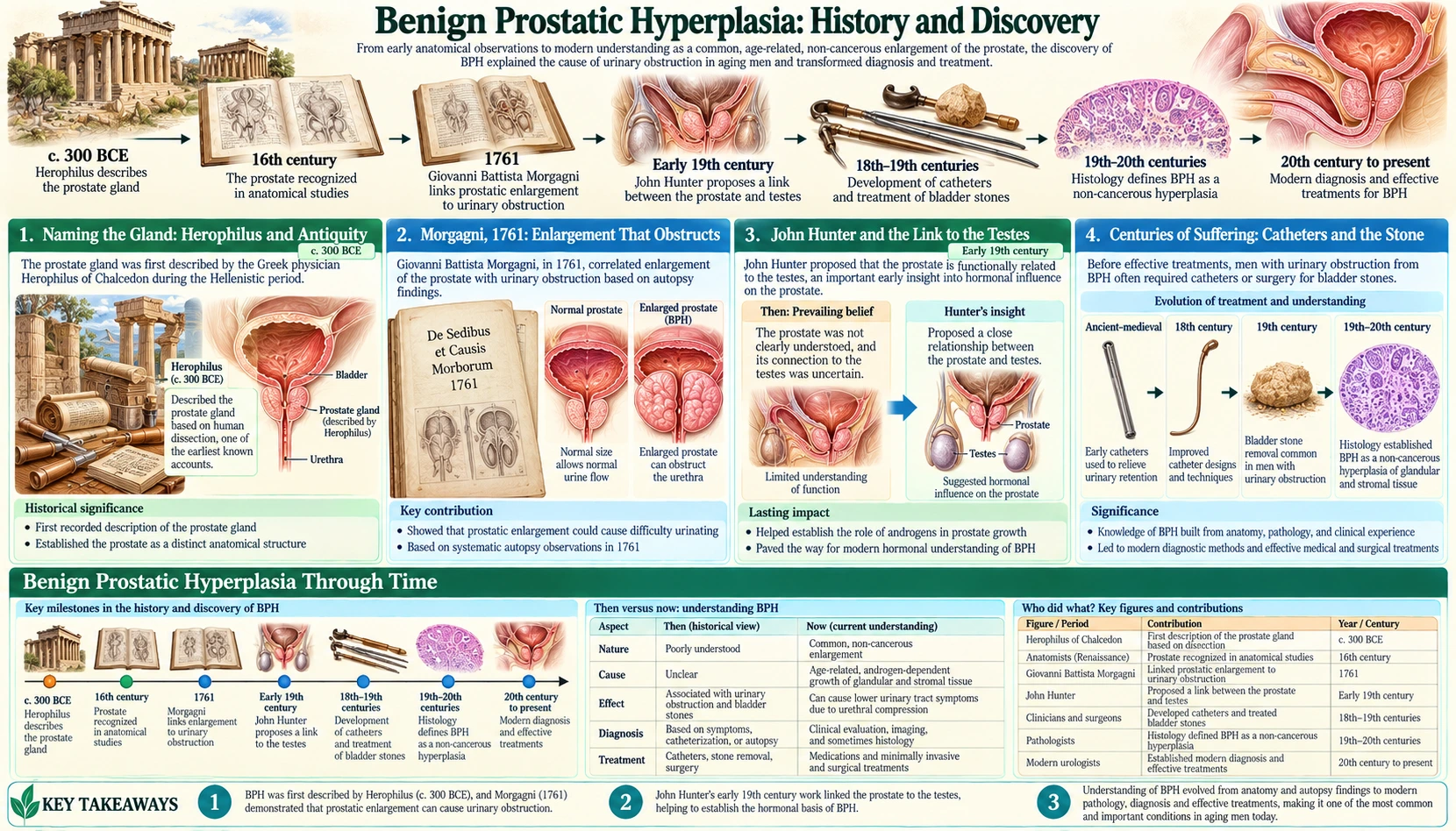
The story of benign prostatic hyperplasia (BPH) is the story of a small gland that medicine struggled for two thousand years to name, then to understand, and finally to treat. The prostate was first described in antiquity; its tendency to enlarge with age and choke off the flow of urine was carefully documented by the great anatomists of the eighteenth century; and only in the twentieth century — through the resectoscope and, later, through drugs aimed at the male hormones that drive prostate growth — did effective, survivable treatment finally arrive. Throughout, one distinction matters above all and is honoured here: benign prostatic enlargement is not prostate cancer. This article traces the people, dates, and discoveries behind that history, and is careful to separate what is firmly established from what was, and in some cases remains, hypothesis.
Table of Contents
- Naming the Gland: Herophilus and Antiquity
- Morgagni, 1761: Enlargement That Obstructs
- John Hunter and the Link to the Testes
- Centuries of Suffering: Catheters and the Stone
- Open Prostatectomy: Fuller, Freyer, and Young
- The Resectoscope and the Birth of TURP
- Huggins, Androgens, and the DHT Story
- The Drug Era: Alpha-Blockers and Finasteride
- Benign Enlargement Versus Prostate Cancer
- Key Research Papers
- Connections
- Featured Videos
Naming the Gland: Herophilus and Antiquity
The prostate entered the written record in the great medical school of Alexandria. Herophilus of Chalcedon (c. 335–280 BCE), who carried out systematic human dissections in Alexandria in the early third century BCE, is the figure most often credited with the first anatomical description of the glandular tissue beneath the bladder. He is also traditionally credited with originating the term that became prostate, from the Greek prostates — literally "one who stands before," a guardian or protector — the structure that "stands before" the bladder. The name has proved remarkably durable: it is essentially unchanged after twenty-three centuries.
Historical honesty requires a caveat here, and modern scholarship supplies it. What exactly Herophilus saw and named is debated. The structures he termed the "glandular assistants" (the parastatae adenoides) below the bladder may have referred as much to the seminal vesicles as to the prostate proper, and the precise sense in which he used the word differs from the "protector" etymology later attached to it. The prostate as a clearly delineated, separately named organ took centuries more to settle. The fair summary — supported by Jonathan Goddard's history of the prostate and by the standard reviews of the term's origin — is that the gland was recognised in antiquity and the name traces to the Greek prostates, while the exact attribution to a single discoverer carries a real, well-documented degree of uncertainty.
For more than a millennium afterward, anatomical knowledge of the region advanced little. Galen and the medieval Arabic and European authorities who followed him described the area around the bladder neck, but a dedicated, accurate account of the prostate as we now understand it would not appear until the Renaissance dissectors and, decisively, the eighteenth-century anatomists who connected the gland's size to a specific and miserable clinical problem.
Morgagni, 1761: Enlargement That Obstructs
The decisive step from naming the prostate to understanding its disease came from Giovanni Battista Morgagni (1682–1771), the Paduan anatomist whose De Sedibus et Causis Morborum per Anatomen Indagatis ("On the Seats and Causes of Diseases Investigated by Anatomy"), published in 1761, founded the discipline of anatomical pathology. Morgagni's method was revolutionary for its time: he correlated the symptoms a patient had suffered in life with the lesions found in the body after death, building disease out of observed anatomy rather than out of theory.
Among the many cases Morgagni recorded was that of an elderly man whose bladder, at autopsy, showed grossly thickened, heaped-up muscle — he likened the bundles of bladder fibres to the strong fibres of the heart — the unmistakable consequence of years of straining to pass urine against an obstruction. The obstruction itself he traced to an enlarged prostate narrowing the outlet, in one description an "excrescence" of the gland shaped like a pear that left scarcely any passage for urine. In modern terms, Morgagni had documented the cardinal anatomy of BPH: an enlarged prostate causing bladder outlet obstruction, and the secondary muscular hypertrophy (trabeculation) of the bladder wall that obstruction produces.
This was a watershed. For the first time, the chronic, age-related "stoppage of urine" that afflicted older men was tied, by direct anatomical observation, to a specific enlarged organ rather than to vague humoral imbalance. Morgagni did not yet know why the gland enlarged — that question would not be meaningfully answered for two more centuries — but he had defined the lesion and its mechanical consequence with a clarity that set the agenda for everyone who followed.
John Hunter and the Link to the Testes
If Morgagni described the lesion, the Scottish surgeon-anatomist John Hunter (1728–1793) — one of the most penetrating experimental minds in the history of surgery — supplied the first real clue to its cause. Working in eighteenth-century London, Hunter studied the comparative anatomy of the reproductive organs across many species and made an observation that would prove foundational: the prostate and the other accessory sex glands depend on the testes. He noted (in work generally dated to around 1786) that in animals the testes and the prostate varied together — including seasonal changes in size — and, crucially, that castration caused the prostate to shrink and fail to develop.
The implication, drawn out over the following century and a half, was momentous: the prostate is a hormone-dependent organ, its growth governed by a substance (later identified as testosterone and its potent derivative) produced by the testes. Hunter could not have framed it in the language of endocrinology — hormones as a concept lay more than a hundred years in the future — but his castration observations are the historical root of every later androgen-based theory of prostate growth, of prostate disease, and ultimately of the drugs used to treat both BPH and prostate cancer. It is fair to call this an early hypothesis brilliantly grounded in experiment; its full molecular vindication came only in the twentieth century.
Hunter is also associated with the era's competing idea that prostatic enlargement might be inflammatory in origin. The tension between an inflammatory and a hormonal account of prostate growth ran through nineteenth-century medicine. History eventually favoured the hormonal thread Hunter had opened with his testes–prostate experiments, though inflammation is now recognised as one contributing factor among several in BPH rather than the whole story.
Centuries of Suffering: Catheters and the Stone
For most of recorded history, a man whose prostate had closed off his bladder faced two grim options, and for a long time only the first was survivable. The first was catheterisation — passing a tube through the urethra to drain the trapped urine. Catheters of bronze, silver, and later flexible gum-elastic and rubber are among the oldest surgical instruments known; for the man with advancing obstruction, repeated or even permanent catheterisation was, for centuries, the only thing standing between him and a death from acute retention or kidney failure. It relieved the immediate crisis but did nothing to the gland, and it carried a constant risk of infection and traumatic injury to the urethra.
The second option was "cutting for the stone" (lithotomy) — the surgical removal of bladder stones, which formed readily in bladders that could not empty. Lithotomy is one of the oldest of all operations, condemned even in the Hippocratic Oath as work to be left to specialist cutters, and in the era before anaesthesia and antisepsis it was savage and frequently fatal: performed in seconds by itinerant lithotomists on a conscious, restrained patient, with appalling rates of haemorrhage, infection, fistula, and death. Stones and prostatic obstruction were intertwined — the stagnant bladder bred the stone, and the stone worsened the suffering — so the lithotomist's blade was, for many older men, the only "treatment" on offer beyond the catheter.
This is the backdrop against which the surgical breakthroughs of the late nineteenth and twentieth centuries must be understood. Until anaesthesia (from the 1840s) and antisepsis (from the 1860s–1870s) made deliberate, deeper surgery survivable, no one could safely cut out the offending gland. The prostate sat in a dangerous location, richly supplied with blood; to remove it before these advances was to court fatal bleeding and sepsis. Anaesthesia and antisepsis were the enabling revolutions that made everything in the next two sections possible.
Open Prostatectomy: Fuller, Freyer, and Young
The first truly effective treatment for the enlarged prostate was to remove the obstructing tissue under direct vision through an open incision — open prostatectomy. The American urologist Eugene Fuller of New York is credited with performing a deliberate, complete suprapubic enucleation of the obstructing prostatic tissue in 1895, reaching the gland through the bladder from an incision above the pubic bone. Fuller demonstrated that the adenomatous tissue could be shelled out with the finger, relieving the obstruction at its source.
It was the Irish surgeon Sir Peter Freyer (1851–1921), working at St Peter's Hospital in London, who turned the suprapubic operation into a standardised, widely adopted procedure around 1900 — he performed his celebrated suprapubic prostatectomy on 1 December 1900 and went on to publish large, comparatively successful series that made the operation famous across the world. Freyer's priority was contested at the time: Fuller (and the American surgeon Ramon Guiteras) had described the essentials of the technique earlier, and the historical consensus now credits Fuller with the operation and Freyer with popularising and perfecting it. Either way, for the first time men could be cured of their obstruction rather than merely catheterised through it.
A different open route was pioneered at Johns Hopkins by Hugh Hampton Young (1870–1945), the towering figure of early American urology. Young developed the perineal approach to the prostate — reaching the gland through an incision between the scrotum and anus — designing special instruments that let him enucleate the prostate under direct vision (work dated to around 1903), and in 1904 he performed the first radical perineal prostatectomy for prostate cancer. Young's perineal technique and his instruments dramatically lowered operative mortality and established American urology as a serious surgical discipline. (A further refinement, the retropubic approach, was introduced later in the twentieth century by Terence Millin.) Between Fuller's suprapubic enucleation, Freyer's popularisation, and Young's perineal method, the open removal of the obstructing prostate became, for the first half of the twentieth century, the definitive cure for severe BPH.
The Resectoscope and the Birth of TURP
Open surgery cured the obstruction but at the cost of a major abdominal or perineal operation. The defining innovation of twentieth-century BPH treatment was to remove the tissue without any external incision at all — passing an instrument up the urethra and shaving the gland away from inside. This is transurethral resection of the prostate (TURP), and the key enabling tool was the resectoscope: an endoscope combining a light, a viewing telescope, and an electrically heated wire loop that cuts and coagulates tissue under direct vision.
The first practical resectoscope was designed by Maximilian Stern of New York, who presented it to the New York Academy of Medicine in 1926. Stern's instrument used a tungsten wire loop and a high-frequency cutting current to pare off "spaghetti-like" strips of prostatic tissue from within the urethra. Its great weakness was bleeding: the early cutting current coagulated poorly, so haemorrhage obscured the field and endangered the patient. The crucial improvement came from Joseph F. McCarthy, who around 1931 combined Stern's cutting loop with a superior foroblique panendoscope and a dual high-frequency current (cutting plus coagulation), encasing the working element in an insulating Bakelite sheath. The resulting Stern–McCarthy resectoscope cut cleanly and controlled bleeding, and it rapidly became the instrument of choice for urologists worldwide.
TURP transformed the treatment of BPH. It removed obstructing tissue effectively with no skin incision, far less pain, and a much faster recovery than open prostatectomy, and despite countless refinements — better optics, safer irrigation, and modern variants — the fundamental Stern–McCarthy design and technique have endured for the better part of a century. As the modern historical review by Strebel and Kaplan emphasises, TURP remains a reference standard against which newer surgical and energy-based treatments for the enlarged prostate are still measured, prized for its balance of high efficacy and acceptably low complications.
Huggins, Androgens, and the DHT Story
John Hunter's eighteenth-century insight — that the prostate depends on the testes — was finally given a rigorous, clinical foundation by Charles Brenton Huggins (1901–1997) at the University of Chicago. In 1941, Huggins and his colleague Clarence V. Hodges published their landmark study showing that the growth of prostate cancer was driven by male hormones: removing androgens, by surgical castration or by giving oestrogen, caused advanced, metastatic prostate cancer to regress, while giving androgen made it flare. This demonstrated, for the first time, that a human cancer could be controlled by manipulating hormones — the founding observation of endocrine cancer therapy. Huggins shared the 1966 Nobel Prize in Physiology or Medicine for this work, and androgen-deprivation therapy remains a frontline treatment for advanced prostate cancer to this day.
Huggins's work was performed on prostate cancer, not on benign hyperplasia, and the distinction matters — but his proof that the prostate is profoundly androgen-dependent illuminated the whole organ. It established the principle, latent since Hunter, that prostatic tissue grows under androgenic drive, which is exactly the lever later exploited to shrink benign enlargement. The missing piece was identifying the specific hormone responsible inside the gland.
That piece arrived in the 1960s and 1970s with the recognition that testosterone is converted, within prostate tissue by the enzyme 5-alpha-reductase, into the far more potent androgen dihydrotestosterone (DHT), and that DHT is the principal driver of prostatic growth. A natural human experiment sealed the case: men with inherited 5-alpha-reductase deficiency produce little DHT and have characteristically small prostates that essentially never develop BPH. Here history connected mechanism to therapy directly — if DHT makes the prostate grow, then blocking its production should make the prostate shrink. That hypothesis, unlike many in this story, was soon confirmed and turned into a medicine.
The Drug Era: Alpha-Blockers and Finasteride
For all of recorded history before the late twentieth century, the only relief for the obstructed prostate had been mechanical — a catheter or a knife. The arrival of effective drugs for BPH in the closing decades of the twentieth century was therefore a genuine break with the entire past, and it followed two distinct mechanistic threads.
The first thread is the alpha-blockers. Researchers recognised in the 1970s that the prostate and bladder neck contain abundant alpha-1 adrenergic receptors, and that the smooth muscle there is held in a state of tension by the sympathetic nervous system — a "dynamic" component of obstruction quite separate from the bulk of the enlarged gland. Drugs that block alpha-1 receptors relax that smooth muscle, widening the outlet and easing urine flow. Early work used prazosin, a drug first developed for high blood pressure; this insight led to prostate-targeted alpha-blockers such as terazosin, doxazosin, tamsulosin, and others, which became a mainstay of medical therapy for the lower urinary tract symptoms of BPH. Alpha-blockers do not shrink the prostate; they relax it, and they work within days.
The second thread is the 5-alpha-reductase inhibitors, which attack the gland itself by cutting off its DHT supply. The first of these, finasteride (developed by Merck under the code MK-906 and marketed as Proscar), was approved by the US Food and Drug Administration for BPH on 19 June 1992. By inhibiting 5-alpha-reductase, finasteride lowers prostatic DHT by roughly 70 percent and, over months, causes the enlarged gland to shrink — directly validating the DHT hypothesis in living patients. A second agent, dutasteride, followed. The two drug classes proved complementary — the alpha-blocker for fast symptomatic relief, the 5-alpha-reductase inhibitor for long-term shrinkage and reduced risk of progression — and combination therapy became a standard medical approach. (Finasteride at a lower dose was later approved separately for male-pattern hair loss, another DHT-dependent condition, as Propecia.) After two thousand years, the line of inquiry that began with Hunter watching castrated animals and ran through Huggins's Nobel-winning hormone work had finally produced a pill that could treat the enlarged prostate.
Benign Enlargement Versus Prostate Cancer
No history of BPH is complete or responsible without insisting on the distinction that the very name encodes: benign prostatic hyperplasia is not cancer. BPH is a non-malignant overgrowth of the prostate's glandular and stromal tissue, typically beginning in the central, peri-urethral "transition zone" of the gland, where it squeezes the urethra and obstructs flow. Prostate cancer, by contrast, is a malignant tumour that most often arises in the outer peripheral zone — which is part of why it can grow silently, away from the urethra, without early urinary symptoms. BPH does not turn into prostate cancer, and having one does not, in itself, mean having the other.
The two conditions were genuinely conflated for much of medical history — older terms like "prostatism" and the broad use of "enlargement" blurred the line, and the surgical and hormonal stories told above sometimes run through both at once. Charles Huggins's hormone work, for instance, was about prostate cancer, even though it illuminated the androgen biology of the benign gland. Modern medicine separates them with tools the pioneers lacked: the prostate-specific antigen (PSA) blood test, digital rectal examination, imaging, and prostate biopsy together allow benign enlargement and malignancy to be distinguished, and the two are managed along entirely different paths.
The practical message that falls out of this long history is reassuring and worth stating plainly. The urinary symptoms of an aging prostate — a weaker stream, hesitancy, getting up at night to urinate — are usually due to benign enlargement, a condition that is common, manageable, and not life-threatening in itself. But because some of those symptoms can overlap with other conditions, and because prostate cancer can be silent, evaluation by a clinician is what allows the benign to be confidently told apart from the dangerous. That distinction — the heart of the word benign — is the most important single lesson of the entire history recounted here.
Key Research Papers
The references below combine peer-reviewed historical and clinical reviews with curated PubMed topic-search links into the history of the prostate, its surgery, and its hormonal biology. Historical primary works (Morgagni's De Sedibus of 1761, and John Hunter's eighteenth-century anatomical and castration studies) are named in the article as historical sources rather than as modern citations. Each external link opens in a new tab.
- Goddard J. The history of the prostate, part one: say what you see. Trends in Urology & Men's Health. 2019;10(1):28-30. — doi:10.1002/tre.676
- Goddard J. Sir Peter Freyer: the man who gave the world prostatectomy. Trends in Urology & Men's Health. 2020. — doi:10.1002/tre.770
- Goddard J. History of the prostate, part three: ‘the size of a filbert!’, open surgery. Trends in Urology & Men's Health. 2021. — doi:10.1002/tre.819
- Strebel RT, Kaplan SA. The state of TURP through a historical lens. World Journal of Urology. 2021;39(7):2255-2262. — doi:10.1007/s00345-021-03607-7 (PubMed PMID: 33772604)
- Lepor H. Pathophysiology, epidemiology, and natural history of benign prostatic hyperplasia. Reviews in Urology. 2004;6(Suppl 9):S3-S10. — PubMed PMID: 16985922
- Huggins C, Hodges CV. Studies on prostatic cancer: I. The effect of castration, of estrogen and of androgen injection on serum phosphatases in metastatic carcinoma of the prostate. 1941. — PubMed PMID: 12050481
- Benadada I, et al. Charles Brenton Huggins: a historical review of the Nobel laureate's pioneering discoveries. Cancer. 2024. — doi:10.1002/cncr.35173 (PubMed PMID: 38146679)
- History and origin of the term "prostate" (Herophilus, etymology, and the anatomy of naming) — PubMed: history of the term prostate
- Morgagni and the early anatomical pathology of prostatic obstruction — PubMed: Morgagni and prostatic obstruction
- John Hunter, the testes, and the androgen dependence of the prostate — PubMed: John Hunter, testes and the prostate
- History of open prostatectomy (Fuller, Freyer, Young) for benign prostatic enlargement — PubMed: history of open prostatectomy
- History of the resectoscope and transurethral resection of the prostate (Stern, McCarthy) — PubMed: resectoscope and TURP history
- 5-alpha-reductase, dihydrotestosterone, and finasteride in benign prostatic hyperplasia — PubMed: finasteride, 5-alpha-reductase and DHT in BPH
- Alpha-1 adrenergic blockers in the treatment of benign prostatic hyperplasia and lower urinary tract symptoms — PubMed: alpha-blockers in BPH
External Authoritative Resources
Connections
- Urology
- Benign Prostatic Hyperplasia (main page)
- Prostate Conditions
- Low Testosterone & TRT
- Urinary Tract Infections
- Erectile Dysfunction
- Kidney Stones
- All Conditions
- Prostate Cancer — the malignant disease that this history is careful to distinguish from benign enlargement.