Asherman's Syndrome (Intrauterine Adhesions)
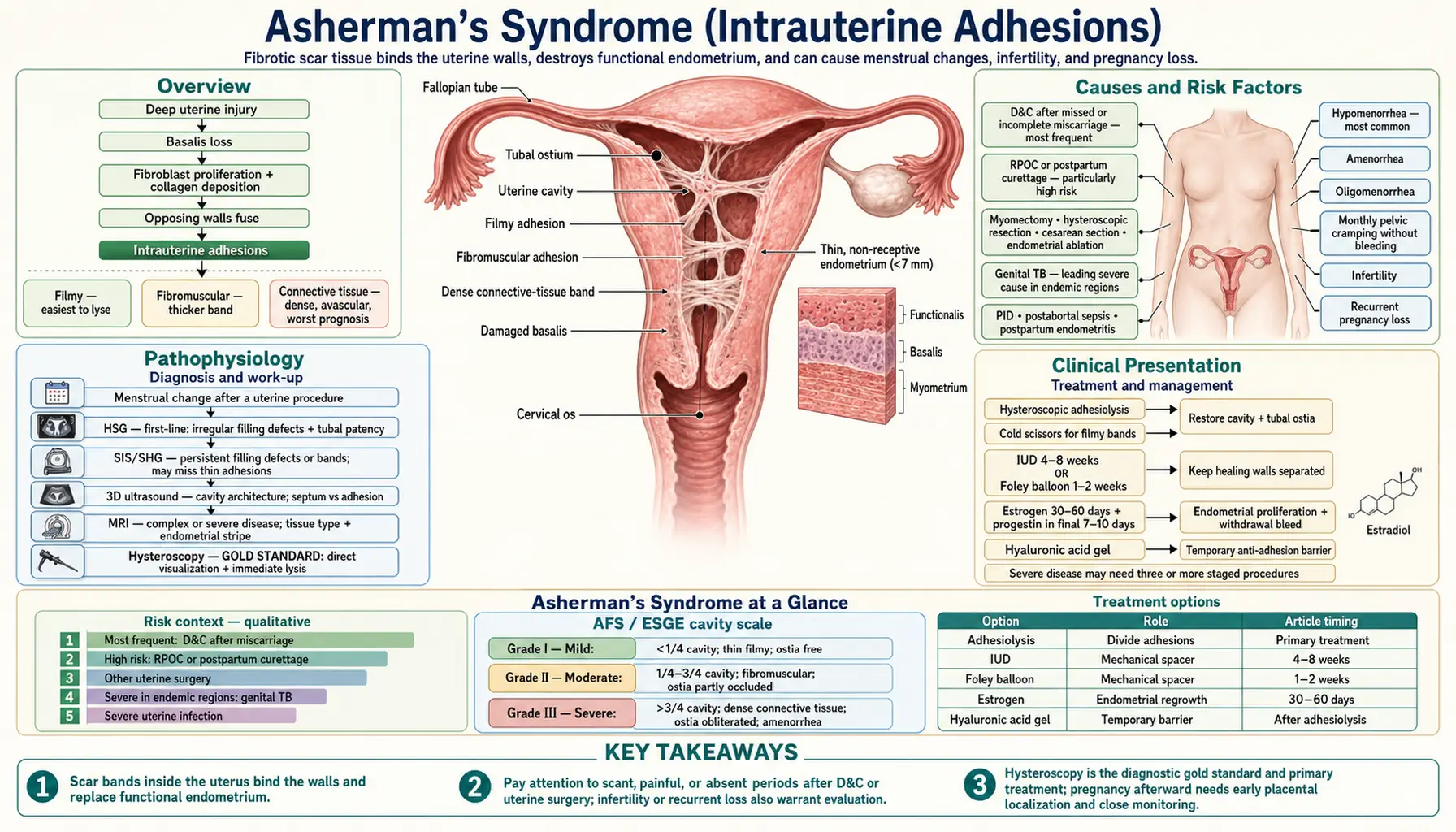
Table of Contents
- Overview
- Causes and Risk Factors
- Pathophysiology
- Clinical Presentation
- Diagnosis and Classification
- Hysteroscopic Treatment
- Post-Operative Adhesion Prevention
- Fertility and Pregnancy Outcomes
- Emerging Therapies
- Psychological Impact
- Key Research Papers
- Featured Videos
Overview
Asherman's syndrome — also called intrauterine adhesions (IUAs) or intrauterine synechiae — is a condition in which fibrotic scar tissue forms inside the uterine cavity, binding the walls together and destroying functional endometrium. The disease ranges from thin, filmy adhesions that partly bridge the cavity to dense, fibromuscular or connective-tissue bands that obliterate it entirely.
The condition was named after the Israeli gynecologist Joseph Asherman, who described it in 1948 after observing amenorrhea following uterine trauma. Its defining feature is damage to the basal layer of the endometrium — the regenerative stem-cell reservoir — leaving the cavity lined with scar rather than functional mucosa. Because the basal layer cannot regenerate after deep injury, even minimal surface damage to this layer can produce lasting adhesions.
Asherman's syndrome is almost always iatrogenic: caused by a medical or surgical procedure, most often a uterine curettage (D&C) performed after a pregnancy. It is the leading cause of secondary amenorrhea and infertility due to uterine factor worldwide. With careful hysteroscopic surgery and post-operative management, many patients can recover normal uterine function — but outcomes depend heavily on adhesion severity and underlying endometrial reserve.
Causes and Risk Factors
The overwhelming majority of Asherman's syndrome cases follow damage to the pregnant or recently pregnant uterus. The gravid uterus is uniquely vulnerable because its decidualized endometrium is highly adherent and the basal layer lies close to the surface, making traumatic curettage more likely to denude it.
Dilation and Curettage (D&C) — The Most Common Cause
Sharp or suction curettage of the uterine cavity after a pregnancy event accounts for the majority of cases globally. The highest-risk scenarios include:
- D&C for missed or incomplete miscarriage — the most frequent cause; the softened postpartum endometrium tears readily at the basal layer
- Curettage for retained products of conception (RPOC) after delivery or miscarriage — particularly risky because the uterus is hypervascular and inflamed
- D&C for elective termination — risk rises if performed in a recently pregnant uterus or if multiple procedures are performed
- Postpartum curettage for hemorrhage or retained placenta — the postpartum uterus is most vulnerable; a single overzealous curettage can ablate the entire basal layer
Other Uterine Surgeries
- Myomectomy — removal of uterine fibroids; posterior uterine wall incisions and intracavitary myomectomy carry the highest IUA risk
- Hysteroscopic procedures — resection of uterine septum, submucous fibroids, or polyps can damage adjacent endometrium
- Cesarean section — lower uterine segment adhesions can form at the scar site
- Endometrial ablation — intentional destruction of the endometrium for heavy bleeding; adhesions are expected and intentional
Genital Tuberculosis
In developing countries — particularly South Asia, sub-Saharan Africa, and parts of the Middle East — genital tuberculosis (TB endometritis) is the leading cause of severe Asherman's syndrome. Mycobacterium tuberculosis spreads hematogenously to the fallopian tubes and then descends to the endometrium, producing granulomatous inflammation followed by fibrotic scarring. Asherman's from TB is frequently the most severe form — complete obliteration of the cavity — and the poorest prognosis for fertility restoration. Any patient from an endemic region presenting with Asherman's should be screened with a tuberculin skin test (PPD) or IGRA (interferon-gamma release assay).
Infection
Severe uterine infections — whether from PID, postabortal sepsis, or postpartum endometritis — can independently cause adhesion formation even without preceding curettage. Infection amplifies the inflammatory-fibrotic response and makes curettage-related adhesions far more severe.
Pathophysiology
Normal endometrial regeneration depends on an intact basalis layer — the deepest zone of the endometrium that is not shed during menstruation. It contains stromal stem cells and glandular progenitors that reconstitute the functionalis (the hormonally responsive upper layer) each cycle. When the basalis is injured, this regenerative capacity is lost in the affected area.
Instead of regeneration, the denuded myometrium responds with fibroblast proliferation and collagen deposition. Adjacent denuded walls fuse during healing, forming adhesions that bridge the cavity. The adhesion type determines clinical severity:
- Filmy adhesions — thin bands of endometrium or fibrous tissue; easily lysed; best prognosis
- Fibromuscular adhesions — thicker bands containing smooth muscle covered by endometrium; require more force to divide
- Connective tissue adhesions — dense, avascular, fibrotic bands without endometrial cover; most severe; resist re-endometrialization even after lysis; worst prognosis
Critically, adhesion lysis does not automatically restore endometrial function. Even after the mechanical obstruction is removed, the underlying basalis may be permanently depleted — leading to thin, non-receptive endometrium (endometrial thickness <7 mm on ultrasound) that cannot support implantation regardless of cavity shape. This is why cavity restoration and endometrial regeneration are separate challenges, and why outcomes in severe disease remain poor even with technically successful surgery.
Clinical Presentation
The hallmark of Asherman's syndrome is a change in menstrual pattern after a uterine procedure. The most important diagnostic clue is the temporal relationship: periods that were previously normal become scanty, painful, or absent after a D&C or other uterine surgery.
Menstrual Abnormalities
- Hypomenorrhea — scanty periods; the most common presenting symptom; often dismissed as "normal variation" after a miscarriage D&C
- Amenorrhea — complete absence of periods; occurs when adhesions obliterate the cavity or block the cervical os; hormonal levels (estrogen, progesterone, FSH, LH) are typically normal, distinguishing this from ovarian failure
- Oligomenorrhea — infrequent or irregular periods
Cyclic Pelvic Pain Without Bleeding (Cryptomenorrhea)
When adhesions seal the cervical os or lower cavity but the upper uterus still produces menstrual fluid, blood accumulates behind the obstruction. The patient experiences monthly cramping at the expected time of menstruation without any external bleeding. This hematometra (blood pooling in the uterus) is an important diagnostic clue when it occurs cyclically after a uterine procedure. Severe hematometra causes severe pelvic pain and distension visible on ultrasound.
Infertility
Adhesions can cause infertility through several mechanisms: physical obstruction of the cavity prevents sperm ascent or embryo implantation; scarred endometrium lacks the receptivity needed for trophoblast invasion; and poor endometrial thickness (thin lining) prevents adequate decidualization. Women may present to fertility clinics without recognizing they have Asherman's, particularly if hypomenorrhea was subtle.
Recurrent Pregnancy Loss
Even partial adhesions that do not prevent implantation can cause recurrent miscarriage by restricting cavity space, impairing blood flow to developing placenta, or creating a hostile implantation environment. Asherman's should be part of the workup for recurrent pregnancy loss.
Diagnosis and Classification
Asherman's syndrome requires direct visualization or imaging of the uterine cavity to diagnose. Hormone levels alone are insufficient — the defining feature is intrauterine pathology, not hormonal disruption.
Hysteroscopy (Gold Standard)
Operative hysteroscopy is simultaneously the definitive diagnostic and primary therapeutic tool. The hysteroscope — a thin camera inserted through the cervix — directly visualizes the adhesions, characterizes their type and extent, and allows immediate lysis. The American Fertility Society (AFS) classification and the European Society of Gynecological Endoscopy (ESGE) classification both grade adhesions by extent and type:
- Grade I (Mild) — thin filmy adhesions, less than one-quarter of cavity involved, ostia free
- Grade II (Moderate) — fibromuscular adhesions, one-quarter to three-quarters of cavity, one or both ostia partially occluded
- Grade III (Severe) — dense connective tissue adhesions, more than three-quarters of cavity, ostia obliterated, amenorrhea
Saline Infusion Sonohysterography (SIS/SHG)
Sterile saline is instilled into the uterine cavity under transvaginal ultrasound guidance. Adhesions appear as filling defects or bands that persist within the fluid-distended cavity. SIS is less invasive than hysteroscopy and can be performed in the office. It reliably detects moderate to severe adhesions but may miss thin filmy adhesions in a small cavity.
Hysterosalpingography (HSG)
Radiographic contrast is injected into the cavity under fluoroscopy. Adhesions produce irregular filling defects. HSG is often the first-line test because it simultaneously evaluates tubal patency in the infertility workup. A normal HSG essentially excludes significant adhesions.
MRI
Reserved for complex or severe cases to characterize the fibromuscular versus connective tissue nature of adhesions and assess the remaining endometrial stripe. MRI helps predict prognosis for endometrial regeneration after adhesiolysis.
3D Ultrasound
Three-dimensional transvaginal ultrasound is emerging as a useful, non-invasive tool for characterizing cavity architecture, particularly to distinguish septa from adhesions and evaluate the depth of obliteration.
Hysteroscopic Treatment
The primary treatment of Asherman's syndrome is hysteroscopic adhesiolysis — surgical division of adhesions under direct visualization. The goal is restoration of the normal uterine cavity shape and maximum endometrial surface area.
Surgical Approach
Adhesiolysis is performed with sharp scissors (cold scissors preferred for filmy adhesions to minimize thermal damage to adjacent endometrium), electrosurgical instruments, or laser. The surgeon systematically divides adhesions working from the cervical os toward the fundus, restoring the tubal ostia (tubal openings) to visibility. For severe obliteration, ultrasound or laparoscopic guidance may be used concurrently to prevent uterine perforation.
The number of procedures required depends on severity. Mild Asherman's typically requires one hysteroscopy. Moderate disease may need two procedures 2–3 months apart. Severe disease (dense connective tissue adhesions, complete obliteration) may require three or more staged procedures, and complete restoration of a normal functional cavity may not be achievable.
Success Rates by Severity
- Mild adhesions: 80–90% achieve normal cavity on follow-up hysteroscopy
- Moderate adhesions: 60–80% achieve normal or near-normal cavity
- Severe adhesions: 30–60% achieve adequate cavity restoration; many require multiple procedures; some achieve a functional but reduced cavity
- Tuberculosis-related Asherman's: poorest outcome even after technically successful adhesiolysis because the underlying endometrium is irreversibly fibrosed
Post-Operative Adhesion Prevention
The major challenge after adhesiolysis is preventing the walls from re-fusing during healing. Re-adhesion rates without post-operative treatment are high, particularly for moderate and severe disease. Multiple strategies are used in combination.
Mechanical Spacers
- Intrauterine device (IUD) — a copper IUD or Foley catheter balloon is placed immediately after adhesiolysis and left in the cavity for 4–8 weeks to physically separate the walls during the critical healing period. The IUD acts purely as a spacer, not a contraceptive in this context.
- Foley catheter balloon — inflated inside the uterine cavity; removed after 1–2 weeks; used when an IUD cannot be placed due to cavity distortion
- Intrauterine triangular stent — newer device designed to mimic uterine shape; limited but promising early data
Estrogen Therapy for Endometrial Regeneration
High-dose exogenous estrogen is the most widely used adjunct to surgery. The rationale: estrogen drives endometrial proliferation, helping the remaining functional basalis cells regenerate and resurface the denuded cavity before fibroblasts can form new adhesions. A typical regimen includes conjugated estrogens (e.g., Premarin 2.5–5 mg/day) or estradiol for 30–60 days, with progestins added in the final 7–10 days to induce withdrawal bleeding and confirm endometrial response. Evidence is largely observational, but the regimen is near-universal in clinical practice for moderate and severe disease.
Hyaluronic Acid Gel
Anti-adhesion gels (e.g., Hyalobarrier) instilled into the cavity after adhesiolysis create a temporary physical barrier between raw surfaces. Meta-analyses suggest a modest reduction in re-adhesion rates with hyaluronic acid gel compared to no gel, though evidence remains heterogeneous.
Fertility and Pregnancy Outcomes
Restoring the uterine cavity does not guarantee successful pregnancy. Outcomes depend on adhesion severity, the patient's age, the integrity of the underlying endometrium, and ovarian reserve.
Pregnancy Rates After Treatment
- Mild Asherman's: live birth rates 70–80% after adhesiolysis, approaching the background rate for age-matched women
- Moderate Asherman's: live birth rates 50–60%
- Severe Asherman's: live birth rates 20–40% even after technically successful adhesiolysis; thin endometrium and poor vascularization limit implantation
- Complete obliteration or tuberculosis-related disease: live birth rates below 20%; gestational surrogacy may be the most practical path to parenthood
Obstetric Risks After Asherman's
Even women who achieve pregnancy after Asherman's treatment face elevated obstetric risks from residual uterine scarring:
- Placenta accreta spectrum (placenta accreta, increta, percreta) — the scarred endometrium provides an abnormal substrate for placental invasion; rates are significantly elevated after Asherman's
- Placenta previa — abnormal placentation in the lower uterine segment
- Preterm birth — uterine cavity restriction
- Intrauterine growth restriction (IUGR) — impaired placental blood supply from scarred decidua
- Recurrent miscarriage — persists at elevated rates even after treatment in moderate and severe cases
Women who have had Asherman's syndrome and become pregnant require close obstetric monitoring, including early placental localization by ultrasound and careful delivery planning at a center equipped to manage placenta accreta.
Emerging Therapies
The challenge of poor endometrial regeneration in severe Asherman's — even after perfect adhesiolysis — has driven active research into therapies that can stimulate endometrial stem cells or replace lost endometrial tissue.
Platelet-Rich Plasma (PRP)
Autologous PRP — concentrated platelets from the patient's own blood, rich in growth factors (VEGF, PDGF, EGF, TGF-β) — is infused directly into the uterine cavity or injected subendometrially. The growth factors aim to stimulate angiogenesis and endometrial regeneration. Multiple small trials and case series report improvements in endometrial thickness and pregnancy rates. A 2021 randomized trial found intrauterine PRP significantly improved endometrial thickness and clinical pregnancy rates in women with refractory thin endometrium post-Asherman's. PRP is now offered at many fertility centers for women with inadequate endometrial response after adhesiolysis.
Bone Marrow-Derived Stem Cells
Autologous infusion of CD133+ bone marrow stem cells via uterine artery catheterization has been explored in small series. The hypothesis is that marrow-derived progenitor cells home to the injured endometrium and differentiate into endometrial cells. Early results from teams in Spain, Israel, and China suggest increased endometrial thickness and occasional pregnancy in women with severe refractory disease. Larger controlled trials are underway but this remains experimental.
Regenerative Scaffolds
Biodegradable scaffolds seeded with endometrial stem cells or growth factors are in early laboratory and animal stages. The concept is to provide a structural template for endometrial regrowth in a completely obliterated cavity. Human applications are investigational.
Granulocyte Colony-Stimulating Factor (G-CSF)
Intrauterine instillation of G-CSF — a cytokine that recruits bone marrow progenitor cells and promotes angiogenesis — has shown improvements in endometrial thickness in several small trials. It is used off-label at some centers for thin endometrium unresponsive to estrogen therapy.
Psychological Impact
Asherman's syndrome carries a disproportionate psychological burden because it typically strikes after what should have been a routine procedure — a D&C after a miscarriage or pregnancy complication — and its consequences (infertility, menstrual changes) emerge gradually over the following months, often without the patient being told that the D&C could have caused harm.
Many women with Asherman's describe medical gaslighting: being told that scanty periods after a D&C are "normal" or "the uterus settling," and not receiving a diagnosis for months or years. This delay is compounded by the condition's relative obscurity — many generalist physicians have limited familiarity with IUAs.
Common psychological sequelae include:
- Grief and anger — particularly when the diagnosis is delayed and fertility windows are lost
- Medical mistrust — after a condition caused by medical care
- Anxiety about future procedures — including the hysteroscopic treatment itself
- Grief over fertility loss — especially when prognosis for pregnancy is poor
- Depression — elevated rates compared to general gynecologic patients
Peer support communities (the Asherman's Syndrome Sisterhood, the International Asherman's Association) have been critical in helping patients navigate diagnosis, find experienced surgeons, and process the emotional consequences of a condition that is poorly recognized by the general medical community. Psychological support and fertility counseling should be integrated into the treatment plan.
Key Research Papers
The following peer-reviewed publications underpin current understanding and management of Asherman's syndrome.
- Asherman JG. Amenorrhoea traumatica (atretica). Journal of Obstetrics and Gynaecology of the British Empire. 1948;55(1):23–30. — Search PubMed
- March CM. Management of Asherman's syndrome. Reproductive BioMedicine Online. 2011;23(1):63–76. PMID 21549641
- Yu D, Wong YM, Cheong Y, Xia E, Li TC. Asherman syndrome — one century later. Fertility and Sterility. 2008;89(4):759–779. — Search PubMed
- Valle RF, Ekele B. Hysteroscopic treatment of intrauterine adhesions. Seminars in Reproductive Medicine. 2017;35(1):68–74. — Search PubMed
- Salma U, Xue M, Sheikh Ali Talpur MH, Haider S. Efficacy of intrauterine device or intrauterine balloon after operative hysteroscopy in prevention of intrauterine adhesions. BioMed Research International. 2014;2014:589269. — Search PubMed
- Chen L, Zhang H, Wang Q, et al. Reproductive outcomes in patients with intrauterine adhesions following hysteroscopic adhesiolysis: experience from the largest women's hospital in China. Journal of Minimally Invasive Gynecology. 2017;24(2):299–304. — Search PubMed
- Deans R, Abbott J. Review of intrauterine adhesions. Journal of Minimally Invasive Gynecology. 2010;17(5):555–569. — Search PubMed
- Johary J, Xue M, Zhu X, Xu D, Velu PP. Efficacy of estrogen therapy in patients with intrauterine adhesions: systematic review. Journal of Minimally Invasive Gynecology. 2014;21(1):44–54. — Search PubMed
- Chang Y, Tsai EM, Long CY, Lee CL, Kay N. Resectoscopic treatment combined with sonohysterographic evaluation of women with intrauterine adhesions. American Journal of Obstetrics and Gynecology. 2000;182(3):510–515. — Search PubMed
- Kou L, Liu X, Ding X, et al. Platelet-rich plasma improves the prognosis of patients with intrauterine adhesion by promoting the expression of TGF-β3 and decorin. Biomedicine & Pharmacotherapy. 2020;131:110718. — Search PubMed
- Cao M, Liu Y, Hou Y, et al. Granulocyte colony stimulating factor administration in intrauterine adhesion patients following transcervical resection of adhesion. Experimental and Therapeutic Medicine. 2016;12(4):2942–2948. — Search PubMed
- AAGL Elevating Gynecologic Surgery. AAGL practice report: practice guidelines for management of intrauterine synechiae. Journal of Minimally Invasive Gynecology. 2010;17(1):1–7. PMID 20129334
Connections
- Reproductive Medicine
- Pelvic Inflammatory Disease
- Female Infertility
- Endometriosis
- Uterine Fibroids
- Premature Ovarian Insufficiency
- Ectopic Pregnancy
- Infertility