Silicosis
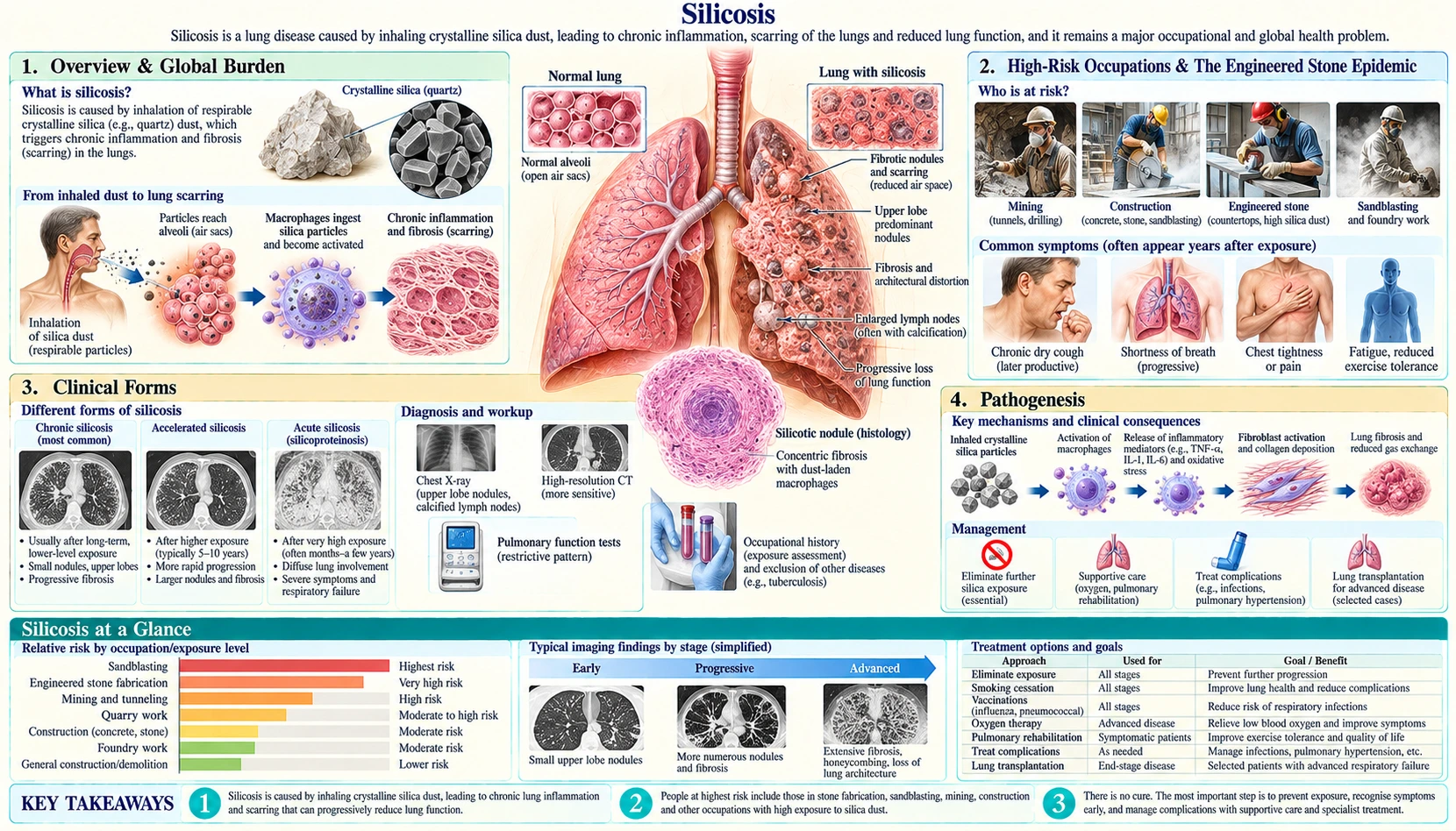
Silicosis is an incurable occupational lung disease caused by inhaling particles of respirable crystalline silica (silicon dioxide, SiO2), which trigger inflammation and fibrosis in the lungs (Rose 2019). Lung function can keep worsening as the disease progresses, even after exposure has ended (Leung 2012). The Global Burden of Disease study identified 23,695 new cases of silicosis worldwide in 2017, a count that a 2022 review describes as a substantial underestimate because of gaps in reporting and surveillance (Hoy 2022). Silica exposure is also associated with tuberculosis, lung cancer, emphysema, autoimmune disease and kidney disease (Rose 2019). Since the first reports from Spain in 2010 and 2011, outbreaks of silicosis among young workers who fabricate engineered-stone countertops have been reported from Israel, Australia, the United States, China, the United Kingdom and other countries (Fazio 2025).
Table of Contents
Overview & Global Burden
Silicosis is a fibrotic lung disease caused by inhaling free crystalline silicon dioxide (silica), and chronic simple silicosis is the oldest described and most prevalent type of pneumoconiosis worldwide (Leung 2012; Fazio 2025). The crystalline silica polymorphs used in industry are mainly quartz and cristobalite; a review of their bioreactivity concluded that their mechanisms of lung injury, inflammation and fibrosis are similar (Mossman 2013). Alpha-quartz is the most common and most toxic form. Particles smaller than 5 µm are classed as respirable because they reach the distal airways and alveoli, and crystalline silica is generally considered more toxic than amorphous silica (Li 2022).
Of the 23,695 new silicosis cases counted by the Global Burden of Disease study in 2017, the largest national numbers were in China (9,066) and India (1,464), and East Asia had the highest age-standardized incidence rate (0.78 per 100,000). More than 23 million workers in China and more than 10 million in India are reported to be exposed to respirable crystalline silica, and an estimated 2.3 million in the United States, 1.85 million of them in construction (Hoy 2022).
The name "silicosis" was coined in 1871 and reached medical consensus at an International Labour Organization (ILO) conference in Johannesburg in 1930, which led to an ILO convention in 1934. An ILO agreement in 1958 defined the chest-radiograph features of the disease, and a joint ILO/World Health Organization Global Programme for the Elimination of Silicosis was established in 1995 (Hoy 2022). In the United States, more than 700 workers died of acute or accelerated silicosis during the 1930 Hawk's Nest tunnel disaster in West Virginia (Fazio 2025).
The International Agency for Research on Cancer (IARC) classified crystalline silica as a probable carcinogen in 1987. In 1997 it placed crystalline silica inhaled as quartz or cristobalite from occupational sources in Group 1 (carcinogenic to humans) (IARC 1997; Pelucchi 2006). The 1997 working group noted that carcinogenicity was not detected in all industrial circumstances studied, and a 2009 IARC review reaffirmed the Group 1 classification with the lung as the sole tumour site (Borm 2011).
High-Risk Occupations & The Engineered Stone Epidemic
Exposure occurs wherever silica-containing rock, sand or manufactured material is cut, crushed, ground, drilled or abraded. Risk rises with cumulative exposure: in a 2024 dose-response meta-analysis of 10 cohorts (8,792 silicosis cases among 65,977 participants), a reduction in cumulative exposure from 4 to 2 mg/m³-years corresponded to a relative risk of 0.23 among miners and 0.55 among non-miners (Howlett 2024).
Industries and materials described in the research:- Mining and quarrying — gold, coal, ore and quarry work (Preisser 2026). In a cross-sectional study of 520 older black migrant goldminers in South Africa, the prevalence of silicosis was 18.3–19.9% at a mean quartz exposure of 0.053 mg/m³, below the then-recommended limit of 0.1 mg/m³ (Churchyard 2004). A review of chest x-rays of 529 sandstone-mine workers in Rajasthan, India, found features of silicosis in 52% (Hoy 2022).
- Tunnel construction (Preisser 2026)
- Stone work — processing of natural stone such as granite and sandstone, and production and processing of artificial stone; a German guideline gives a quartz content of 30–80% for silica dust in the stone and construction industry (Preisser 2026)
- Construction — described in a 2022 review as a setting where hazardous exposure receives less attention than in mining; median exposures of 0.75–3.2 mg/m³ have been measured among US painters, laborers, bricklayers and operating engineers (Hoy 2022)
- Foundries, ceramics, enamel and glass, and the steel and iron industry (Preisser 2026)
- Dental-prosthesis production, jewellery polishing, gemstone work and denim sandblasting (Hoy 2022; Barnes 2019)
- Hydraulic fracturing — at 11 US sites, more than 50% of full-shift samples exceeded the permissible exposure limit (Hoy 2022)
The Engineered Stone Epidemic
Engineered stone (also called artificial or agglomerate stone, and colloquially "quartz" countertops) has been used for kitchen and bathroom countertops since the 1990s. It typically contains more than 90% silica by weight, compared with at most 40–50% in granite and under 10% in marble (Fazio 2025). A 2012 report measured dust concentrations of 215–519 µg/m³ during dry finishing of countertop slabs, well above the 50 µg/m³ limit used in the United States and Australia (Fazio 2025).
In Israel, 25 patients with silicosis were referred to the national lung transplantation program between 1997 and 2010; all had been exposed by dry cutting a high-silica artificial stone product, 10 underwent lung transplantation and 3 died during follow-up without transplantation. The incidence of transplantation for silicosis was 14.6 times that expected from the international transplant registry (Kramer 2012). An Australian series of seven men (median age 44, range 26–61) from small benchtop businesses with poor dust control found a median of 7 years of exposure before symptoms; six had progressive massive fibrosis (Hoy 2018). A 2019 CDC report described 18 cases in four US states, including the first two US deaths (Rose 2019), and by 2024 public health officials in California had confirmed more than 230 cases. In Queensland's screening program, 224 of 1,054 stone workers screened (21%) had silicosis as of August 2024, 36 of them with progressive massive fibrosis (Fazio 2025).
An Australian Government taskforce found inadequate dust control, ineffective health monitoring and insufficient enforcement of existing laws in the stone benchtop industry (Hoy 2022). Safe Work Australia considered three policy options and recommended prohibiting all engineered stone; the ban on its use took effect in July 2024 (Fazio 2025). A 2025 American Thoracic Society workshop report found that hazardous exposures persist across settings despite widespread use of wet methods, ventilation and respiratory protection, and described artificial-stone silicosis as a failure of primary prevention (Gandhi 2026).
Clinical Forms
Silica exposure can produce three disease patterns: chronic silicosis, typically after more than 10 years of exposure to dust containing less than 30% quartz; accelerated (subacute) silicosis, after shorter periods of heavier exposure, usually 2 to 10 years; and acute silico-proteinosis, often after a few months of intense exposure to fine, high-silica dust. Chronic silicosis is described as simple or complicated, the complicated form also being called progressive massive fibrosis (Fazio 2025).
Chronic (Simple) Silicosis
Simple silicosis shows numerous small, mostly rounded nodular opacities under 10 mm across, with a centrilobular and perilymphatic distribution and a predilection for the posterior upper zones of the lungs (Fazio 2025). On CT these are named by size as P (under 1.5 mm), Q (1.5–3 mm) or R (3–10 mm), and may be non-calcified, partly or completely calcified (Preisser 2026). Hilar and mediastinal lymph nodes are frequently involved; shell-like "eggshell" calcification of these nodes was long considered pathognomonic for silicosis, but it also occurs in sarcoidosis, berylliosis, amyloidosis and treated lymphoma (Preisser 2026). Symptoms can be insidious, with a long symptom-free period out of proportion to the imaging; shortness of breath, dry cough, chest pain and back pain are common (Fazio 2025).
Accelerated Silicosis
Accelerated silicosis follows intense exposure and becomes manifest roughly 2 to 10 years after exposure begins (Preisser 2026; Fazio 2025). Its imaging can combine the nodules and fibrosis of chronic silicosis with the ground-glass opacities of silico-proteinosis (Fazio 2025). Engineered-stone fabricators, many with this short-latency form, have higher rates of progressive massive fibrosis than other silica-exposed groups, with 30–40% developing it in case series (Fazio 2025).
Acute Silicosis (Silico-Proteinosis)
Acute silico-proteinosis can develop after a high but short exposure lasting from a few weeks up to about 3 years (Preisser 2026). Pathologically it resembles pulmonary alveolar proteinosis (PAP), with acellular lipoproteinaceous material accumulating in the alveoli; silicoproteinosis has been found on biopsy or transplant explant in 7–9% of engineered-stone workers in case series (Fazio 2025). On HRCT it shows numerous bilateral centrilobular nodular or patchy ground-glass opacities, often with consolidation and in some cases a crazy-paving pattern (Preisser 2026). A German guideline describes whole lung lavage, with up to 30 L of saline in several sessions under general anaesthesia, as the treatment of choice for acute silico-proteinosis (Preisser 2026).
Progressive Massive Fibrosis (PMF) / Complicated Silicosis
In PMF, small nodules enlarge and coalesce into mass-like fibrotic opacities larger than 1 cm, usually bilateral and in the upper and middle zones; the masses tend to form in the periphery and migrate centrally over time, and PMF can occur without radiographic simple silicosis preceding it (Fazio 2025). The ILO classification grades these large opacities as A, B or C (Preisser 2026). PMF carries a poor prognosis, with rapid progression to cardiopulmonary failure in the absence of lung transplantation (Fazio 2025).
Pathogenesis
The toxicity of silica particles depends on their size, shape, polymorph, porosity and surface. "Nearly free silanol" groups on the surface of quartz particles have been reported as the key molecular features responsible for toxicity (Li 2022), and reviews attribute part of the severity of modern outbreaks to very high exposures and oxidative stress from freshly fractured silica (Barnes 2019).
The sequence described in reviews and laboratory studies:
- Respirable particles reach the distal airways and alveoli, where alveolar macrophages recognize and take them up through scavenger receptors (Li 2022).
- Phagocytosis of silica crystals leads to lysosomal damage and rupture (Hornung 2008; Leung 2012).
- Lysosomal damage activates the NALP3 (NLRP3) inflammasome; in cell experiments, blocking phagosomal acidification or cathepsin B activity impaired this activation (Hornung 2008). The inflammasome activates caspase-1; macrophages lacking inflammasome components could not secrete IL-1β and IL-18 in response to silica, and activation required potassium efflux and reactive oxygen species (Cassel 2008).
- In mice, the inflammatory response and the later pulmonary fibrosis after silica inhalation depended on the Nalp3 inflammasome (Cassel 2008).
- Because macrophages cannot degrade silica, sustained activity produces reactive oxygen species that kill the macrophage, releasing the particles and continuing the inflammation (Fazio 2025).
- The resulting silicotic nodule has a central acellular zone of whorled collagen fibres, often with dust-laden macrophages at the periphery; silica particles are weakly birefringent under polarized light (Fazio 2025). Nodules can coalesce into the masses of progressive massive fibrosis (Fazio 2025).
In experimental studies silica also induced STING-dependent reactive oxygen species production, cell death and release of self-DNA, leading to a type I interferon response (Li 2022). Why fibrosis continues to progress after dust exposure stops is listed among the unresolved questions in silicosis research (Li 2022).
Mycobacterial Infections & Autoimmune Associations
Tuberculosis and Nontuberculous Mycobacteria
A 2021 systematic review and meta-analysis found a pooled relative risk of tuberculosis of 4.01 (95% CI 2.88–5.58) with radiological silicosis, rated high confidence, with a low silicosis-severity threshold for increased risk; for silica exposure without silicosis the pooled relative risk was 1.92 (95% CI 1.36–2.73), rated low confidence (Ehrlich 2021). The mechanism is incompletely understood; in laboratory models, exposure of lung macrophages to crystalline silica deregulates cell-death pathways and limits their ability to control Mycobacterium tuberculosis growth (Fazio 2025).
Higher figures come from heavily exposed groups: among Lesotho ex-miners, prevalences of 42.5% for silicosis and 25.7% for silico-tuberculosis have been reported (Hoy 2022). In a California series of engineered-stone workers, 2 of 45 had confirmed active tuberculosis, while 10 of 45 were initially misdiagnosed with active tuberculosis, many receiving months of treatment before silicosis was recognized (Fazio 2025). Confirming active tuberculosis requires microbiological examination of sputum or bronchial secretions; direct smears are often negative and the organism is often detected only by culture (Preisser 2026). The US silica standard requires testing for latent tuberculosis infection at the initial medical examination (29 CFR 1910.1053).
In engineered-stone silicosis cohorts in Israel and California, 9% of patients had nontuberculous mycobacterial (NTM) disease, the same prevalence reported for silicosis of any cause in a Brazilian cohort (Fazio 2025).
Autoimmune Associations
Silica exposure has been linked to systemic sclerosis, rheumatoid arthritis, systemic lupus erythematosus, dermatomyositis, polymyositis and ANCA-associated vasculitis. Among engineered-stone workers, autoimmune disease rates of around 20% have been reported, an estimated seven times the expected general-population prevalence (Fazio 2025).
- Erasmus syndrome (silica exposure + systemic sclerosis): scleroderma among Witwatersrand goldminers was described by Erasmus in 1957 (Erasmus 1957); a German guideline dates the first description of systemic sclerosis with quartz-dust exposure to Bramwell in 1914 (Preisser 2026). A 2010 meta-analysis of 16 studies found a combined relative risk of 3.20 (95% CI 1.89–5.43) with marked heterogeneity; the estimate for women was 1.03 and the authors described the risk as applying specifically to men (McCormic 2010).
- Systemic lupus erythematosus: listed among the rheumatological diseases linked to silica exposure (Fazio 2025).
- Rheumatoid arthritis: in 1953 Caplan described unusual chest radiograph appearances in coal miners with rheumatoid arthritis (Caplan 1953), later known as Caplan syndrome; rounded pulmonary "rheumatoid nodules" have been observed in underground miners with or without silicosis (Preisser 2026).
- ANCA-associated vasculitis: a 2013 meta-analysis of six case-control studies found a summary odds ratio of 2.56 (95% CI 1.51–4.36) for ever-exposure to silica, with similar estimates for microscopic polyangiitis (3.95) and granulomatosis with polyangiitis (3.56) (Gómez-Puerta 2013).
- Kidney disease: OSHA's 2016 rulemaking record identified an increased risk of kidney disease in silica-exposed workers (OSHA 2016). In a multinational registry of engineered-stone silicosis, the estimated prevalence of kidney disease was 10%, mostly in older Israeli patients with advanced disease (Fazio 2025).
Lung Cancer
A systematic review of studies published after the 1997 IARC monograph found a pooled lung-cancer relative risk of 1.34 across cohort studies of silica-exposed workers. The relative risk was 1.69 in cohort studies of people with silicosis and 3.27 in case-control studies of people with silicosis, but 1.19 and 0.97 among people without silicosis; the authors concluded that the carcinogenic role of silica in the absence of silicosis was still unclear (Pelucchi 2006). A pooled analysis of 10 cohorts cited in a 2022 review estimated an excess lifetime lung-cancer risk of 1.1–1.7% above a background of 3–6% for a worker exposed from age 20 to 65 at 0.1 mg/m³ (Hoy 2022). Based on rat and cell studies, one review argues that silica's genotoxicity is mainly secondary to inflammation rather than direct (Borm 2011).
Diagnosis
Diagnosis rests on carefully documented occupational exposure and radiological features, with other diagnoses excluded (Leung 2012). Lung biopsy is generally not performed unless needed, for example when there is no exposure history, chest radiograph and HRCT disagree, or the presentation is atypical (Li 2022).
Occupational History
A review of engineered-stone silicosis lists these elements of an exposure history (Fazio 2025):
- The chronology of jobs and tasks, including construction work that involved installing or demolishing stone or other silica sources
- The types of material handled and the proportion of time spent on artificial stone
- Dry versus wet cutting, ventilation, and the type, fit-testing and consistency of respirator use
- Housekeeping practices such as compressed-air cleaning, and disease among co-workers
Radiology
Chest radiographs classified by the ILO system remain the basis of surveillance; HRCT is more sensitive and specific for early changes, though cost, radiation and access limit its use for screening (Li 2022). In Victoria, Australia, 23 of 65 stone workers (35%) with simple silicosis had chest radiographs read as normal (ILO category 0) but CT findings of silicosis (Hoy 2022), and a review cites a chest-radiograph sensitivity of 35–48% compared with HRCT (Fazio 2025). Findings described include:
- Small rounded nodules (P, Q, R), mainly in the upper and middle lung zones (Preisser 2026)
- Enlarged, hyperdense hilar and mediastinal lymph nodes, often calcified (Fazio 2025)
- Progressive massive fibrosis: opacities larger than 1 cm in the upper and middle zones (Fazio 2025)
- Acute silico-proteinosis: bilateral ground-glass opacities, consolidation and sometimes crazy paving (Preisser 2026)
The ILO International Classification of Radiographs of Pneumoconioses grades the profusion of small opacities (one South African study defined silicosis as profusion 1/1 or greater; Churchyard 2004), names small rounded opacities p, q and r by size, and classes large opacities as A, B or C (Preisser 2026). Under the US silica standard, surveillance radiographs are classified by a NIOSH-certified B Reader (29 CFR 1910.1053).
Pulmonary Function Tests
A German guideline summarizes the functional impairments associated with silicosis as obstructive and restrictive ventilatory defects, hyperinflation and impaired gas exchange (Preisser 2026). Findings reported in the research:
- Restriction is the most common pattern in engineered-stone workers (Fazio 2025)
- Obstruction: silica dust exposure can lead to chronic bronchitis, emphysema and airflow obstruction even without radiological silicosis (Hnizdo 2003)
- Normal tests early: in an Italian series of workers with abnormal CT scans, only 33% had abnormal spirometry and 50% abnormal diffusing capacity, so lung-function testing is less sensitive than CT for diagnosis but tracks progression and disability (Fazio 2025)
- Rapid decline: Australian engineered-stone workers with PMF lost a mean 386 mL/year of FEV1 and 448 mL/year of FVC over a median 16 months (Hoy 2018)
Additional Investigations
- Bronchoalveolar lavage (BAL): used in the diagnosis of acute silico-proteinosis (Preisser 2026)
- Testing for latent tuberculosis: part of the initial examination under the US silica standard (29 CFR 1910.1053)
- Autoantibodies: among engineered-stone workers, ANA was positive in 24.2% of those exposed without silicosis, 34.0% with simple silicosis and 47.1% with complicated silicosis (Fazio 2025)
Differential Diagnosis
- Sarcoidosis: granulomas and elevated ACE levels can occur in both, and accelerated silicosis has been misdiagnosed as sarcoidosis; detailed occupational histories and tissue analysis showing silica particles distinguished the two (Fazio 2025). Eggshell lymph-node calcification also occurs in sarcoidosis (Preisser 2026).
- Coal workers' pneumoconiosis: a related coal-mine-dust disease, covered on its own page
- Pulmonary tuberculosis: rapidly increasing asymmetric opacities, cavitation or tree-in-bud signs in a person with silicosis raise the question of active tuberculosis, which is confirmed microbiologically (Preisser 2026)
- Other granulomatous diseases: a German guideline lists fungal infections, hypersensitivity pneumonitis, vasculitis and other conditions in the differential diagnosis (Preisser 2026)
- Pulmonary alveolar proteinosis (PAP): silicoproteinosis is less likely than idiopathic PAP to show crazy paving, and lymph-node calcification is highly specific for silicosis (Fazio 2025); about 90% of PAP cases have antibodies against GM-CSF (Preisser 2026)
Treatment & Prevention
Medical Management
No treatment has been shown to be effective for silicosis, and people with pneumoconiosis have largely been excluded from drug trials in interstitial lung disease (Fazio 2025; Barnes 2019). Management described in reviews is supportive: supplemental oxygen for hypoxia, vaccination against respiratory pathogens, and identifying and treating coexisting autoimmune disease or infection (Fazio 2025). Silicosis often progresses whether or not exposure continues, though ongoing exposure is widely accepted to accelerate progression (Fazio 2025). A 2012 review notes that comprehensive management strategies help improve quality of life and slow deterioration (Leung 2012). Decisions about treatment belong with a clinician.
Experimental Therapies
- Whole lung lavage (WLL): used in early silicosis to relieve chest tightness, chest pain and breathlessness, with one study reporting radiological improvement in artificial-stone silicosis (Li 2022); a German guideline describes it as the treatment of choice for acute silico-proteinosis (Preisser 2026).
- Tetrandrine: approved to treat silicosis in China and reported to inhibit lung inflammation and fibrosis (Li 2022).
- Anti-fibrotic drugs: pirfenidone and nintedanib, approved for idiopathic pulmonary fibrosis, have been studied in silicosis models (Li 2022), and clinical trials of anti-fibrotics, immunosuppression and lavage are ongoing (Fazio 2025). As of 2022 there were no large randomized placebo-controlled trials of these drugs in silicosis (Li 2022).
Lung Transplantation
Lung transplantation is the main treatment for end-stage silicosis (Fazio 2025; Barnes 2019). At one Israeli centre, 17 of 342 lung transplants (4.9%) performed in 2006–2013 were for silicosis, and survival was not reduced compared with matched patients transplanted for idiopathic pulmonary fibrosis (hazard ratio 0.6, 95% CI 0.24–1.55, not statistically significant) (Rosengarten 2017). A 2022 review cites a 3-year survival after transplantation of about 76% and a median survival of about 6–7 years (Li 2022). Very high silica levels have been found in the explanted lungs of engineered-stone workers (Hoy 2022).
Primary Prevention
Silicosis is preventable through control of dust exposure (Hoy 2022). The NIOSH hierarchy of controls ranks methods of protecting workers, and a review of engineered-stone fabrication reports a growing consensus that no single method consistently keeps exposures below occupational limits (Fazio 2025):
- Elimination/substitution: Australia banned engineered stone; Australian reviews in 2019–2023 concluded there was no guarantee that exposure to lower-silica materials is harmless (Fazio 2025)
- Engineering controls: wet methods, sheet wetting, negative-pressure workstations and waterfall ventilation booths (Fazio 2025); computer-controlled water-jet cutting is increasingly used, though its effect on dust levels was untested as of 2022 (Hoy 2022)
- Administrative controls: training, hazard signage, supervision of work practices and housekeeping such as wet mopping and HEPA vacuuming (Fazio 2025)
- Respiratory protection: under the US standard, respirators supplement engineering and work-practice controls where those cannot keep exposure at or below the limit (29 CFR 1910.1053)
The US standard requires employers to assess the exposure of each employee who is or may be exposed at or above the action level (29 CFR 1910.1053).
NIOSH, Regulation & Workers' Rights
US Regulatory Standards
In the United States, occupational silica exposure is regulated by the Occupational Safety and Health Administration (OSHA); the National Institute for Occupational Safety and Health (NIOSH) recommended a limit of 50 µg/m³ in 1974, which OSHA did not adopt until its 2016 final rule (Fazio 2025).
- OSHA final rule (published 25 March 2016): OSHA determined that workers exposed at the previous permissible exposure limits faced a significant risk of material impairment of health, citing silicosis and other non-malignant respiratory disease, lung cancer and kidney disease. The rule set a permissible exposure limit of 50 µg/m³ as an 8-hour time-weighted average in all covered industries, issued as two standards (general industry and maritime; construction), and added requirements for exposure assessment, exposure control, respiratory protection, medical surveillance, hazard communication and recordkeeping (OSHA 2016).
- Action level: 25 µg/m³ as an 8-hour time-weighted average (29 CFR 1910.1053).
- Controls: employers must use engineering and work-practice controls to keep exposure at or below the limit unless they can show such controls are not feasible, supplementing them with respirators where they are insufficient (29 CFR 1910.1053).
Medical Surveillance Requirements
Under the general-industry standard, employers must make medical surveillance available at no cost to each employee exposed at or above the action level for 30 or more days a year (obligations at the action level began 23 June 2020). The initial examination is offered within 30 days of initial assignment, unless a qualifying examination took place in the previous three years, and comprises a medical and work history, a physical examination focused on the respiratory system, a chest x-ray classified under the ILO system by a NIOSH-certified B Reader, spirometry (FVC, FEV1 and their ratio), and testing for latent tuberculosis infection. Periodic examinations repeat these, except the tuberculosis test, at least every three years or more often if the examining clinician recommends (29 CFR 1910.1053).
Engineered Stone Regulation
Australia applied a precautionary approach and banned the use and import of engineered stone, with the ban on all engineered stone in effect from July 2024 after Safe Work Australia recommended full prohibition over two partial options based on silica content (Fazio 2025).
In California, Cal/OSHA began a Special Emphasis Program after the state's first reported outbreak in 2019 and found overexposures in more than half and citations in more than two-thirds of workplaces. An Emergency Temporary Standard adopted in December 2023 prohibited dry cutting and cleaning with compressed air or sweeping, and required full-face, tight-fitting powered air-purifying respirators; in its first year, inspections of 85 workshops shut down 26% for immediate safety risks and cited 95% for violations. A permanent standard similar to the emergency standard was adopted in December 2024. Federal OSHA found in 2022 that about one quarter of air samples in stone countertop fabrication facilities exceeded the permissible exposure limit (Fazio 2025).
Workers at Greatest Risk
Workers in insecure jobs, often immigrants working in small businesses in the informal sector, are reported to face more intense exposures with fewer regulatory protections (Hoy 2022). In the United States, more than 95% of workers affected by engineered-stone silicosis are Spanish-speaking immigrants from Mexico or Central America, most likely uninsured or underinsured, and nearly half of patients in California first presented to an emergency department rather than through surveillance or primary care (Fazio 2025). In New South Wales, Australia, annual certified silicosis cases rose from 9 in 2015–2016 to 107 in 2019–2020 (Hoy 2022).
Global Disparities
There is no international agreement on a protective, enforceable exposure limit: national limits range from 0.025 to 0.35 mg/m³ over an 8-hour shift, most low- and middle-income countries have no legislated limit, and the American Conference of Governmental Industrial Hygienists has recommended 0.025 mg/m³ since 2009. A 2017 European directive set 0.1 mg/m³, a level the review's authors report several studies consider not protective. The 1995 ILO/WHO elimination programme has been followed by implementation the authors describe as disappointing, and progress toward elimination appears to have stagnated over the last 20 years (Hoy 2022).
Prognosis
Silicosis often progresses whether or not exposure continues after diagnosis. Historically one-third to two-thirds of people with silicosis show progression, and up to 88% did in a 1988 study of South African gold miners. Reported risk factors include greater radiological severity, younger age at diagnosis, a rapid early increase in the size and number of opacities, and higher cumulative exposure; in Iranian quarry workers, about half progressed in the 10 years after exposure stopped completely (Fazio 2025).
Chronic Simple Silicosis
Continued exposure has been linked to more frequent radiographic progression in a Swedish registry with 20-year follow-up and to a higher risk of progressive massive fibrosis among South African and Brazilian gold miners (Fazio 2025).
Progressive Massive Fibrosis
PMF carries a poor prognosis, with rapid progression to cardiopulmonary failure in the absence of lung transplantation (Fazio 2025). In an Australian engineered-stone series, patients with PMF lost a mean 386 mL of FEV1 per year (Hoy 2018).
Engineered-Stone and Acute Silicosis
In a Spanish study of engineered-stone silicosis, 56% of patients with simple silicosis showed progression after four years and 37.7% progressed to PMF (Fazio 2025). Follow-up of artificial-stone silicosis has suggested rapid progression, with some patients needing lung transplantation (Hoy 2022), and a significant proportion of workers in modern high-exposure industries may develop respiratory failure and die (Barnes 2019).
Lung Transplant Outcomes
At one Israeli centre, survival after lung transplantation for artificial-stone silicosis was not reduced compared with idiopathic pulmonary fibrosis, within the limits of a small sample (Rosengarten 2017); a 2022 review cites a 3-year post-transplant survival of about 76% (Li 2022).
FEV1 Decline and Quality of Life
Impairment of lung function increases with disease progression, even after exposure ends, and comprehensive management is described as helping to improve quality of life and slow deterioration (Leung 2012).
Key Research Papers
- Hnizdo E, Vallyathan V. Chronic obstructive pulmonary disease due to occupational exposure to silica dust: a review of epidemiological and pathological evidence. Occup Environ Med. 2003;60(4):237–243. — PubMed PMID: 12660371
- Kramer MR, Blanc PD, Fireman E, et al. Artificial stone silicosis: disease resurgence among artificial stone workers. Chest. 2012;142(2):419–424. — PubMed PMID: 22383661
- Cassel SL, Eisenbarth SC, Iyer SS, et al. The Nalp3 inflammasome is essential for the development of silicosis. Proc Natl Acad Sci USA. 2008;105(26):9035–9040. — PubMed PMID: 18577586
- Hoy RF, Baird T, Hammerschlag G, et al. Artificial stone-associated silicosis: a rapidly emerging occupational lung disease. Occup Environ Med. 2018;75(1):3–5. — PubMed PMID: 28882991
- Churchyard GJ, Ehrlich R, teWater Naude JM, et al. Silicosis prevalence and exposure-response relations in South African goldminers. Occup Environ Med. 2004;61(10):811–816. — PubMed PMID: 15377766
- Preisser AM, Eisenhawer C, Cerviș LI, et al. AWMF S2k Guideline: Diagnosis and Assessment of Lung Disease Caused by Occupational Silica Dust Exposure (Silicosis) – Disease No. 4101 as per Occupational Diseases Ordinance (BKV) Annex 1. Respiration. 2026:1–33. — PubMed PMID: 42412737 (replaces an entry for a 2005 ILO-classification paper that could not be found in PubMed or Crossref)
- Pelucchi C, Pira E, Piolatto G, et al. Occupational silica exposure and lung cancer risk: a review of epidemiological studies 1996–2005. Ann Oncol. 2006;17(7):1039–1050. — PubMed PMID: 16403810
- Leung CC, Yu IT, Chen W. Silicosis. Lancet. 2012;379(9830):2008–2018. — PubMed PMID: 22534002
- Mossman BT, Glenn RE. Bioreactivity of the crystalline silica polymorphs, quartz and cristobalite, and implications for occupational exposure limits (OELs). Crit Rev Toxicol. 2013;43(8):632–660. — PubMed PMID: 23863112
- Enright PL, Sherrill DL. Reference equations for the six-minute walk in healthy adults. Am J Respir Crit Care Med. 1998;158(5 Pt 1):1384–1387. — PubMed PMID: 9817683
- McCormic ZD, Khuder SS, Aryal BK, Ames AL, Khuder SA. Occupational silica exposure as a risk factor for scleroderma: a meta-analysis. Int Arch Occup Environ Health. 2010;83(7):763–769. — PubMed PMID: 20047060 (replaces an entry for a 2020 Erasmus-syndrome paper that could not be found in PubMed or Crossref)
- Hoy RF, Jeebhay MF, Cavalin C, et al. Current global perspectives on silicosis — convergence of old and newly emergent hazards. Respirology. 2022;27(6):387–398. — PubMed PMID: 35302259 (replaces an entry for a 2019 artificial-stone policy paper that could not be found in PubMed or Crossref)
- Ehrlich R, Akugizibwe P, Siegfried N, Rees D. The association between silica exposure, silicosis and tuberculosis: a systematic review and meta-analysis. BMC Public Health. 2021;21(1):953. — PubMed PMID: 34016067
- International Agency for Research on Cancer. Silica. In: Silica, some silicates, coal dust and para-aramid fibrils. IARC Monogr Eval Carcinog Risks Hum. 1997;68:41–242. — PubMed PMID: 9268738
- Borm PJ, Tran L, Donaldson K. The carcinogenic action of crystalline silica: a review of the evidence supporting secondary inflammation-driven genotoxicity as a principal mechanism. Crit Rev Toxicol. 2011;41(9):756–770. — PubMed PMID: 21923565
- Hornung V, Bauernfeind F, Halle A, et al. Silica crystals and aluminum salts activate the NALP3 inflammasome through phagosomal destabilization. Nat Immunol. 2008;9(8):847–856. — PubMed PMID: 18604214
- Rose C, Heinzerling A, Patel K, et al. Severe silicosis in engineered stone fabrication workers — California, Colorado, Texas, and Washington, 2017–2019. MMWR Morb Mortal Wkly Rep. 2019;68(38):813–818. — PubMed PMID: 31557149
- Fazio JC, Viragh K, Houlroyd J, Gandhi SA. A review of silicosis and other silica-related diseases in the engineered stone countertop processing industry. J Occup Med Toxicol. 2025;20(1):9. — PubMed PMID: 40098042
- Li T, Yang X, Xu H, Liu H. Early identification, accurate diagnosis, and treatment of silicosis. Can Respir J. 2022;2022:3769134. — PubMed PMID: 35509892
- Barnes H, Goh NSL, Leong TL, Hoy R. Silica-associated lung disease: an old-world exposure in modern industries. Respirology. 2019;24(12):1165–1175. — PubMed PMID: 31517432
- Howlett P, Gan J, Lesosky M, Feary J. Relationship between cumulative silica exposure and silicosis: a systematic review and dose-response meta-analysis. Thorax. 2024;79(10):934–942. — PubMed PMID: 39107111
- Gómez-Puerta JA, Gedmintas L, Costenbader KH. The association between silica exposure and development of ANCA-associated vasculitis: systematic review and meta-analysis. Autoimmun Rev. 2013;12(12):1129–1135. — PubMed PMID: 23820041
- Rosengarten D, Fox BD, Fireman E, et al. Survival following lung transplantation for artificial stone silicosis relative to idiopathic pulmonary fibrosis. Am J Ind Med. 2017;60(3):248–254. — PubMed PMID: 28145560
- Erasmus LD. Scleroderma in goldminers on the Witwatersrand with particular reference to pulmonary manifestations. S Afr J Lab Clin Med. 1957;3(3):209–231. — PubMed PMID: 13495613
- Caplan A. Certain unusual radiological appearances in the chest of coal-miners suffering from rheumatoid arthritis. Thorax. 1953;8(1):29–37. — PubMed PMID: 13038735
- Gandhi SA, Liu GY, Fazio JC, et al. Silicosis in the artificial stone countertop industry: an official American Thoracic Society workshop report. Ann Am Thorac Soc. 2026 (online ahead of print). — PubMed PMID: 42363709
- Occupational Safety and Health Administration. Occupational exposure to respirable crystalline silica; final rule. Federal Register. 2016 Mar 25;81 FR 16286. — Federal Register 2016-04800
- Respirable crystalline silica (general industry and maritime). 29 CFR 1910.1053. Electronic Code of Federal Regulations. — eCFR 29 CFR 1910.1053
PubMed Topic Searches
Connections
- Pulmonology
- Asbestosis
- Mesothelioma
- Interstitial Lung Disease
- Lung Cancer
- Pulmonary Arterial Hypertension
- Lymphangioleiomyomatosis
- Toxins
- Silicon Toxicity — why swallowed silicon is well tolerated and is not a route to silicosis.