Alpha-1-Antitrypsin Deficiency
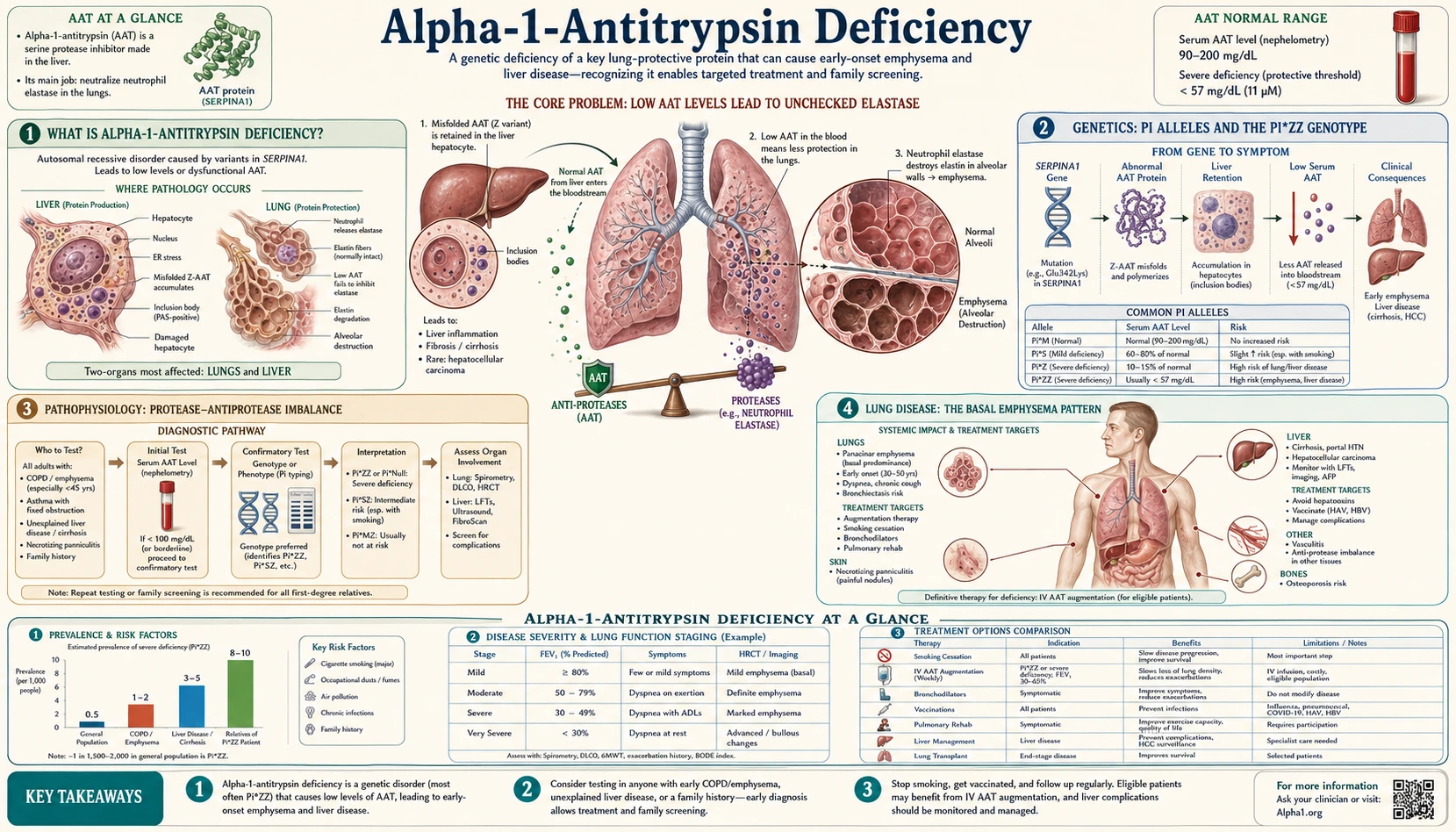
Table of Contents
- What Is Alpha-1-Antitrypsin Deficiency?
- Genetics: Pi Alleles and the Pi*ZZ Genotype
- Pathophysiology: Protease-Antiprotease Imbalance
- Lung Disease: Emphysema
- Liver Disease: Fibrosis and Cirrhosis
- Other Manifestations
- Diagnosis: Who Guidelines List for Testing
- Treatment: Augmentation Therapy and the RAPID Trial
- Smoking and Other Factors in the Research
- Complications
- Prognosis
- Key Research Papers
- Connections
- Featured Videos
What Is Alpha-1-Antitrypsin Deficiency?
Alpha-1-antitrypsin deficiency (AATD) is an inherited disorder caused by mutations in the SERPINA1 gene, leading to lung and liver disease. Alpha-1-antitrypsin (A1AT) is made mainly in the liver, but its main function is to protect the lung against damage from neutrophil elastase. Clinically, the condition is characterised by early-onset emphysema and liver disease.
A 2005 Lancet review put its frequency at about one in 2,000–5,000 people, and a 2021 review estimated about 1 in 3,500 people in the United States. The 2017 European Respiratory Society statement describes AATD as the most common hereditary disorder in adults and notes that a large proportion of affected people remain undiagnosed. In a 2003 US mail survey of 1,953 people with AATD, the mean delay between the onset of symptoms and the diagnosis was 5.6 years, down from 7.2 years in a 1994 survey; the delay was longer in women and in older people.
A blood test measures the A1AT level, a specific treatment for the lung disease exists (intravenous augmentation therapy), and smoking is strongly linked to how fast the lung disease progresses (see below).
Genetics: Pi Alleles and the Pi*ZZ Genotype
A1AT is encoded by the SERPINA1 gene. Its variants are named in the protease inhibitor (Pi) system; the S and Z alleles are the most frequent disease-associated mutations.
- Pi*MM (normal): most northern Europeans carry only the normal M form, according to a 1992 Nature paper.
- Pi*MZ (heterozygous carriers): the same paper puts Z heterozygotes at some 4% of northern Europeans. A 2014 family study compared 89 Pi*MZ and 99 Pi*MM relatives of Pi*MZ patients with COPD: the Pi*MZ group had lower lung function and an adjusted odds ratio for COPD of 5.18 (95% CI 1.27–21.15), rising to 10.65 in ever-smokers; the effect was not seen in never-smokers.
- Pi*ZZ (the severe genotype): both alleles carry the Z mutation, a Glu342Lys substitution. In the Z homozygote only about 15% of the protein is secreted into the blood; the other 85% stays in the endoplasmic reticulum of liver cells, where much of it is degraded and the rest aggregates into insoluble inclusions. A serum level below the protective threshold of 11 µmol/L increases the risk of emphysema.
- The S allele: the other frequent disease-associated variant; like Z, it is linked to accumulation of misfolded A1AT in liver cells.
Pathophysiology: Protease-Antiprotease Imbalance
Emphysema in AATD results from the breakdown of lung-matrix elastin by proteases, including neutrophil elastase, which A1AT normally inhibits. The lung disease is caused principally by inadequate protease inhibition.
Smoking acts on the same balance. Hydrogen peroxide, a component of cigarette smoke, is known to be essential for inactivating A1AT; a 2000 laboratory study found that oxidation of either of two methionines in the protein (methionine 351 or 358) removes its anti-elastase activity.
The liver disease has a different mechanism. The Z mutation lets the reactive loop of one A1AT molecule insert into a gap in the next molecule's A-sheet, so the protein polymerises inside liver cells (demonstrated in the 1992 Nature study); the retained protein causes endoplasmic-reticulum stress and liver damage.
Lung Disease: Emphysema
In a Swedish series of 246 adults with Pi*Z deficiency diagnosed between 1963 and 1977, primary emphysema was present in 109; the median age at onset of breathlessness was 40 years in smokers and 53 in non-smokers.
Where the emphysema sits. AATD emphysema is traditionally described as lower-lobe and panlobular. A 2018 CT study of 14 smokers with AATD and 15 smokers with COPD found more emphysema in the lower lobes in both groups, panlobular emphysema predominating in the lower lung and centrilobular in the upper lung, and an upper- and middle-lobe predominance in the COPD group compared with the AATD group — but the authors concluded that these typical patterns were of little use in telling the two conditions apart.
Not everyone with Pi*ZZ develops lung disease. In a 1989 case series, 20 of 30 people with Pi*Z deficiency who had not been identified through COPD had an FEV1 above 65% of predicted, often with normal lung function. The authors concluded that the perceived natural history had been distorted by ascertainment bias and that, besides smoking, asthma, lower respiratory infections and possibly familial factors contribute to a severe course.
Measuring progression. CT lung densitometry has become the main trial measure. In the 2009 EXACTLE trial, CT was more sensitive than lung physiology and health status; a 1999 trial's power analysis estimated that 130 patients would suffice to show a protective effect by CT, compared with 550 patients needed using yearly FEV1 decline.
Liver Disease: Fibrosis and Cirrhosis
Liver disease in AATD arises from retention of the mutant protein inside liver cells, which causes hepatic damage and cirrhosis, rather than from the lack of circulating A1AT that drives the lung disease.
- Infants: a Swedish study screened 200,000 newborns and identified 120 Pi*Z infants; 14 had prolonged obstructive jaundice, nine of them with severe clinical and laboratory evidence of liver disease, and all 22 Pi*Z infants with liver abnormalities appeared healthy at six months of age. The 1992 Nature paper states that 10% of newborn Z homozygotes develop liver disease, which often leads to fatal childhood cirrhosis.
- Adults: a 2019 study of 554 Pi*ZZ adults without known liver disease in 9 European countries found significant fibrosis suspected in 20–36% by non-invasive tests, and signs of advanced fibrosis 9 to 20 times more common than in non-carriers. Male sex, age over 50, raised liver enzymes (ALT, AST or GGT) and low platelet counts were associated with more fibrosis; lung function was not related to liver fibrosis. Signs of severe steatosis were found in 39% of Pi*ZZ carriers and 31% of controls. In the 1978 Swedish series, 19% of Pi*Z individuals over 50 had a diagnosis of cirrhosis.
- Transplantation: a 2016 review states that there is no cure for severe liver disease and that liver transplantation is the only management option when liver failure is life-threatening.
- Investigational RNA interference (fazirsiran): in an open-label phase 2 trial in Pi*ZZ adults with liver fibrosis (cohorts of 4, 8 and 4 patients), every patient had less Z-AAT in the liver (median reduction 83% at week 24 or 48), the histologic globule score fell from a mean of 7.4 to 2.3, and fibrosis regressed in 7 of 15 patients and progressed in 2 of 15. The placebo-controlled phase 2 SEQUOIA trial randomised 40 patients; at week 16, serum Z-AAT fell by 61%, 83% and 94% with 25, 100 and 200 mg, and at follow-up biopsy median liver Z-AAT fell by 93% with fazirsiran against a 26% increase with placebo. No adverse events led to discontinuation in either trial.
Other Manifestations
- Panniculitis: AATD predisposes to this inflammatory skin disease. No randomised trial has tested augmentation therapy for it; clinical experience and case series suggest a benefit, according to a 2021 review.
- ANCA-associated vasculitis: the same review describes a minority of patients presenting with antineutrophil cytoplasmic antibody-associated vasculitis, thought to be directly related to AATD. It describes links with aneurysmal disease and several neurological conditions as speculative.
- Bronchiectasis: the 2016 Alpha-1 Foundation guideline lists unexplained bronchiectasis among the reasons for testing for AATD.
- Kidneys: in the 1978 Swedish series, 15% of Pi*Z individuals over 50 had signs of glomerular kidney damage.
Diagnosis: Who Guidelines List for Testing
The 2003 American Thoracic Society/European Respiratory Society statement made a strong recommendation for testing all symptomatic adults with COPD. The 2016 Alpha-1 Foundation guideline continues to recommend testing for AATD in all adults with symptomatic fixed airflow obstruction, whether labelled COPD or asthma, and in people with unexplained bronchiectasis or liver disease; it describes family testing of first-degree relatives as currently the most efficient way of finding new cases.
Testing measures the serum A1AT concentration (11 µmol/L is the protective threshold cited for emphysema risk) and identifies the genotype. The 2017 European Respiratory Society statement notes that newer, more accurate and less expensive genetic diagnostic methods have been developed since 2003.
A 2021 review attributes under-recognition to limited awareness among some physicians, misperceptions that no effective therapy exists, and the overlap of symptoms with asthma and ordinary COPD.
Treatment: Augmentation Therapy and the RAPID Trial
Lung disease in AATD is treated with the standard therapies used for COPD, plus augmentation therapy. The 2016 Alpha-1 Foundation guideline states that people with AATD and emphysema, bronchiectasis or liver disease are in general managed according to the usual guidelines for those conditions. A 2017 systematic review notes that most COPD trials exclude people with AATD and that treatments for usual COPD may not be as effective in AATD.
Augmentation therapy (A1AT replacement)
Intravenous infusion of purified A1AT from pooled human plasma raises the concentrations in serum and in the fluid lining the lungs above the protective threshold. The 2017 European Respiratory Society statement describes augmentation as the only specific treatment available for the lung disease of AATD.
The RAPID trial (2015) was a double-blind, placebo-controlled trial at 28 centres in 13 countries. It randomised 180 non-smokers aged 18–65 with severe deficiency (serum A1AT below 11 µM) and an FEV1 of 35–70% of predicted to intravenous A1AT 60 mg/kg weekly (93 patients) or placebo (87) for 24 months (PubMed PMID: 26026936). Key findings:
- The yearly loss of lung density measured at total lung capacity and functional residual capacity combined did not differ significantly between groups (−1.50 vs −2.12 g/L per year; p = 0.06).
- Measured at total lung capacity alone, lung density loss was significantly slower with treatment: −1.45 vs −2.19 g/L per year (difference 0.74 g/L per year, 95% CI 0.06–1.42; p = 0.03). At functional residual capacity alone, the difference was not significant (p = 0.18).
- Adverse events were similar in the two groups; severe adverse events occurred in 27% of treated and 31% of placebo patients. One death occurred in the treated group and three in the placebo group.
- In the open-label extension (RAPID-OLE), 140 patients went on to receive treatment for two more years. In those who had started on placebo, the rate of density loss fell from −2.26 to −1.26 g/L per year; in those treated from the start, the effect was sustained to month 48. Lung density already lost was never recovered.
Earlier trials. A 1999 Danish-Dutch trial randomised 26 Danish and 30 Dutch ex-smokers with Pi*ZZ and moderate emphysema to A1AT (250 mg/kg) or albumin every four weeks for at least three years: FEV1 decline did not differ, and CT tissue loss was 1.5 vs 2.6 g/L per year (p = 0.07). The 2009 EXACTLE trial randomised 77 people to weekly 60 mg/kg A1AT or placebo for 2–2.5 years: all CT analyses showed a trend toward benefit (p = 0.049–0.084), exacerbation frequency was unchanged and exacerbation severity was reduced. A 1997 non-randomised comparison of untreated Danish and treated German ex-smokers found a yearly FEV1 decline of 75 vs 53 mL (p = 0.02), with the difference confined to people whose starting FEV1 was 31–65% of predicted.
Pooled evidence. A 2017 meta-analysis of the randomised trials found that intravenous augmentation slowed CT density decline by 0.79 g/L per year compared with placebo (p = 0.002), with a small increase in exacerbations of 0.29 per year (p = 0.02).
The 2005 Lancet review describes augmentation as expensive and its cost-effectiveness as uncertain. The 2016 Alpha-1 Foundation guideline states that, where it is available, recent evidence provides strong support for its use in appropriate individuals with lung disease due to AATD.
Who the trials enrolled
RAPID enrolled non-smokers aged 18–65 with serum A1AT below 11 µM and an FEV1 of 35–70% of predicted, and excluded people who had undergone, or were waiting for, lung transplantation, lobectomy or lung volume-reduction surgery. The 1999 trial enrolled ex-smokers with an FEV1 of 30–80% of predicted.
Lung transplantation
A UK registry study of 32 people with Pi*ZZ who received a lung transplant between 1996 and 2011 found that lung physiology and health status improved significantly after transplant, but five-year mortality was no better than in matched people who were not transplanted: quality of life improved, survival did not. The 2017 systematic review found mortality after lung transplantation comparable between AATD-related and other COPD, and worse outcomes for lung volume-reduction surgery in AATD than in other emphysema.
Smoking and Other Factors in the Research
- Smoking: in 161 Danish patients with Pi*Z deficiency, the mean yearly FEV1 decline was 132 mL in the 43 current smokers and 52 mL in the 100 ex-smokers (p < 0.001); in the 18 never-smokers it was 86 mL. In the 1978 Swedish series, breathlessness began at a median age of 40 in smokers and 53 in non-smokers, and smokers had a significantly lower life expectancy. In Pi*MZ carriers, the 2014 family study found the lung-function effect accentuated in ever-smokers.
- Other factors linked to a severe course: the 1989 case series identified asthma, lower respiratory infections and possibly familial factors, besides smoking.
- Liver: the factors associated with more liver fibrosis in the 2019 European study were male sex, age over 50, raised liver enzymes and low platelet counts.
- N-acetylcysteine (NAC): results in general COPD are mixed. The PANTHEON trial (1,006 Chinese patients with moderate-to-severe COPD, 600 mg twice daily for a year) found 1.16 vs 1.49 exacerbations per patient-year (risk ratio 0.78) (PubMed PMID: 24621680). The earlier BRONCUS trial (523 patients, 600 mg daily for three years) found no difference in FEV1 decline or exacerbations (PubMed PMID: 15866309). Neither trial reports results for people with AATD.
Complications
- Emphysema and respiratory death: of 91 deaths in the 1978 Swedish series, 56 were from COPD.
- Liver fibrosis, cirrhosis and liver death: 12 of the 91 deaths in the same series were from liver disease; a 2021 review describes liver disease as the second leading cause of death in AATD.
- Exacerbations: in EXACTLE, augmentation did not change how often exacerbations occurred but reduced their severity.
- Panniculitis and vasculitis: seen in a minority of patients (see Other Manifestations).
Prognosis
- Smoking: the 1978 Swedish series found greatly reduced survival in Pi*Z individuals of both sexes, and a significantly lower life expectancy in smokers than in non-smokers.
- Variable course: the 1989 case series found that many people with the deficiency have no clinically significant loss of lung function.
- Augmentation therapy: the 2005 Lancet review summarised the evidence as suggesting that augmentation is safe, slows the decline of lung function, could reduce infection rates and might enhance survival. In RAPID-OLE, lung density already lost was never recovered.
- Lung transplantation: in the UK registry study, transplantation improved quality of life but not five-year survival compared with matched patients.
Key Research Papers
- Chapman KR, Burdon JG, Piitulainen E, et al. (2015). Intravenous augmentation treatment and lung density in severe α1 antitrypsin deficiency (RAPID): a randomised, double-blind, placebo-controlled trial. The Lancet — PubMed PMID: 26026936
- McElvaney NG, Burdon J, Holmes M, et al. (2017). Long-term efficacy and safety of α1 proteinase inhibitor treatment for emphysema caused by severe α1 antitrypsin deficiency: an open-label extension trial (RAPID-OLE). The Lancet Respiratory Medicine — PubMed PMID: 27916480
- Stoller JK, Aboussouan LS. (2005). Alpha1-antitrypsin deficiency. The Lancet — PubMed PMID: 15978931
- American Thoracic Society, European Respiratory Society. (2003). American Thoracic Society/European Respiratory Society statement: standards for the diagnosis and management of individuals with alpha-1 antitrypsin deficiency. American Journal of Respiratory and Critical Care Medicine — PubMed PMID: 14522813
- Dirksen A, Dijkman JH, Madsen F, et al. (1999). A randomized clinical trial of alpha(1)-antitrypsin augmentation therapy. American Journal of Respiratory and Critical Care Medicine — PubMed PMID: 10556107
- Laurell CB, Eriksson S (1963). The electrophoretic α1-globulin pattern of serum in α1-antitrypsin deficiency. Scandinavian Journal of Clinical and Laboratory Investigation 15:132–140 (the original description of the deficiency) — doi:10.3109/00365516309051324; reprinted in 2013 in COPD — PubMed PMID: 23527532
- Silverman EK, Pierce JA, Province MA, et al. (1989). Variability of pulmonary function in alpha-1-antitrypsin deficiency: clinical correlates. Annals of Internal Medicine — PubMed PMID: 2596778
- Lomas DA, Evans DL, Finch JT, et al. (1992). The mechanism of Z alpha 1-antitrypsin accumulation in the liver. Nature — PubMed PMID: 1608473
- Hamesch K, Mandorfer M, Pereira VM, et al. (2019). Liver Fibrosis and Metabolic Alterations in Adults With alpha-1-antitrypsin Deficiency Caused by the Pi*ZZ Mutation. Gastroenterology — PubMed PMID: 31121167
- Lomas DA, Hurst JR, Gooptu B. (2016). Update on alpha-1 antitrypsin deficiency: New therapies. Journal of Hepatology — PubMed PMID: 27034252
- Miravitlles M, Dirksen A, Ferrarotti I, et al. (2017). European Respiratory Society statement: diagnosis and treatment of pulmonary disease in α1-antitrypsin deficiency. European Respiratory Journal — PubMed PMID: 29191952
- Sandhaus RA, Turino G, Brantly ML, et al. (2016). The Diagnosis and Management of Alpha-1 Antitrypsin Deficiency in the Adult. Chronic Obstructive Pulmonary Diseases: Journal of the COPD Foundation — PubMed PMID: 28848891
- Dirksen A, Piitulainen E, Parr DG, et al. (2009). Exploring the role of CT densitometry: a randomised study of augmentation therapy in alpha1-antitrypsin deficiency. European Respiratory Journal — PubMed PMID: 19196813
- Seersholm N, Wencker M, Banik N, et al. (1997). Does alpha1-antitrypsin augmentation therapy slow the annual decline in FEV1 in patients with severe hereditary alpha1-antitrypsin deficiency? Wissenschaftliche Arbeitsgemeinschaft zur Therapie von Lungenerkrankungen (WATL) alpha1-AT study group. European Respiratory Journal — PubMed PMID: 9387950
- Edgar RG, Patel M, Bayliss S, et al. (2017). Treatment of lung disease in alpha-1 antitrypsin deficiency: a systematic review. International Journal of Chronic Obstructive Pulmonary Disease — PubMed PMID: 28496314
- Strnad P, Mandorfer M, Choudhury G, et al. (2022). Fazirsiran for Liver Disease Associated with Alpha1-Antitrypsin Deficiency. New England Journal of Medicine — PubMed PMID: 35748699
- Clark VC, Strange C, Strnad P, et al. (2024). Fazirsiran for Adults With Alpha-1 Antitrypsin Deficiency Liver Disease: A Phase 2 Placebo Controlled Trial (SEQUOIA). Gastroenterology — PubMed PMID: 38964420
- Sveger T. (1976). Liver disease in alpha1-antitrypsin deficiency detected by screening of 200,000 infants. New England Journal of Medicine — PubMed PMID: 1083485
- Larsson C. (1978). Natural history and life expectancy in severe alpha1-antitrypsin deficiency, Pi Z. Acta Medica Scandinavica — PubMed PMID: 309708
- Seersholm N, Kok-Jensen A, Dirksen A. (1995). Decline in FEV1 among patients with severe hereditary alpha 1-antitrypsin deficiency type PiZ. American Journal of Respiratory and Critical Care Medicine — PubMed PMID: 8520756
- Stoller JK, Sandhaus RA, Turino G, et al. (2005). Delay in diagnosis of alpha1-antitrypsin deficiency: a continuing problem. Chest — PubMed PMID: 16236846
- Molloy K, Hersh CP, Morris VB, et al. (2014). Clarification of the risk of chronic obstructive pulmonary disease in α1-antitrypsin deficiency PiMZ heterozygotes. American Journal of Respiratory and Critical Care Medicine — PubMed PMID: 24428606
- Greene CM, Marciniak SJ, Teckman J, et al. (2016). α1-Antitrypsin deficiency. Nature Reviews Disease Primers — PubMed PMID: 27465791
- Tejwani V, Stoller JK. (2021). The spectrum of clinical sequelae associated with alpha-1 antitrypsin deficiency. Therapeutic Advances in Chronic Disease — PubMed PMID: 34408829
- Taggart C, Cervantes-Laurean D, Kim G, et al. (2000). Oxidation of either methionine 351 or methionine 358 in alpha 1-antitrypsin causes loss of anti-neutrophil elastase activity. Journal of Biological Chemistry — PubMed PMID: 10867014
- Konietzke P, Jobst B, Wagner WL, et al. (2018). Similarities in the Computed Tomography Appearance in α1-Antitrypsin Deficiency and Smoking-Related Chronic Obstructive Pulmonary Disease in a Smoking Collective. Respiration — PubMed PMID: 29940576
- Stone HM, Edgar RG, Thompson RD, et al. (2016). Lung Transplantation in Alpha-1-Antitrypsin Deficiency. COPD: Journal of Chronic Obstructive Pulmonary Disease — PubMed PMID: 26488418
- Zheng JP, Wen FQ, Bai CX, et al. (2014). Twice daily N-acetylcysteine 600 mg for exacerbations of chronic obstructive pulmonary disease (PANTHEON): a randomised, double-blind placebo-controlled trial. The Lancet Respiratory Medicine — PubMed PMID: 24621680
- Decramer M, Rutten-van Mölken M, Dekhuijzen PN, et al. (2005). Effects of N-acetylcysteine on outcomes in chronic obstructive pulmonary disease (Bronchitis Randomized on NAC Cost-Utility Study, BRONCUS): a randomised placebo-controlled trial. The Lancet — PubMed PMID: 15866309
PubMed Topic Searches
- PubMed: alpha-1 antitrypsin deficiency
- PubMed: alpha-1 antitrypsin augmentation therapy
- PubMed: AATD emphysema CT densitometry
- PubMed: SERPINA1 gene mutation
- PubMed: alpha-1 antitrypsin liver disease cirrhosis
- PubMed: protease antiprotease imbalance lung
- PubMed: PiZZ genotype emphysema
- PubMed: alpha-1 antitrypsin gene therapy