Seasonal Affective Disorder
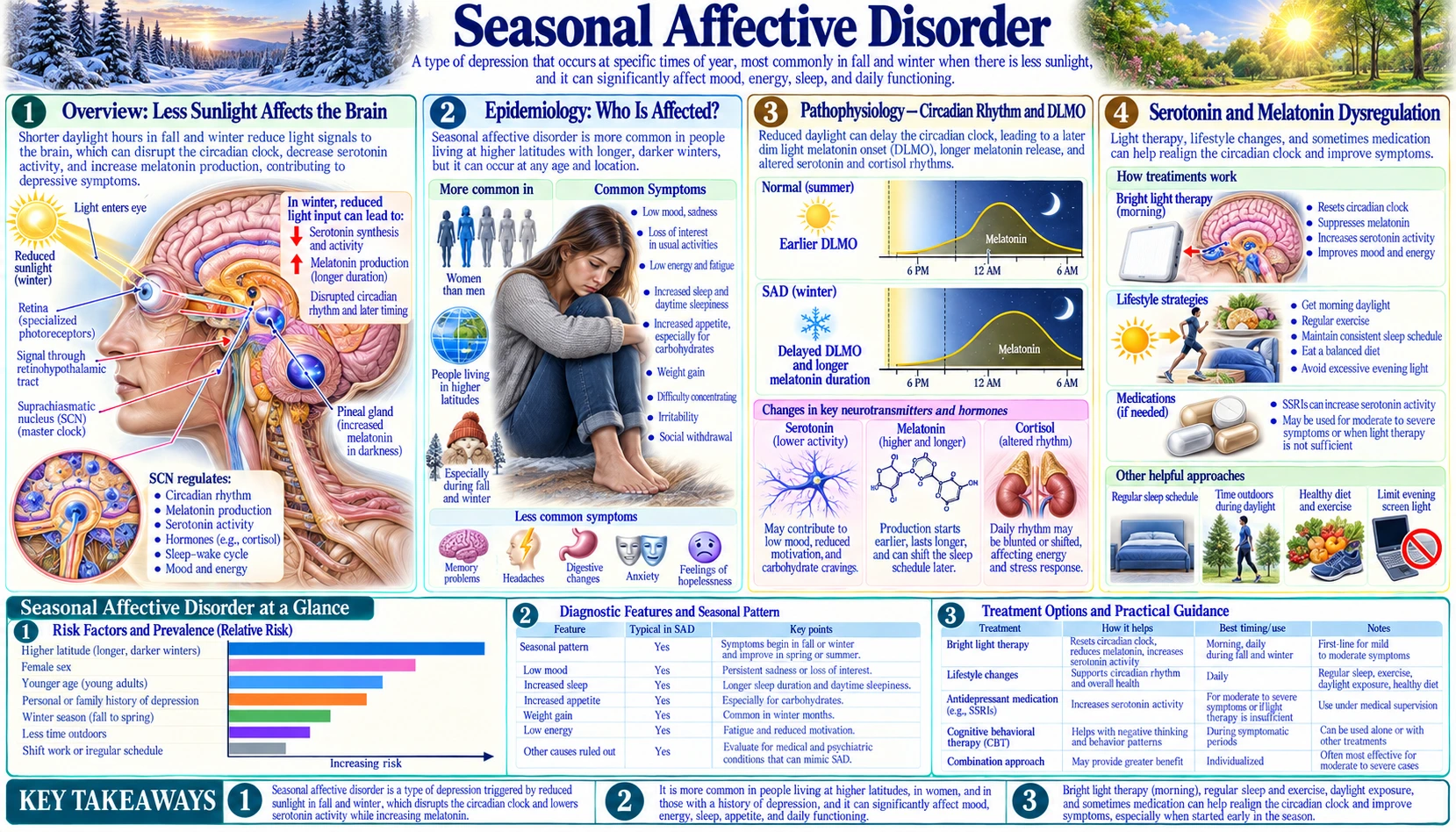
- Overview
- Epidemiology
- Pathophysiology — Circadian Rhythm and DLMO
- Serotonin and Melatonin Dysregulation
- Clinical Features — Winter vs. Summer SAD
- Diagnosis — DSM-5 Criteria
- Light Therapy — the 10,000 Lux Regimen in Trials
- Pharmacotherapy — Bupropion XL and SSRIs
- Melatonin and Vitamin D
- Behavioral and Psychological Interventions
- Research Papers
- Connections
Interactive Visualization Serotonin, Mood & SSRIs — build it, fire it, block reuptake Assemble serotonin from tryptophan, fire it across the synapse, then take an SSRI and watch the cleft flood — or starve the tryptophan and watch the signal fade. Launch →
Overview
Seasonal Affective Disorder (SAD) is a recurrent depressive disorder with a seasonal pattern. The winter-onset form is the common one; a less common summer-onset form also exists. It was first formally described by Rosenthal and colleagues at the National Institute of Mental Health in 1984: their report described 29 patients whose depressions were generally marked by hypersomnia, overeating and carbohydrate craving, and preliminary studies in 11 of them suggested that extending the photoperiod with bright artificial light had an antidepressant effect (Rosenthal 1984, PubMed PMID: 6581756).
SAD is classified in DSM-5 as "Major Depressive Disorder with Seasonal Pattern" — it is not a separate diagnosis but a specifier applied to recurrent major depression (or bipolar disorder) when episodes cluster reliably by season. Cochrane reviewers put its prevalence at 1.5% to 9%, depending on latitude (Gartlehner 2019, PubMed PMID: 30883669). Milder, subsyndromal seasonal symptoms ("winter blues") are more common than the full disorder. The disorder can be disabling: occupational impairment, social withdrawal, weight gain, hypersomnia and carbohydrate craving set it apart from typical depression. It tends to recur: in the three bupropion prevention trials, participants reported an average of 13 previous seasonal depressive episodes, and almost 60% had never been treated for depression (Modell 2005, PubMed PMID: 16271314).
Three treatments have the most trial evidence for winter SAD: morning bright light therapy (most trials used 10,000 lux for about 30 minutes a day), antidepressant medication, and cognitive-behavioral therapy adapted for SAD (CBT-SAD). In head-to-head trials, light therapy and fluoxetine produced similar results (Lam 2006, PubMed PMID: 16648320), and so did light therapy and CBT-SAD during an acute episode (Rohan 2015, PubMed PMID: 25859764). Bupropion XL is the medicine with a US FDA indication for preventing seasonal depressive episodes.
Epidemiology
Prevalence generally rises with latitude. A mailed-questionnaire survey in four US areas, from Sarasota, Florida to Nashua, New Hampshire, found winter SAD and subsyndromal winter SAD significantly more common at the more northern sites, while summer SAD showed no relation to latitude (Rosen 1990, PubMed PMID: 2326393). Magnusson's review of 20 retrospective studies found prevalence estimates ranging from 0% to 9.7%, higher at northern latitudes but varying across ethnic groups (Magnusson 2000, PubMed PMID: 10721866). Icelanders are the best-known exception: a survey of Canadians of wholly Icelandic descent found SAD in 1.2% and subsyndromal SAD in 3.3%, significantly lower than on the US east coast, and the authors suggested genetic adaptation (Magnússon 1993, PubMed PMID: 8250680).
Reviews consistently find SAD more common in women and in young people, and it has been identified in children and adolescents (Magnusson 2000; Magnusson 2005, PubMed PMID: 16041294). In an Australian study of 4,639 adult twins, genetic effects accounted for at least 29% of the variance in seasonal changes in mood and behavior, in both men and women (Madden 1996, PubMed PMID: 8540777).
For the seasonal pattern specifier to apply, the seasonal relationship must have been present for at least 2 consecutive years, and seasonal episodes must substantially outnumber non-seasonal major depressive episodes over the individual's lifetime. This prevents misclassification when a person happens to have two consecutive winter depressions due to coincidental life stressors.
Pathophysiology — Circadian Rhythm and DLMO
The dominant pathophysiological model is the phase-shift hypothesis, developed by Alfred Lewy, Robert Sack, and colleagues. The central claim: in winter-onset SAD, insufficient morning light exposure fails to properly entrain the circadian clock (centered in the suprachiasmatic nucleus, SCN) to the environmental light-dark cycle. This produces a phase delay — the internal clock runs later than it should relative to the sleep-wake schedule.
Dim Light Melatonin Onset (DLMO) is a widely used circadian phase marker in clinical research. It marks the time at which pineal melatonin secretion begins in the evening, measured under dim-light conditions. In Lewy's 1998 study, dim-light melatonin onsets were generally delayed in patients with winter depression compared with matched controls (Lewy 1998, PubMed PMID: 9783559) — meaning the onset of the melatonin-driven biological night is shifted later, out of alignment with the social and work schedule the patient must keep.
Under this model, patients must wake up and function during part of their biological night. The "circadian misalignment" theory holds that this mismatch, repeated daily for months, drives winter SAD symptoms. In Lewy's 2006 study, depression ratings correlated with circadian phase, which the authors read as a "therapeutic window" for optimal alignment of circadian rhythms (Lewy 2006, PubMed PMID: 16648247).
Under the phase-shift model, morning bright light acts as a zeitgeber (time-giver). Light entering the eye activates intrinsically photosensitive retinal ganglion cells (ipRGCs) containing the photopigment melanopsin, which is most sensitive to short-wavelength (blue) light; ipRGC axons project via the retinohypothalamic tract to the suprachiasmatic nucleus. In Lewy's 1998 crossover and parallel-group study of 51 patients and 49 matched controls, morning light (6 to 8 AM) advanced the dim-light melatonin onset and was more antidepressant than evening light (7 to 9 PM), which delayed it (Lewy 1998, PubMed PMID: 9783559). In Terman's 1998 trial of 158 patients, morning and evening light did not differ on percentage change scores, but stringent remission criteria showed a significantly higher response to morning light (Terman 1998, PubMed PMID: 9783557).
An alternative model — the photoperiodism hypothesis (Wehr) — proposes that it is the reduction in total daylight duration (photoperiod) in winter, rather than a phase shift per se, that drives SAD. Under this model, the brain's internal representation of season (encoded by the duration of nocturnal melatonin secretion) signals winter conditions that trigger the depressive phenotype. Both mechanisms may operate in different patients or in combination within the same patient.
Serotonin and Melatonin Dysregulation
Serotonin transporter (SERT) binding varies with the seasons. In a PET study using the radioligand [11C]DASB in 88 drug-naive healthy volunteers, SERT binding was significantly higher in every brain region examined in people scanned in fall and winter than in those scanned in spring and summer, and it fell as daily sunshine rose (Praschak-Rieder 2008, PubMed PMID: 18762593). Higher SERT density is associated with lower synaptic serotonin. The first longitudinal study in SAD scanned 17 patients and 23 healthy controls in both summer and winter: binding was similar in summer, but in winter the patients had higher SERT binding than the controls; the patients changed their SERT binding significantly less between seasons than the controls did, and in the patients the seasonal change tracked the change in depressive symptoms (Mc Mahon 2016, PubMed PMID: 26994750).
How light regulates SERT is not fully characterized. In 11 people with SAD scanned before and after 2 weeks of daily morning light therapy, SERT binding fell in the anterior cingulate (by 11.94%) and prefrontal cortex (by 9.13%) and in other regions assayed (Tyrer 2016, PubMed PMID: 27553523). SSRIs (selective serotonin reuptake inhibitors) block SERT pharmacologically, raising synaptic serotonin through a different route.
Melatonin dynamics in SAD are more nuanced than a simple "too much melatonin" model. Under the phase-shift hypothesis, what matters is the phase of the melatonin rhythm relative to sleep timing; the photoperiod hypothesis instead points to the duration of nocturnal melatonin secretion (see above).
Dopamine has also been proposed to play a part, consistent with anhedonia (reduced reward-circuit signaling) as a symptom; it is part of the rationale given for studying bupropion, a norepinephrine-dopamine reuptake inhibitor (NDRI), in SAD.
Melatonin timing follows from the phase-shift model. Lewy's group gave low doses of melatonin in the morning to induce phase delays, or in the afternoon or evening to induce phase advances, without causing sleepiness; correlations between depression ratings and circadian phase supported the phase-shift hypothesis (Lewy 2006, PubMed PMID: 16648247). An earlier pilot study gave low-dose afternoon melatonin to five patients and placebo to five; melatonin significantly decreased depression ratings, and the authors called for replication in a larger sample (Lewy 1998, PubMed PMID: 10710176).
Clinical Features — Winter vs. Summer SAD
Winter-onset SAD has a clinical profile that differs from classical melancholic depression: its cognitive and emotional symptoms are as in other depression, but the vegetative symptoms are reversed — increased sleep and increased appetite (Magnusson 2005, PubMed PMID: 16041294). Episodes typically begin in autumn and remit in spring. Commonly described features:
- Mood: Depressed, dysphoric, hopeless — but with preserved mood reactivity (positive events can transiently lift mood). This "atypical" feature distinguishes winter SAD from melancholic depression.
- Sleep: Hypersomnia, often with sleep that does not restore energy, and difficulty getting out of bed in the morning. Sleep recordings in Rosenthal's first series confirmed hypersomnia, with increased sleep latency and reduced slow-wave sleep.
- Appetite and weight: Increased appetite, especially carbohydrate craving, and winter weight gain. A systematic review found that people with SAD tended to eat larger dinners and more evening snacks than non-clinical subjects (Yang 2020, PubMed PMID: 32903693).
- Energy: Leaden fatigue — the heaviness of limbs characteristic of atypical depression. Profound energy loss often more disabling than mood itself.
- Cognitive: Slowed thinking, difficulty concentrating, impaired short-term memory. Occupational and academic performance can decline in winter.
- Social: Social withdrawal, hibernation-like behavior, loss of interest in activities previously enjoyed.
Suicidal thoughts can occur in SAD, as in other forms of major depression, and episodes can reach the severity of major depression.
Summer-onset SAD is described with a nearly opposite neurovegetative profile: insomnia rather than hypersomnia, loss of appetite and weight loss rather than overeating, and prominent anxiety and irritability. Episodes begin in late spring or early summer and remit in autumn. Its causes are less well understood, and in the four-latitude survey summer SAD showed no relation to latitude (Rosen 1990). Trial evidence for treating the summer form is thin.
Subsyndromal SAD ("winter blues") — also called sub-SAD — involves energy loss, mood lowering, appetite changes and social withdrawal in winter that fall short of full major-depression criteria. In surveys it is more common than full SAD: 3.3% versus 1.2% in the Icelandic-Canadian survey, for example (Magnússon 1993).
Diagnosis — DSM-5 Criteria
In DSM-5, SAD is not a stand-alone diagnosis. It is the "Seasonal Pattern" specifier applied to Major Depressive Disorder, Recurrent — or to Bipolar I or Bipolar II Disorder. The specifier requires all of the following:
- A regular temporal relationship exists between the onset of major depressive episodes and a particular time of year (e.g., autumn or winter onset).
- Full remissions (or a change from depression to mania/hypomania in bipolar) also occur at a characteristic time of year (e.g., spring remission).
- The seasonal pattern episodes must not be better explained by seasonally linked psychosocial stressors (e.g., annual unemployment every winter, anniversary reactions).
- At least two major depressive episodes have occurred with the seasonal temporal relationship in the past 2 years, with no non-seasonal episodes during that period.
- Seasonal major depressive episodes substantially outnumber non-seasonal major depressive episodes over the individual's lifetime.
The differential diagnosis includes:
- Non-seasonal MDD: Recurrent depression that happens to cluster by chance in winter — requires ≥2 years of seasonal pattern to meet specifier criteria.
- Bipolar disorder with seasonal pattern: Some people with bipolar disorder have a seasonal pattern — depressive episodes in autumn/winter, hypomanic or manic episodes in spring/summer; most of Rosenthal's first 29 patients had bipolar disorder, especially bipolar II. Antidepressant monotherapy carries a reported risk of switching into mania in bipolar disorder, which is why a history of hypomanic symptoms matters in the assessment.
- Hypothyroidism: Fatigue, weight gain, cognitive slowing and depression can mimic SAD; thyroid testing is commonly part of the workup.
- Vitamin D deficiency: Winter fatigue and low mood; serum 25-hydroxyvitamin D is sometimes measured as part of the workup.
- Normal winter sleepiness: Increased appetite and sleep in winter are common human seasonal adaptations and do not constitute SAD unless accompanied by significant mood disturbance and functional impairment.
Light Therapy — the 10,000 Lux Regimen in Trials
Morning bright light therapy is the most studied treatment for winter-onset SAD. A 2020 meta-analysis of 19 randomized trials found bright light superior to placebo (standardized mean difference −0.37 for depression ratings; risk ratio 1.42 for response), while noting moderate heterogeneity, a moderate-to-high risk of bias and small-to-medium samples (Pjrek 2020, PubMed PMID: 31574513). In the Can-SAD trial, light-treated patients improved more than fluoxetine-treated patients at week 1, but not at later time points (Lam 2006).
Regimens used in the trials:
- Device and intensity: Fluorescent white-light boxes at 10,000 lux (Can-SAD used neutral-density-filtered 100-lux boxes as the placebo light).
- Duration: 30 minutes a day in most trials (Terman 1998; Lam 2006; Rohan 2015, where the dose was then adjusted by response and side effects).
- Timing: Morning. In Lewy's 1998 study, light at 6 to 8 AM advanced circadian phase and was more antidepressant than light at 7 to 9 PM, which delayed it; Lewy's group concluded that bright light is best scheduled immediately on awakening for most patients.
- Use during the session: Eyes open, with ordinary activities such as reading or eating breakfast, as described in clinical protocols (Terman 2005, PubMed PMID: 16041296).
- Season: Acute-treatment trials lasted 2 to 8 weeks during a winter episode. Evidence on starting light before symptoms, to prevent an episode, is limited to one small trial: Cochrane reviewers found 46 people in that trial and could draw no conclusion (Nussbaumer-Streit 2019, PubMed PMID: 30883670).
Efficacy: In the Can-SAD trial of 96 patients, response rates were 67% with both 10,000-lux light (plus a placebo capsule) and fluoxetine 20 mg (plus placebo light), and remission rates were 50% and 54% (Lam 2006, PubMed PMID: 16648320). Terman's 1998 trial compared morning and evening light with a non-light control, negative air ionization: the low-density ion (placebo) condition did worse than all the other groups (Terman 1998, PubMed PMID: 9783557). Rohan and colleagues put remission at 53% across light-therapy studies (Rohan 2007, PubMed PMID: 17563165).
Side effects: Terman and Terman describe the side-effect profile as favorable compared with medications, with vigilance needed for emergent hypomania and autonomic hyperactivation, especially in the first days of treatment (Terman 2005, PubMed PMID: 16041296). Bright light can trigger hypomania or mania in people with bipolar disorder. On the eyes: in 50 patients given 10,000-lux light for 30 minutes a day, eye examinations found no changes after 2 to 8 weeks, and none in 17 patients after 3 to 6 years of seasonal use. The authors found no definite ocular contraindications, but recommended periodic eye examinations for people with pre-existing eye abnormalities or taking photosensitizing drugs (Gallin 1995, PubMed PMID: 7832227).
Blue-enriched light: Because melanopsin-containing ipRGCs are most sensitive to short-wavelength light, lower-intensity blue-enriched devices have been proposed as an alternative to standard white light boxes. Whether they match standard light boxes, and what high-intensity blue light does to the retina over the long term, are questions the sources on this page do not settle.
Dawn simulators: These devices gradually brighten the bedroom during the final hours of sleep, mimicking a natural dawn. In Terman's 2006 trial of 99 adults, improvement after 3 weeks was 57.1% with post-awakening bright light (10,000 lux, 30 minutes), 49.5% with naturalistic dawn simulation, 42.7% with a brief dawn light pulse, 47.9% with high-density negative ions, and 22.7% with low-density ions (significantly lower than the others); dawn simulation was not superior to bright light (Terman 2006, PubMed PMID: 17151164).
Pharmacotherapy — Bupropion XL and SSRIs
Bupropion XL (extended-release bupropion) is the medicine with a US FDA indication specifically for prevention of seasonal major depressive episodes (approved 2006). It was tested as prevention — started in autumn while patients were still well, rather than as treatment of an established episode:
- Trial regimen: Three placebo-controlled prevention trials enrolled 1,042 patients across the northern US and Canada in autumn, while they were well; patients took bupropion XL 150–300 mg or placebo daily until spring and were then followed off medication for 8 weeks (Modell 2005, PubMed PMID: 16271314).
- Results: Major depression recurred in 19% versus 30%, 13% versus 21%, and 16% versus 31% (bupropion XL versus placebo) in the three trials — a relative risk reduction of 44% across them (Modell 2005).
- Cochrane assessment: Pooling the three trials (1,100 people), Cochrane reviewers rated the evidence for prevention as moderate quality (risk ratio 0.56), with more headaches (moderate-quality evidence), insomnia and nausea (low-quality evidence) than placebo; all three trials had high attrition (Gartlehner 2019, PubMed PMID: 30883669).
- Mechanism: Norepinephrine-dopamine reuptake inhibitor (NDRI) — distinct from SSRIs.
- Number needed to treat (NNT) for prevention: This depends on how often episodes would otherwise recur. The Cochrane review gives an NNT of 8 where the yearly recurrence rate is 30%, 5 at 50% and 4 at 60%, and notes that even in a high-risk population three out of four people do not benefit and remain at risk of harm (Gartlehner 2019).
- Contraindications: The US prescribing information lists seizure disorders, current or prior bulimia or anorexia nervosa, abrupt discontinuation of alcohol or benzodiazepines, and use with MAOIs. Bupropion lowers the seizure threshold in a dose-dependent way.
SSRIs are used to treat established winter SAD, though none carries a prevention indication, and the trial evidence is limited. A 2021 Cochrane review found one trial of 68 participants in which fluoxetine was numerically but not significantly better than placebo, and two trials (136 participants) in which fluoxetine and light therapy were about equal (Nussbaumer-Streit 2021, PubMed PMID: 33661528). It found no eligible trial comparing one SSRI or similar antidepressant with another, or with psychotherapy:
- In the Can-SAD trial (American Journal of Psychiatry, 2006), Lam and colleagues found fluoxetine 20 mg and 10,000-lux morning light therapy equally effective over 8 weeks in winter SAD. The trial had no combination arm; fluoxetine brought more agitation, sleep disturbance and palpitations, though overall adverse effects did not differ (Lam 2006, PubMed PMID: 16648320).
- In the same trial, light-treated patients improved more at week 1, but the groups did not differ at later time points.
Combination therapy: The Can-SAD trial did not test light combined with medication. Terman and Terman describe light therapy as a compatible adjunct to antidepressant medication that can speed improvement (Terman 2005). In Rohan's 2007 pilot trial of 61 adults, CBT combined with light therapy reached a 73% remission rate against 20% in a minimal-contact control (Rohan 2007, PubMed PMID: 17563165). Cochrane reviewers found no trials comparing an antidepressant with light therapy for prevention (Gartlehner 2019).
MAOIs: Older monoamine oxidase inhibitors (phenelzine, tranylcypromine) are used for depression with atypical features, but they carry dietary tyramine restrictions and drug-interaction risks; no trial of them specifically in SAD is cited on this page.
Melatonin and Vitamin D
Melatonin: Under the phase-shift hypothesis, melatonin's effect on the clock depends on timing: low-dose melatonin taken in the morning delays circadian phase, while melatonin taken in the afternoon or evening advances it (Lewy 2006, PubMed PMID: 16648247). For a phase-delayed patient, then, the timing is what the model predicts would matter.
The trial evidence is small. Lewy's 1998 pilot study found that low-dose afternoon melatonin lowered depression ratings compared with placebo in a total of 10 patients (Lewy 1998, PubMed PMID: 10710176). For prevention, a 2019 Cochrane review found no studies of melatonin at all, and one trial of agomelatine, a melatonin-receptor drug, with an indeterminate result (Nussbaumer-Streit 2019, PubMed PMID: 31206585). DLMO measurement (via serial saliva or plasma samples) can be used to individualize melatonin timing, though it is available mainly in research settings.
Vitamin D: Low serum 25-hydroxyvitamin D has been associated with a higher likelihood of SAD, but firm evidence for the link is lacking (Frandsen 2014, PubMed PMID: 25125215). Less winter sun at northern latitudes, together with more time indoors, lowers vitamin D levels.
Supplementation trials have not shown a benefit for SAD. In a randomized, double-blind trial in 34 healthcare workers with seasonal symptoms, 70 μg of vitamin D daily for 3 months did not differ from placebo on SAD symptoms; the authors note the trial was underpowered (Frandsen 2014, PubMed PMID: 25125215). A 2020 systematic review found that neither vitamin D nor vitamin B12 supplementation showed benefit for SAD (Yang 2020, PubMed PMID: 32903693). The causal direction is uncertain: low vitamin D may follow from winter indoor behavior rather than cause the mood disorder.
Whether to test for and correct a vitamin D deficiency is a separate question from treating SAD; the trials above did not find that supplementation relieved SAD symptoms.
Behavioral and Psychological Interventions
Cognitive-behavioral therapy adapted for SAD (CBT-SAD) was manualized by Kelly Rohan and colleagues to address the specific cognitive patterns and behavioral avoidance that perpetuate and worsen winter SAD. The treatment combines two main components: behavioral activation (deliberately scheduling pleasurable, engaging activities during the winter months to counteract the hibernation drive and withdrawal) and cognitive restructuring (identifying and challenging automatic negative seasonal thoughts such as "I always get depressed in winter and there's nothing I can do," "I should hibernate until spring," or "my life is worthless in winter").
In a randomized trial of 177 adults, 6 weeks of group CBT-SAD and 6 weeks of 10,000-lux morning light therapy improved depression comparably, with similar remission rates (47.6% and 47.2% on the SIGH-SAD interview) (Rohan 2015, PubMed PMID: 25859764). The follow-up found no difference during the first year; at the second winter, CBT-SAD was associated with fewer recurrences (27.3% versus 45.6%), less severe symptoms, and more remissions (68.3% versus 44.5% on the BDI-II). The authors interpret this as greater durability for CBT-SAD (Rohan 2016, PubMed PMID: 26539881).
Exercise has been studied as a treatment for major depression in general. Outdoor morning activity combines exercise with daylight exposure; trials of exercise specifically in SAD are few, and none is cited on this page.
Sleep timing and circadian anchoring: Under the phase-shift model, a consistent wake time — including weekends — acts as a behavioral anchor for the circadian clock, and variable wake times can shift it later. This rationale comes from circadian research rather than from SAD-specific trials.
Long sleep in SAD often does not restore energy, unlike recovery sleep after genuine sleep deprivation. How much of that reflects circadian misalignment is not settled.
Diet: A 2020 systematic review of 11 studies found that people with SAD show distinctive eating patterns, including more binge, external and emotional eating and cravings for starch-rich foods. No nutrition intervention, including carbohydrate-loaded meals and vitamin D or B12 supplements, had shown efficacy for SAD symptoms (Yang 2020, PubMed PMID: 32903693). The same review associated alcoholism, but not normal alcohol intake, with SAD.
Key Research Papers
- Rosenthal NE, Sack DA, Gillin JC, et al. (1984). Seasonal affective disorder. A description of the syndrome and preliminary findings with light therapy. Archives of General Psychiatry — PubMed PMID: 6581756
- Terman M, Terman JS, Ross DC (1998). A controlled trial of timed bright light and negative air ionization for treatment of winter depression. Archives of General Psychiatry — PubMed PMID: 9783557
- Terman M, Terman JS (2005). Light therapy for seasonal and nonseasonal depression: efficacy, protocol, safety, and side effects. CNS Spectrums — PubMed PMID: 16041296
- Lam RW, Levitt AJ, Levitan RD, et al. (2006). The Can-SAD study: a randomized controlled trial of the effectiveness of light therapy and fluoxetine in patients with winter seasonal affective disorder. American Journal of Psychiatry — PubMed PMID: 16648320
- Praschak-Rieder N, Willeit M, Wilson AA, et al. (2008). Seasonal variation in human brain serotonin transporter binding. Archives of General Psychiatry — PubMed PMID: 18762593
- Lewy AJ, Lefler BJ, Emens JS, Bauer VK (2006). The circadian basis of winter depression. Proceedings of the National Academy of Sciences of the USA — PubMed PMID: 16648247
- Rohan KJ, Roecklein KA, Tierney Lindsey K, et al. (2007). A randomized controlled trial of cognitive-behavioral therapy, light therapy, and their combination for seasonal affective disorder. Journal of Consulting and Clinical Psychology — PubMed PMID: 17563165
- Rohan KJ, Mahon JN, Evans M, et al. (2015). Randomized trial of cognitive-behavioral therapy versus light therapy for seasonal affective disorder: acute outcomes. American Journal of Psychiatry — PubMed PMID: 25859764
- Gallin PF, Terman M, Remé CE, et al. (1995). Ophthalmologic examination of patients with seasonal affective disorder, before and after bright light therapy. American Journal of Ophthalmology — PubMed PMID: 7832227
- Magnusson A (2000). An overview of epidemiological studies on seasonal affective disorder. Acta Psychiatrica Scandinavica — PubMed PMID: 10721866
- Nussbaumer-Streit B, Forneris CA, Morgan LC, et al. (2019). Light therapy for preventing seasonal affective disorder. Cochrane Database of Systematic Reviews — PubMed PMID: 30883670 (update of the 2015 version, PubMed PMID: 26558494)
- Lewy AJ, Bauer VK, Cutler NL, et al. (1998). Morning vs evening light treatment of patients with winter depression. Archives of General Psychiatry — PubMed PMID: 9783559
- Lewy AJ, Bauer VK, Cutler NL, Sack RL (1998). Melatonin treatment of winter depression: a pilot study. Psychiatry Research — PubMed PMID: 10710176
- Mc Mahon B, Andersen SB, Madsen MK, et al. (2016). Seasonal difference in brain serotonin transporter binding predicts symptom severity in patients with seasonal affective disorder. Brain — PubMed PMID: 26994750
- Tyrer AE, Levitan RD, Houle S, et al. (2016). Serotonin transporter binding is reduced in seasonal affective disorder following light therapy. Acta Psychiatrica Scandinavica — PubMed PMID: 27553523
- Modell JG, Rosenthal NE, Harriett AE, et al. (2005). Seasonal affective disorder and its prevention by anticipatory treatment with bupropion XL. Biological Psychiatry — PubMed PMID: 16271314
- Gartlehner G, Nussbaumer-Streit B, Gaynes BN, et al. (2019). Second-generation antidepressants for preventing seasonal affective disorder in adults. Cochrane Database of Systematic Reviews — PubMed PMID: 30883669
- Nussbaumer-Streit B, Thaler K, Chapman A, et al. (2021). Second-generation antidepressants for treatment of seasonal affective disorder. Cochrane Database of Systematic Reviews — PubMed PMID: 33661528
- Nussbaumer-Streit B, Greenblatt A, Kaminski-Hartenthaler A, et al. (2019). Melatonin and agomelatine for preventing seasonal affective disorder. Cochrane Database of Systematic Reviews — PubMed PMID: 31206585
- Pjrek E, Friedrich ME, Cambioli L, et al. (2020). The efficacy of light therapy in the treatment of seasonal affective disorder: a meta-analysis of randomized controlled trials. Psychotherapy and Psychosomatics — PubMed PMID: 31574513
- Terman M, Terman JS (2006). Controlled trial of naturalistic dawn simulation and negative air ionization for seasonal affective disorder. American Journal of Psychiatry — PubMed PMID: 17151164 (an erratum was published: Am J Psychiatry 2007;164:529)
- Rohan KJ, Meyerhoff J, Ho SY, et al. (2016). Outcomes one and two winters following cognitive-behavioral therapy or light therapy for seasonal affective disorder. American Journal of Psychiatry — PubMed PMID: 26539881
- Madden PA, Heath AC, Rosenthal NE, Martin NG (1996). Seasonal changes in mood and behavior. The role of genetic factors. Archives of General Psychiatry — PubMed PMID: 8540777
- Rosen LN, Targum SD, Terman M, et al. (1990). Prevalence of seasonal affective disorder at four latitudes. Psychiatry Research — PubMed PMID: 2326393
- Magnússon A, Axelsson J (1993). The prevalence of seasonal affective disorder is low among descendants of Icelandic emigrants in Canada. Archives of General Psychiatry — PubMed PMID: 8250680
- Magnusson A, Partonen T (2005). The diagnosis, symptomatology, and epidemiology of seasonal affective disorder. CNS Spectrums — PubMed PMID: 16041294
- Frandsen TB, Pareek M, Hansen JP, Nielsen CT (2014). Vitamin D supplementation for treatment of seasonal affective symptoms in healthcare professionals: a double-blind randomised placebo-controlled trial. BMC Research Notes — PubMed PMID: 25125215
- Yang Y, Zhang S, Zhang X, et al. (2020). The role of diet, eating behavior, and nutrition intervention in seasonal affective disorder: a systematic review. Frontiers in Psychology — PubMed PMID: 32903693
PubMed Topic Searches
PubMed topic searches for further reading:
- Seasonal affective disorder winter depression
- SAD light therapy 10000 lux
- Seasonal affective disorder circadian DLMO phase shift
- SAD bupropion prevention treatment
- Seasonal affective disorder serotonin SERT
- SAD melatonin circadian rhythm
- Seasonal affective disorder vitamin D
- CBT cognitive behavioral therapy SAD
- SAD summer onset atypical
- Seasonal depression epidemiology latitude
- Seasonal affective disorder bipolar spectrum
- SAD SSRIs pharmacotherapy