Chronic Urticaria
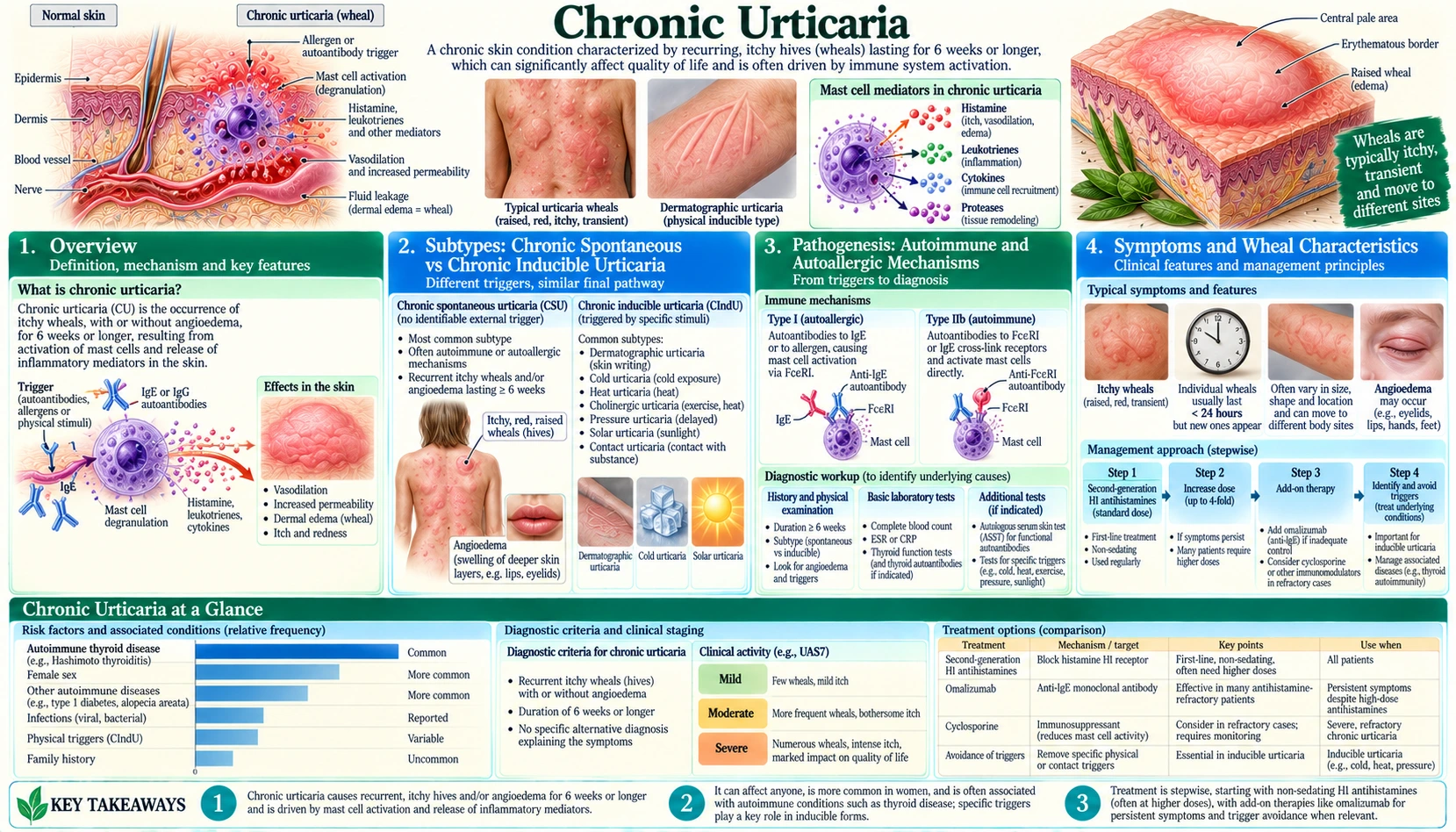
Table of Contents
- Overview
- Subtypes: Chronic Spontaneous vs Chronic Inducible Urticaria
- Pathogenesis: Autoimmune and Autoallergic Mechanisms
- Symptoms and Wheal Characteristics
- Chronic Inducible Urticaria: Dermographism, Cold, Solar, and More
- Diagnosis and Disease Activity Scoring (UAS7)
- Associated Conditions: Thyroid Autoimmunity and H. pylori
- Treatment: Step-Up Ladder from Antihistamines to Omalizumab
- Omalizumab in Chronic Urticaria: Mechanism and Evidence
- Quality of Life and Long-Term Outlook
- Key Research Papers
- Connections
- Featured Videos
1. Overview
Chronic urticaria (CU) is defined as the recurrent occurrence of wheals (hives), angioedema, or both, for more than six weeks. A 2020 meta-analysis of population studies found a point prevalence of chronic urticaria of about 1.4% in Asia, 0.5% in Europe, and 0.1% in North America; the often-quoted lifetime prevalence of about 20% refers to acute urticaria (2022 international guideline). The condition has a bimodal age distribution, peaking in young adults and again in middle age, and shows a clear female predominance of approximately 2:1.
Chronic urticaria is classified into two major categories: chronic spontaneous urticaria (CSU), in which wheals and angioedema arise without an identifiable external physical trigger, and chronic inducible urticaria (CINDU), in which symptoms are consistently reproducible by a specific physical or environmental stimulus such as pressure, cold, heat, or light. Understanding this distinction is fundamental to management, because CINDU subtypes require trigger avoidance and provocation testing strategies that differ from CSU.
The individual lesions of urticaria are transient — this is a defining clinical feature. A wheal that persists beyond 24 hours at a fixed skin site is not typical urticaria and points instead to urticarial vasculitis, autoinflammatory syndromes, or other diagnoses. Despite the transient nature of individual lesions, the condition itself can last months to years, significantly impairing quality of life. Modern therapy has transformed outcomes: in the ASTERIA I trial of the anti-IgE monoclonal antibody omalizumab, 35.8% of antihistamine-refractory CSU patients on 300 mg had no itch and no hives (UAS7 = 0) at week 12, versus 8.8% on placebo.
2. Subtypes: Chronic Spontaneous vs Chronic Inducible Urticaria
Chronic Spontaneous Urticaria (CSU)
CSU accounts for 80–90% of all chronic urticaria cases. Formerly called "chronic idiopathic urticaria" (CIU), the preferred term is now chronic spontaneous urticaria because an underlying autoimmune or autoallergic mechanism can be identified in many patients. The hallmark is the spontaneous appearance of wheals and/or angioedema without any consistent identifiable external trigger. Episodes may occur daily or near-daily, though the frequency and severity vary over time. Stress, infections, nonsteroidal anti-inflammatory drugs (NSAIDs), and alcohol can non-specifically worsen symptoms but are not the primary cause.
Chronic Inducible Urticaria (CINDU)
CINDU comprises a group of distinct subtypes in which wheals are consistently provoked by a specific physical stimulus. CINDU may coexist with CSU in the same patient. The major CINDU subtypes are:
- Symptomatic dermographism (dermatographic urticaria): The most common inducible form, affecting 2–5% of the population. Firm stroking of the skin produces a linear wheal within 5–10 minutes that resolves within 30 minutes. Pruritic wheals follow the exact path of skin trauma.
- Cold urticaria: Cold-contact triggers whealing on rewarmed skin. Can cause life-threatening systemic anaphylaxis with whole-body cold exposure (e.g., swimming in cold water).
- Solar urticaria: Exposure to ultraviolet (UV) or visible light wavelengths triggers wheals, typically within minutes of sun exposure.
- Delayed pressure urticaria: Deep, painful swelling appears 4–6 hours after sustained pressure (waistbands, bra straps, prolonged sitting). Unlike other forms, angioedema-like swelling — not superficial wheals — predominates.
- Aquagenic urticaria: Water contact at any temperature triggers small perifollicular wheals; extremely rare.
- Cholinergic urticaria: Increase in core body temperature from exercise, hot baths, or emotional stress triggers characteristic small (1–3 mm) wheals with large surrounding erythematous flares.
- Contact urticaria: Direct skin contact with specific substances (latex, foods, topical medications) triggers localized immediate whealing at the contact site.
3. Pathogenesis: Autoimmune and Autoallergic Mechanisms
The central event in all urticaria is mast cell degranulation in the superficial dermis, releasing histamine, prostaglandins, leukotrienes, and cytokines. This triggers transient subepidermal edema (the wheal), axon-reflex erythema (the surrounding flare), and sensory nerve activation (pruritus). In CSU, two distinct immunologic pathways drive this mast cell activation:
Type IIb Autoimmune CSU (under 10% of cases with strict criteria)
Immunoglobulin G (IgG) autoantibodies are directed against either the alpha subunit of the high-affinity immunoglobulin E receptor (FcεRI) on mast cells and basophils, or against immunoglobulin E itself. These autoantibodies bind and cross-link FcεRI directly, triggering mast cell degranulation without any allergen or immunoglobulin E-mediated bridge. Key features of this subtype:
- Autologous serum skin test (ASST) is typically positive — intradermal injection of the patient's own serum induces a wheal-and-flare response from the circulating activating factors.
- Associated with higher disease severity and longer disease duration.
- Slower and less complete initial response to omalizumab compared to non-autoimmune CSU (though still clinically meaningful with continued treatment).
- Higher prevalence of concomitant autoimmune diseases (Hashimoto thyroiditis, rheumatoid arthritis, type 1 diabetes).
Type I Autoallergic CSU (IgE-Mediated Autoallergy, ~10%)
A conceptually distinct mechanism: immunoglobulin E antibodies directed against self-antigens (autoantigens) drive ongoing mast cell activation. Identified autoantigens include thyroid peroxidase (TPO), double-stranded DNA (dsDNA), and interleukin-24 (IL-24). This is not a classical exogenous allergen allergy — the triggering antigen is endogenously produced, resulting in continuous low-level mast cell priming. These patients tend to have elevated total immunoglobulin E levels and respond rapidly and completely to omalizumab.
Non-Immune and Mixed Mechanisms
In the remaining cases of CSU, the precise mechanism is unclear. Contributions from coagulation cascade activation (elevated D-dimer in severe disease), basophil dysfunction, complement activation, and neuropeptide dysregulation have been described. Regardless of the upstream pathway, the final common effector is mast cell and basophil degranulation releasing:
- Histamine: Acts on H1 receptors on endothelial cells (vasodilation, increased vascular permeability → wheal) and sensory nerves (pruritus).
- Prostaglandin D2 and leukotrienes: Amplify the inflammatory response and contribute to pruritus.
- Cytokines (IL-4, IL-13, tumor necrosis factor-α): Sustain local inflammation and may contribute to systemic symptoms in severe disease.
4. Symptoms and Wheal Characteristics
The classic urticarial lesion is a wheal: a circumscribed, raised, erythematous or pale-centered edematous plaque with a surrounding erythematous flare. The central wheal is pale because of the pressure effect of dermal edema on superficial vessels, while the surrounding flare is erythematous from axon-reflex vasodilation. Individual lesions are intensely pruritic — often described as burning, stinging, or maddening itch that disrupts sleep and daily activity.
The Critical 24-Hour Rule
Individual urticarial lesions resolve completely within 24 hours by definition. This transient nature distinguishes CSU from urticarial vasculitis, Schnitzler syndrome (monoclonal gammopathy with fixed urticarial lesions), bullous pemphigoid (which can present with urticarial plaques), and autoinflammatory syndromes. If the patient reports that individual lesions persist beyond 24 hours at the same site, or if post-lesion bruising or purpura is present, skin biopsy is the test used to evaluate for urticarial vasculitis or neutrophilic dermatosis.
Angioedema
Angioedema — deep tissue swelling due to increased vascular permeability in the deep dermis and subcutaneous tissues — occurs in 40–50% of CSU patients. Common locations include the face (lips, periorbital area), tongue, extremities, and genitals. Angioedema is typically non-pitting (unlike venous edema), asymmetric, and resolves within 24–72 hours.
A critical clinical distinction: The angioedema of CSU is histaminergic — it responds to antihistamines and omalizumab. This is fundamentally different from hereditary angioedema (HAE), which is bradykinin-mediated (due to C1-inhibitor deficiency or dysfunction) and does not respond to antihistamines, epinephrine, or omalizumab. Confusing HAE with histaminergic angioedema can be fatal, as HAE requires icatibant, C1-inhibitor concentrate, or kallikrein inhibitors. Distinguishing features: HAE typically lacks associated wheals, has a family history, lacks pruritus, and has low C4 levels. When urticaria accompanies angioedema, CSU is far more likely than HAE.
Laryngeal angioedema is a rare but potentially life-threatening complication of CSU-associated angioedema, presenting with throat tightening, voice changes, and stridor. These are emergency warning signs, and self-injectable epinephrine is the emergency treatment for a throat reaction in people with a history of laryngeal involvement.
5. Chronic Inducible Urticaria: Dermographism, Cold, Solar, and More
Symptomatic Dermographism
The most common form of CINDU. The diagnostic tool of choice is a calibrated dermographism testing device, a spring-loaded instrument that applies standardized pressure at defined force levels (0.4–3.0 g/cm²) across a defined skin area. This allows both diagnosis and quantitative monitoring of treatment response. In clinical practice, a firm tongue depressor or fingernail stroke is used for screening, but the calibrated device is preferred for rigorous assessment. The wheal appears within 5–10 minutes of stroking and fades within 30 minutes. The threshold force at which whealing occurs defines severity. Management: non-sedating antihistamines and avoidance of unnecessary skin friction.
Cold Urticaria
The standard diagnostic provocation test is the ice cube test: an ice cube in a thin plastic bag (to prevent freeze-burn of the skin) is applied to the forearm for 5 minutes, then removed. A wheal forms at the cold contact site during the rewarming phase, typically within 10 minutes. The bag prevents direct skin freezing, which would give a false-positive result due to cold injury rather than cold urticaria.
Cold urticaria carries a specific life-threatening risk: systemic anaphylaxis from total-body cold exposure, such as swimming in cold water, cold rain, or even cold air exposure in severe cases. Cold-water immersion can trigger a whole-body reaction, and self-injectable epinephrine is the emergency treatment for anaphylaxis. Rare associations include cryoglobulinemia (serum protein that precipitates at cold temperatures), for which a serum cryoglobulin test is used in atypical presentations (older patients, extensive cold exposure required, systemic symptoms).
Solar Urticaria
Solar urticaria is provoked by ultraviolet or visible light wavelengths. The diagnostic gold standard is phototesting: calibrated monochromatic light sources deliver incremental ultraviolet-A (320–400 nm), ultraviolet-B (290–320 nm), and visible light (400–700 nm) to a small area of unexposed skin. An urticarial wheal appearing within 30 minutes in the irradiated area at doses below the minimal urticarial dose (MUD) confirms the diagnosis and identifies the action spectrum. Most patients react to visible light; some react to ultraviolet only. Broad-spectrum sunscreens, UPF-rated protective clothing, and tinted window films help with avoidance. Omalizumab is effective for antihistamine-refractory solar urticaria.
Cholinergic Urticaria
Triggered by any stimulus that raises core body temperature — exercise, hot baths/showers, emotional sweating, spicy food. The diagnostic provocation test is an exercise challenge (treadmill or cycling to raise core temperature) or a hot bath challenge (immersion in 42°C water for 15 minutes). The characteristic lesions are small (1–3 mm) pale wheals surrounded by large (1–3 cm) erythematous flares — quite distinct from the larger wheals of CSU. Severe cholinergic urticaria can progress to systemic anaphylaxis. A subset of patients have sweat hypersensitivity (immunoglobulin E to sweat antigens) as the mechanism rather than simple thermogenic mast cell activation.
Pressure Urticaria
Delayed pressure urticaria is provoked by sustained pressure (not light touch). Typical triggers: waistband pressure from tight clothing or belts, prolonged sitting on hard surfaces, carrying bags, wearing gloves or tight shoes. The reaction is characteristically delayed 4–6 hours after the pressure stimulus and consists of deep, painful angioedema-like swellings rather than superficial wheals. Diagnostic testing uses a weighted pressure device (0.5–1.5 kg/cm² applied for 15–20 minutes, with reading at 6 and 24 hours). Delayed pressure urticaria responds poorly to antihistamines; omalizumab and montelukast are useful adjuncts.
6. Diagnosis and Disease Activity Scoring (UAS7)
Clinical Diagnosis
Chronic urticaria diagnosis is primarily clinical. The EAACI 2022 guideline defines CU as the occurrence of wheals, angioedema, or both on at least 2 days per week for more than 6 weeks. A careful history addresses: duration and frequency of episodes, lesion appearance and duration (verify the 24-hour rule), presence and location of angioedema, potential physical triggers, aggravating factors (nonsteroidal anti-inflammatory drugs, angiotensin-converting enzyme inhibitors (ACE inhibitors), alcohol, stress, infections), personal and family history of autoimmune disease, and response to antihistamines.
Baseline Laboratory Investigations
Routine laboratory workup for newly diagnosed CU aims to identify treatable underlying causes and screen for associated conditions:
- Complete blood count (CBC) with differential: Eosinophilia may suggest parasitic infection or hypereosinophilic syndrome; leukocytosis may indicate infection.
- C-reactive protein (CRP) and erythrocyte sedimentation rate (ESR): Elevated acute-phase reactants suggest systemic inflammation; markedly elevated erythrocyte sedimentation rate with fixed urticarial lesions >24h raises concern for urticarial vasculitis.
- Thyroid-stimulating hormone (TSH), thyroid peroxidase antibodies (anti-TPO), anti-thyroglobulin antibodies: Thyroid autoimmunity is present in 25–30% of CSU patients.
- Total immunoglobulin E: Elevated levels suggest Type I autoallergic mechanism and predict faster omalizumab response.
- Specific immunoglobulin E and skin-prick testing: Only if the history suggests a specific allergic trigger; routine screening for food allergies in CSU is not indicated and rarely informative.
- Cryoglobulin screen: For atypical cold urticaria (older patient, difficult to reproduce, systemic symptoms).
- Hepatitis B and C serology: Chronic hepatitis C has been associated with urticaria in some cohorts.
- D-dimer: Elevated in moderate-to-severe CSU; correlates with disease activity and can serve as a biomarker for treatment response to omalizumab.
Skin biopsy is not routinely indicated for uncomplicated CU. It is reserved for cases where urticarial vasculitis is suspected (lesions persisting >24 hours at a fixed site, post-lesion purpura, burning > itching, systemic symptoms).
Urticaria Activity Score 7 (UAS7)
The UAS7 is the primary validated patient-reported outcome measure for monitoring CSU activity and treatment response. Over 7 consecutive days, patients record daily scores in two domains:
- Wheal number: 0 = none; 1 = 1–6 wheals; 2 = 7–12 wheals; 3 = >12 wheals
- Itch intensity: 0 = none; 1 = mild (present but not annoying); 2 = moderate (troublesome but does not interfere with sleep or activity); 3 = intense (severe, interferes with daily activities or sleep)
The maximum UAS7 score is 42 (max daily score 6 × 7 days). Interpretation: 0–6 = well-controlled or urticaria-free; 7–15 = mild; 16–27 = moderate; 28–42 = severe. The minimum clinically important difference (MCID) is 10 points. A UAS7 of 0 on stable therapy is the treatment goal (complete response). The phase III ligelizumab trials (PEARL-1 and PEARL-2) used the UAS7 as their primary endpoint; the phase III omalizumab trials ASTERIA I and ASTERIA II used the weekly itch-severity score, and the primary objective of GLACIAL was safety.
The CU-Q2oL (Chronic Urticaria Quality of Life Questionnaire) and the DLQI (Dermatology Life Quality Index) complement the UAS7 by capturing the impact of CU on sleep, daily activities, work, relationships, and emotional well-being.
7. Associated Conditions: Thyroid Autoimmunity and H. pylori
Thyroid Autoimmunity
The association between CSU and thyroid autoimmunity is well-established. Approximately 25–30% of CSU patients have detectable anti-TPO or anti-thyroglobulin antibodies, compared to 5–10% of the general population. Most commonly, this reflects Hashimoto thyroiditis — the patients may be euthyroid, hypothyroid, or overtly symptomatic. The mechanistic link is not fully understood; shared autoimmune susceptibility (common human leukocyte antigen (HLA) haplotypes, regulatory T cell dysfunction) and the possible role of TPO as an immunoglobulin E autoantigen (in Type I autoallergic CSU) are leading hypotheses. Clinical implication: routine thyroid antibody screening in CSU is recommended by the EAACI 2022 guidelines. Whether treating hypothyroidism or thyroid autoimmunity improves urticaria is debated — some studies report improvement in CSU with levothyroxine therapy in anti-TPO-positive euthyroid patients, but evidence remains inconsistent.
Helicobacter pylori
H. pylori gastric infection has been proposed as a trigger for CSU through molecular mimicry, chronic low-grade inflammation, and cross-reactive immune responses. Multiple studies have reported improvement or remission of CSU after successful H. pylori eradication in seropositive patients, but the association and clinical benefit remain inconsistent across populations and geographic regions. The EAACI 2022 guideline acknowledges the association but does not recommend universal H. pylori screening in CSU; rather, testing and eradication follow standard clinical indications (dyspepsia, atrophic gastritis risk). When the infection is found, eradication carries a favorable risk-benefit profile.
Autoimmune Diseases
CSU patients have higher rates of systemic autoimmune conditions compared to the general population, including rheumatoid arthritis, systemic lupus erythematosus (SLE), type 1 diabetes, and celiac disease. These associations reflect the shared underlying autoimmune predisposition rather than a causal relationship. Clinical evaluation is guided by symptoms; routine autoimmune serologies (antinuclear antibody (ANA), anti-dsDNA) beyond thyroid antibodies are not standard in uncomplicated CSU without systemic features.
Psychological Comorbidities
Depression and anxiety disorders affect approximately 30% of patients with chronic urticaria — a rate significantly higher than in the general population. The bidirectional relationship between psychological stress and mast cell activation (via neuropeptide release and the hypothalamic-pituitary-adrenal axis) can create a vicious cycle. Sleep disruption from nocturnal pruritus amplifies the psychological burden. Screening for depression and anxiety is part of comprehensive CSU management; cognitive-behavioral therapy and psychological support are underutilized but effective adjuncts.
Metabolic Syndrome
Some population-based studies have identified associations between CSU and metabolic syndrome, insulin resistance, and obesity. Adipose tissue contains resident mast cells and secretes pro-inflammatory adipokines that may lower the threshold for mast cell degranulation. The causal direction of this relationship is unclear, and weight loss has not been demonstrated to reliably improve CU in controlled studies.
8. Treatment: Step-Up Ladder from Antihistamines to Omalizumab
The EAACI/GA²LEN/EuroGuiDerm/APAAACI 2022 guideline on urticaria provides the current international standard-of-care framework. Treatment follows a stepwise escalation based on response, beginning with the safest and most tolerable options:
Step 1: Standard-Dose 2nd-Generation H1-Antihistamine (Daily)
Modern second-generation non-sedating H1-antihistamines are the first-line treatment for all forms of CU. Agents in use, with standard doses:
- Cetirizine 10 mg once daily
- Loratadine 10 mg once daily
- Fexofenadine 180 mg once daily
- Bilastine 20 mg once daily (not U.S. Food and Drug Administration-approved in the US; widely used in Europe)
- Rupatadine 10 mg once daily (not U.S. Food and Drug Administration-approved in the US)
Second-generation antihistamines are preferred over first-generation agents (diphenhydramine, hydroxyzine, chlorphenamine). First-generation antihistamines cross the blood-brain barrier, cause significant sedation and cognitive impairment, have anticholinergic side effects, and are associated with worse outcomes in quality-of-life studies. These drawbacks weigh against their routine long-term use. Treatment is taken continuously (not on demand/as needed), because mast cell priming and histamine release occur 24 hours a day in active CSU.
Step 2: Updosing 2nd-Generation H1-Antihistamine up to 4× Licensed Dose
If standard-dose antihistamine provides inadequate control after 2–4 weeks, the licensed dose may be increased up to four times (e.g., cetirizine 40 mg/day, fexofenadine 720 mg/day). This is explicitly endorsed by the EAACI 2022 guideline and is supported by pharmacodynamic data showing dose-dependent H1 receptor occupancy above baseline. Up to 40% of antihistamine-refractory patients at standard doses achieve adequate control with updosing. Sedation may increase with higher doses of cetirizine; levocetirizine or fexofenadine may be better tolerated at high doses in individual patients.
Step 3: Omalizumab 300 mg SC Every 4 Weeks
For patients who fail updosed antihistamines, the guideline's next step is omalizumab 300 mg subcutaneous injection every 4 weeks. Omalizumab received U.S. Food and Drug Administration (FDA) approval for antihistamine-refractory CSU in 2014. It is no longer the only approved option: the FDA label of the biologic dupilumab (anti-IL-4Rα) now covers CSU in people aged 2 years and older who remain symptomatic despite H1-antihistamine treatment, and the oral Bruton's tyrosine kinase (BTK) inhibitor remibrutinib, which blocks mast cell and basophil signaling and was first approved in the U.S. in 2025, is labeled for adults with CSU or symptomatic dermographism who remain symptomatic despite H1 antihistamines. Key efficacy data: complete symptom control (UAS7 = 0) in approximately 35–50%; UAS7 reduction of ≥10 points in approximately 70–80% of patients. Onset of action: typically 1–4 weeks; maximum response may take up to 6 months. The omalizumab label carries a boxed warning for anaphylaxis, which has occurred after the first dose and also more than 1 year after regular treatment began; the label states that treatment is started in a healthcare setting, with patients closely observed for an appropriate period after administration. Anaphylaxis was seen in 0.1% of patients in clinical trials and in at least 0.2% of patients in postmarketing reports; about 60–70% of cases occurred within the first three doses, and about 75% began within 2 hours. In the CSU trials, injection-site reactions occurred in 2.7% of patients on 300 mg. A minimum treatment trial of 6 months is recommended before concluding non-response, because some patients (particularly those with Type IIb autoimmune CSU) have delayed responses at 3–6 months.
Step 4: Ciclosporin (Cyclosporine)
For patients who fail omalizumab, ciclosporin at 2.5–5 mg/kg/day is the recommended third-line immunosuppressant. It inhibits T-cell activation (calcineurin inhibitor) and directly suppresses mast cell activation. Response rates of approximately 50–70% are reported in antihistamine- and omalizumab-refractory patients. Significant adverse effects include nephrotoxicity (requires monitoring of creatinine and glomerular filtration rate, GFR), hypertension, and increased infection risk. Ciclosporin is typically used for 3–6 months and requires careful monitoring; it is not suitable for long-term therapy. Alternative third-line options with variable evidence include dapsone, hydroxychloroquine, and mycophenolate mofetil.
Corticosteroids: Short Bursts Only
Systemic corticosteroids are not recommended for long-term CU management due to well-known adverse effects (adrenal suppression, osteoporosis, metabolic effects, immunosuppression). Short courses (≤10 days) of oral prednisolone (0.3–0.5 mg/kg/day) may be used for severe acute exacerbations, but such courses are the exception rather than the rule.
Investigational Agents
Several next-generation agents are in clinical trials:
- Ligelizumab: A next-generation anti-IgE monoclonal antibody with higher immunoglobulin E-binding affinity than omalizumab; the completed phase III PEARL-1 and PEARL-2 trials (Lancet 2024) found it superior to placebo but not to omalizumab.
- Rilzabrutinib (BTK inhibitor): An oral Bruton's tyrosine kinase inhibitor that, like remibrutinib (above), blocks downstream mast cell and basophil signaling; under investigation for CSU.
- Tezepelumab (anti-TSLP): Under investigation for CU given TSLP's role in mast cell activation and type 2 inflammation.
9. Omalizumab in Chronic Urticaria: Mechanism and Evidence
Mechanism of Action in CSU
Omalizumab is a humanized monoclonal IgG1 antibody that binds to the Fc region of free circulating immunoglobulin E, preventing immunoglobulin E from binding to FcεRI (the high-affinity immunoglobulin E receptor on mast cells and basophils). The downstream effects are:
- Free immunoglobulin E depletion: Omalizumab reduces free serum immunoglobulin E by >95% within hours of the first injection.
- FcεRI downregulation: With less immunoglobulin E available to occupy and stabilize FcεRI, the receptor is internalized and degraded. FcεRI surface expression on mast cells decreases by approximately 97% within 3 months of treatment.
- Mast cell stabilization: With markedly reduced surface FcεRI density, mast cells become refractory to both immunoglobulin E-mediated and (to some extent) immunoglobulin E-independent activation stimuli.
This mechanism explains why omalizumab is effective in CSU even in patients without identifiable immunoglobulin E-mediated triggers: FcεRI downregulation broadly stabilizes mast cells regardless of whether the original activation pathway was Type IIb autoimmune (immunoglobulin G anti-FcεRI) or Type I autoallergic (immunoglobulin E to autoantigens). In Type IIb patients, where immunoglobulin G autoantibodies directly activate FcεRI, reducing FcεRI density still reduces the surface target available for autoantibody engagement.
Pivotal Clinical Evidence
The phase III clinical trial program for omalizumab in CSU (ASTERIA I, ASTERIA II, and GLACIAL trials) collectively enrolled over 1,000 patients with antihistamine-refractory CSU. Key findings from these randomized, placebo-controlled trials:
- Omalizumab 300 mg every 4 weeks was superior to placebo; ASTERIA I and II compared each dose (75, 150, and 300 mg) with placebo, GLACIAL compared only 300 mg with placebo, and in ASTERIA I the 300 mg dose met all nine secondary endpoints.
- Complete response (UAS7 = 0): 35–50% of patients at week 12.
- Well-controlled disease (UAS7 ≤6): 51.9% on 300 mg versus 11.3% on placebo at week 12 in ASTERIA I.
- DLQI improvement of ≥4 points: approximately 60–70%.
- Safety: overall adverse events similar to placebo; injection-site reactions in 2.7% of patients on 300 mg in the CSU trials (FDA label); anaphylaxis in 0.1% of patients in clinical trials and at least 0.2% in postmarketing reports, under a boxed warning (see Step 3).
Biomarkers Predicting Response
- High baseline total immunoglobulin E (>100 international units (IU)/mL): Predicts faster and more complete response; free immunoglobulin E depletion is more dramatic when baseline immunoglobulin E is high. A "basophil shift" (rapid relocation of basophils from peripheral blood to skin) within 1–2 weeks of the first omalizumab injection is a specific early biomarker of the favorable early-response phenotype.
- Positive BHRA (basophil histamine release assay) or low baseline immunoglobulin E: Suggests Type IIb autoimmune CSU; these patients tend to have a delayed response (onset at 3–6 months rather than 1–4 weeks) but can still achieve excellent long-term control.
- Elevated baseline D-dimer: Markers of coagulation cascade activation in severe CSU; D-dimer levels fall in parallel with clinical improvement on omalizumab, suggesting coagulation activation is downstream of mast cell activation rather than a primary driver.
Dosing Adjustments and Discontinuation
The standard dose is 300 mg SC every 4 weeks. In complete responders, the dosing interval may be cautiously extended to every 6–8 weeks, with monitoring for symptom recurrence. After 12 months of complete symptom control, a planned discontinuation attempt is appropriate: approximately 35–50% of patients achieve sustained remission (no relapse at 12 months off therapy), while the remainder relapse — typically within weeks to months — and require resumption of omalizumab. Omalizumab can be safely and effectively restarted after relapse; there is no evidence of tachyphylaxis or loss of efficacy with repeated treatment courses.
10. Quality of Life and Long-Term Outlook
Impact on Daily Life
Chronic urticaria imposes a substantial burden on quality of life that rivals or exceeds many chronic conditions including coronary artery disease and diabetes in quality-of-life impact scores. The Dermatology Life Quality Index (DLQI) in poorly controlled CU typically ranges from 10–14, representing moderate-to-severe impairment across all life domains. Specific impacts include:
- Sleep disruption: Nocturnal pruritus is reported by over 70% of CU patients with active disease; chronic sleep deprivation amplifies pain perception, anxiety, and fatigue.
- Work and school performance: Concentration impairment, absenteeism, and reduced productivity are measurable in population studies of CU patients.
- Social and recreational restriction: Fear of triggering episodes (for CINDU patients) or embarrassment from visible wheals leads to social withdrawal, avoidance of exercise, and changes in clothing choices.
- Mental health: Approximately 30% of CU patients have clinically significant depression or anxiety — rates comparable to chronic pain conditions. The uncertainty of the condition's unpredictable course contributes to heightened health anxiety.
- Relationship and sexual function: Reduced body image confidence and avoidance of physical intimacy are reported, particularly in young adults.
The CU-Q2oL Instrument
The CU-Q2oL (23-item disease-specific quality-of-life questionnaire) captures domains particularly relevant to urticaria: pruritus impact, sleep disturbance, daily activities, limits, looking/feeling, swelling impact. It is validated in multiple languages and more sensitive to urticaria-specific impairment than the general DLQI. It complements the UAS7 by measuring the patient's subjective experience of disease impact.
Natural History and Spontaneous Remission
Despite the chronicity of CU, spontaneous remission is the natural long-term outcome for most patients. Population-based natural history data indicate:
- Approximately 30–35% of CSU patients achieve spontaneous remission within 1 year of diagnosis.
- Approximately 50% within 3 years.
- Approximately 80% within 5 years.
- A subset (~20%) has persistent disease beyond 5 years; those with Type IIb autoimmune CSU tend to have longer disease courses.
This natural history has important implications for treatment planning: after achieving complete control with omalizumab, a structured annual discontinuation attempt is appropriate to assess whether the patient is in natural remission. Markers suggesting longer disease duration include positive ASST, high disease severity at diagnosis, female sex, concurrent angioedema, and concomitant autoimmune disease.
Patient Education and Self-Management
Patients benefit from understanding that CU is a manageable condition with excellent treatments available, and that spontaneous remission is expected in most patients over time. Key self-management points:
- Reported aggravating factors include nonsteroidal anti-inflammatory drugs and aspirin (acetaminophen is the usual alternative pain reliever), alcohol, heat and sudden temperature changes, pressure from tight clothing (in dermographism and pressure urticaria), and stress.
- Angiotensin-converting enzyme inhibitors can worsen angioedema; angiotensin receptor blockers (ARBs) are the usual alternative.
- Antihistamines work best when taken continuously at a consistent time each day, not on-demand when symptoms appear.
- A symptom diary (daily UAS7 scoring) helps track disease activity and treatment response.
- For people with a history of angioedema, particularly with any laryngeal involvement, a self-injectable epinephrine pen is the emergency treatment for a throat reaction.
Key Research Papers
The following peer-reviewed studies represent the foundational and recent evidence base for chronic urticaria pathophysiology, diagnosis, and management:
- Zuberbier T et al. The international EAACI/GA2LEN/EuroGuiDerm/APAAACI guideline for the definition, classification, diagnosis, and management of urticaria. Allergy. 2022;77(3):734–766. — Search PubMed
- Kaplan AP, Gimenez-Arnau AM, Saini SS. Mechanisms of action that contribute to efficacy of omalizumab in chronic spontaneous urticaria. Allergy. 2017;72(4):519–533. — PubMed PMID: 27861988
- Saini SS et al. A randomized, placebo-controlled, dose-ranging study of single-dose omalizumab in patients with H1-antihistamine-refractory chronic idiopathic urticaria. J Allergy Clin Immunol. 2011;128(3):567–573.e1. — PubMed PMID: 21762974
- Maurer M et al. Omalizumab for the treatment of chronic idiopathic or spontaneous urticaria. N Engl J Med. 2013;368(10):924–935. — PubMed PMID: 23432142
- Hide M et al. Autoantibodies against the high-affinity IgE receptor as a cause of histamine release in chronic urticaria. N Engl J Med. 1993;328(22):1599–1604. — PubMed PMID: 7683772
- Kolkhir P et al. Autoimmune chronic spontaneous urticaria. J Allergy Clin Immunol. 2022;149(6):1819–1831. — Search PubMed
- Magerl M et al. The definition and diagnostic testing of physical and cholinergic urticarias — EAACI/GA2LEN/EDF/UNEV consensus panel recommendations. Allergy. 2009;64(12):1715–1721. — PubMed PMID: 19793059
- Sabroe RA, Grattan CE, Francis DM, Barr RM, Kobza Black A, Greaves MW. The autologous serum skin test: a screening test for autoantibodies in chronic idiopathic urticaria. Br J Dermatol. 1999;140(3):446–452. — PubMed PMID: 10233264
- Mathias SD et al. Evaluating the minimally important difference of the urticaria activity score and other measures of disease activity in patients with chronic idiopathic urticaria. Ann Allergy Asthma Immunol. 2012;108(1):20–24. — PubMed PMID: 22192960
- Vestergaard C, Deleuran M. Chronic spontaneous urticaria: latest developments in aetiology, diagnosis and therapy. Ther Adv Chronic Dis. 2015;6(6):304–313. — PubMed PMID: 26568807
- Asero R, Marzano AV, Ferrucci S, Cugno M. D-Dimer plasma levels parallel the clinical response to omalizumab in patients with severe chronic spontaneous urticaria. Int Arch Allergy Immunol. 2017;172(1):40–44. — PubMed PMID: 28219067
Explore additional peer-reviewed literature on chronic urticaria through these PubMed topic searches:
- PubMed: Chronic spontaneous urticaria treatment
- PubMed: Omalizumab chronic urticaria
- PubMed: Chronic inducible urticaria diagnosis
- PubMed: Urticaria activity score UAS7
- PubMed: Mast cell autoimmunity urticaria
- PubMed: Cold urticaria management
- PubMed: Urticaria thyroid autoimmunity
- PubMed: Antihistamine updosing urticaria
- PubMed: Urticaria quality of life
- PubMed: Dermographism treatment
- PubMed: Cholinergic urticaria pathophysiology
- PubMed: Urticaria angioedema natural history