Chalazion and Stye (Hordeolum)
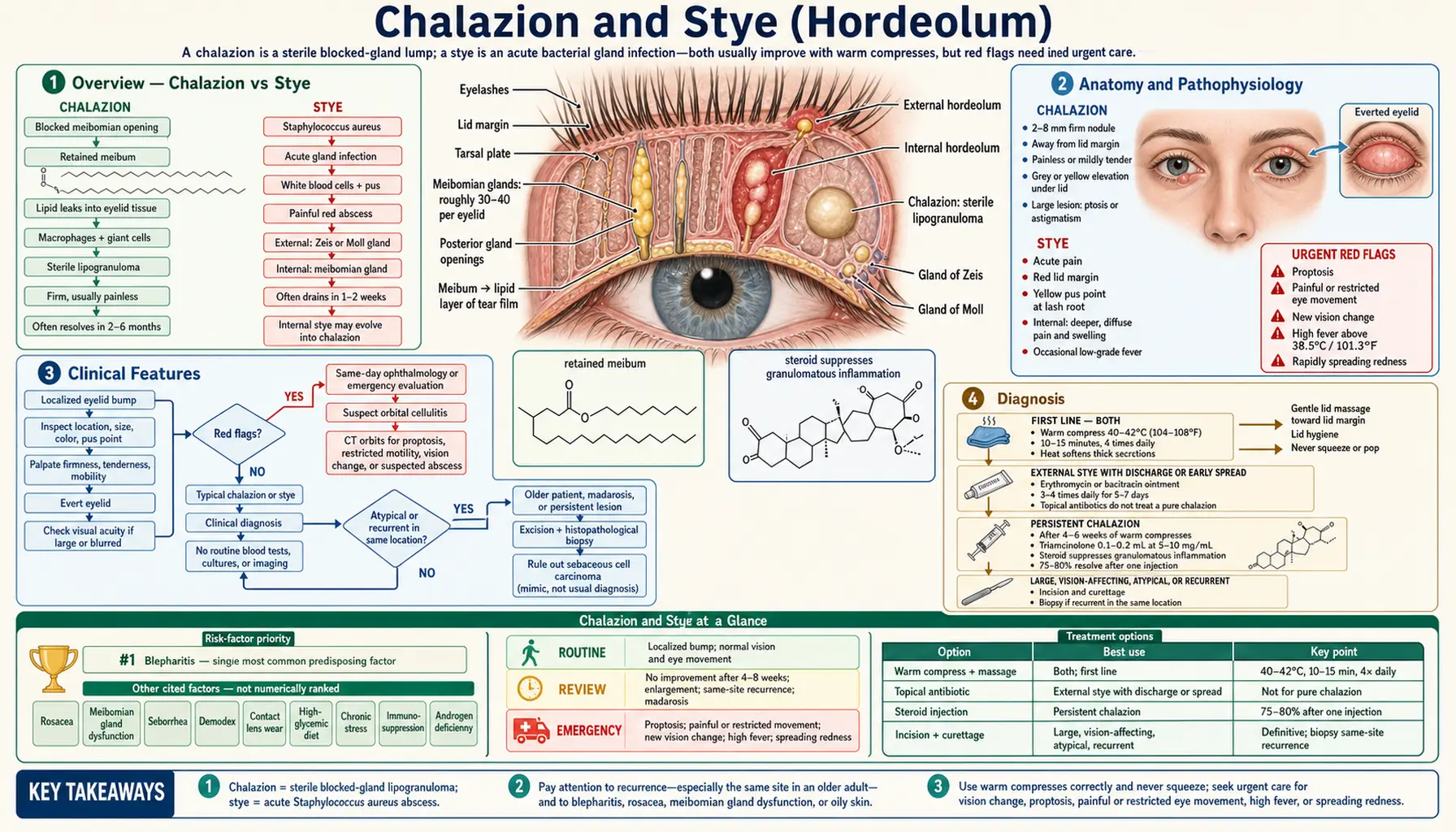
A chalazion is a small, firm lump that develops on the eyelid when one of the oil-producing glands inside becomes blocked and inflamed. A stye — medically called a hordeolum — is an acute bacterial infection of a different set of eyelid glands, causing a painful, red swelling, often with a visible pus point near the base of an eyelash. Both conditions are extremely common, affecting people of all ages, and the vast majority resolve on their own or with simple home care such as warm compresses applied several times daily.
Together, chalazia and styes account for millions of doctor visits every year. Most people experience at least one in their lifetime, and some — particularly those with oily skin, rosacea, or blepharitis — may develop them repeatedly. Understanding the difference between the two, and knowing when home treatment is enough versus when you need professional care, can spare you unnecessary worry and help you heal faster.
Most styes and chalazia are not dangerous, but certain warning signs should prompt same-day or emergency evaluation: fever, any change in vision, the eyeball appearing to be pushed forward, the inability to move the eye normally, or redness spreading rapidly beyond the eyelid onto the cheek or bridge of the nose. These signs suggest the infection may have spread deeper into the eye socket — a serious condition called orbital cellulitis that requires immediate medical attention.
- Overview — Chalazion vs Stye
- Anatomy and Pathophysiology
- Clinical Features
- Diagnosis
- Conservative Treatment — Warm Compresses and Lid Hygiene
- Medical Treatment
- Surgical Treatment — Incision and Curettage
- Prevention and Management of Recurrence
- Key Research Papers
- Connections
Overview — Chalazion vs Stye
Chalazion and stye are two distinct eyelid conditions that are often confused with each other because they can look similar — both cause a bump or swelling on the eyelid. However, their causes, timelines, and treatments differ in important ways.
A chalazion (plural: chalazia; from the Greek word for "hailstone") is a sterile lipogranuloma of the meibomian gland, or less commonly of the glands of Zeis or Moll. It is not an infection. Instead, when a meibomian gland becomes obstructed, the oily secretion it normally releases into the tear film backs up inside the gland. Over days to weeks, this retained lipid material leaks into the surrounding eyelid tissue, triggering the immune system to form a granulomatous reaction — a walled-off collection of immune cells trying to contain and digest the lipid. The result is a painless or minimally tender, firm, rubbery nodule that sits within the eyelid tissue and moves when the overlying skin is gently pressed. Most chalazia slowly resolve on their own over two to six months, though larger ones may need treatment.
A large chalazion can cause complications beyond mere appearance: if it sits on the upper eyelid and is heavy enough, it can push the eyelid down and cause ptosis (drooping). If it presses on the cornea — the clear front surface of the eye — it can indent the cornea just enough to alter its curvature and produce astigmatism, which blurs vision. These complications generally resolve when the chalazion is treated. One important caution: a chalazion that keeps coming back in exactly the same location, especially in an older adult, should always be biopsied to rule out sebaceous cell carcinoma, a rare but serious eyelid malignancy that can masquerade as a persistent chalazion.
A hordeolum — the medical name for a stye — is an acute bacterial infection of an eyelid gland, almost always caused by Staphylococcus aureus. There are two types: an external hordeolum is an abscess of the glands of Zeis or Moll, which sit at the base of the eyelashes along the lid margin. It presents as a tiny, acutely painful pustule right at the lash line — often with a yellow point of pus visible at the center. It usually ruptures and drains on its own within one to two weeks. An internal hordeolum is an abscess of a meibomian gland — larger, deeper, and more painful than the external type, pointing toward the inner surface of the eyelid. After the acute bacterial phase resolves, an internal hordeolum may leave behind a residual blocked gland that then evolves into a chalazion — which is why the two conditions are so often discussed together.
Anatomy and Pathophysiology
To understand why chalazia and styes form, it helps to know the glandular architecture of the eyelid.
The eyelids contain three types of glands relevant to these conditions. The meibomian glands are the largest and most important: there are roughly 30 to 40 of them in each eyelid, running vertically through the tarsal plate (the firm connective-tissue scaffold that gives the eyelid its structure). They are modified sebaceous glands, meaning they produce an oily secretion called meibum. Their openings line the posterior lid margin, just behind the lash line. Meibum spreads across the surface of each blink to form the outermost, lipid layer of the tear film, which prevents the watery layer beneath it from evaporating too quickly. When meibomian gland openings become narrowed or plugged — a condition called meibomian gland dysfunction (MGD) — the glands cannot express their secretions normally. Over time, the backed-up meibum thickens, the gland enlarges, and the stage is set for a chalazion.
The glands of Zeis are small modified sebaceous glands that open into each eyelash follicle. When they become infected, the result is an external hordeolum. The glands of Moll are modified apocrine sweat glands also located at the lid margin, interdigitated between the lashes; infection here also produces an external hordeolum.
In chalazion pathophysiology, the sequence is: blocked meibomian gland opening → retained meibum → lipid leaks into the surrounding eyelid tissue (through rupture of the gland wall or gradual seepage) → macrophages and other immune cells recognize the lipid as foreign → a lipogranuloma forms. Under the microscope, a chalazion consists of lipid-laden macrophages (foam cells), lymphocytes, epithelioid histiocytes, and multinucleated giant cells surrounding a central lipid pool — the hallmark of a granulomatous reaction. There are no bacteria in a pure chalazion; it is entirely a sterile inflammatory process.
In hordeolum pathophysiology, bacteria — overwhelmingly Staphylococcus aureus, including in some cases methicillin-resistant strains (MRSA) — colonize the gland, replicate rapidly, and trigger a classic suppurative (pus-forming) abscess. White blood cells rush to the site, pus accumulates, and the lesion either points and drains spontaneously or, if internal, may wall off and evolve into the sterile granuloma of a chalazion once the bacteria are cleared.
The key risk factors for both conditions overlap considerably. Blepharitis — chronic inflammation of the eyelid margins — is the single most common predisposing factor: it alters the quality of meibum, promotes bacterial overgrowth along the lid margin, and physically plugs gland openings with debris and crusting. Rosacea accelerates meibomian gland dysfunction through its inflammatory effects on skin and glands. Seborrhea (oily skin) clogs gland openings with excess sebum. Demodex folliculorum — a microscopic mite that lives in eyelash follicles and is nearly universal in older adults — disrupts the gland architecture and promotes blepharitis. Contact lens wear, high glycemic-index diets, chronic stress, and immunosuppression (from medication or systemic disease) all increase recurrence risk. Androgen deficiency, which reduces meibum production and alters its composition, may also contribute, particularly in postmenopausal women and men on androgen-deprivation therapy.
Clinical Features
Recognizing the presentation of each condition guides treatment decisions and helps identify the rare cases that need urgent evaluation.
Chalazion presentation: The typical chalazion appears as a painless or mildly tender firm nodule within the body of the upper or lower eyelid. It is usually 2 to 8 millimeters in diameter. Crucially, it does not sit at the lid margin — it points away from it, toward the inner eyelid surface (the tarsal conjunctiva). When you gently pinch the overlying skin, the nodule moves with the deeper tissue, indicating it is attached to the tarsal plate rather than to the skin itself. The overlying skin is usually normal in color, though it may be slightly pink early on. Everting the eyelid (flipping it inside-out to expose its inner surface) reveals a grey or yellow elevation at the site of the blocked meibomian gland.
Early in its formation (the first one to two weeks), a chalazion may be acutely tender, warm, and associated with some eyelid redness as the granuloma is establishing. This acute phase can be easily confused with an internal hordeolum. After the acute phase, the lesion becomes a firm, non-tender nodule that persists without further change for weeks to months. Larger chalazia can cause significant cosmetic concern or, as described above, ptosis and induced astigmatism with blurred vision. These size-related effects generally resolve after treatment.
Hordeolum presentation: A stye almost always begins with acute pain. The external hordeolum presents as a tiny tender swelling at the base of one eyelash, often with a small yellow pus point visible at its center within a day or two. The surrounding lid margin is red. It is like a pimple at the lash root — and indeed behaves similarly, with most pointing and draining within seven to fourteen days. An internal hordeolum is larger, deeper, and more diffusely painful — the entire inner lid may feel tender to touch, and the eyelid may swell significantly. There may be mild periorbital (around-the-eye) swelling. A low-grade fever is occasionally present with larger internal hordeola. Most internal hordeola either drain through the conjunctival surface on their own or evolve into a chalazion as described above.
Red flags requiring urgent or emergency evaluation — the following signs should never be attributed to a simple stye or chalazion and require same-day ophthalmology evaluation or emergency room assessment:
- Proptosis — the eyeball appearing to protrude or push forward out of the socket
- Restricted or painful eye movement — difficulty or pain when trying to look in any direction
- Vision change — any blurring, double vision, or loss of vision that is new
- High fever (above 38.5°C / 101.3°F) combined with a red, swollen eyelid
- Rapidly spreading redness — erythema extending onto the cheek, forehead, or bridge of the nose beyond the eyelids
- Severe pain on eye movement
Any of these features suggests that what appeared to be a simple eyelid infection has spread behind the orbital septum into the eye socket itself — the dangerous condition of orbital cellulitis — which is a medical emergency requiring IV antibiotics and potentially surgery.
Diagnosis
In the vast majority of cases, a chalazion or stye is a clinical diagnosis — meaning a doctor can identify it by looking at and examining the eyelid. No blood tests, cultures, or imaging are needed for a typical presentation.
The examination includes inspection of the external eyelid (noting location, size, color, presence of a pus point), palpation (assessing firmness, tenderness, and whether the lesion is mobile), and eversion of the eyelid to inspect the inner surface. Visual acuity should be checked if the lesion is large or the patient reports any blurring.
The most important diagnostic task is not distinguishing chalazion from stye — it is ruling out conditions that look similar but carry very different implications. The differential diagnosis includes:
- Sebaceous cell carcinoma (SGC) — the most important and dangerous mimic of a chalazion. SGC is a malignancy of the sebaceous glands of the eyelid and accounts for approximately 1–5% of all eyelid malignancies. It classically masquerades as a recurrent chalazion or persistent blepharitis. Suspect SGC when: the "chalazion" is in an atypical location; the patient is elderly; there is associated loss of eyelashes (madarosis); the lesion recurs in exactly the same spot after surgical excision; or there is a yellowish, firm nodule with loss of the normal follicle details. Any atypical or recurrent chalazion in an older patient should be excised and sent for histopathological biopsy.
- Preseptal (periorbital) cellulitis — diffuse warmth, redness, and tenderness of the entire eyelid, usually following a stye, minor trauma, or skin break; the eye itself moves normally and there is no proptosis. Requires oral or IV antibiotics, unlike a simple stye. Critical to distinguish from orbital cellulitis (behind the septum), which requires emergency management.
- Pyogenic granuloma — a rapidly growing, soft, vascular red nodule that bleeds easily. Often appears after minor trauma or following a stye or chalazion. Treated by excision or laser.
- Basal cell carcinoma and squamous cell carcinoma — slow-growing, pearly or scaly nodules; more likely at the lower lid margin in sun-exposed patients; do not fluctuate in size like infected lesions.
- Molluscum contagiosum — small, dome-shaped, umbilicated (centrally dimpled) nodules; viral; common in children; may appear on the lid margin and cause a follicular conjunctivitis.
- Dermoid cyst — smooth, non-inflamed, slowly enlarging cystic swelling, typically at the lateral upper orbital rim in children; present from birth but may not be noticed until adolescence.
- Dacryocystitis — infection of the lacrimal sac at the medial corner of the eye; produces a tender swelling at the medial canthal angle (inner corner), not within the eyelid body. Associated with tearing and discharge from the punctum.
When to image: CT scanning of the orbits is indicated when orbital cellulitis is suspected (proptosis, restricted motility, vision change), when an abscess is suspected, or when a child fails to improve after 24 to 48 hours of appropriate IV antibiotics. CT is not indicated for a routine chalazion or stye.
Conservative Treatment — Warm Compresses and Lid Hygiene
Warm compresses are the cornerstone of treatment for both chalazia and styes, and represent the single most evidence-supported intervention available at home. They work through two mechanisms: heat softens the thickened, stagnant secretions inside the blocked gland, making them more fluid and easier to express; and gentle warmth increases local blood flow, which supports the immune response.
How to apply warm compresses correctly:
- Apply four times daily for at least 10 to 15 minutes each session — not just briefly touching a warm cloth to the eye. Duration matters. Short, perfunctory applications are ineffective.
- Target skin-surface temperature should be 40 to 42°C (104 to 108°F) — warm enough to be therapeutic but not hot enough to burn the delicate eyelid skin. A clean cloth soaked in warm water from the tap works well. Change the water as it cools to maintain temperature.
- Commercial warm compress masks designed for eyelid use — such as the Bruder Moist Heat Eye Compress or the MGDRx EyeBag — are heated briefly in a microwave and retain their temperature for the full 10 to 15 minutes, which is an advantage over a simple wet cloth. They have been shown in clinical studies to maintain therapeutic temperature significantly better than a washcloth.
- After each warm compress session, follow immediately with lid massage: using a clean finger, gently massage the eyelid with circular or sweeping motions directed toward the lid margin. This helps express the softened contents of the gland and can accelerate resolution. Do not press hard enough to cause pain.
Lid hygiene addresses the bacterial overgrowth and crusting along the lid margin that contribute to gland blockage. Cleansing options include:
- Hypochlorous acid lid spray (e.g., Avenova, Heyedrate) — a dilute solution of hypochlorous acid that kills bacteria and demodex without irritating the eye. Spray onto a cotton pad or directly onto closed lids and gently wipe. It is the most studied and most recommended modern option.
- Diluted baby shampoo — a classic option: dilute a small amount of mild, no-tears baby shampoo in warm water, apply to a cotton ball or pad, and gently scrub along the lid margins in a back-and-forth motion. Rinse well. Effective and inexpensive, though slightly more irritating than hypochlorous acid.
- Pre-moistened lid wipes (OCuSOFT, Systane Lid Wipes) — convenient for travel or patients who find the scrub technique difficult.
Expected timeline: An external stye typically ruptures and resolves within 7 to 14 days of diligent warm compresses. An internal hordeolum may take 2 to 4 weeks. A chalazion commonly takes 4 to 8 weeks for full resolution with conservative treatment — and some require 3 to 6 months. Continue warm compresses and lid hygiene for the entire duration, not just until the nodule shrinks slightly. Stopping too early leads to incomplete drainage and recurrence.
One thing you should never do: squeeze or try to pop a stye or chalazion. Squeezing introduces bacteria from the skin surface into the semi-closed space of an inflamed gland, which can convert a simple localized infection into preseptal cellulitis or, rarely, orbital cellulitis. Allow the process to proceed at its own pace with warmth and gentle massage.
Medical Treatment
When conservative measures are insufficient, or when the underlying cause needs to be addressed to prevent recurrence, several medical treatments are available.
Topical antibiotics are indicated for an external hordeolum that has associated discharge or that appears to be causing early preseptal spread. Erythromycin ophthalmic ointment or bacitracin ointment applied to the lid margin three to four times daily for five to seven days reduces bacterial load and limits spread. Topical antibiotics do not reach meibomian glands in effective concentrations — they cannot penetrate to where a chalazion or internal hordeolum lives — so they are not useful for pure chalazion or uncomplicated internal hordeolum.
Oral doxycycline is one of the most useful medical treatments for patients with recurrent chalazia, particularly those who also have rosacea, blepharitis, or MGD. Doxycycline at low anti-inflammatory doses (50 mg once daily or 20 mg twice daily — the sub-antimicrobial dose) taken for four to eight weeks reduces both the inflammatory response in the eyelid and, separately, alters meibum composition to make it less viscous and less likely to obstruct gland openings. It also has modest activity against staphylococci. Multiple studies have shown reduced recurrence rates with doxycycline in this population. Oral azithromycin (1 g single dose or 500 mg for three days) is an alternative used in some centers, with some evidence of benefit for blepharitis-associated MGD, though evidence is less robust than for doxycycline.
Demodex-targeted treatment is appropriate when examination reveals heavy demodex mite infestation (cylindrical dandruff at lash bases, collarettes). Options include:
- Ivermectin 1% cream applied to the lid margin nightly for several weeks, killing mites without eye irritation
- Oral ivermectin (200 mcg/kg single dose, repeated in two weeks) for severe or treatment-resistant cases
- Tea tree oil (TTO) 10% lid scrubs for maintenance after initial eradication — kills mites but must be kept off the cornea
- In-office thermal pulsation treatments (LipiFlow) for severe MGD with demodex component
Intralesional triamcinolone acetonide injection is a highly effective office-based treatment for persistent chalazia that have not responded to 4 to 6 weeks of warm compresses. The procedure involves injecting a small volume (0.1 to 0.2 mL) of triamcinolone acetonide (5 to 10 mg/mL concentration) directly into the body of the chalazion using a fine needle. The steroid suppresses the granulomatous inflammation, causing the lesion to shrink and resorb over two to four weeks. Published series report resolution rates of 75 to 80% with a single injection — comparable to surgical incision and curettage, but without a procedure. It is particularly preferred when the chalazion is in a cosmetically sensitive location where even a small scar from surgery would be objectionable (such as near the lacrimal punctum, or at the center of the lower eyelid). One important caution: in patients with darker skin tones, steroid injection carries a risk of producing a visible patch of skin hypopigmentation at the injection site that may persist for months — in such patients, surgical excision is preferred. Other risks include skin atrophy and, if the needle is misplaced anteriorly, inadvertent punctal occlusion.
Surgical Treatment — Incision and Curettage
Surgical incision and curettage (I&C) is the definitive treatment for chalazia that fail conservative management and steroid injection, and is the preferred initial treatment for large, vision-affecting, or cosmetically unacceptable lesions. It is a brief office procedure performed under local anesthesia with a very high success rate.
Indications for surgery:
- Chalazion larger than 3 to 4 mm that has not resolved after 4 to 8 weeks of diligent warm compresses
- Chalazion causing ptosis or induced astigmatism with blurred vision
- Cosmetically unacceptable lesion that the patient wants removed
- Recurrent chalazion in the same location (biopsy mandatory at time of surgery)
- Any atypical lesion where sebaceous cell carcinoma must be excluded
Internal (transconjunctival) approach — the most commonly used technique for chalazia. After local anesthetic injection into the eyelid, a chalazion clamp is applied to stabilize the lid and reduce bleeding. The eyelid is then everted to expose its inner (conjunctival) surface. A vertical incision is made through the conjunctiva directly into the body of the chalazion — vertical so that it runs parallel to the meibomian glands rather than across them. The granulomatous contents are curetted (scooped out) and sent for biopsy if there are any atypical features. The incision is typically not sutured — it heals spontaneously. An antibiotic ointment is applied post-procedure. The key advantage of the internal approach is that the incision is on the inner surface of the lid, leaving no visible scar on the skin.
External (transcutaneous) approach — used when the chalazion points anteriorly toward the skin surface, when it is firmly adherent to the skin, or when the surgeon prefers this approach for lower-lid lesions at certain locations. A small horizontal incision is made through the skin directly over the chalazion. The contents are evacuated and the incision closed with fine absorbable sutures. A small scar may be visible on the skin for several weeks but generally heals to an imperceptible line.
What to expect after I&C: The eyelid is typically bruised and swollen for 3 to 7 days post-procedure. An eye patch is sometimes worn for a few hours. Antibiotic ointment to the lid margin twice daily for 5 to 7 days reduces the small risk of secondary infection. Warm compresses can be resumed 48 hours post-operatively to help with residual swelling. Full healing typically takes 1 to 2 weeks.
Recurrence after I&C occurs in 10 to 20% of cases and almost always indicates that the underlying cause — most commonly MGD or blepharitis — has not been adequately addressed. When a chalazion recurs in the same anatomical location after surgical excision, biopsy of the excised tissue is mandatory, as this is precisely the pattern associated with sebaceous cell carcinoma. In a landmark series by Kempster and colleagues, a notable proportion of "recurrent chalazia" excised for the second or third time were found on histopathology to be sebaceous cell carcinomas that had been missed on the first excision. The message is clear: a chalazion that keeps coming back in the same spot is a chalazion that must be biopsied.
Prevention and Management of Recurrence
For many patients, chalazia and styes are not one-time events — they recur, sometimes repeatedly, until the underlying predisposing factors are identified and controlled. Prevention requires treating the root cause, not just the bump.
Treat underlying blepharitis — since blepharitis is the single most common predisposing factor, its management is central to preventing recurrence. This is a chronic condition that requires permanent daily maintenance, not a short course of treatment:
- Daily warm compress + lid massage (10 minutes every morning, indefinitely)
- Daily lid hygiene with hypochlorous acid spray or diluted baby shampoo
- Oral doxycycline 50 mg daily for 3 to 6 months in moderate-to-severe cases, then reassess
Treat rosacea — patients with rosacea have a dramatically elevated risk of chalazion formation because of its systemic effects on meibomian gland function. Management is ideally coordinated with a dermatologist: oral doxycycline, topical metronidazole or azelaic acid, avoidance of rosacea triggers (alcohol, spicy food, UV exposure), and sun protection all reduce the frequency of eyelid flares.
Eradicate demodex if a heavy mite burden is contributing. Treat all household contacts if a child has molluscum contagiosum (another source of lid margin inflammation). The ivermectin or tea tree oil regimen described under Medical Treatment is appropriate here.
Dietary measures with emerging evidence:
- Omega-3 fatty acid supplementation — fish oil at 2 g of EPA+DHA daily has been shown in multiple randomized controlled trials to improve meibomian gland secretion quality, reduce tear evaporation, and decrease the frequency of chalazion recurrence in patients with MGD. The effect takes 3 to 6 months to become apparent. This is one of the most practically useful interventions for recurrence-prone patients.
- Reduce refined carbohydrates and high-glycemic foods — some evidence suggests that high-glycemic dietary patterns may worsen sebaceous gland dysfunction, paralleling the diet-acne relationship; mechanistic data are not yet definitive, but reducing refined carbs is generally sound advice with no downside.
- Adequate hydration — dehydration concentrates meibum and worsens tear film quality.
Contact lens hygiene — contact lens wear increases eyelid margin inflammation and bacterial colonization. Patients who develop recurrent styes or chalazia while wearing contact lenses should switch to daily disposable lenses (which eliminate the microbial biofilm that accumulates on reusable lenses), never sleep in lenses, replace their contact lens case monthly, and consider temporary discontinuation of lens wear during acute flares.
When to return to your doctor:
- No improvement after 4 to 8 weeks of consistent warm compresses
- Any enlargement of the lesion, especially rapid growth
- Vision change or blurring that persists beyond a few days
- Fever or redness spreading beyond the eyelid
- Third or subsequent recurrence in the same eyelid location — biopsy is needed
- Eyelash loss (madarosis) near the lesion — a red flag for malignancy
Key Research Papers
The following peer-reviewed publications form the evidence base for the diagnosis and management of chalazion and hordeolum. All citations link to PubMed.
- Ben Simon GJ et al. "Intralesional triamcinolone acetonide injection versus incision and curettage for primary chalazia: a prospective, randomized study." Am J Ophthalmol. 2011;151(4):714–718 — Search PubMed — Demonstrated equivalent efficacy of steroid injection versus surgical I&C, supporting injection as a first-line alternative to surgery for primary chalazia.
- Delaney YM et al. "Recurrent chalazion treated with heat and lidocaine/adrenaline injection." Eye (Lond). 2002;16(6):795–796 — Search PubMed — Evaluation of thermal approaches and local anesthesia in management of recurrent lid lesions.
- Korn BS et al. "Sebaceous cell carcinoma of the eyelid." Ophthalmology. 2008;115(11):2032–2037 — Search PubMed — Describes the clinical masquerade patterns of SGC including its presentation as recurrent chalazion and the importance of biopsy.
- Lederman C, Miller M. "Hordeola and chalazia." Pediatr Rev. 1999;20(8):283–284 — Search PubMed — Practical review of eyelid infections in the pediatric population including diagnostic criteria and treatment thresholds.
- Dhaliwal U et al. "Eyelid hygiene and lid margin disease." Indian J Ophthalmol. 2004;52(4):349–352 — Search PubMed — Prospective study correlating blepharitis severity with chalazion recurrence rates and the role of lid hygiene in prevention.
- Hwang JB et al. "Factors associated with recurrence of chalazion." Korean J Ophthalmol. 2006;20(4):224–227 — Search PubMed — Identified blepharitis, rosacea, seborrhea, and prior chalazion history as independent predictors of recurrence after I&C.
- Kashkouli MB et al. "Oral azithromycin versus doxycycline in meibomian gland dysfunction and posterior blepharitis." Cornea. 2011;30(10):1145–1150 — Search PubMed — Head-to-head randomized trial showing similar efficacy of azithromycin and doxycycline for MGD-related blepharitis that predisposes to chalazia.
- Kempster RC et al. "Sebaceous carcinoma: histopathology in 63 cases." Eye (Lond). 1994;8(Pt 6):694–698 — Search PubMed — Classic clinicopathological series establishing that SGC frequently mimics recurrent chalazion, emphasizing the necessity of histopathological examination of excised tissue.
- Falkoff A et al. "Warm compresses for chalazion and hordeolum: temperature achieved and duration of efficacy." Ophthal Plast Reconstr Surg. 2019;35(3):258–261 — Search PubMed — Measured eyelid surface temperatures achieved with different warm compress methods, demonstrating that commercial microwaveable masks maintain therapeutic temperatures far longer than plain wet washcloths.
- Zhao Y et al. "Omega-3 essential fatty acids supplementation in the treatment of dry eye: a systematic review and meta-analysis." Int J Ophthalmol. 2019;12(5):820–826 — Search PubMed — Meta-analysis supporting omega-3 supplementation's role in improving meibomian gland function, tear film stability, and lipid secretion quality relevant to chalazion prevention in MGD patients.
- Hau SC et al. "Incision and curettage versus steroid injection for the management of chalazion." Graefes Arch Clin Exp Ophthalmol. 2012;250(7):989–995 — Search PubMed — Comparison of outcomes and recurrence rates between surgical excision and intralesional steroid injection across a large retrospective cohort.
- Spierer O, Barequet IS. "Stye and chalazion: the approach to their management and prevention." Harefuah. 2012;151(11):644–648 — Search PubMed — Comprehensive clinical review integrating current evidence on the pathophysiology, treatment ladder, and recurrence prevention strategies for both conditions.
Connections
- Ophthalmology
- Blepharitis
- Conjunctivitis
- Dry Eye Disease
- Orbital Cellulitis
- Keratoconus
- Thyroid Eye Disease