Duchenne Muscular Dystrophy (DMD)
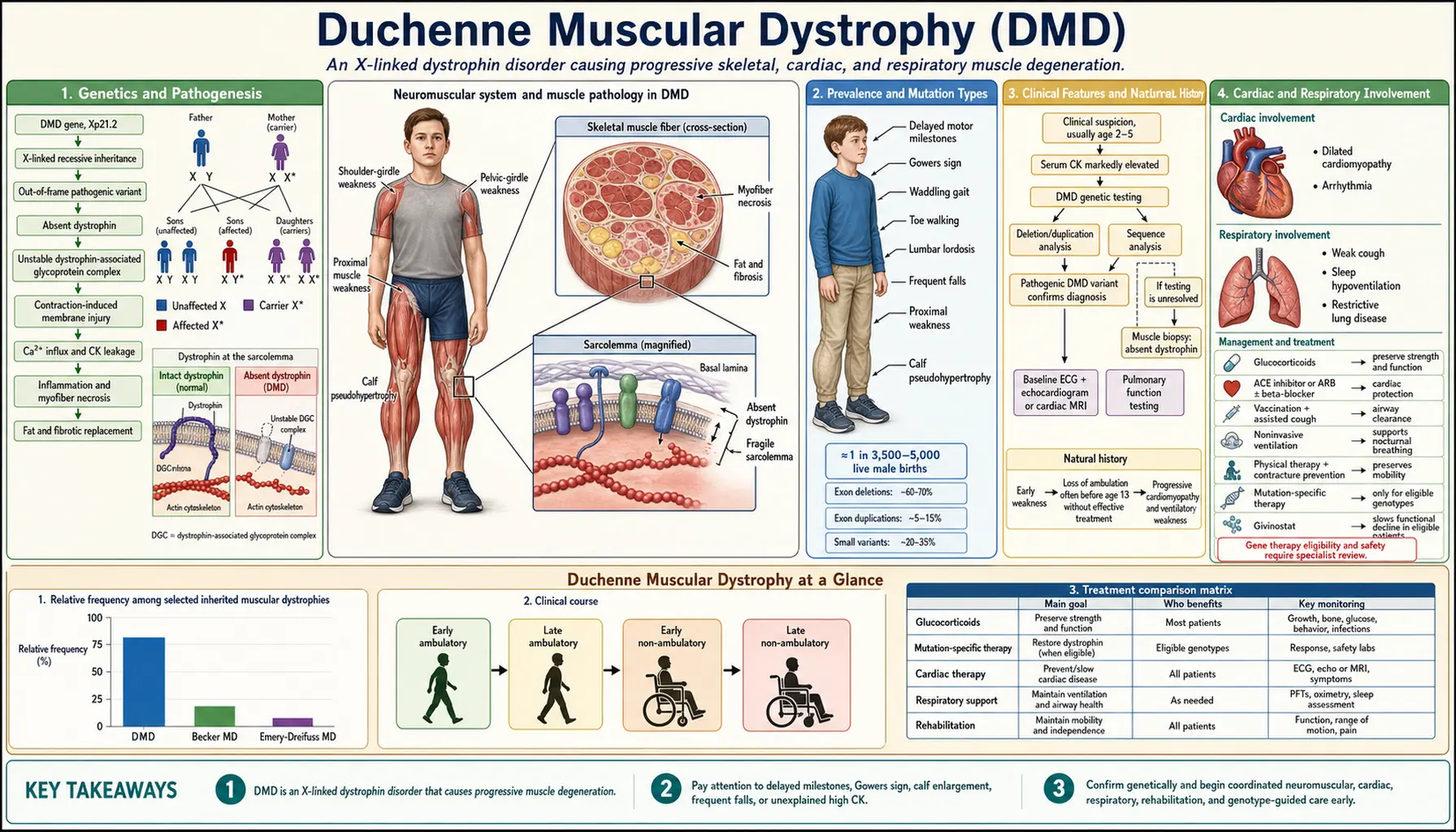
Duchenne muscular dystrophy (DMD) is an X-linked recessive muscle disease caused by mutations in the DMD gene that abolish production of the muscle form of dystrophin. Muscles without dystrophin are more easily damaged, which leads to progressive loss of muscle tissue and function and, later, to cardiomyopathy. The 2021 Nature Reviews Disease Primers review gives a birth incidence of 1 in 5,000 to 1 in 6,000 live male births for dystrophinopathies, and reports that several therapies aiming to restore dystrophin or act on the damage that follows have received regulatory approval, with many others in development.
Interactive Visualization Muscle Contraction — release the calcium Expose the actin binding sites and watch myosin heads ratchet through the cross-bridge cycle to shorten the sarcomere. Launch →Table of Contents
1. Genetics and Pathogenesis
The DMD gene on the X chromosome spans about 2.4 megabases and contains 79 exons; its full-length muscle transcript encodes the 427 kDa dystrophin protein. De novo mutations are common: a 2021 review in Nature Reviews Disease Primers reports that Duchenne and Becker muscular dystrophy are caused by de novo germline mutations in one-third of patients, and that mothers who are not somatic carriers can still have a second affected child because of germline mosaicism.
The reading-frame rule, proposed by Monaco and colleagues in 1988, explains the difference between Duchenne and the milder Becker muscular dystrophy. In Duchenne, mutations shift the reading frame, leading to prematurely truncated, dysfunctional dystrophin. In Becker, in-frame mutations allow an internally shortened but largely functional dystrophin to be made. In a 2006 overview of more than 4,700 mutations in the Leiden DMD mutation database, 91% were in agreement with this rule. The rule is also the rationale behind exon-skipping drugs.
In muscle, dystrophin links the actin cytoskeleton inside the fibre to the extracellular matrix through the dystrophin-glycoprotein complex, which includes the dystroglycan and sarcoglycan subcomplexes, sarcospan, syntrophin, dystrobrevin and neuronal nitric oxide synthase. Without dystrophin the muscle membrane is more easily damaged. The 2021 review describes a raised resting calcium concentration in dystrophic muscle, mitochondrial dysfunction, and calcium-triggered breakdown pathways such as calpain proteases. In young patients (2–8 years of age) the inflammatory infiltrates consist mainly of macrophages and T cells. Over time, failed regeneration leads to muscle wasting, fibrosis and fat replacement.
Shorter dystrophin isoforms are made from internal promoters: Dp140 is expressed in the central nervous system and kidney, and Dp71 is expressed throughout the body, at higher levels in neurons. The same review reports that one-third of patients with DMD have cognitive impairment, that rates of attention deficit/hyperactivity disorder, autism spectrum disorder, anxiety and obsessive-compulsive disorder are higher than in the general population, and that some studies link cognitive impairment to mutations that affect shorter isoforms such as Dp140. How the brain isoforms work is still poorly understood.
2. Prevalence and Mutation Types
The 2021 review gives a birth incidence of dystrophinopathies (Duchenne and Becker together) of 1 in 5,000 to 1 in 6,000 live male births, and a DMD prevalence of under 10 cases per 100,000 males that seems to be the same between regions.
The same review reports that about 60–70% of DMD mutations are deletions, 5–15% are duplications and about 20% are point mutations, small deletions or insertions. Deletions and duplications cluster in two hotspots, exons 45–55 and exons 3–9, which carry the mutation in about 47% and 7% of patients respectively. The TREAT-NMD global database analysis of 7,149 DMD mutations (Bladen 2015) found 80% large mutations (86% of them deletions, 14% duplications) and 20% small mutations; nonsense mutations made up half of the small mutations and only 30 were missense mutations. That analysis estimated that about 10% of all mutations could be candidates for stop-codon read-through therapy and 55% for exon skipping. The mutation class matters because each approved molecular drug fits only certain mutations.
Female carriers are usually without symptoms, but the 2021 review reports that about 2.5–19% have skeletal muscle symptoms and 7.3–16.7% develop dilated cardiomyopathy. The 2018 care considerations cite a 2016 study in which 47% of carriers had at least one abnormal finding on cardiac MRI, and they describe a baseline cardiac assessment in early adulthood (electrocardiogram and imaging, preferably cardiac MRI) followed by assessment every 3–5 years.
The 2018 care considerations describe deletion/duplication testing, by multiplex ligation-dependent probe amplification (MLPA) or comparative genomic hybridisation array, as usually the first confirmatory test, followed by gene sequencing if that is negative. Newborn screening by measuring creatine kinase in dried blood spots was first shown to be feasible in the mid-1970s. As of 2018, most newborn screening studies had been discontinued, and DMD was not on the US Recommended Uniform Screening Panel.
3. Clinical Features and Natural History
The 2021 review reports that the earliest symptoms are difficulty climbing stairs, a waddling gait and frequent falls, which appear around 2–3 years of age. It describes DMD as suspected in young boys (aged 2–4 years) with delayed motor milestones, muscle weakness, enlarged (hypertrophic) calves and the Gowers sign. The 2018 care considerations add clumsiness and toe walking to the signs that usually start the diagnostic process.
Gowers sign: when getting up from the floor, the child uses the hands to "walk" up the legs to make up for weakness in the upper leg and hip muscles.
Serum creatine kinase is increased. The 2018 care considerations note that a raised alanine aminotransferase, aspartate aminotransferase or lactate dehydrogenase can sometimes lead to a mistaken focus on the liver and delay the diagnosis of DMD.
The 2021 review reports that most patients become wheelchair-dependent at around 10–12 years of age and need assisted ventilation at around 20 years. The 2018 care considerations cite natural-history data in which the mean age at loss of walking was 10.0 years with less than 1 year of corticosteroid treatment, 11.2 years with daily prednisone and 13.9 years with daily deflazacort. Contractures, scoliosis and reduced bone mineralisation are features of the disease; corticosteroids further affect bone and can predispose to vertebral compression fractures, and corticosteroid treatment has reduced the need for scoliosis surgery in adolescents.
4. Cardiac and Respiratory Involvement
The 2021 review describes cardiomyopathy as a late manifestation of DMD and reports that, with optimal care, most patients die between 20 and 40 years of age from cardiac and/or respiratory failure. A 2015 review (Mavrogeni) reports that death from heart disease is usually due to ventricular dysfunction, heart block or dangerous arrhythmias, and that cardiac MRI has documented a pattern of epicardial fibrosis in patients and in carriers, even when muscle disease is not obvious. In an ECG study of 115 boys (Thrush 2009), the most common findings were a short PR interval and right ventricular hypertrophy; the ECG changes were similar whether or not dilated cardiomyopathy was present, and the "characteristic" changes described in earlier reports were seen in only a minority.
The 2018 care considerations describe cardiac MRI as the imaging method of choice, with echocardiography used until about age 6–7, when cardiac MRI can usually be done without anaesthesia, and an annual cardiac assessment (electrocardiogram and imaging) through childhood and beyond.
On treatment, the 2018 care considerations report that ACE inhibitors or angiotensin receptor blockers have traditionally been the first-line drugs, that opinion differs on their use in asymptomatic boys under 10 with normal imaging, and that a 2014 NHLBI working group recommended an ACE inhibitor or ARB by age 10. They describe beta-blockers as typically started once ventricular dysfunction is seen. In a randomised, double-blind trial of 42 boys aged 7 or older with myocardial damage on cardiac MRI but preserved ejection fraction (Raman 2015), adding eplerenone to an ACE inhibitor or ARB slowed the decline in left ventricular circumferential strain over 12 months; the care considerations note that further studies are needed to establish its effectiveness. A left ventricular assist device is described as a possible long-term therapy for people not considered for a transplant, and heart transplantation as a theoretical option weighed case by case because donors are scarce.
The 2018 care considerations describe spirometry from about age 5–6. Forced vital capacity (FVC) rises with growth until walking is lost, then plateaus and declines, and the decline can occur without breathlessness. They list manual and mechanically assisted coughing when FVC is below 50% predicted, peak cough flow is below 270 L/min or maximum expiratory pressure is below 60 cm H2O, and night-time assisted ventilation when FVC is below 50% predicted or maximum inspiratory pressure is below 60 cm H2O. Invasive ventilation via tracheostomy is among the options they cover.
Survival has improved. The 2021 review cites a French study in which median life expectancy was 25.77 years for patients born before 1970 and 40.95 years for those born after 1970. In a retrospective series of 100 patients born 1970–1990 (Eagle 2007), median survival was 22.2 years with night-time ventilation alone and 30 years with both spinal surgery and ventilation.
5. Diagnosis
The 2021 review notes that DMD cannot be diagnosed from a raised creatine kinase alone; genetic confirmation is needed. It describes a step-wise approach: MLPA or array comparative genomic hybridisation first, and, if these do not find a mutation, sequencing of each of the 79 exons and the neighbouring intronic regions. The 2018 care considerations add that finding the boundaries of a deletion or duplication can show whether the mutation is predicted to keep or disrupt the reading frame. The exact mutation also decides whether a person fits one of the mutation-specific drugs and allows carrier testing in female relatives.
If genetic testing does not confirm a clinical diagnosis, the 2018 care considerations describe testing a muscle biopsy for dystrophin protein by immunohistochemistry or western blot. In a 1988 study of 103 patients (Hoffman), dystrophin was absent or very low (less than 3% of normal) in 35 of 38 patients with the severe Duchenne phenotype, and of abnormal size in 12 of 18 with the milder Becker phenotype.
The main related diagnosis is Becker muscular dystrophy, caused by mutations in the same gene, which the 2021 review describes as milder, with a later onset and slower progression.
6. Corticosteroid Therapy
The 2018 care considerations describe physiotherapy and glucocorticoids as the mainstays of DMD treatment, with long-term benefits that include losing the ability to walk at a later age, preserved upper limb and respiratory function, and avoidance of scoliosis surgery. A 2016 Cochrane review (12 studies, 667 participants) found moderate-quality evidence that corticosteroids improve muscle strength and function in the short term (12 months) and strength up to two years, but no evidence other than from non-randomised studies on prolongation of walking. The FDA approved deflazacort for DMD in February 2017.
In a phase III trial of 196 boys aged 5–15 years (Griggs 2016; the study was completed in 1995), deflazacort 0.9 or 1.2 mg/kg/day and prednisone 0.75 mg/kg/day all improved muscle strength compared with placebo at 12 weeks (the primary endpoint), and prednisone caused more weight gain than either deflazacort dose at 12 and 52 weeks. The 2016 Cochrane review rated the evidence for less weight gain with deflazacort than prednisone as very low quality, and found the data insufficient to assess fractures or cataracts. The 2021 review notes that earlier evidence linked prednisone more often with weight gain and deflazacort more often with cataracts.
The FOR-DMD trial (Guglieri 2022) randomised 196 steroid-naive boys aged 4–7 years to daily prednisone 0.75 mg/kg, daily deflazacort 0.90 mg/kg, or intermittent prednisone (10 days on, 10 days off), and followed them for 3 years. Both daily regimens did better than the intermittent regimen on the combined primary outcome (mainly through rise-from-floor speed), and the two daily regimens did not differ significantly. Abnormal behaviour was the most common adverse event in all three groups (34–38%). The 2021 review reports an average delay in loss of walking of 2 years with daily steroids and 1 year with an on/off regimen.
Vamorolone, which the trial authors describe as a structurally unique dissociative steroidal anti-inflammatory drug (its FDA label classes it as a corticosteroid), was tested against placebo and prednisone in 121 steroid-naive boys aged 4 to under 7 (Guglieri 2022, 24 weeks). Vamorolone 6 mg/kg/day met the primary endpoint (time-to-stand speed versus placebo). Height percentile fell with prednisone but not vamorolone, and bone turnover markers fell with prednisone only; adrenal insufficiency increased in all three treatment groups. The FDA approved vamorolone in October 2023; its current label covers patients 2 years of age and older.
Adverse effects reported more often with corticosteroids than placebo in the Cochrane review include excessive weight gain, behavioural changes, cushingoid appearance and excess hair growth. The 2018 care considerations cover growth delay, delayed puberty, bone health and adrenal insufficiency. They describe yearly checks of dietary calcium and blood 25-hydroxyvitamin D, with supplementation if intake is low or the level falls below 30 ng/mL, and keeping a stress dose of steroids at home for signs of adrenal insufficiency during illness, surgery or other physical stress. The FDA labels for deflazacort and vamorolone warn that withdrawal symptoms can follow abrupt discontinuation, and list cataracts and glaucoma among the eye effects. Decisions about these medicines belong with the treating clinicians.
7. Gene-Based and Molecular Therapies
Several drugs that try to restore dystrophin or act on the damage that follows have received regulatory approval, and many others are in development. All the approvals below are from FDA documents (approval records and current labels).
Exon skipping with antisense oligonucleotides (ASOs). ASOs are short modified RNA strands that bind a target exon during pre-mRNA splicing so that it is left out of the mRNA. Skipping the right exon next to a deletion can restore the reading frame and allow a shorter, Becker-like dystrophin. The 2021 review lists the exons that apply to the largest groups of patients as exon 51 (14%), exon 45 (8%), exon 53 (8%) and exon 44 (6%). The FDA has approved four ASOs, each for patients whose mutation is amenable to skipping one exon: eteplirsen (exon 51, September 2016), golodirsen (exon 53, December 2019), viltolarsen (exon 53, August 2020) and casimersen (exon 45, February 2021). Each label states that the approval is an accelerated approval based on an increase in dystrophin in skeletal muscle, and that continued approval may depend on confirmation of clinical benefit in confirmatory trials. In the eteplirsen extension study (Mendell 2016), 12 treated boys walked 151 m further on the 6-minute walk test at 36 months than 13 matched historical controls; the comparison was with historical controls, not a randomised placebo group.
Nonsense read-through. Ataluren was designed to let ribosomes read through premature stop codons. The 2021 review reports that two randomised placebo-controlled trials missed their 48-week primary endpoint on the 6-minute walk test, that the drug received conditional approval from the European Medicines Agency, and that it was not approved by the FDA. The European Medicines Agency reports that in March 2025 the European Commission decided not to renew the conditional authorisation, because the medicine's effectiveness had not been confirmed.
Micro-dystrophin gene therapy. Delandistrogene moxeparvovec delivers a shortened micro-dystrophin gene in an adeno-associated virus (rh74) vector, given once by infusion. An open-label phase 1/2a study of intravenous rAAVrh74.MHCK7.micro-dystrophin in 4 boys (Mendell 2020), with safety as the primary outcome, reported micro-dystrophin expression in muscle biopsies at 12 weeks. The FDA granted accelerated approval in June 2023 for ambulatory boys aged 4–5, on the basis of micro-dystrophin expression. In the phase 3 EMBARK trial (Mendell 2025; ambulatory boys aged 4 to under 8, 63 treated and 62 given placebo), the primary endpoint, change in North Star Ambulatory Assessment score at 52 weeks, was not met (difference 0.65 points; P = 0.2441); some secondary endpoints numerically favoured treatment, but the authors state that no statistical significance can be claimed. In June 2024 the FDA nonetheless granted traditional approval for ambulatory patients 4 years and older, citing the secondary and exploratory endpoints, and accelerated approval for non-ambulatory patients. The current FDA label (2026) is limited to ambulatory patients 4 years and older and carries a boxed warning that acute serious liver injury and acute liver failure, including fatal cases, have occurred.
Givinostat. Givinostat is a histone deacetylase inhibitor. In the EPIDYS trial (Mercuri 2024; 179 ambulant boys aged 6 or older on corticosteroids, 72 weeks), four-stair-climb times worsened in both groups, but the decline was significantly smaller with givinostat than with placebo in the primary analysis group; diarrhoea (36% vs 18%) and vomiting (29% vs 13%) were the most common adverse events. The FDA approved givinostat in March 2024 for patients 6 years and older, and lists diarrhoea, abdominal pain, decreased platelets, nausea/vomiting, raised triglycerides and fever among its common side effects.
Earlier-stage approaches. The 2021 review reports that all genome-editing work for DMD was still preclinical. Utrophin, a protein closely related to dystrophin, can recruit most of the same partner proteins; ezutromid was developed to increase it, but showed very limited bioavailability and no therapeutic effect in a placebo-controlled trial, and its development was stopped. Cell transplantation approaches (satellite cells/myoblasts and other stem cell types) are also under study.
Part 3 of the 2018 care considerations attributes the improvements in function, quality of life and longevity of people with DMD to a multidisciplinary approach across many health-care specialties; the newer drugs are used alongside that care.
Key Research Papers
- Mendell JR et al. "Longitudinal effect of eteplirsen versus historical control on ambulation in Duchenne muscular dystrophy." Ann Neurol. 2016;79(2):257–271. — PubMed PMID: 26573217
- Griggs RC et al. "Efficacy and safety of deflazacort vs prednisone and placebo for Duchenne muscular dystrophy." Neurology. 2016;87(20):2123–2131. — PubMed PMID: 27566742
- Birnkrant DJ et al. "Diagnosis and management of Duchenne muscular dystrophy, part 1: diagnosis, and neuromuscular, rehabilitation, endocrine, and gastrointestinal and nutritional management." Lancet Neurol. 2018;17(3):251–267. — PubMed PMID: 29395989
- Birnkrant DJ et al. "Diagnosis and management of Duchenne muscular dystrophy, part 2: respiratory, cardiac, bone health, and orthopaedic management." Lancet Neurol. 2018;17(4):347–361. — PubMed PMID: 29395990
- Duan D et al. "Duchenne muscular dystrophy." Nat Rev Dis Primers. 2021;7(1):13. — PubMed PMID: 33602943
- Mendell JR et al. "Assessment of Systemic Delivery of rAAVrh74.MHCK7.micro-dystrophin in Children with Duchenne Muscular Dystrophy: A Nonrandomized Controlled Trial." JAMA Neurol. 2020;77(9):1122–1131. — PubMed PMID: 32539076
- Eagle M et al. "Managing Duchenne muscular dystrophy — the additive effect of spinal surgery and home nocturnal ventilation in improving survival." Neuromuscul Disord. 2007;17(6):470–475. — PubMed PMID: 17490881
- Thrush PT et al. "Re-examination of the electrocardiogram in boys with Duchenne muscular dystrophy and correlation with its dilated cardiomyopathy." Am J Cardiol. 2009;103(2):262–265. — PubMed PMID: 19121448 (Citation corrected: this entry previously gave a nonexistent title in Can J Cardiol.)
- Mavrogeni S et al. "Cardiac involvement in Duchenne and Becker muscular dystrophy." World J Cardiol. 2015;7(7):410–414. — PubMed PMID: 26225202 (Citation corrected: the paper previously listed here, in JACC Cardiovasc Imaging 2015;8(12):1444–1456, could not be found; that volume and page range hold an unrelated paper.)
- Bladen CL et al. "The TREAT-NMD DMD Global Database: analysis of more than 7,000 Duchenne muscular dystrophy mutations." Hum Mutat. 2015;36(4):395–402. — PubMed PMID: 25604253
- Matthews E et al. "Corticosteroids for the treatment of Duchenne muscular dystrophy." Cochrane Database Syst Rev. 2016;(5):CD003725. — PubMed PMID: 27149418
- Hoffman EP et al. "Characterization of dystrophin in muscle-biopsy specimens from patients with Duchenne's or Becker's muscular dystrophy." N Engl J Med. 1988;318(21):1363–1368. — PubMed PMID: 3285207
- Birnkrant DJ et al. "Diagnosis and management of Duchenne muscular dystrophy, part 3: primary care, emergency management, psychosocial care, and transitions of care across the lifespan." Lancet Neurol. 2018;17(5):445–455. — PubMed PMID: 29398641
- Guglieri M et al. "Effect of Different Corticosteroid Dosing Regimens on Clinical Outcomes in Boys With Duchenne Muscular Dystrophy: A Randomized Clinical Trial." JAMA. 2022;327(15):1456–1468. — PubMed PMID: 35381069
- Guglieri M et al. "Efficacy and Safety of Vamorolone vs Placebo and Prednisone Among Boys With Duchenne Muscular Dystrophy: A Randomized Clinical Trial." JAMA Neurol. 2022;79(10):1005–1014. — PubMed PMID: 36036925
- Mendell JR et al. "AAV gene therapy for Duchenne muscular dystrophy: the EMBARK phase 3 randomized trial." Nat Med. 2025;31(1):332–341. — PubMed PMID: 39385046
- Mercuri E et al. "Safety and efficacy of givinostat in boys with Duchenne muscular dystrophy (EPIDYS): a multicentre, randomised, double-blind, placebo-controlled, phase 3 trial." Lancet Neurol. 2024;23(4):393–403. — PubMed PMID: 38508835
- Raman SV et al. "Eplerenone for early cardiomyopathy in Duchenne muscular dystrophy: a randomised, double-blind, placebo-controlled trial." Lancet Neurol. 2015;14(2):153–161. — PubMed PMID: 25554404
- Aartsma-Rus A et al. "Entries in the Leiden Duchenne muscular dystrophy mutation database: an overview of mutation types and paradoxical cases that confirm the reading-frame rule." Muscle Nerve. 2006;34(2):135–144. — PubMed PMID: 16770791
Connections
- Neurology
- Muscle Contraction — interactive animation
- Becker Muscular Dystrophy
- Facioscapulohumeral Muscular Dystrophy (FSHD)
- Myotonic Dystrophy
- Spinal Muscular Atrophy
- ALS
- Myasthenia Gravis
- Charcot-Marie-Tooth Disease
- Lab Tests
- Roberts & Sharp — split genes and splicing — the mechanism behind exon-skipping drugs