Diet for Inflammatory Bowel Disease (IBD): Specific Carbohydrate, Mediterranean, CDED, and Enteral Nutrition
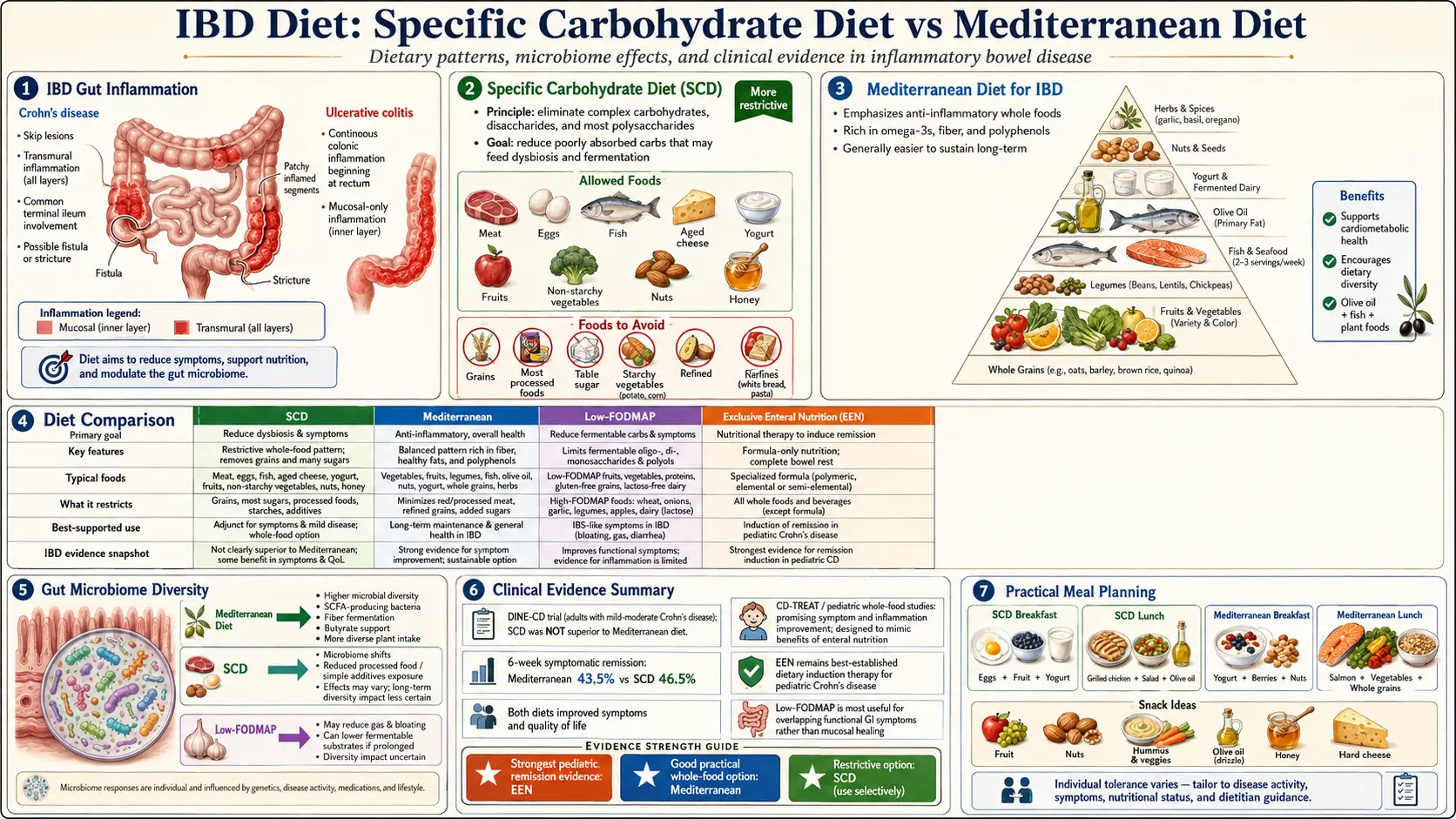
Table of Contents
- Why No Single Diet Fits All Inflammatory Bowel Disease
- The DINE-CD Trial: SCD vs Mediterranean
- The Specific Carbohydrate Diet (SCD) in Practice
- The Mediterranean Diet for Inflammatory Bowel Disease
- Exclusive Enteral Nutrition (EEN)
- The Crohn's Disease Exclusion Diet (CDED) + Partial EN
- Low-FODMAP for Irritable Bowel Syndrome-Like Symptoms in Quiescent Inflammatory Bowel Disease
- The Fiber Controversy: Strictures vs Everyone Else
- Emulsifiers and Ultra-Processed Foods
- Practical Meal Patterns
- Food-Symptom Journaling Done Right
- Working With an Inflammatory Bowel Disease-Trained Dietitian
- Key Research Papers
- Connections
- Featured Videos
Why No Single Diet Fits All Inflammatory Bowel Disease
If you have Crohn's disease or ulcerative colitis, you have probably been told conflicting things about food — by gastroenterologists, by forums, by friends, by YouTube, by a dietitian, by your mother-in-law. Some of the advice contradicts itself because inflammatory bowel disease (IBD) is not one disease. A newly diagnosed 22-year-old with mild colonic Crohn's, a 55-year-old with ileal stricturing disease, and a 40-year-old with pan-ulcerative colitis in remission on vedolizumab need three different eating patterns.
Five realities frame the specific diets:
- Food does not cause inflammatory bowel disease and no diet cures it. Genetics, microbiome, and immune dysregulation drive the disease. Diet can reduce inflammatory triggers and nourish the bowel, but it is not a substitute for effective medication when you have active inflammation.
- Your disease phenotype matters. Stricturing small-bowel Crohn's, inflammatory colonic Crohn's, and ulcerative colitis respond differently to fiber, fat, and fermentable carbohydrates.
- Active flare vs remission changes everything. A food that feels toxic during a flare (raw kale, popcorn, nuts) may be perfectly tolerated once you are in deep remission.
- Irritable bowel syndrome-like symptoms are common in inflammatory bowel disease patients whose inflammation is controlled. These feel like inflammatory bowel disease but respond to irritable bowel syndrome (IBS) strategies (like low-FODMAP), not to escalating biologics.
- Malnutrition is common and under-treated. Weight loss, iron deficiency, B12 deficiency, low vitamin D, and low magnesium are routine — especially in Crohn's — and restrictive diets can make this worse if not supervised.
The rest of this article walks through the five diet frameworks with the strongest evidence for inflammatory bowel disease, what each is designed to do, who benefits most, and where each falls short.
The DINE-CD Trial: SCD vs Mediterranean
For decades, patients have asked whether the Specific Carbohydrate Diet (SCD) — a strict grain-free, refined-sugar-free, starchy-legume-free pattern — actually works better than more conventional eating. In 2021, Lewis and colleagues published DINE-CD, the first large randomized head-to-head comparison in adults with mild-to-moderate Crohn's disease.
194 adults were randomized to follow either the SCD or a Mediterranean diet for 12 weeks, with meals initially delivered and then transitioned to self-prepared. The primary endpoint was symptomatic remission at week 6.
- Symptomatic remission at week 6: 46.5% on SCD vs 43.5% on Mediterranean (P = .77) — statistically indistinguishable.
- Fecal calprotectin response (an objective inflammation marker): similar between groups — 8 of 23 participants (34.8%) on SCD and 4 of 13 (30.8%) on the Mediterranean diet (P = .83); the SCD was not superior.
- C-reactive protein response: also similar.
- Adherence was easier on the Mediterranean diet, which matters for a pattern you have to follow long-term.
The trial's authors concluded that, given these results, the greater ease of following the Mediterranean diet, and its other health benefits, the Mediterranean diet may be preferred to the SCD for most patients with mild-to-moderate Crohn's symptoms. It delivered about the same symptomatic benefit with far less restriction and less social burden. The SCD was not superior on symptoms, calprotectin or C-reactive protein, and it was not the clear winner patients expected.
DINE-CD does not mean diet replaces medication. Participants with severe disease, perianal fistulas, or strictures were excluded. It also does not apply directly to ulcerative colitis, where the evidence is smaller: a 2023 randomized trial in 28 adults with ulcerative colitis in remission (Haskey et al.) found that fewer participants on a Mediterranean pattern than on their habitual diet had fecal calprotectin above 100 µg/g at week 12 (3 of 15 vs 9 of 12).
The Specific Carbohydrate Diet (SCD) in Practice
SCD was popularized by Elaine Gottschall's 1994 book Breaking the Vicious Cycle, itself based on earlier work by pediatrician Sidney Haas in the 1920s. The underlying theory: complex carbohydrates (disaccharides and most polysaccharides) are incompletely digested in inflamed bowel, feed dysbiotic bacteria, and perpetuate inflammation. Eliminating them starves the offending microbes.
What you eat on SCD:
- Meat, fish, eggs, most fresh vegetables, most fresh fruits.
- Well-cooked, well-strained beans and lentils (after an introductory phase). Navy beans and chickpeas are allowed; soybeans and mung beans are not.
- Almonds and nut flours.
- Homemade yogurt fermented for 24 hours (so lactose is consumed by the bacteria).
- Hard aged cheeses (low lactose).
- Honey (the only allowed sweetener).
What you cannot eat: all grains (wheat, rice, corn, oats, quinoa, buckwheat), potatoes, all refined sugar, most legumes initially, starchy vegetables (yams, plantains, cassava), fluid milk, soft cheeses, all processed foods with additives, and most canned goods. No sucrose, no maltodextrin, no lactose outside homemade 24-hour yogurt.
SCD can push symptomatic remission and sometimes objective healing in a real subset of patients — pediatric case series from Seattle Children's and Stanford have shown fecal calprotectin drops and mucosal healing in some kids. But it is genuinely restrictive. Social eating becomes hard. Dining out is nearly impossible. Caloric density drops unless you are deliberate about nut butters, eggs, avocado, and olive oil, which matters because Crohn's patients are already prone to weight loss.
Practitioners who use SCD describe doing it with a registered dietitian familiar with the protocol, with baseline labs (iron, ferritin, B12, vitamin D, folate, zinc), and over at least 8–12 weeks before the result is judged.
The Mediterranean Diet for Inflammatory Bowel Disease
The Mediterranean pattern is the most evidence-supported diet across nearly every chronic disease studied, and inflammatory bowel disease is no exception. Core elements: extra-virgin olive oil as the main fat, daily vegetables and fruits, fish 2–3 times per week, modest poultry, moderate legumes and whole grains, small amounts of fermented dairy, minimal red meat, minimal processed food, minimal added sugar. For a deeper philosophical primer, see the elimination diet framework.
For inflammatory bowel disease specifically, the Mediterranean diet:
- Matched SCD in DINE-CD for symptomatic Crohn's remission.
- Correlates with lower risk of later-onset Crohn's in prospective cohorts (two large Swedish cohorts, Khalili 2020, in which greater Mediterranean-diet adherence was linked with lower Crohn's risk but not with ulcerative colitis risk).
- Is compatible with virtually all cultural cuisines (easy to adapt for Indian, Mexican, Middle Eastern, East Asian households).
- Delivers fiber, polyphenols, omega-3s, and fermented foods without the rigid food-list policing of SCD.
Practical Mediterranean adaptations for inflammatory bowel disease:
- Active flare: peel fruits and vegetables, cook them well (stews, soups, roasted-until-soft), switch whole grains to white rice or sourdough, reduce raw leafy greens.
- Remission: reintroduce raw salads, whole grains, nuts, seeds, and beans gradually.
- Stricturing Crohn's: keep the Mediterranean philosophy but permanently modify for low insoluble fiber — peeled cooked vegetables, no nuts/seeds with intact hulls, no popcorn (see the fiber section below).
Exclusive Enteral Nutrition (EEN)
Exclusive enteral nutrition is the most counter-intuitive inflammatory bowel disease therapy and also one of the best-documented. For 6–8 weeks, the patient consumes nothing but a liquid formula — polymeric (whole protein), semi-elemental, or elemental (free amino acids) — providing 100% of calories. No solid food. No juice. Usually water, plain tea, and the formula.
In pediatric Crohn's disease in Europe, Canada, and Australia, EEN is first-line induction therapy for new-onset disease — used ahead of corticosteroids because it achieves comparable remission rates with none of steroids' growth, bone, or mood effects. Pediatric data:
- 70–85% clinical remission rates at 8 weeks, similar to or better than corticosteroids.
- Superior mucosal healing compared to corticosteroids (the Borrelli, Ruemmele, and ESPGHAN guidelines all emphasize this).
- Better growth, fewer side effects, and measurable microbiome shift.
In adults, EEN is used less often for two reasons: cultural resistance (adults hate liquid-only diets) and smaller effect sizes in the adult trials. Still, for adult Crohn's patients who want to avoid steroids during a flare, who need preoperative nutritional optimization before bowel resection, or who have penetrating or stricturing disease that needs to "cool down" before surgery, EEN is used.
The formulas used fall into three types: polymeric (for example, a polymeric casein-based formula enriched with transforming growth factor-beta 2), semi-elemental (peptide-based), and elemental (free amino acids). Insurance coverage in the U.S. is inconsistent; many adults pay out of pocket. Nasogastric tube feeding at night plus sipping during the day is an option when oral volume is hard to sustain.
The mechanism is not fully understood. Bowel rest, removal of dietary antigens, profound microbiome shift, and direct anti-inflammatory effects of the formula ingredients (especially TGF-β2) all likely contribute.
The Crohn's Disease Exclusion Diet (CDED) + Partial EN
CDED is a structured whole-food elimination diet designed by Arie Levine and colleagues in Israel, engineered specifically to exclude components hypothesized to impair barrier function or feed pathobionts in Crohn's. It is combined with partial enteral nutrition (PEN) — typically 50% of calories from formula in phase 1, tapering in later phases.
The Levine 2019 trial in Gastroenterology compared CDED + PEN against EEN in 78 children with mild-to-moderate Crohn's. Results:
- Both groups achieved comparable remission at week 6 (75% CDED+PEN vs 59% EEN, with CDED+PEN numerically higher and better tolerated).
- Sustained remission at week 12 was significantly better on CDED+PEN (75.6% vs 45.1%) because most EEN patients relapsed as they reintroduced solid food, whereas CDED+PEN had a structured whole-food reintroduction built in.
- Calprotectin dropped in both groups.
- CDED+PEN was dramatically easier to adhere to.
A follow-up trial in adults (CDED-AD, Yanai et al. 2022) showed similar benefit for mild-to-moderate adult Crohn's.
CDED phase 1 (6 weeks) mandates specific daily foods and excludes others: chicken breast, eggs, specific fruits (apple, banana, strawberry, melon, avocado), potato, rice, lemon, specific vegetables, and olive oil are core mandatories. Wheat, dairy, beef, pork, processed meat, baked goods, most canned foods, emulsifiers, maltodextrin, carrageenan, and animal fat are excluded. Phase 2 (weeks 7–12) liberalizes some foods; phase 3 is maintenance with more flexibility.
CDED is the most evidence-backed whole-food diet for Crohn's induction and maintenance to date. It is highly specific — it cannot be approximated by eating "clean," and it is delivered through dietitians trained in the Levine protocol rather than from a generic functional-medicine list.
Low-FODMAP for Irritable Bowel Syndrome-Like Symptoms in Quiescent Inflammatory Bowel Disease
A 2012 meta-analysis (Halpin and Ford, 13 studies, 1,703 patients) found symptoms meeting criteria for irritable bowel syndrome — bloating, cramping, gas, urgency, alternating bowel habits — in 39% of all inflammatory bowel disease patients: 44% of those with active disease and 35% of those judged clinically to be in remission. This is called irritable bowel syndrome-in-IBD, and it is frequently treated wrong. Gastroenterologists sometimes escalate biologics chasing symptoms while calprotectin is already below 50 µg/g, which is expensive, risky, and ineffective because the underlying driver is visceral hypersensitivity and fermentable-carbohydrate sensitivity, not active inflammatory bowel disease.
The tool studied here is the low-FODMAP diet, developed at Monash University. FODMAPs — Fermentable Oligo-, Di-, Mono-saccharides And Polyols — are short-chain carbohydrates that pull water into the small bowel and ferment rapidly in the colon. Common high-FODMAP foods: onion, garlic, wheat, apples, pears, honey, stone fruit, beans, cauliflower, milk, cashews, pistachios, sugar alcohols.
The protocol is three phases: strict elimination for 2–6 weeks, structured reintroduction one FODMAP group at a time, and personalization into a long-term diet that only excludes your specific triggers. Randomized trials in quiescent inflammatory bowel disease (Cox 2020, Pedersen 2017) show significant symptom relief with low-FODMAP.
Critical caveat: the low-FODMAP trials were done in quiescent disease, when inflammation is controlled. During an active inflammatory bowel disease flare, a diet change can delay treatment of the inflammation. Calprotectin (< 150 µg/g) is used to confirm remission before ongoing symptoms are put down to food.
The Fiber Controversy: Strictures vs Everyone Else
Few inflammatory bowel disease topics are more confused than fiber. The simple framework:
- If you have a stricture — a fibrotic narrowing of the small bowel or colon, common in ileal Crohn's — insoluble fiber can genuinely cause a bowel obstruction. Standard surgical and gastroenterology guidance for strictures limits raw vegetables, popcorn, corn kernels, nuts, seeds, fruit skins, and mushrooms.
- If you do not have a stricture — which is most UC patients and many Crohn's patients — the trials do not support restricting fiber (see below). Soluble fiber (oats, psyllium, cooked carrots, bananas, peeled apples, peeled squash) feeds butyrate-producing bacteria, which are depleted in inflammatory bowel disease and which directly nourish colonocytes.
The fear of fiber is inherited from pre-biologic-era guidelines when patients had more structural disease and less control of inflammation. Today, when MR enterography and colonoscopy show no significant stricture, a moderate-fiber Mediterranean pattern is the usual default. A 2014 systematic review of 23 randomized trials (Wedlake 2014) found no evidence, outside overt gastrointestinal obstruction, for restricting fiber in inflammatory bowel disease, and a small 2014 randomized trial (Brotherton 2014) found that people with Crohn disease given wheat-bran diet instructions reported better quality of life and bowel function than an attention-control group.
Whether a stricture is present is a question the gastroenterologist answers from the most recent MR enterography or computed tomography (CT) enterography report. "Luminal narrowing" is different from "high-grade stricture with prestenotic dilation." The first may still tolerate fiber; the second does not.
Emulsifiers and Ultra-Processed Foods
A growing body of evidence points at dietary emulsifiers and ultra-processed foods as modifiable inflammatory bowel disease triggers. Emulsifiers — the additives that keep salad dressing smooth and ice cream from crystallizing — are nearly ubiquitous in packaged foods. Two of the most studied:
- Polysorbate 80 (E433)
- Carboxymethylcellulose (E466, CMC)
In Chassaing et al. 2015 (Nature), low doses of both emulsifiers thinned the colonic mucus layer, let bacteria penetrate the epithelium, altered the microbiome, induced low-grade inflammation, and promoted colitis in interleukin-10 (IL-10) knockout mice. A 2022 human randomized feeding trial by the same group showed CMC altered microbiome composition and metabolomics in healthy humans within two weeks.
Separately, the prospective PURE study (Narula 2021, BMJ; 116,087 adults in 21 countries, median follow-up 9.7 years) found that higher ultra-processed food intake was associated with a higher risk of incident inflammatory bowel disease, with a significant trend across intake levels — and soft drinks, refined sweetened foods, salty snacks, and processed meat were each associated with higher risk. The French NutriNet-Santé cohort (Vasseur 2021; 105,832 adults, 75 incident cases over a mean 2.3 years) found no significant association between ultra-processed food intake and incident inflammatory bowel disease.
Ways people reduce emulsifier and ultra-processed food exposure:
- Reading labels for polysorbate-80, CMC (E466), carrageenan, maltodextrin, and artificial sweeteners (sucralose, saccharin), and choosing products without them.
- Cooking at home more: a home-cooked meal on any framework carries fewer additives than an ultra-processed "inflammatory bowel disease-safe" packaged meal.
- Real dairy (not ice cream with stabilizers), real bread (sourdough rather than industrial loaves with dough conditioners), real meat (not deli meat with phosphates and carrageenan).
Practical Meal Patterns
Concrete examples often help more than principles. Three sample patterns, scaled to disease state:
Active flare, no stricture. Breakfast: rice porridge with stewed banana and a drizzle of honey. Lunch: chicken and carrot soup with well-cooked white rice. Snack: peeled banana, smooth nut butter. Dinner: baked white fish with mashed potato and roasted-soft zucchini (skin removed). The aim: easy digestion, stable calories, no raw plants, and enough protein.
Active flare with stricture. Same as above but strictly no nuts, seeds, skins, or raw produce. Formula supplements (polymeric oral nutrition drinks) are used to meet calorie needs. Pureed soups, smooth yogurt, eggs, and tender slow-cooked meat.
Remission — Mediterranean template. Breakfast: Greek yogurt, berries, oats, olive oil, walnuts. Lunch: salmon, roasted sweet potato, cooked greens, olive oil, lemon. Dinner: lentil soup with carrots and cumin, sourdough bread, small salad. Coffee and dark chocolate are included; wine tolerance is individual.
In all three, hydration matters most (especially with diarrhea or an ileostomy) and protein targets are roughly 1.2–1.5 g/kg body weight during active disease — higher than general population recommendations — to support mucosal healing and prevent muscle loss.
Food-Symptom Journaling Done Right
Most patients who try to "find their trigger foods" by memory fail. Human memory is terrible at linking yesterday's lunch to today's bloating. A 2–3 week structured journal is one of the most useful exercises in all of inflammatory bowel disease self-management.
A structured journal logs, per meal:
- Time, full food list (including condiments, drinks, and sauces — this is where emulsifiers hide).
- Symptoms in the next 1–12 hours: bloating, cramping, urgency, number of stools, blood, stool form (Bristol scale 1–7), pain (0–10).
- Sleep hours and stress level (many symptom patterns correlate with stress and sleep, not food).
- Medications and supplements taken.
What counts is the pattern across multiple exposures. A single bad reaction after raw broccoli may be coincidence; three out of three times it reliably triggers bloating 4 hours later is a pattern. Smartphone symptom-tracking apps can automate this; a paper journal records the same information.
Brought to a dietitian visit, the journal turns a speculative conversation into a data conversation.
Working With an Inflammatory Bowel Disease-Trained Dietitian
Almost every inflammatory bowel disease patient benefits from at least one session with a registered dietitian who specializes in inflammatory bowel disease — not a generic wellness nutritionist. Situations in which a dietitian referral is commonly made:
- Unintended weight loss of more than 5% in 6 months.
- Any restrictive diet already in progress (SCD, carnivore, long-term elimination).
- Planning EEN, CDED, or structured low-FODMAP reintroduction.
- New ileostomy or J-pouch.
- Persistent iron, B12, vitamin D, or folate deficiency.
- Planning pregnancy with inflammatory bowel disease.
- Stricturing disease where fiber guidance is needed.
- Feeding a pediatric patient with Crohn's who needs EEN or CDED.
Finding one. In the U.S., the Academy of Nutrition and Dietetics directory lists registered dietitian nutritionists and can be searched for "inflammatory bowel disease" or "gastrointestinal." The Crohn's & Colitis Foundation maintains a list of inflammatory bowel disease-specialized dietitians. In the U.K., BDA Gastroenterology Specialist Group. In Australia and Canada, Monash-trained dietitians are typically excellent on FODMAP protocols; academic inflammatory bowel disease centers usually have a specialist dietitian on staff.
Insurance. In the U.S., most commercial plans cover medical nutrition therapy for inflammatory bowel disease under a gastroenterologist referral. Medicare coverage is narrower. If insurance denies, many dietitians offer a single consultation out of pocket ($150–$300) that can set up a year of better eating.
An inflammatory bowel disease dietitian typically reviews labs, recent imaging, medications, disease phenotype, the food journal, and the person's actual life — then builds a plan that fits, rather than selling supplements, handing out a universal "anti-inflammatory food list," or blaming nightshades for inflammatory bowel disease.
Key Research Papers
- Lewis JD, et al. A Randomized Trial Comparing the Specific Carbohydrate Diet to a Mediterranean Diet in Adults With Crohn's Disease (DINE-CD). Gastroenterology. 2021. — doi:10.1053/j.gastro.2021.05.047
- Levine A, et al. Crohn's Disease Exclusion Diet Plus Partial Enteral Nutrition Induces Sustained Remission in a Randomized Controlled Trial. Gastroenterology. 2019. — doi:10.1053/j.gastro.2019.04.021
- Yanai H, et al. The Crohn's Disease Exclusion Diet for induction and maintenance of remission in adults with mild-to-moderate Crohn's disease (CDED-AD): an open-label, pilot, randomised trial. Lancet Gastroenterol Hepatol. 2022. — doi:10.1016/s2468-1253(21)00299-5
- Ruemmele FM, et al. Consensus guidelines of ECCO/ESPGHAN on the medical management of paediatric Crohn's disease. J Crohns Colitis. 2014;8(10):1179–1207. — doi:10.1016/j.crohns.2014.04.005 (EEN as first-line induction)
- Chassaing B, et al. Dietary emulsifiers impact the mouse gut microbiota promoting colitis and metabolic syndrome. Nature. 2015. — doi:10.1038/nature14232
- Chassaing B, et al. Randomized Controlled-Feeding Study of Dietary Emulsifier Carboxymethylcellulose Reveals Detrimental Impacts on the Gut Microbiota and Metabolome. Gastroenterology. 2022. — doi:10.1053/j.gastro.2021.11.006
- Narula N, et al. Association of ultra-processed food intake with risk of inflammatory bowel disease: prospective cohort study (PURE). BMJ. 2021. — doi:10.1136/bmj.n1554
- Cox SR, et al. Effects of Low FODMAP Diet on Symptoms, Fecal Microbiome, and Markers of Inflammation in Patients With Quiescent Inflammatory Bowel Disease in a Randomized Trial. Gastroenterology. 2020. — doi:10.1053/j.gastro.2019.09.024
PubMed Topic Searches
For further reading, the following PubMed topic searches return current peer-reviewed work on diet and inflammatory bowel disease:
- PubMed: Specific carbohydrate diet and Crohn's disease
- PubMed: Mediterranean diet and inflammatory bowel disease
- PubMed: Exclusive enteral nutrition in pediatric Crohn's disease
- PubMed: Crohn's Disease Exclusion Diet (CDED)
- PubMed: Low-FODMAP in quiescent IBD
- PubMed: Dietary emulsifiers, colitis, and microbiome
- PubMed: Ultra-processed food and IBD risk
- PubMed: Fiber and stricturing Crohn's disease
Connections
- Gastroenterology
- Inflammatory Bowel Disease Overview
- Crohn's vs Ulcerative Colitis: Key Differences
- Diagnostic Workup: Calprotectin, Colonoscopy, MRE
- Biologics: Tumor Necrosis Factor, IL-23, and Integrin Inhibitors
- JAK Inhibitors and S1P Modulators
- Inflammatory Bowel Disease Surgery Decisions
- Extraintestinal Manifestations: Joints, Skin, Eyes
- Inflammatory Bowel Disease Fatigue, Anemia, and Nutrient Deficiencies
- Pregnancy and Inflammatory Bowel Disease
- Crohn's Disease
- Ulcerative Colitis
- Low-FODMAP Diet for Irritable Bowel Syndrome
- Celiac Disease
- Elimination Diet
- Ultra-Processed Foods
- Fermented Foods
- Olive Oil
- Carrageenan