Fermented Foods
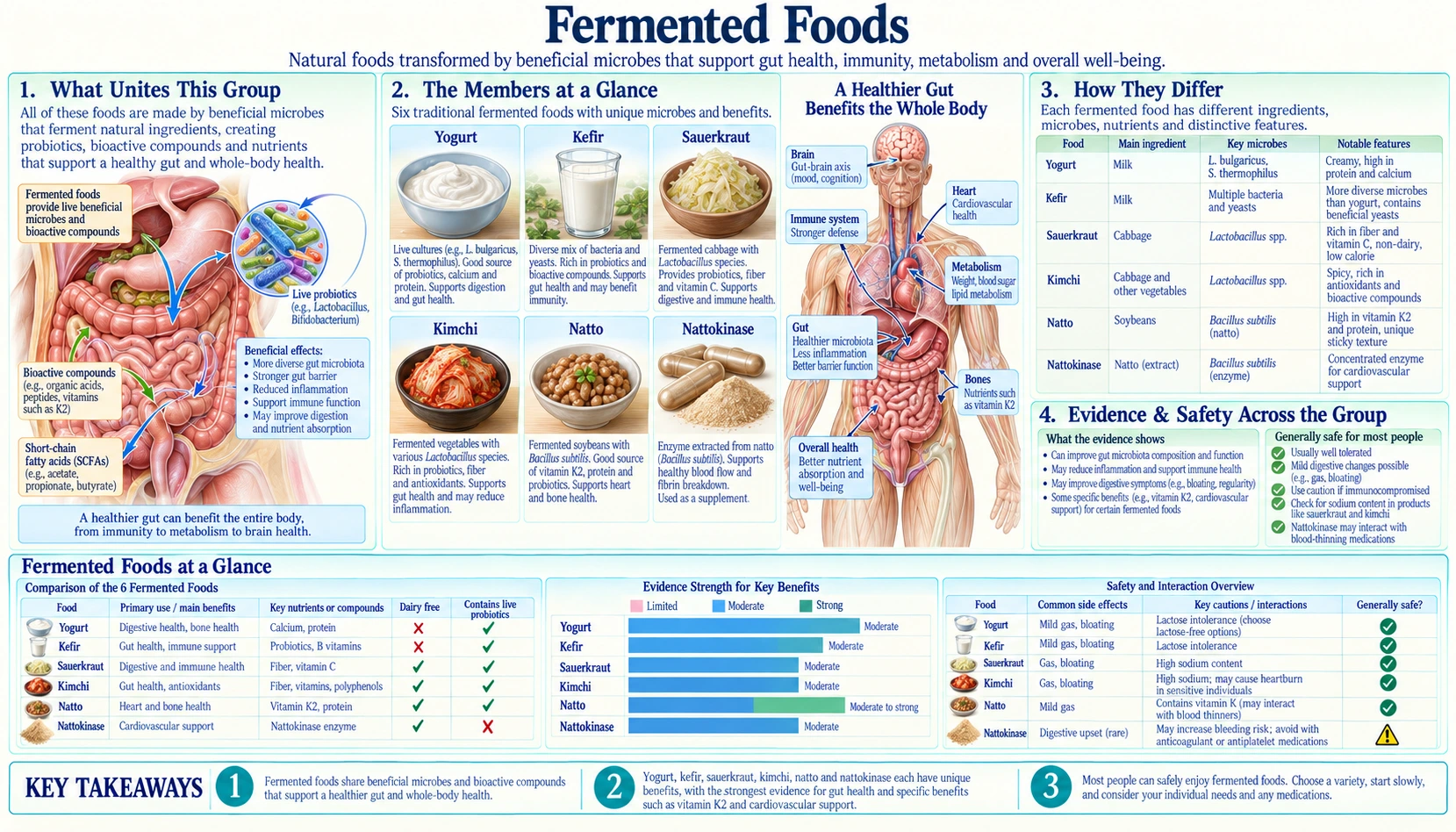
The Foods (6)
Yogurt
The best-studied fermented food, from strains to Greek straining
Read the deep dive →Kefir
The drinkable ferment with far more strains than yogurt
Read the deep dive →Sauerkraut
Raw cabbage ferment: live cultures, vitamin C and a modest, variable amount of K2
Read the deep dive →Kimchi
Korea's spiced ferment and its research base
Read the deep dive →Natto
The stringy soybean ferment, richest food source of vitamin K2
Read the deep dive →Nattokinase
An enzyme from natto that breaks down fibrin, the protein of blood clots, in laboratory studies
Read the deep dive →Fermentation is the oldest food technology on Earth — microbes partially digest a food, preserve it, and load it with live cultures and new compounds. Each page covers what the culture does, the nutrition, and how to buy or make the real thing (the shelf-stable, vinegar-brined versions have no living cultures at all).
How a Diet High in Fermented Foods Changed Gut Microbes in a 17-Week Trial
In a 17-week randomized study of healthy adults published in 2021 (18 people per group), researchers compared a diet high in fermented foods with a diet high in plant fiber. The high-fermented-food diet steadily increased the diversity of the gut microbes and lowered markers of inflammation. The high-fiber diet increased the microbes’ enzymes for breaking down carbohydrates, while the diversity of the microbial community stayed stable. The authors suggest that fermented foods may be valuable in countering the lower microbial diversity and higher inflammation common in industrialized society.
Fermented Soy and Death Rates in a Large Japanese Study
Natto and miso are fermented soy products. In a Japanese study of 92,915 adults aged 45 to 74 (42,750 men and 50,165 women) followed for 14.8 years, people in the highest fifth of fermented soy intake had lower death rates from all causes than those in the lowest fifth (hazard ratio 0.90 in men and 0.89 in women). Total soy intake showed no significant link with death rates, and natto was linked with lower death rates from cardiovascular disease in both sexes. The authors write that the findings should be interpreted with caution, because the link with fermented soy might be weakened by confounding factors the study could not adjust for.
Key Research Papers
- Wastyk HC, Fragiadakis GK, Perelman D, et al. Gut-microbiota-targeted diets modulate human immune status. Cell. 2021;184(16):4137-4153.e14. — doi:10.1016/j.cell.2021.06.019 · PubMed PMID: 34256014
- Katagiri R, Sawada N, Goto A, et al. Association of soy and fermented soy product intake with total and cause specific mortality: prospective cohort study. BMJ. 2020;368:m34. — doi:10.1136/bmj.m34 · PubMed PMID: 31996350
Connections
- Gut Health — The section hub with all sub-pages
- Gastroenterology — The complete digestive-conditions library
- Food — Whole foods, including every fermented food above
- Infections — The hostile side of the microbial world
- Herbs — Including the digestive and carminative herbs
- Amino Acids — Glutamine, glycine, and the gut-lining builders
- Biology — All 138 interactive animations
- Longevity — Where gut health and healthy aging meet
- Lab Tests — Including the gastrointestinal (GI) and liver panels
- Discussed in depth on these pages: Fermented Foods for Immune Function · Fermented Foods: Ancient Wisdom for Modern Gut Health · Fermented Foods for Gut Microbiome Diversity · Fermented Foods — Benefits Deep Dive · Fermented Foods History and Cultures