Serratia marcescens
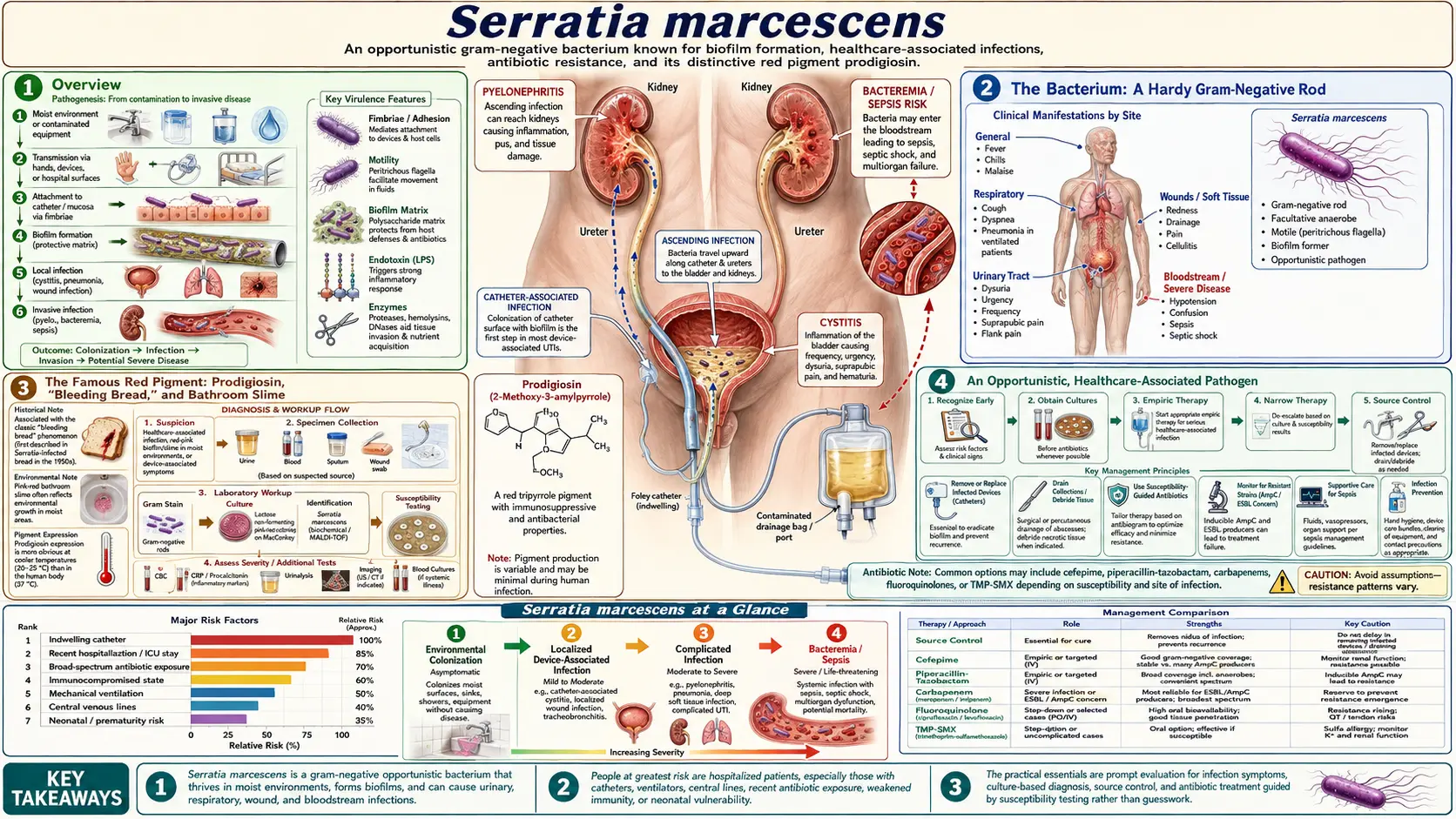
Serratia marcescens is a hardy, water-loving bacterium with two very different reputations. To most of us it is best known as the harmless-looking pink or red slime that creeps across shower tiles, grout, and the waterline of a toilet bowl — and, centuries ago, as the eerie blood-red stain that appeared on damp bread and communion wafers and was mistaken for a miracle. To hospitals, however, Serratia is something more serious: a resourceful opportunistic pathogen that rarely bothers healthy people but is an important cause of healthcare-associated infections, especially in intensive care units and newborn nurseries. This page tells both sides of the story — the genuinely charming history of its red pigment, and the practical medicine of how it infects vulnerable patients, why it is often resistant to common antibiotics, and how those infections are prevented and treated.
Table of Contents
- Overview
- The Bacterium: A Hardy Gram-Negative Rod
- The Famous Red Pigment: Prodigiosin, “Bleeding Bread,” and Bathroom Slime
- An Opportunistic, Healthcare-Associated Pathogen
- Who Is Most at Risk
- Diagnosis
- Treatment and the Antibiotic-Resistance Problem
- Prevention and Infection Control
- The Honest Bottom Line
- Key Research Papers
- Connections
- Featured Videos
Overview
Serratia marcescens is a member of the large family of gut-and-environment bacteria known as the Enterobacterales — the same broad group that includes Escherichia coli, Klebsiella, and Salmonella. Unlike some of those relatives, Serratia is above all an environmental organism: it lives in water, soil, on plants, and on the damp surfaces of everyday life. For a healthy person with intact skin and a working immune system, running into Serratia is almost always harmless.
The trouble begins in the hospital. When a person is already sick, has a tube or line crossing the body’s natural barriers, or has a weakened immune system, Serratia can take advantage of the opening. It is a classic opportunist — it does not go looking for a fight, but it is very good at exploiting one that circumstances hand it. Because it survives well in moisture, tolerates many disinfectants, and can hitch a ride on medical equipment, hands, and contaminated liquids, it has a long track record of causing outbreaks in intensive care units, surgical wards, and newborn nurseries.
Two facts make Serratia especially worth understanding. First, its red pigment gives it one of the most colorful stories in all of microbiology — a story that runs from medieval “miracles” straight through to the slime in your bathroom. Second, it carries built-in resistance to several widely used antibiotics and can develop more resistance during treatment, which means doctors cannot simply guess at therapy — they must test the specific strain and tailor the drugs to it.
The Bacterium: A Hardy Gram-Negative Rod
Serratia marcescens is a Gram-negative, rod-shaped bacterium. “Gram-negative” refers to how it takes up a laboratory stain, but it also tells you something real about its biology: Gram-negative bacteria have a tough outer membrane that acts like a second wall, helping to keep certain antibiotics out. This outer layer is part of why Serratia and its relatives can be stubborn to treat.
It is a motile organism — it swims using whip-like flagella that ring its surface — which helps it spread across wet surfaces and up the inside of tubing and catheters. It is a facultative anaerobe, meaning it can grow with or without oxygen, and it is remarkably undemanding about food and conditions. A few of the practical traits that make it a successful survivor:
- It loves moisture. Serratia thrives in water and on damp surfaces, and it can persist for long periods in the fluids and reservoirs found in a hospital — sinks, drains, soap and lotion dispensers, respiratory equipment, and intravenous solutions.
- It is hard to starve out. It can grow on very thin nutrition, including the mineral deposits and soap-and-shampoo residue on bathroom tile, which is why it colonizes showers and toilets so readily at home.
- It tolerates many antiseptics. Some strains survive in dilute disinfectant and antiseptic solutions that would kill more fragile bacteria — a trait that has repeatedly turned contaminated cleaning and injection solutions into the source of hospital outbreaks.
Not every Serratia makes the famous red color. Pigment production is temperature-dependent: strains tend to turn red when growing at cooler temperatures (around room temperature) and often stay pale at human body temperature. Importantly, many strains that cause human infection are not pigmented at all — so while a blood-red colony on a laboratory plate is a delightful clue that you may be looking at Serratia, its absence tells you nothing. Doctors and microbiologists cannot rely on color to identify it.
The Famous Red Pigment: Prodigiosin, “Bleeding Bread,” and Bathroom Slime
The red substance that some Serratia strains produce is called prodigiosin — a deep blood-red pigment whose very name comes from the Latin for “prodigy” or “marvel.” That name is a nod to one of the most charming episodes in the history of microbiology.
For centuries, people occasionally found bright red, wet, blood-like patches appearing on starchy food left in warm, damp conditions — on bread, on polenta and cornmeal, and, most dramatically, on the communion wafers (the “host”) used in church. To an earlier age with no knowledge of microbes, a wafer or a loaf that seemed to bleed looked like a genuine miracle or an omen, and such appearances were sometimes woven into religious accounts of “miraculous blood.” We now know the far more down-to-earth explanation: a colorless colony of Serratia marcescens growing on the starchy surface, its cells producing enough prodigiosin to make the patch look like a spreading drop of blood.
The science-meets-history moment came in 1819 in Padua, Italy, when the pharmacist Bartolomeo Bizio investigated a frightening outbreak of blood-red polenta and correctly traced it to a living, growing organism rather than anything supernatural. He named the microbe Serratia after an Italian physicist, and the species name marcescens — Latin for “decaying” or “fading” captures the way the red color melts away as the colony ages. It is a rare case where a bacterium’s name preserves both a scientist’s detective work and a poetic description of its behavior.
The same pigment explains a much more familiar modern sighting. That pink-to-red slimy film that builds up around the shower, along tile grout, on shower curtains, and at the waterline of the toilet bowl is very often Serratia marcescens. It is feeding on the phosphorus and fatty residues left behind by soap, shampoo, and hard-water minerals, and it flourishes in the warm, wet, rarely-scrubbed corners of the bathroom. For a healthy household this pink slime is a cosmetic nuisance, not a health hazard — a good scrub with a bathroom cleaner and keeping surfaces dry keeps it in check. It is a small, everyday reminder that the same organism starring in medieval “miracles” is quietly living alongside us.
Prodigiosin itself has become a subject of genuine scientific interest beyond its folklore, with researchers studying its chemistry and its possible biological activities. But for the purposes of health, the pigment’s main role is as a memorable identifying clue — and a wonderful story.
An Opportunistic, Healthcare-Associated Pathogen
Here is the heart of the medical story. Serratia marcescens rarely causes disease in healthy people going about ordinary life. Its importance comes almost entirely from healthcare-associated (nosocomial) infections — infections that people acquire while being cared for in hospitals, long-term care facilities, and especially intensive care and neonatal units. In that setting it is a recognized and sometimes serious pathogen.
The infections Serratia causes tend to follow the tubes, lines, and broken barriers that modern medical care requires:
- Urinary tract infections. These are among the most common Serratia infections and are frequently catheter-related — the bacterium travels along an indwelling urinary catheter into the bladder. It has been responsible for extended hospital outbreaks of urinary infection.
- Pneumonia and lower-respiratory infection. Serratia is a notable cause of hospital-acquired pneumonia, and especially ventilator-associated pneumonia, where a breathing tube gives the organism a direct path into the lungs.
- Bloodstream infections and sepsis. When Serratia reaches the blood — often by way of an intravenous line, central catheter, or a contaminated infusion — it can cause bacteremia and sepsis, a whole-body inflammatory response to infection that can become life-threatening, particularly in already-fragile patients.
- Surgical-wound and device infections. Operative sites, prosthetic devices, and implanted hardware can all become infected, sometimes requiring removal of the device to clear the infection.
- Outbreaks from contaminated liquids and equipment. Because Serratia survives in fluids, clusters of infection have been repeatedly traced to contaminated intravenous solutions, saline flushes, multi-dose vials, prefilled syringes, disinfectant and soap solutions, and respiratory equipment, as well as to spread from the hands of healthcare workers to patients. These outbreaks are a defining feature of Serratia in the hospital.
Less commonly, Serratia can cause infections of the eye (linked to contact-lens use and eye surgery), bone and joint, the heart valves (endocarditis, classically associated with injection drug use), and — in newborns — meningitis. What ties all of these together is the same theme: Serratia is an opportunist that takes advantage of a weakened host and a breached barrier.
Who Is Most at Risk
Understanding who is vulnerable makes the whole picture clearer — and it is reassuring for the general public, because most readers are simply not in the high-risk group. The people most at risk from Serratia marcescens include:
- Hospitalized and intensive-care patients, who are both more exposed and more vulnerable.
- Newborns, especially premature and low-birth-weight infants in neonatal intensive care units, where Serratia is a well-documented cause of outbreaks of bloodstream infection and, occasionally, meningitis. Neonatal units take Serratia very seriously.
- People with urinary catheters, breathing tubes, or intravenous and central lines — any device that crosses the body’s natural defenses is a potential doorway.
- People with weakened immune systems — from chemotherapy, transplant medications, advanced diabetes, or other serious illness.
- People who inject drugs, who are at particular risk for bloodstream infection and endocarditis when non-sterile equipment introduces environmental bacteria directly into the veins.
- Patients undergoing surgery or receiving implanted devices, where the operative site and hardware can become infected.
For a healthy person with intact skin, no indwelling devices, and a normal immune system, Serratia is not a meaningful everyday threat — which is exactly why the pink slime in the shower can be treated as a cleaning chore rather than a medical emergency.
Diagnosis
Serratia infection is diagnosed the way most bacterial infections are: by culture, in which a sample from the suspected site is grown in the laboratory and identified. Depending on the infection, the sample might be urine, blood, sputum or respiratory secretions, wound fluid, or the tip of a removed catheter.
- The red pigment can be a helpful clue — when it appears. A colony that grows blood-red on the laboratory plate immediately raises the possibility of Serratia. But because pigment depends on temperature and because many clinical strains never turn red at all, the laboratory does not rely on color. It confirms the identification with standard biochemical tests or modern rapid methods.
- Modern identification. Clinical laboratories increasingly use rapid techniques such as mass-spectrometry-based identification and automated systems that name the organism quickly and reliably, regardless of whether it happens to be pigmented.
- Susceptibility testing is essential. Because Serratia is resistant to several common antibiotics and can develop more resistance during treatment (see below), the laboratory does not stop at naming the organism. It performs antibiotic susceptibility testing to determine which drugs will actually work against that specific strain — a step that genuinely guides therapy.
Treatment and the Antibiotic-Resistance Problem
Treating Serratia marcescens is where its reputation as a difficult organism is most deserved, and it is worth understanding why. There are two layers to the resistance problem.
Built-in (intrinsic) resistance
Serratia is naturally resistant to a number of antibiotics from birth, before it has ever encountered a drug. This intrinsic resistance includes ampicillin and amoxicillin, first-generation cephalosporins (such as cefazolin), certain other older beta-lactam drugs, and the polymyxin antibiotics (such as colistin). This means several agents that a doctor might reach for against a simpler urinary or wound infection are useless against Serratia from the start.
Resistance that emerges during treatment
The second, subtler problem is an enzyme system called an inducible AmpC beta-lactamase. Many Serratia strains carry a gene, normally kept quiet, that produces an enzyme capable of destroying a broad class of beta-lactam antibiotics — including some third-generation cephalosporins that a laboratory test might initially report as effective. The danger is that treatment itself can switch the gene on: exposure to certain antibiotics can select for mutant bacteria that produce the enzyme all the time, so an infection that looked treatable at the start can relapse with a now-resistant strain partway through therapy. Serratia belongs to a well-known group of hospital bacteria that share this behavior.
On top of these intrinsic mechanisms, Serratia can also acquire further resistance genes — including extended-spectrum and carbapenem-destroying enzymes — producing multidrug-resistant strains that have spread in hospitals in various countries.
What this means for treatment
The practical consequences are straightforward and important:
- Therapy must be guided by susceptibility testing, not by guesswork. Because of intrinsic resistance and the risk of emergent resistance, doctors choose antibiotics based on the laboratory result for that specific strain.
- Certain reliable agents are generally favored when the strain is susceptible — such as cefepime, carbapenems, fluoroquinolones, aminoglycosides, or trimethoprim-sulfamethoxazole — while third-generation cephalosporins are often used cautiously or avoided for serious infection precisely because of the AmpC problem. The exact choice depends on the infection, its severity, and the local resistance pattern.
- Source control matters. When a catheter, line, or infected device is the source, removing or replacing it is often as important as the antibiotic itself.
None of this is something a patient manages alone — but understanding it explains why a doctor treating Serratia may wait for culture results, change antibiotics after a few days, or choose a drug that seems more powerful than the infection appears to warrant. It is a considered response to a genuinely tricky organism.
Prevention and Infection Control
Because Serratia is chiefly a hospital problem spread through moisture, hands, and contaminated liquids, prevention is overwhelmingly a matter of good infection-control practice — and it works. The core measures are:
- Hand hygiene. Thorough, consistent hand cleaning by healthcare workers between patients is the single most powerful defense, because hand-to-patient spread is a common route in outbreaks.
- Sterile technique with catheters and lines. Inserting and caring for urinary catheters, intravenous lines, and central lines using strict sterile technique — and removing them as soon as they are no longer needed — closes the doorways Serratia uses.
- Careful handling of solutions and equipment. Not reusing single-use products, not contaminating multi-dose vials, using sterile solutions properly, and maintaining respiratory equipment prevent the contaminated-fluid outbreaks that are a signature of Serratia.
- Environmental cleaning and moisture control. Keeping wet reservoirs — sinks, drains, and equipment — clean and, where possible, dry reduces the places Serratia can persist.
- Surveillance and outbreak response. When cases cluster, infection-control teams investigate for a common source, sometimes typing the strains to confirm a single origin, and intervene quickly.
At home, prevention is far simpler and lower-stakes: the pink shower slime is kept down by regular cleaning, drying wet surfaces, and good bathroom ventilation. For a healthy household there is no need for alarm.
The Honest Bottom Line
Serratia marcescens is a bacterium of two worlds. In the ordinary world it is a mostly harmless environmental microbe with one of the best stories in biology — the red pigment that turned bread and communion wafers into apparent “miracles” and that now paints the corners of our showers pink. If you find that slime at home, it is a cleaning task, not a health scare.
In the world of the hospital, though, Serratia deserves respect. It is an opportunist that seldom troubles the healthy but readily infects the vulnerable — through catheters, ventilators, lines, and contaminated fluids — causing urinary, lung, bloodstream, wound, and device infections, and outbreaks that hit intensive care and newborn units hardest. Its intrinsic resistance to common antibiotics and its ability to grow more resistant during treatment mean that infections must be diagnosed by culture and treated according to susceptibility testing, not assumptions. The reassuring flip side is that the same measures that control it — scrupulous hand hygiene, sterile technique, careful handling of solutions, and prompt removal of unnecessary devices — are exactly the everyday practices that good hospitals already work hard to uphold. Understanding Serratia is a small window into a larger truth: much of modern infection control is about keeping resourceful, ordinary microbes on the harmless side of the line.
Key Research Papers
- Mahlen SD. Serratia infections: from military experiments to current practice. Clinical Microbiology Reviews. 2011;24(4):755–791. — The comprehensive modern review of Serratia as a human pathogen: its biology, the range of infections it causes, and current clinical and laboratory practice. — doi:10.1128/CMR.00017-11
- Hejazi A, Falkiner FR. Serratia marcescens. Journal of Medical Microbiology. 1997;46(11):903–912. — A widely cited overview of the organism’s ecology, its rise as a nosocomial pathogen, and its resistance patterns. — doi:10.1099/00222615-46-11-903
- Sandner-Miranda L, Vinuesa P, Cravioto A, Morales-Espinosa R. The genomic basis of intrinsic and acquired antibiotic resistance in the genus Serratia. Frontiers in Microbiology. 2018;9:828. — Explains, at the genetic level, why Serratia is naturally resistant to several antibiotics and how it acquires more. — doi:10.3389/fmicb.2018.00828
- Jacoby GA. AmpC beta-lactamases. Clinical Microbiology Reviews. 2009;22(1):161–182. — The definitive review of the inducible AmpC enzyme system that lets Serratia and related bacteria develop resistance during treatment. — doi:10.1128/CMR.00036-08
- Tamma PD, Doi Y, Bonomo RA, Johnson JK, Simner PJ. A primer on AmpC beta-lactamases: necessary knowledge for an increasingly multidrug-resistant world. Clinical Infectious Diseases. 2019;69(8):1446–1455. — A practical, clinician-facing guide to choosing antibiotics for AmpC-producing organisms, Serratia among them. — doi:10.1093/cid/ciz173
- Moradigaravand D, Boinett CJ, Martin V, Peacock SJ, Parkhill J. Recent independent emergence of multiple multidrug-resistant Serratia marcescens clones within the United Kingdom and Ireland. Genome Research. 2016;26(8):1101–1109. — Genomic study tracking how multidrug-resistant hospital strains of Serratia arose and spread. — doi:10.1101/gr.205245.116
- Cristina ML, Sartini M, Spagnolo AM. Serratia marcescens infections in neonatal intensive care units (NICUs). International Journal of Environmental Research and Public Health. 2019;16(4):610. — Reviews why newborn units are so vulnerable to Serratia outbreaks and how they are controlled. — doi:10.3390/ijerph16040610
- Engel HJ, Collignon PJ, Whiting PT, Kennedy KJ. Serratia sp. bacteremia in Canberra, Australia: a population-based study over 10 years. European Journal of Clinical Microbiology & Infectious Diseases. 2009;28(7):821–824. — A decade of real-world data on who develops Serratia bloodstream infection and their outcomes. — doi:10.1007/s10096-009-0707-7
- Su LH, Ou JT, Leu HS, Chiang PC, Yeh YC, Chen CL, Chiu CH. Extended epidemic of nosocomial urinary tract infections caused by Serratia marcescens. Journal of Clinical Microbiology. 2003;41(10):4726–4732. — A detailed investigation of a prolonged hospital outbreak of catheter-associated urinary infection. — doi:10.1128/JCM.41.10.4726-4732.2003
- Williamson NR, Fineran PC, Leeper FJ, Salmond GPC. The biosynthesis and regulation of bacterial prodiginines. Nature Reviews Microbiology. 2006;4(12):887–899. — How bacteria such as Serratia build the red prodigiosin pigment and why they make it. — doi:10.1038/nrmicro1531
- Bennett JW, Bentley R. Seeing red: the story of prodigiosin. Advances in Applied Microbiology. 2000;47:1–32. — A delightful history connecting the red pigment to “bleeding” bread and communion wafers and to the birth of its scientific study. — doi:10.1016/S0065-2164(00)47000-0
- Darshan N, Manonmani HK. Prodigiosin and its potential applications. Journal of Food Science and Technology. 2015;52(9):5393–5407. — Reviews the chemistry and studied biological properties of the Serratia red pigment. — doi:10.1007/s13197-015-1740-4