Enterobacter cloacae
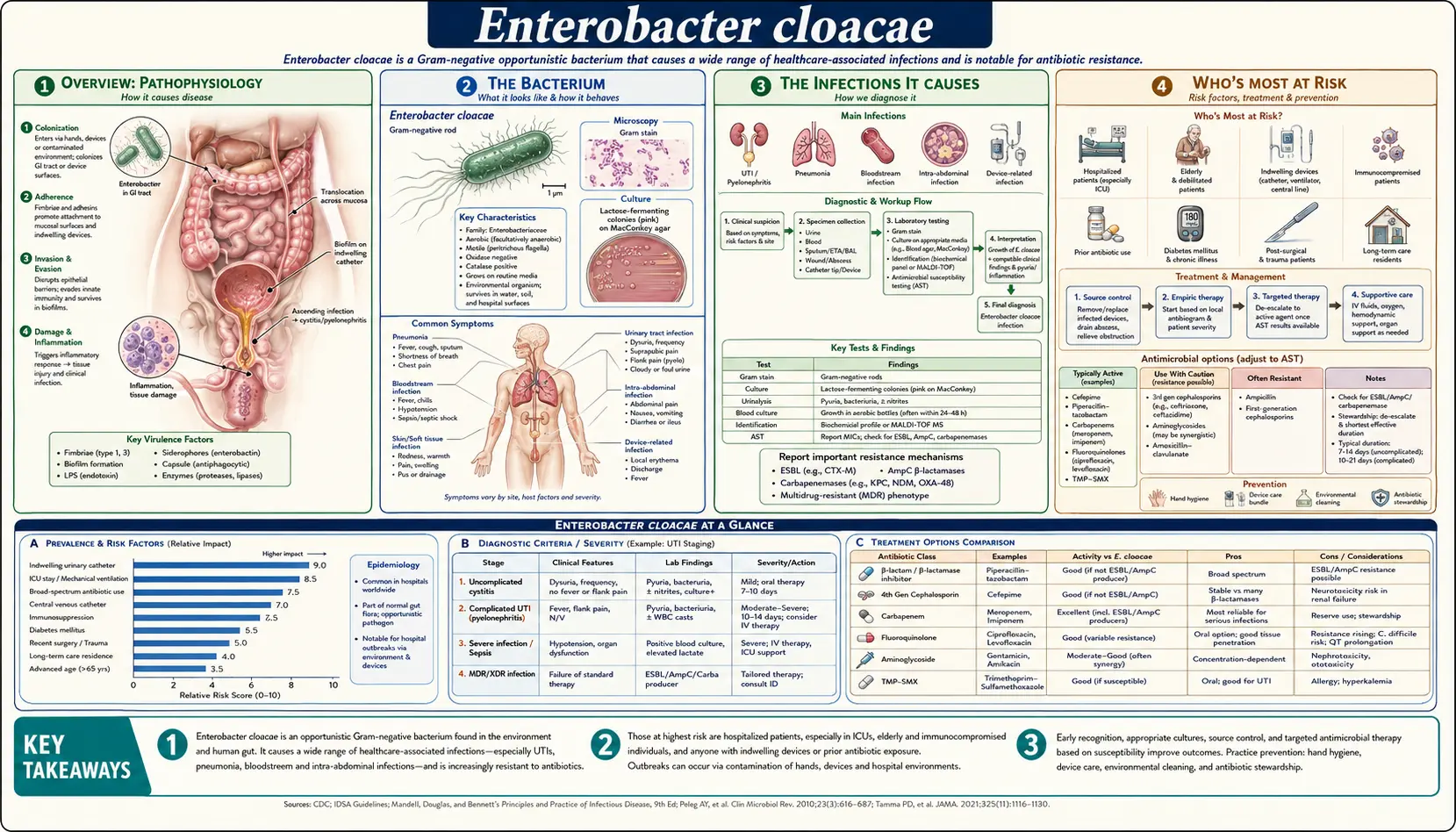
Enterobacter cloacae is a gram-negative bacterium that lives quietly in the human gut, in soil and water, and on plants. For most healthy people it causes no trouble at all — it is simply one of many organisms that share our bodies and our environment. In the hospital, though, it is a different story. E. cloacae is one of the more important causes of healthcare-associated infections: bloodstream infections in patients with IV lines, pneumonia in people on ventilators, urinary infections in those with catheters, and wound infections after surgery. It also belongs to a small, notorious group of hospital bacteria known by the acronym "ESKAPE" because they are especially good at escaping (resisting) our antibiotics. This page explains what the bacterium is, the infections it causes, who is most at risk, and — most importantly — the honest story of its antibiotic resistance, including a famous quirk that changes how doctors treat it.
Table of Contents
Overview
Enterobacter cloacae is a member of the Enterobacteriaceae — the large family of gut bacteria that also includes Escherichia coli, Klebsiella, Salmonella, and Proteus. Like its relatives, it is a normal inhabitant of the intestines of humans and animals, and it turns up widely in the outside world too: in fresh water, sewage, soil, and on the surfaces and roots of plants. In everyday life, carrying E. cloacae in your gut is completely normal and causes no illness.
The bacterium becomes a problem when it reaches a place in the body it does not belong — the bloodstream, the lungs, the urinary tract, or a surgical wound — usually in someone whose defenses are already down. For this reason it is called an opportunistic pathogen: it takes the opportunity that illness, hospitalization, and medical devices create. It is one of the more common Enterobacter species isolated from serious hospital infections, and its habit of developing resistance during treatment has earned it a lasting place in medical teaching.
Two ideas run through everything on this page. First, E. cloacae is overwhelmingly a hospital (healthcare-associated) organism, not a cause of ordinary community food poisoning like Salmonella or Campylobacter. Second, its clinical importance comes less from how aggressive it is and more from how resistant to antibiotics it can be — which is why it is counted among the ESKAPE pathogens that public-health agencies watch most closely.
The Bacterium
Enterobacter cloacae is a motile, gram-negative rod. Breaking that down in plain terms:
- Gram-negative means it has a particular kind of outer cell envelope (with an extra outer membrane) that stains pink rather than purple under the classic Gram stain. That outer membrane is also part of why gram-negative bacteria are often harder to treat — it acts as a barrier that keeps many antibiotics out.
- Rod (bacillus) describes its shape: a short, straight rod rather than a sphere or a spiral.
- Motile means it can swim, propelled by hair-like flagella arranged around its body.
- It is a facultative anaerobe, meaning it can grow with or without oxygen — a flexibility that helps it survive in the gut, in the environment, and in an infected human tissue alike.
An important wrinkle is that "Enterobacter cloacae" is not really a single species but a complex — a cluster of very closely related bacteria that are almost impossible to tell apart with ordinary laboratory tests. The Enterobacter cloacae complex includes species such as E. cloacae, E. hormaechei, E. asburiae, E. kobei, and E. ludwigii, among others. In clinical practice many isolates simply get reported as "Enterobacter cloacae complex" because separating the members reliably requires molecular (DNA-based) methods. For patients and doctors, the practical point is that these organisms behave similarly and share the same resistance concerns discussed below.
The Infections It Causes
Nearly all serious E. cloacae infections happen in hospitalized or otherwise vulnerable people. The main ones are:
- Bloodstream infections (bacteremia and sepsis). This is one of the most serious presentations. The bacteria frequently enter through intravenous (IV) catheters and central lines, and outbreaks have been repeatedly traced to contaminated infusion fluids, intravenous nutrition, and other injectable solutions — E. cloacae can multiply in these liquids. From the blood, the infection can spread and trigger sepsis, a life-threatening whole-body response.
- Pneumonia, including ventilator-associated pneumonia. In patients on breathing machines in the intensive care unit, E. cloacae is a recognized cause of hospital-acquired pneumonia. The breathing tube provides a direct path into the lungs and bypasses the body's normal defenses.
- Urinary tract infections. These are usually catheter-related — occurring in people who have a urinary (Foley) catheter in place for medical reasons. The catheter gives the bacteria a surface to colonize and a route into the bladder.
- Surgical-wound and intra-abdominal infections. E. cloacae can infect surgical incisions and can be part of the mixed bacterial community in abdominal infections (for example after bowel surgery or perforation).
- Neonatal infections and NICU outbreaks. Newborns — especially premature and low-birth-weight babies in the neonatal intensive care unit (NICU) — are particularly vulnerable. E. cloacae can cause bloodstream infection, meningitis, and serious gut inflammation in neonates, and clusters or outbreaks in NICUs have been linked to contaminated feeds, parenteral nutrition, and shared equipment.
- Other infections can occur too, including skin and soft-tissue infections, and, less commonly, infections of bones, joints, or the lining around the brain (meningitis) — generally in people with significant underlying illness or devices.
What ties these together is the setting: medical devices, intensive care, surgery, and weakened defenses. E. cloacae is an efficient exploiter of the vulnerabilities that hospital care sometimes creates.
Who's Most at Risk
E. cloacae rarely troubles healthy people going about their lives. The risk is concentrated among:
- Hospitalized and ICU patients, particularly those with long stays and serious illness.
- People with indwelling medical devices — central venous catheters, urinary catheters, breathing tubes, drains, and other hardware that gives bacteria a foothold.
- Newborns, especially premature infants in the NICU.
- Immunocompromised people — those receiving chemotherapy, transplant recipients on immune-suppressing drugs, and others with weakened immune systems.
- Patients who have recently received broad-spectrum antibiotics. Powerful antibiotics clear away competing "good" bacteria and select for hardy, resistant survivors like E. cloacae, allowing it to overgrow and, sometimes, to develop further resistance.
- People recovering from major surgery or with severe burns or wounds.
The more of these factors a person has, the higher the risk — and many hospitalized patients unfortunately have several at once.
Diagnosis
Diagnosis rests on culturing the bacterium from the site of infection — a sample of blood, urine, sputum, or wound fluid is grown in the laboratory. Once E. cloacae is identified (modern labs often use rapid mass-spectrometry identification, known as MALDI-TOF), the single most important next step is antibiotic susceptibility testing.
Susceptibility testing measures which antibiotics actually kill the specific strain infecting the patient. With E. cloacae this testing is not a formality — it is essential, because resistance varies widely from strain to strain and, as the next section explains, the laboratory result can even change during the course of an infection. Doctors treating a serious Enterobacter infection watch these results closely and interpret them with the organism's resistance quirks firmly in mind.
The Antibiotic-Resistance Problem
This is the heart of why Enterobacter cloacae matters, and it deserves an honest, careful explanation.
The AmpC enzyme and "resistance during treatment"
E. cloacae naturally carries, in its own chromosome, a gene for an enzyme called an inducible AmpC beta-lactamase. Beta-lactamases are enzymes that chop up and inactivate beta-lactam antibiotics — the huge and important family that includes penicillins and cephalosporins. The word "inducible" is the crux: normally the bacterium makes only small amounts of this enzyme, so in the laboratory the strain can look susceptible to certain cephalosporins. But exposure to those very antibiotics can switch the enzyme production up, and — more permanently — the treatment can select for mutant bacteria that have their AmpC gene stuck in the "on" position (this is called stable derepression). Those mutants pour out the enzyme constantly and become fully resistant.
The practical consequence is a famous clinical teaching point: an Enterobacter infection that tests susceptible to a third-generation cephalosporin (such as ceftriaxone, cefotaxime, or ceftazidime) at the start can become resistant during treatment, sometimes leading to relapse or treatment failure. A landmark 1991 study of Enterobacter bloodstream infections documented exactly this, and follow-up work has confirmed that the risk is real and meaningful. Because of it, many clinicians avoid third-generation cephalosporins as sole (monotherapy) treatment for serious Enterobacter infections, even when the lab initially calls the strain susceptible.
Acquired resistance: ESBLs and carbapenemases (CRE)
On top of its built-in AmpC enzyme, E. cloacae can also acquire extra resistance genes from other bacteria, carried on mobile pieces of DNA. Two acquired threats stand out:
- ESBLs (extended-spectrum beta-lactamases) — enzymes that knock out an even broader range of cephalosporins.
- Carbapenemases — enzymes that destroy the carbapenems, a class of powerful antibiotics that are often held in reserve as a last line against resistant gram-negative bacteria. When an Enterobacter strain becomes resistant to carbapenems, it joins the group known as carbapenem-resistant Enterobacterales (CRE). CRE infections are a genuinely serious, and thankfully still relatively uncommon, problem: treatment options become few, and public-health agencies rank CRE among the most urgent antibiotic-resistance threats.
Why it is an "ESKAPE" pathogen
Because of this combination of built-in and acquired resistance, Enterobacter is the "E" in ESKAPE — an acronym coined by infectious-disease specialists for six bacterial groups (Enterococcus, Staphylococcus aureus, Klebsiella, Acinetobacter, Pseudomonas, and Enterobacter) that most often "escape" the effects of antibiotics and cause difficult hospital infections. The label is a call to attention, not a cause for panic: it flags exactly the bugs where careful antibiotic choice and good infection control matter most.
Treatment
There is no single "right" antibiotic for E. cloacae. Treatment is guided by susceptibility testing for the individual strain, and adjusted with the resistance concerns above in mind. In broad, honest terms:
- Third-generation cephalosporins are used cautiously, if at all, for serious infections — because of the derepression risk, they are commonly avoided as monotherapy even when the strain tests susceptible.
- Carbapenems (such as meropenem) are very stable against the AmpC enzyme and are a mainstay for serious infections — provided the strain is not carbapenem-resistant.
- Cefepime, a fourth-generation cephalosporin, is far more stable against AmpC than the third-generation drugs and is often an appropriate choice for susceptible strains.
- Depending on susceptibility, fluoroquinolones, aminoglycosides, or trimethoprim-sulfamethoxazole may be options, sometimes as part of the regimen.
- For highly resistant strains, including CRE, newer agents (such as ceftazidime-avibactam and other recently developed beta-lactamase-inhibitor combinations) are reserved for when they are truly needed, guided by specialist advice and detailed susceptibility results.
Alongside antibiotics, source control is critical: removing or replacing an infected IV line or catheter, draining an abscess, or cleaning out an infected wound often matters as much as the drug itself. Decisions about serious Enterobacter infections are typically made with input from infectious-disease specialists.
Prevention & Infection Control
Because E. cloacae infections are largely a product of the hospital environment, prevention is mostly about infection control — the everyday practices that stop bacteria from moving from surfaces, fluids, and hands into vulnerable patients:
- Hand hygiene. Thorough handwashing and alcohol-based hand rub by healthcare workers between patients is the single most effective measure — unglamorous but genuinely lifesaving.
- Careful line and catheter management. Inserting IV lines and urinary catheters with sterile technique, caring for them properly, and — crucially — removing them as soon as they are no longer needed dramatically cuts the risk of device-related infection.
- Sterile technique and safe handling of fluids. Because E. cloacae can multiply in intravenous fluids and nutrition, strict aseptic preparation and handling of injectable and infusion solutions is essential; contaminated solutions have caused outbreaks.
- Environmental cleaning and equipment hygiene, especially in ICUs and NICUs, to prevent shared surfaces and devices from spreading the organism between patients.
- Antimicrobial stewardship. Using antibiotics only when needed, choosing the narrowest effective drug, and not treating longer than necessary all reduce the pressure that drives resistant strains like E. cloacae to emerge and spread. Stewardship protects both the individual patient and the wider community.
The Bottom Line
Here is the honest summary. Enterobacter cloacae is a normal, usually harmless gut and environmental bacterium — if you are healthy, you almost certainly need not worry about it. Its importance lies in the hospital, where it is a leading opportunistic pathogen in vulnerable patients with IV lines, catheters, breathing tubes, surgical wounds, and weakened immune systems, and where premature newborns are especially at risk.
Its defining feature is antibiotic resistance: a built-in, inducible AmpC enzyme that can make the bacterium become resistant to certain cephalosporins during treatment — the classic reason clinicians avoid third-generation cephalosporins as monotherapy — plus the ability to acquire ESBLs and carbapenemases that push some strains into the difficult category of CRE. That is why it counts among the ESKAPE pathogens. The good news is that infection control works: hand hygiene, careful device management, sterile handling of fluids, and sensible antibiotic use prevent the great majority of these infections. And when infections do occur, susceptibility-guided treatment — often with carbapenems or cefepime and the help of infectious-disease specialists — remains effective for most strains.
Key Research Papers
- Mezzatesta ML, Gona F, Stefani S. Enterobacter cloacae complex: clinical impact and emerging antibiotic resistance. Future Microbiology. 2012;7(7):887–902. — A defining review of the E. cloacae complex, its taxonomy, and its resistance profile. — doi:10.2217/fmb.12.61
- Davin-Regli A, Lavigne JP, Pagès JM. Enterobacter spp.: update on taxonomy, clinical aspects, and emerging antimicrobial resistance. Clinical Microbiology Reviews. 2019;32(4):e00002-19. — A comprehensive modern overview of the genus, clinical disease, and resistance mechanisms. — doi:10.1128/CMR.00002-19
- Davin-Regli A, Pagès JM. Enterobacter aerogenes and Enterobacter cloacae; versatile bacterial pathogens confronting antibiotic treatment. Frontiers in Microbiology. 2015;6:392. — Explains how these organisms combine resistance and virulence to evade treatment. — doi:10.3389/fmicb.2015.00392
- Sanders WE Jr, Sanders CC. Enterobacter spp.: pathogens poised to flourish at the turn of the century. Clinical Microbiology Reviews. 1997;10(2):220–241. — A classic clinical review establishing Enterobacter as a rising nosocomial opportunist. — doi:10.1128/CMR.10.2.220
- Chow JW, Fine MJ, Shlaes DM, Quinn JP, et al. Enterobacter bacteremia: clinical features and emergence of antibiotic resistance during therapy. Annals of Internal Medicine. 1991;115(8):585–590. — The landmark study documenting resistance emerging during third-generation cephalosporin therapy. — doi:10.7326/0003-4819-115-8-585
- Kaye KS, Cosgrove S, Harris A, Eliopoulos GM, Carmeli Y. Risk factors for emergence of resistance to broad-spectrum cephalosporins among Enterobacter species. Antimicrobial Agents and Chemotherapy. 2001;45(9):2628–2630. — Quantifies how often cephalosporin resistance is selected during treatment. — doi:10.1128/AAC.45.9.2628-2630.2001
- Jacoby GA. AmpC β-lactamases. Clinical Microbiology Reviews. 2009;22(1):161–182. — The definitive review of the AmpC enzyme central to Enterobacter resistance. — doi:10.1128/CMR.00036-08
- Harris PN, Ferguson JK. Antibiotic therapy for inducible AmpC β-lactamase-producing gram-negative bacilli: what are the alternatives to carbapenems, quinolones and aminoglycosides? International Journal of Antimicrobial Agents. 2012;40(4):297–305. — A practical look at treatment options for AmpC producers. — doi:10.1016/j.ijantimicag.2012.06.004
- Tamma PD, Girdwood SC, Gopaul R, Tekle T, et al. The use of cefepime for treating AmpC β-lactamase–producing Enterobacteriaceae. Clinical Infectious Diseases. 2013;57(6):781–788. — Evidence supporting cefepime as an alternative to carbapenems for AmpC organisms. — doi:10.1093/cid/cit395
- Rice LB. Federal funding for the study of antimicrobial resistance in nosocomial pathogens: no ESKAPE. The Journal of Infectious Diseases. 2008;197(8):1079–1081. — The commentary that coined the "ESKAPE" acronym for the key resistant hospital pathogens. — doi:10.1086/533452
- Annavajhala MK, Gomez-Simmonds A, Uhlemann AC. Multidrug-resistant Enterobacter cloacae complex emerging as a global, diversifying threat. Frontiers in Microbiology. 2019;10:44. — Reviews the global spread of carbapenem-resistant E. cloacae complex strains. — doi:10.3389/fmicb.2019.00044
- Dalben M, Varkulja G, Basso M, Krebs VLJ, et al. Investigation of an outbreak of Enterobacter cloacae in a neonatal unit and review of the literature. Journal of Hospital Infection. 2008;70(1):7–14. — A detailed NICU outbreak investigation, with a review of neonatal Enterobacter outbreaks. — doi:10.1016/j.jhin.2008.05.003