C. diff Symptoms and Overview: How Antibiotics Enable Clostridioides difficile
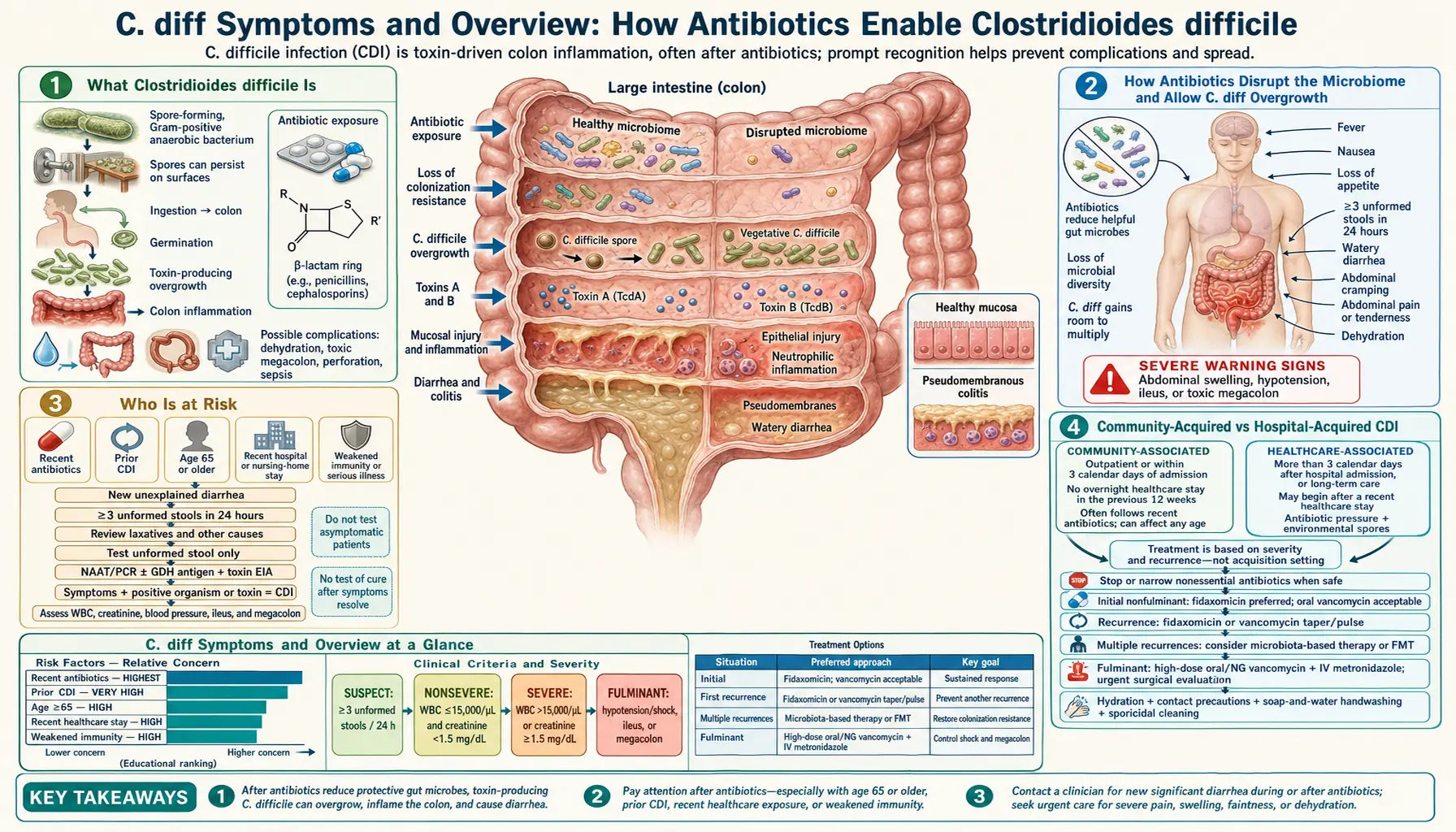
Clostridioides difficile (C. diff) is the leading cause of healthcare-associated diarrhea in the United States, responsible for roughly 500,000 infections and up to 30,000 deaths every year. Antibiotics open the door: they wipe out the protective gut bacteria that ordinarily keep C. diff spores from germinating, allowing toxin-producing colonies to bloom and damage the colon lining. Understanding what C. diff is, how it spreads, who is most vulnerable, and what its full symptom range looks like is the foundation for recognizing, treating, and preventing it.
Diarrhea & Colitis
Watery diarrhea, abdominal cramps, and the pseudomembranous colitis pattern explained.
Read the deep dive →Severe C. diff
Toxic megacolon, colectomy, intensive care unit (ICU) admission, and mortality predictors.
Read the deep dive →Diagnosis Tests
NAAT, GDH antigen, toxin EIA, and the two-step testing algorithm.
Read the deep dive →Treatment & Prevention
Stopping the offending antibiotic, oral vancomycin, FMT, and infection control.
Read the deep dive →- What Clostridioides difficile Is
- How Antibiotics Disrupt the Microbiome
- Who Is at Risk
- Community-Acquired vs Hospital-Acquired Clostridioides Difficile Infection
- Recurrent Clostridioides Difficile Infection
- Colonization vs Disease
- Global Burden
- The Full Symptom Spectrum
- Key Research Papers
- Connections
- Featured Videos
What Clostridioides difficile Is
Clostridioides difficile — until 2016 classified as Clostridium difficile and still commonly called C. diff or Clostridioides difficile infection (CDI) — is a spore-forming, anaerobic, gram-positive rod-shaped bacterium. It lives naturally in soil, water, and the intestines of many animals, including a minority of healthy human adults. In the right conditions, however, it colonizes the human colon in large numbers and releases two powerful exotoxins that destroy the intestinal lining.
Toxin A (TcdA) and Toxin B (TcdB) are the main weapons C. diff uses against its host. Both are glucosyltransferases — enzymes that inactivate small GTPases inside colon epithelial cells, collapsing the cytoskeleton and triggering cell death. TcdB is generally considered more potent than TcdA on a molar basis, though both are required for full virulence in most strains. The result is inflammation, fluid secretion into the colon lumen, and the characteristic diarrhea of Clostridioides difficile infection.
A particularly dangerous variant emerged in the early 2000s: the NAP1/BI/027 hypervirulent strain (also called ribotype 027). This strain produces substantially more TcdA and TcdB than historical strains, and also produces a third toxin — binary toxin (CDT) — whose role in disease is still being characterized but which may enhance spore adherence and worsen outcomes. NAP1 is resistant to fluoroquinolone antibiotics (a factor in its epidemic spread during the 2000s), grows more rapidly, and is associated with higher rates of severe disease, colectomy, and death. Outbreaks linked to NAP1 swept through North American and European hospitals from roughly 2003 to 2010, fundamentally changing how clinicians think about Clostridioides difficile infection severity.
C. diff forms hardy, chlorine-resistant spores that can survive on surfaces — bedrails, call buttons, commodes, floors — for months. Spores are the primary mode of transmission: hand-to-mouth contact after touching a contaminated surface. Standard alcohol-based hand sanitizers do not kill C. diff spores; soap and water, which physically remove spores from hands, is required.
How Antibiotics Disrupt the Microbiome and Allow C. diff Overgrowth
A healthy human gut contains trillions of bacteria belonging to hundreds of species — a complex community that collectively provides what microbiologists call colonization resistance. This resistance operates through several overlapping mechanisms: competition for nutrients, competition for epithelial binding sites, production of antimicrobial compounds (bacteriocins, short-chain fatty acids), stimulation of host immune defenses, and maintenance of the mucus layer. Together these mechanisms suppress C. diff even when small numbers of spores are ingested.
Antibiotics break colonization resistance. Even a single dose can dramatically reduce microbial diversity and density, leaving ecological niches that C. diff spores — which survive the antibiotic because spores are metabolically inert — can fill the moment they germinate. The germination trigger is bile acids: primary bile acids (particularly taurocholate) promote germination; secondary bile acids produced by healthy gut bacteria (particularly deoxycholate) inhibit it. When antibiotics eliminate the bacteria that convert primary to secondary bile acids, the gut becomes flooded with germinants and depleted of inhibitors, creating an ideal environment for C. diff vegetative growth.
Research in mouse models showed that a single dose of clindamycin was sufficient to make animals susceptible to Clostridioides difficile infection for weeks afterward, even after the antibiotic was cleared — illustrating how durable the damage to colonization resistance can be. In humans, susceptibility persists for at least 4 weeks after a course of antibiotics ends, and in some cases much longer, particularly in older patients or those with underlying gut disease.
Not all antibiotics carry equal risk. The highest-risk classes are:
- Clindamycin — historically the most Clostridioides difficile infection-associated antibiotic; disrupts anaerobes that normally suppress C. diff.
- Fluoroquinolones (ciprofloxacin, levofloxacin, moxifloxacin) — broad-spectrum disruption; also selected for NAP1/027 resistance.
- Third- and fourth-generation cephalosporins — broad-spectrum, poor anaerobic coverage, major hospital-CDI drivers.
- Carbapenems and piperacillin-tazobactam — broader impact but sometimes paradoxically lower Clostridioides difficile infection risk than narrower cephalosporins due to direct C. diff suppression.
- Ampicillin and amoxicillin-clavulanate — significant gut disruption in some patients.
Narrow-spectrum agents such as trimethoprim, macrolides (for short courses), and tetracyclines carry lower but not negligible risk.
Who Is at Risk
While Clostridioides difficile infection can theoretically affect anyone who takes antibiotics, certain populations face dramatically higher risk. Risk accumulates multiplicatively when several factors co-occur.
Recent antibiotic use is the single strongest modifiable risk factor, present in 80–90% of Clostridioides difficile infection cases. The risk is highest in the 4 weeks after a course ends but persists up to 3 months. Longer courses and broader-spectrum agents carry higher risk than shorter, narrower ones.
Age 65 and older is a major independent risk factor. Older adults have less diverse baseline microbiomes, weakened immune responses (especially reduced immunoglobulin A (IgA) and mucosal immunity), and are more likely to be hospitalized and receive antibiotics. Clostridioides difficile infection incidence in adults 65+ is 5–10 times higher than in younger adults, and mortality is dramatically higher — the median age at death from Clostridioides difficile infection in the US is in the mid-70s.
Hospitalization longer than 48 hours — hospital environments harbor C. diff spores at high density. The longer a patient stays, the greater the environmental exposure and the more antibiotics they are likely to receive.
Proton pump inhibitor (PPI) use is an independent risk factor, likely because gastric acid is a barrier to C. diff spore passage; proton pump inhibitors (PPIs) reduce that barrier. A meta-analysis found approximately 1.7-fold increased Clostridioides difficile infection risk in proton pump inhibitor users. The effect is modest compared to antibiotics but clinically meaningful given the massive prevalence of proton pump inhibitor prescribing.
Immunosuppression — chemotherapy, solid organ or stem cell transplant recipients, high-dose corticosteroids, and tumor necrosis factor-alpha inhibitors all impair the immune response that limits C. diff proliferation. Transplant patients may develop Clostridioides difficile infection without the usual antibiotic exposure.
Inflammatory bowel disease (IBD) — patients with Crohn's disease or ulcerative colitis have 3–10 times the Clostridioides difficile infection risk of the general population. Disrupted mucosal integrity, immune dysregulation, and frequent antibiotic and immunosuppressant use all contribute. Clostridioides difficile infection in inflammatory bowel disease patients triggers inflammatory bowel disease flares and is associated with much worse outcomes.
Prior Clostridioides difficile infection episode is itself a risk factor for recurrence — having had Clostridioides difficile infection once means the microbiome was already disrupted and may not fully recover, leaving the patient vulnerable to re-infection or relapse.
Nasogastric tube placement and enteral feeding, gastrointestinal surgery, and chronic kidney disease have also been identified as independent risk factors in various studies.
Community-Acquired vs Hospital-Acquired Clostridioides Difficile Infection
Clostridioides difficile infection has traditionally been considered a hospital disease, and most historical data reflect healthcare settings. But a striking epidemiological shift has taken place over the past two decades: a growing proportion of Clostridioides difficile infection cases now originate in the community among patients with no recent hospitalization.
The definitions are now standardized: healthcare facility-onset (HO-CDI) is defined as diarrhea onset more than 48 hours after hospital admission. Community-acquired CDI (CA-CDI) is defined as onset in the community, or within 48 hours of hospital admission, in a patient who was not hospitalized in the preceding 12 weeks. A third category — community-onset healthcare-associated CDI (CO-HCAI) — captures patients whose symptoms begin at home but who had recent healthcare contact (hospitalization, nursing home stay, dialysis, surgery).
In 2011, the U.S. Centers for Disease Control and Prevention (CDC) estimated that community-onset cases accounted for approximately 32% of all Clostridioides difficile infection cases in the US. By more recent estimates, CA-CDI accounts for 30–40% of all Clostridioides difficile infection, and CA-CDI patients are increasingly younger (median age 50–55 vs 70+ for HO-CDI), more likely to be female, and less likely to have classic risk factors like recent hospitalization. Many CA-CDI patients do have recent antibiotic exposure (from outpatient prescriptions), but a subset — perhaps 10–20% — have no identifiable antibiotic exposure at all, suggesting environmental or foodborne transmission routes.
CA-CDI generally has better outcomes than HO-CDI: lower rates of severe disease, lower mortality, and lower recurrence risk. This likely reflects the younger age and lower medical comorbidity burden of CA-CDI patients, along with potentially lower-virulence strains circulating in the community setting.
Recurrent Clostridioides Difficile Infection
Recurrent Clostridioides difficile infection is one of the most challenging problems in infectious disease management. After a successfully treated first episode, approximately 25% of patients experience a recurrence within 8 weeks. After a second episode, the risk of another recurrence rises to 40–65%. Each subsequent recurrence further increases the probability of another.
Two mechanisms drive recurrence, and both are often simultaneously at play:
- Relapse — the same C. diff strain persists, often as dormant spores in the colon that were not cleared during treatment. When antibiotics (used to treat Clostridioides difficile infection) are stopped, spores germinate again into toxin-producing vegetative cells.
- Reinfection — a genotypically distinct C. diff strain causes a new episode, contracted from the environment or from endogenous spores of a different strain already present.
Studies using whole-genome sequencing suggest that relapse and reinfection occur in roughly equal proportions among recurrent cases, though reinfection becomes more common over time from the initial episode.
The deeper problem underlying both mechanisms is persistent microbiome disruption. Standard Clostridioides difficile infection antibiotics (metronidazole, vancomycin, fidaxomicin) suppress C. diff vegetative cells, but they do not reconstitute the depleted microbiome. Patients who recover from Clostridioides difficile infection often have measurably reduced gut diversity for months, leaving them vulnerable to spore germination if any perturbation — another antibiotic course, illness, dietary change — tips the balance.
Risk factors for recurrence include: age 65+, severe initial episode, ongoing antibiotic use for another infection, proton pump inhibitor use, impaired immune function, and prior recurrences. The emergence of microbiome-based therapies (fecal microbiota transplant, and now U.S. Food and Drug Administration-approved SER-109/Vowst) specifically targets this persistent dysbiosis and has dramatically reduced recurrence rates in clinical trials.
Colonization vs Disease
Not every person carrying C. diff in their gut develops Clostridioides difficile infection. Asymptomatic colonization — harboring C. diff without symptoms — is common in certain populations. Studies find asymptomatic carriage in approximately 3–8% of healthy community adults, but the rate rises dramatically in healthcare settings: up to 15–20% of hospitalized patients who are tested carry C. diff without diarrhea.
Infants represent an extreme example: C. diff colonizes the guts of 30–70% of newborns and is present in a substantial minority of healthy children under 2 years old, yet Clostridioides difficile infection is rare in this age group. The leading explanation is that infant enterocytes lack the receptor (likely involving the brush border enzyme that binds TcdA and TcdB) that allows toxins to damage the mucosa. As receptor expression increases in later childhood, susceptibility to Clostridioides difficile infection increases as well.
In adults, whether colonization progresses to disease depends on the balance between C. diff virulence and host immune defense:
- Immunoglobulin G (IgG) antibodies against TcdA and TcdB — individuals with higher serum titers of anti-toxin antibodies are less likely to develop symptomatic Clostridioides difficile infection when colonized, and less likely to experience recurrence when infected. This is the basis for bezlotoxumab (Zinplava), a monoclonal antibody against TcdB approved to reduce Clostridioides difficile infection recurrence.
- Strain virulence — colonization with low-virulence or non-toxigenic C. diff strains carries little risk of disease, while colonization with hypervirulent strains (NAP1/027, ribotype 078) is more likely to progress.
- Microbiome state — colonization in the setting of a depleted microbiome (post-antibiotics) is far more likely to result in disease than colonization in the setting of a healthy, diverse community.
The distinction matters clinically: asymptomatic colonization should not be treated with Clostridioides difficile infection antibiotics. Treating asymptomatic carriers does not prevent disease and may actually increase the risk of recurrence by further disrupting the microbiome and eliminating even partial colonization resistance.
Global Burden
Clostridioides difficile infection is primarily a disease of high-income countries with high antibiotic use and highly developed healthcare systems — a consequence of both the exposure (frequent antibiotics) and the setting (healthcare-associated transmission). The United States carries one of the world's highest Clostridioides difficile infection burdens.
A landmark 2015 study in The New England Journal of Medicine (Lessa et al.) estimated that 453,000 Clostridioides difficile infection cases occurred in the US in 2011, resulting in approximately 29,300 deaths within 30 days of diagnosis. C. diff was responsible for more deaths than any other single infectious pathogen reported to the U.S. Centers for Disease Control and Prevention in that year, including methicillin-resistant Staphylococcus aureus (MRSA). The economic burden exceeded $4.8 billion annually in excess healthcare costs in US acute care facilities alone.
A 2020 follow-up study (Guh et al., NEJM) found that the overall US CDI burden had declined somewhat from the 2011 peak — driven largely by reductions in healthcare facility-onset cases — but community-onset cases were not decreasing and may have been increasing. The investigators estimated approximately 462,100 Clostridioides difficile infection cases and 12,900 in-hospital deaths in 2017, with reductions in hospital-onset burden offset by persistent community-onset disease.
In Europe, a multicenter point-prevalence study (the EUCLID study, 2011–2012) found Clostridioides difficile infection incidence of 7.0 cases per 10,000 patient-days, with ribotype 027 being the most common type in several countries. The United Kingdom experienced a severe NAP1/027 outbreak in the mid-2000s that triggered major national policy changes, including fluoroquinolone restriction campaigns that successfully reduced Clostridioides difficile infection rates.
In lower-income countries, Clostridioides difficile infection is likely substantially underdiagnosed due to limited access to diagnostic testing (NAAT and toxin EIA are not universally available). Diarrheal illness in these settings is attributed to other pathogens by default, and the true global burden of Clostridioides difficile infection remains incompletely characterized.
The Full Symptom Spectrum
Clostridioides difficile infection presents across a wide spectrum of severity, from mild self-limited diarrhea to life-threatening colitis requiring emergency surgery. Understanding this spectrum is essential for risk-stratifying patients and making treatment decisions.
Mild to moderate Clostridioides difficile infection — the most common presentation. Symptoms typically begin 2–10 days after starting antibiotics (but can appear up to 10 weeks later). Key features include:
- Watery, non-bloody diarrhea — 3 or more loose stools in 24 hours, characteristically foul-smelling.
- Lower abdominal cramping and bloating.
- Low-grade fever (38–38.5°C / 100.4–101.3°F) in about half of cases.
- Leukocytosis (elevated white blood cell count) in the 12,000–20,000/μL range.
- Nausea and appetite loss.
Severe Clostridioides difficile infection — defined by the Infectious Diseases Society of America (IDSA) as: WBC ≥15,000/μL or serum creatinine ≥1.5 mg/dL. Patients may have:
- High fever (above 38.5°C).
- Profuse diarrhea with more significant dehydration and electrolyte disturbance.
- Severe abdominal pain, distension, or tenderness.
- Evidence of pseudomembranous colitis on colonoscopy or computed tomography (CT) scan.
Fulminant Clostridioides difficile infection (formerly called "severe complicated") — defined by hypotension, shock, ileus, or toxic megacolon. This presentation is a medical emergency:
- Paradoxical cessation of diarrhea — when colonic ileus develops, diarrhea may stop even as the underlying disease worsens dramatically.
- Abdominal distension, absent bowel sounds.
- Septic shock (hypotension, tachycardia, altered mental status).
- Colon dilation on imaging (toxic megacolon: transverse colon diameter >6 cm).
- Risk of perforation, peritonitis, and death.
Fulminant Clostridioides difficile infection requires emergency colectomy in a substantial proportion of cases; mortality in fulminant Clostridioides difficile infection treated medically alone ranges from 35% to over 80% depending on series and comorbidities.
Detailed coverage of each symptom category — diarrhea patterns, pseudomembranous colitis pathology, severe complications, and the diagnostic tests used to confirm Clostridioides difficile infection — is provided in the sub-articles linked above and in the connections below.
Key Research Papers
Epidemiology and Burden
- Lessa FC, Mu Y, Bamberg WM, et al. Burden of Clostridium difficile infection in the United States. N Engl J Med. 2015;372(9):825–834. — PubMed PMID: 25714160
- Guh AY, Mu Y, Winston LG, et al. Trends in U.S. Burden of Clostridioides difficile Infection and Outcomes. N Engl J Med. 2020;382(14):1320–1330. — Search PubMed
Hypervirulent NAP1/027 Strain
- McDonald LC, Killgore GE, Thompson A, et al. An epidemic, toxin gene-variant strain of Clostridium difficile. N Engl J Med. 2005;353(23):2433–2441. — PubMed PMID: 16322603
Pathophysiology and Microbiome
- Buffie CG, Jarchum I, Equinda M, et al. Profound alterations of intestinal microbiota following a single dose of clindamycin results in sustained susceptibility to Clostridium difficile-induced colitis. Infect Immun. 2012;80(1):62–73. — PubMed PMID: 22006564
- Seekatz AM, Young VB. Clostridium difficile and the microbiota. J Clin Invest. 2014;124(10):4182–4189. — Search PubMed
- Smits WK, Lyras D, Lacy DB, Wilcox MH, Kuijper EJ. Clostridium difficile infection. Nat Rev Dis Primers. 2016;2:16020. — PubMed PMID: 27158839
Clinical Review and Management
- Kelly CP, LaMont JT. Clostridium difficile — more difficult than ever. N Engl J Med. 2008;359(18):1932–1940. — PubMed PMID: 18971494
- Czepiel J, Dróżdż M, Pituch H, et al. Clostridium difficile infection: review. Eur J Clin Microbiol Infect Dis. 2019;38(7):1211–1221. — PubMed PMID: 30945014
Recurrence and Microbiome Therapy
- Feuerstadt P, Louie TJ, Lashner B, et al. SER-109, an Oral Microbiome Therapy for Recurrent Clostridioides difficile. N Engl J Med. 2022;386(3):220–229. — PubMed PMID: 35045228
Long-Term Care and Special Populations
- Vardakas KZ, Politi V, Patouni K, et al. Incidence, characteristics and outcomes of patients with Clostridium difficile infection in long-term care facilities: a systematic review and meta-analysis. J Hosp Infect. 2016;92(3):255–260. — Search PubMed