Magnesium for Blood Sugar

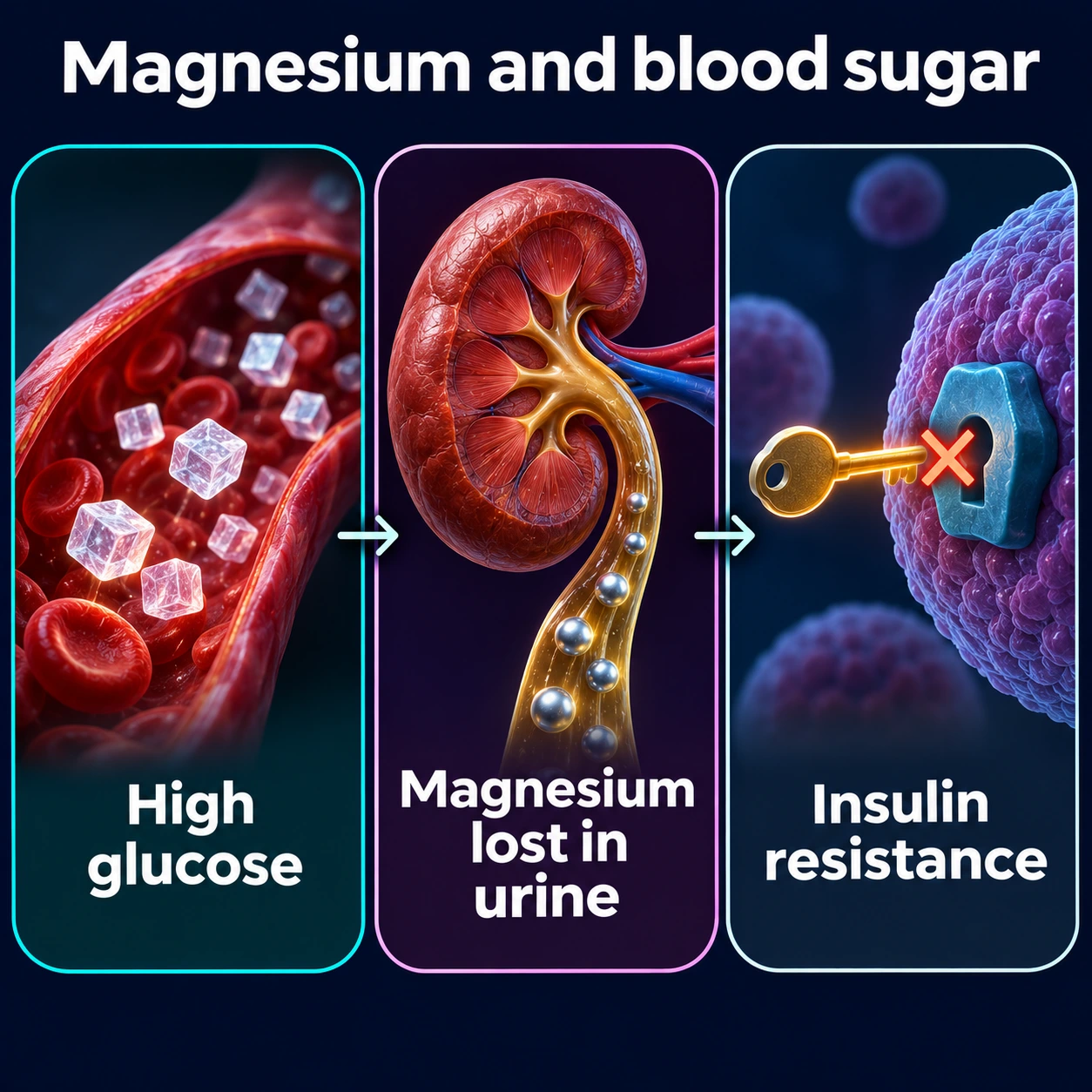

Magnesium is a cofactor for the enzymes of glucose metabolism, and deficiency is genuinely common in poorly controlled diabetes — high glucose drives urinary magnesium loss, which in turn worsens insulin resistance, which raises glucose further. That loop is real.
Evidence tier 2, with a caveat that changes how you read the trials.
Table of Contents
Why the Pooled Trials Look Disappointing
Amiri and colleagues' 2026 systematic review in BMC Nutrition pooled 15 randomised trials in 1,085 people with diabetes and prediabetes and found that, in people with diabetes, oral magnesium supplementation produced no statistically significant change in insulin levels (mean difference (MD) −1.73; 95% confidence interval (CI) −3.73 to 0.27; P = 0.09) or homeostatic model assessment of insulin resistance (HOMA-IR) (MD −0.74; 95% CI −1.58 to 0.09; P = 0.08). The results in people with prediabetes were also not statistically significant.
Read carelessly, that is a null result and the end of the story. Read properly, it is the predictable consequence of a design problem that affects every nutrient on this page.
Magnesium is a repletion intervention, not a drug. Correcting a deficiency helps the deficient; giving more to someone already replete does nothing. A trial that enrols both groups and reports a single average will report a diluted effect — and the more replete participants it enrols, the smaller that average gets. A null pooled result is therefore consistent both with "magnesium does not work" and with "magnesium works in the people who need it, and most trial participants did not." The pooled number cannot distinguish those, and neither can this page.
The same review tested part of this idea. In its meta-regression, the starting insulin level and HOMA-IR significantly changed the effect of magnesium (p = 0.01), while the starting magnesium level, glycated haemoglobin (HbA1c), fasting blood glucose, age and body mass index (BMI) showed no significant link. So the pooled data point to insulin resistance, not the measured magnesium level, as the factor that changed the response, and the authors call for trials aimed at people with higher insulin resistance. Whether people with a true magnesium deficiency respond more is not answered by these data.
Mohammadi and colleagues' 2026 dose-response meta-analysis in Nutrients takes a broader look at cardiometabolic risk factors across 78 randomised trials. Compared with control groups, magnesium lowered HOMA-IR (weighted mean difference −0.48), fasting blood glucose (−3.60 mg/dL) and HbA1c (−0.15%), with no significant effect on fasting insulin. Most of the trials (79.5%) used 300 mg a day or more. The authors describe the effects as "generally modest" and their clinical relevance as uncertain.
Who This Actually Applies To
The people most likely to benefit are the ones most likely to be depleted:
- Poorly controlled diabetes — glycosuria drags magnesium out with the glucose, so the worse the control, the greater the loss.
- Long-term proton-pump inhibitor users — proton pump inhibitors (PPIs) impair magnesium absorption, and the U.S. Food and Drug Administration (FDA) has warned about hypomagnesaemia with prolonged use.
- Loop and thiazide diuretic users — renal wasting.
- Heavy alcohol use — both poor intake and increased excretion.
Serum magnesium is a poor test for status — less than 1% of body magnesium is in the blood and the level is defended tightly, so it can read normal against a substantially depleted body store. That is an argument for considering the clinical picture rather than for trusting a normal result.
Forms and Dosing
Typical supplemental doses are 200–400 mg of elemental magnesium a day. The official adult upper limit for magnesium from supplements, set by the US Institute of Medicine in 1997, is 350 mg a day, with diarrhoea as the limiting effect. The form matters mainly for tolerability:
- Glycinate and malate — well absorbed and the least likely to cause diarrhoea.
- Citrate — well absorbed, mildly laxative, inexpensive.
- Oxide — cheap, poorly absorbed, and mostly a laxative. It is what is in most bargain products.
The 350 mg limit is debated. A 2023 review by magnesium researchers argues that it should be re-examined: of 10 studies it found (5 meta-analyses and 5 randomised controlled trials), seven, using 128–1,200 mg of magnesium a day, found no significant difference in diarrhoea between the magnesium and control groups, and a search of the FDA's adverse-event reports found only 40 cases of gut side effects linked to single-ingredient magnesium products.
Food sources are worth naming because unlike some entries here, dietary intake genuinely matters: pumpkin seeds, almonds, spinach, black beans and dark chocolate are all substantial contributors.
Cautions
- It lowers blood glucose, and so does your medication. The effects add. With insulin or a sulfonylurea this adds to the risk of low blood sugar (hypoglycemia) — see hypoglycemia awareness and prevention.
- Kidney impairment raises the risk. The kidney clears magnesium, and in significant chronic kidney disease supplementation can cause dangerous accumulation. This is the one contraindication that matters.
- It reduces absorption of several drug classes taken at the same time, including tetracycline and quinolone antibiotics, levothyroxine and bisphosphonates. The interaction depends on timing: it occurs when the doses are taken together.
- Diarrhoea is the dose-limiting effect for most people. It is the effect the official upper limit was based on, and how likely it is depends on the form (see Forms and Dosing).
- Measurement shows the effect. When a supplement is added without measuring, an interaction shows up as a symptom rather than as a number.
Key Research Papers
Every DOI below was checked against Crossref and the abstract read for support before it was listed.
- Amiri A, Seighali F, Gholami-Chahkand MS, Jannat B, Seighali N. Oral magnesium supplements and insulin resistance in individuals with diabetes and pre-diabetes: an updated systematic review and meta-analysis of randomized controlled trials. BMC Nutrition, 2026;12(1):207. — doi:10.1186/s40795-026-01424-y — PubMed PMID: 42426860 — Fifteen randomised controlled trials, 1,085 participants; no significant change in insulin or HOMA-IR.
- Mohammadi S, Palermo A, Ojani P, Alaghemand N, et al. Comprehensive Effects of Magnesium Supplementation on Cardiometabolic Risk Factors: A Systematic Review and Dose-Response Meta-Analysis. Nutrients, 2026;18(15):2435. — doi:10.3390/nu18152435 — PubMed PMID: 42588058
- Costello R, Rosanoff A, Nielsen F, West C. Perspective: Call for Re-evaluation of the Tolerable Upper Intake Level for Magnesium Supplementation in Adults. Advances in Nutrition, 2023;14(5):973-982. — doi:10.1016/j.advnut.2023.06.008 — PubMed PMID: 37487817