Benfotiamine and Diabetic Neuropathy
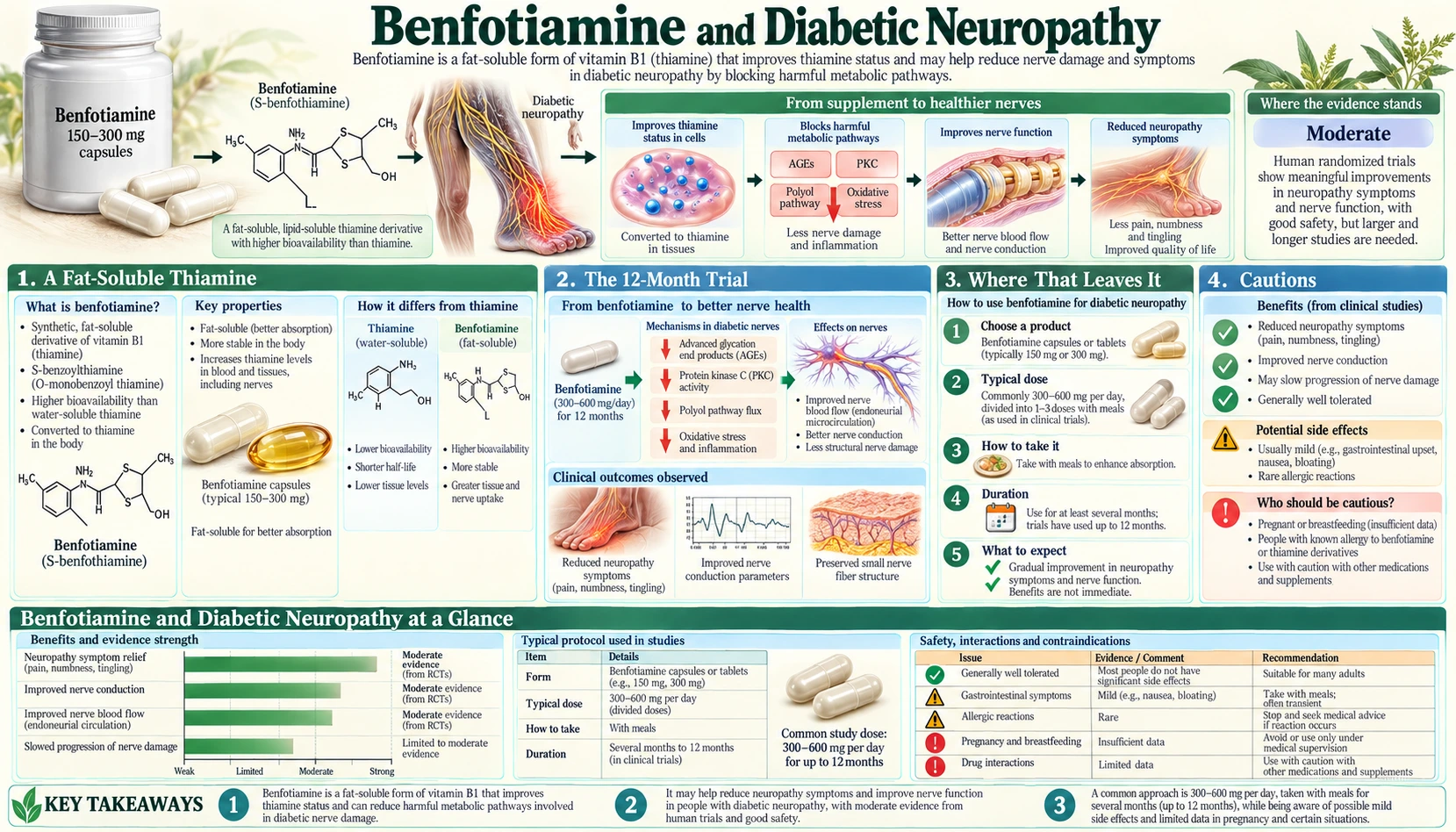
Benfotiamine is aimed at a different target from everything else in this section. It is not trying to lower your blood sugar. It is trying to reduce the damage that high blood sugar causes — specifically through the advanced glycation pathway that injures nerves.
Evidence tier 2, and the most recent trial was negative.
Table of Contents
A Better-Absorbed Form of Thiamine
Thiamine (vitamin B1) is water-soluble and its absorption is saturable, which caps how much can be pushed into tissue. Benfotiamine is a synthetic S-acyl derivative of thiamine that reaches substantially higher tissue thiamine concentrations than an equivalent dose of thiamine itself. It is often described as fat-soluble (lipid-soluble), but a 2008 laboratory study found it practically insoluble in water, organic solvents or oil. The study's authors propose that it is absorbed after enzymes in the gut (intestinal alkaline phosphatases) remove its phosphate group, which sets it apart from the truly fat-soluble thiamine forms (allithiamine, sulbutiamine and fursultiamine). In mice, it strongly raised thiamine levels in blood and liver but had no significant effect in the brain.
The reason to want that: thiamine is the cofactor for transketolase, an enzyme that diverts excess glycolytic intermediates into the pentose phosphate pathway. When glucose is high, those intermediates accumulate and feed four damaging routes — the polyol pathway, hexosamine pathway, protein kinase C activation, and formation of advanced glycation end products. Boosting transketolase is meant to drain the pool before it does harm.
This mechanism comes mainly from animal research. A 2003 study in Nature Medicine found that benfotiamine activated transketolase and blocked three of these pathways (the hexosamine pathway, advanced glycation end product formation and protein kinase C), along with an inflammatory switch called NF-kappaB, in the retinas of diabetic animals, and that it prevented experimental diabetic retinopathy (eye damage) in those animals. That is animal evidence, not a result in people.
This is a genuinely elegant mechanism and it targets the complication rather than the cause — the same strategic position as alpha-lipoic acid occupies.
The 12-Month Trial
Ziegler and colleagues published a 12-month randomised trial of benfotiamine in type 2 diabetes with polyneuropathy in BMJ Open Diabetes Research & Care in 2026. Fifty-seven participants were randomised, and the primary outcome — change in corneal nerve fibre length, an objective structural measure of small-fibre nerve damage — did not differ between the benfotiamine and placebo groups. The secondary morphometric, neurophysiological, clinical and quality-of-life outcomes did not differ either.
Participants took 300 mg of benfotiamine twice a day. Besides the primary outcome, the trial measured three other corneal nerve measures, four skin-biopsy measures, 13 nerve-conduction measures, other sensory and autonomic nerve tests, and 15 clinical scores for neuropathy symptoms and signs. Only the Neuropathy Symptom Score tended to improve with benfotiamine, and that trend was not statistically significant (p=0.098 versus placebo). Benfotiamine raised all six blood thiamine measures studied (p≤0.003 versus placebo), so the supplement was being absorbed. The safety analysis showed no relevant differences between the groups in the rates of adverse events.
That is a clean negative result on the outcome that matters most, from the same research group that produced much of the positive alpha-lipoic acid evidence. It deserves more weight than the shorter, smaller, symptom-score studies that preceded it, because structural nerve measures are harder to move and harder to fool than a patient-reported symptom scale.
Mandra and colleagues' 2026 review and meta-analysis of B-vitamin supplementation for diabetic peripheral neuropathy in the Journal of Clinical Medicine sets the broader context. It pooled 13 randomised trials (834 people) of B vitamins in any form, dose or route. B vitamins improved scores on the Michigan Neuropathy Screening Instrument questionnaire and examination, but the examination gain (0.39 points) fell below the 0.5-point minimal clinically important difference (the smallest change considered meaningful). Pain measured on general numeric or visual scales did not change significantly, although disease-specific pain scales and sural nerve conduction favoured B vitamins. Combination B-vitamin products looked more promising than single vitamins, and the authors write that substantial heterogeneity and risk of bias preclude firm recommendations for routine use.
Earlier and Longer Trials
The positive short-term evidence comes from the BENDIP trial, published in 2008. It randomised 165 people with diabetic polyneuropathy (diabetic nerve damage) to benfotiamine 600 mg a day, benfotiamine 300 mg a day or placebo for 6 weeks. The Neuropathy Symptom Score differed significantly between the groups only among the people who completed the study as planned (the per-protocol analysis, p=0.033); in the full intention-to-treat analysis the result was just short of significance (p=0.055), and the Total Symptom Score showed no significant difference. The improvement was more marked at the higher dose. Treatment was well tolerated in all groups.
A longer trial, published in 2012, gave 67 people with type 1 diabetes benfotiamine 300 mg a day or placebo for 24 months. Blood thiamine rose markedly in the benfotiamine group, but peripheral nerve function and blood markers of inflammation did not differ from placebo.
Where That Leaves It
Benfotiamine is well tolerated and inexpensive, and the mechanism remains scientifically interesting. But a well-conducted 12-month trial with an objective structural endpoint found nothing, and honest reporting means leading with that rather than burying it under the mechanism.
For diabetic neuropathy specifically, the intervention with the better evidence is alpha-lipoic acid, which is a licensed medicine for this indication in Germany. And the intervention with better evidence than either is glucose control itself.
Cautions
- Tolerability in trials. In the 12-month trial (300 mg twice a day), the safety analysis showed no relevant differences from placebo in the rates of adverse events, and the 6-week BENDIP trial reported that treatment was well tolerated in all groups.
- Numb or burning feet have several causes. Some of them are urgent, and none of them is diagnosed by trying benfotiamine.
- Thiamine deficiency is a separate, real condition in heavy drinkers and after bariatric surgery. It is treated with thiamine itself; benfotiamine is a different product, studied for diabetic neuropathy.
- Glucose monitoring. Measuring blood sugar shows directly whether anything new in the routine changes it, rather than leaving it to be noticed from a symptom.
Key Research Papers
Every DOI below was checked against Crossref and the abstract read for support before it was listed.
- Ziegler D, et al. Effects of benfotiamine treatment over 12 months on morphometric, neurophysiological and clinical measures in type 2 diabetes patients with symptomatic polyneuropathy: a randomized, placebo-controlled, double-blind clinical trial (BOND study). BMJ Open Diabetes Research & Care, 2026;14(1):e005773 — doi:10.1136/bmjdrc-2025-005773 — Negative on the primary and secondary outcomes.
- Mandra EV, Parfenov VA, Stupin VA, Silina EV. Vitamin B Supplementation for Diabetic Peripheral Neuropathy: A Review and Meta-Analysis. Journal of Clinical Medicine, 2026;15(13):5156. — doi:10.3390/jcm15135156
- Stracke H, Gaus W, Achenbach U, Federlin K, Bretzel RG. Benfotiamine in diabetic polyneuropathy (BENDIP): results of a randomised, double blind, placebo-controlled clinical study. Experimental and Clinical Endocrinology & Diabetes, 2008;116(10):600-5. — PubMed PMID: 18473286
- Fraser DA, Diep LM, Hovden IA, et al. The effects of long-term oral benfotiamine supplementation on peripheral nerve function and inflammatory markers in patients with type 1 diabetes: a 24-month, double-blind, randomized, placebo-controlled trial. Diabetes Care, 2012;35(5):1095-7. — PubMed PMID: 22446172
- Volvert ML, Seyen S, Piette M, et al. Benfotiamine, a synthetic S-acyl thiamine derivative, has different mechanisms of action and a different pharmacological profile than lipid-soluble thiamine disulfide derivatives. BMC Pharmacology, 2008;8:10. — PubMed PMID: 18549472
- Hammes HP, Du X, Edelstein D, et al. Benfotiamine blocks three major pathways of hyperglycemic damage and prevents experimental diabetic retinopathy. Nature Medicine, 2003;9(3):294-9. — PubMed PMID: 12592403