Spermidine: History and Discovery
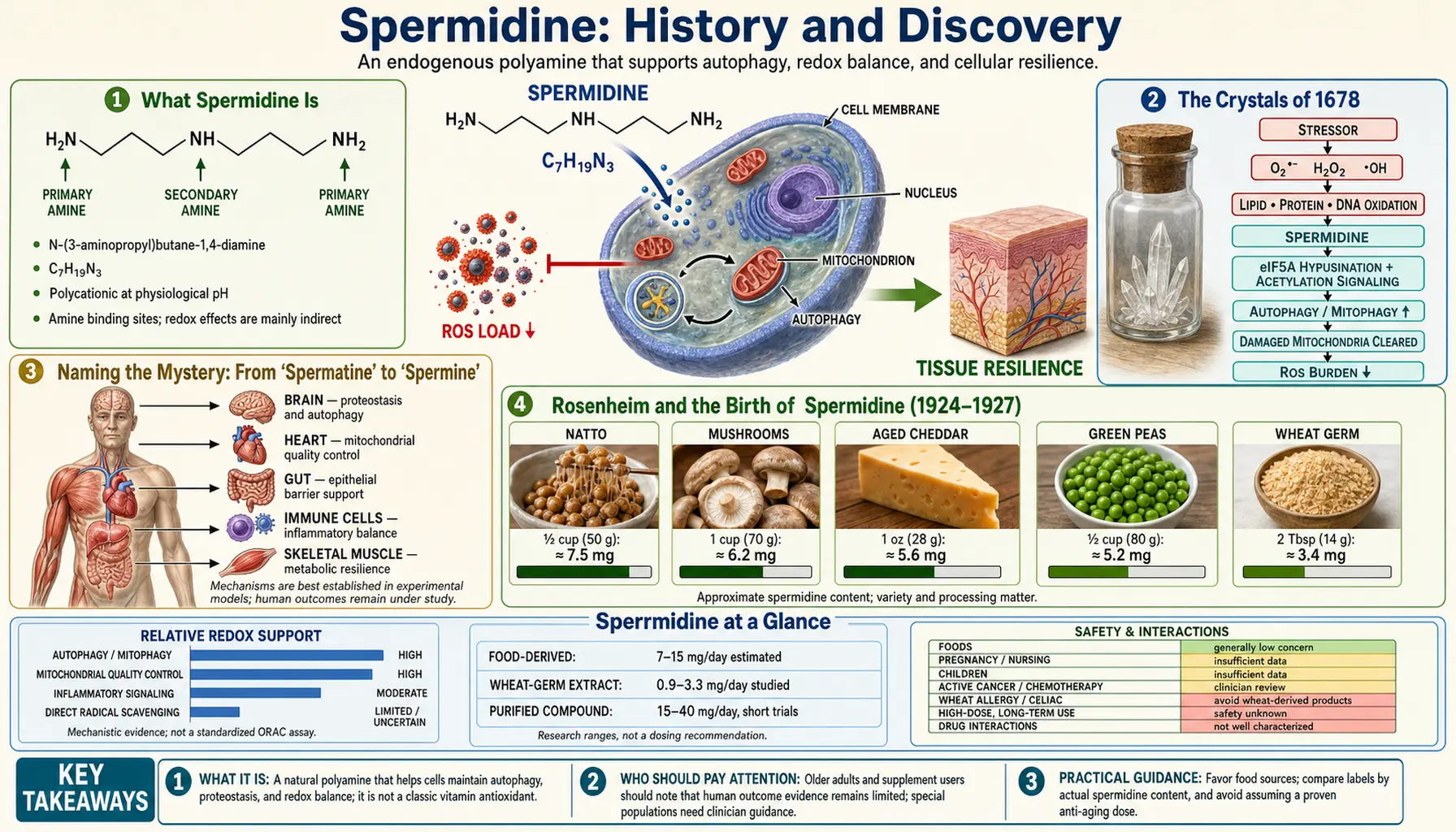
Spermidine's history is a chemist's story rather than a healer's. The molecule was not handed down by any folk tradition; it was teased out of the laboratory over the course of two and a half centuries. The trail begins in 1678, when a Dutch lens-grinder peering at drying semen described glittering crystals he could not name — crystals that turn out to belong not to spermidine but to its close relative spermine. From those crystals came the family name "sperm-," and from a long line of chemists came the slow work of figuring out what the crystals actually were. Spermidine itself was not isolated and named until the 1920s, and its remarkable modern role — as a natural trigger of the cell's self-cleaning program, autophagy — was only uncovered in 2009. This page sticks to what the record firmly supports, corrects a popular myth about who "discovered" spermidine, and marks clearly where a claim is established and where it is still being tested.
Table of Contents
- What Spermidine Is
- The Crystals of 1678
- Naming the Mystery: From "Spermatine" to "Spermine"
- Rosenheim and the Birth of Spermidine (1924–1927)
- Mapping the Polyamine Pathway
- The Longevity Turn: Autophagy (2009)
- From Mice to Mediterranean Diets
- A Molecule Hidden in Everyday Food
- Research Papers and References
- Connections
- Featured Videos
What Spermidine Is
Before the history makes sense, it helps to know what is being discovered. Spermidine is a small molecule called a polyamine — in plain terms, a short carbon chain studded with nitrogen-containing amine groups that carry a positive charge. Spermidine specifically is a triamine: it has three of those amine groups, and chemists write its formula as C7H19N3. It belongs to a small family of related compounds, the best-known being putrescine (a diamine, the simplest of the group) and spermine (a tetramine, the largest). The three are made one from the next, like rungs added to a ladder.
What makes polyamines worth a history at all is that they are not exotic. Spermidine is found in essentially every living cell — bacterial, plant, and animal — where its positive charge lets it cling to the negatively charged surfaces of DNA, RNA, and proteins and help hold them in working order. Because it is woven so deeply into basic cell biology, spermidine was bound to surface again and again in different sciences: first in seventeenth-century microscopy, then in nineteenth-century chemistry, and finally in twenty-first-century research on aging. The rest of this page follows that thread.
The Crystals of 1678
The story opens with Antonie van Leeuwenhoek (1632–1723), the self-taught Delft microscopist whose hand-ground lenses first revealed bacteria, sperm cells, and a hidden microscopic world. In 1678 Leeuwenhoek reported something else in human semen: as the fluid dried, it threw down distinct, glittering crystals. He described them but could not say what they were — the chemistry to identify such a substance simply did not exist yet. This observation is the documented beginning of polyamine research, and it is why the whole family of molecules eventually took its name from semen (Latin sperma).
Here a popular claim needs correcting, because it appears on many supplement websites and in earlier drafts of our own pages. It is often said that Leeuwenhoek "discovered spermidine" in 1678. That is not accurate. The crystals Leeuwenhoek saw were later identified as a phosphate salt of spermine — spermidine's larger cousin — not spermidine itself. Spermidine would not be isolated, named, or chemically defined for roughly another 250 years. What 1678 gives us is genuine and important: the first sighting of a polyamine crystal, and the origin of the family name. But the honest version is that Leeuwenhoek opened the door to the polyamines as a group; he did not discover the specific molecule spermidine.
Naming the Mystery: From "Spermatine" to "Spermine"
For more than a century after Leeuwenhoek, the crystals were a curiosity in search of an explanation, and the explanation came in slow instalments from a succession of chemists. In 1791 the French chemist Louis Nicolas Vauquelin rediscovered the crystals and showed that they were poorly soluble in water and alcohol, concluding — incorrectly, as it turned out — that they were a phosphate salt of some simple inorganic substance. In 1865 the German physician Arnold Adolph Böttcher described them again and guessed they were made of a protein, which he called spermatine; that guess was also wrong, but the name shows how completely the true nature of the crystals still eluded everyone.
The decisive step came in 1878, when Philipp Schreiner established that the crystals were the phosphate salt of a simple basic organic compound — not a protein and not an inorganic mineral, but an organic base. Ten years later, in 1888, the chemists Albert Ladenburg and J. Abel gave that organic base the name it still carries: spermine. (A Russian physician, Alexander von Poehl, separately promoted spermine in the 1890s as a therapeutic "vital" substance, an episode now regarded as more enthusiasm than science.) By the close of the nineteenth century, then, science had a name — spermine — and the knowledge that it was an organic base, but still no correct chemical structure and no awareness that a second, related base was hiding alongside it.
Rosenheim and the Birth of Spermidine (1924–1927)
The riddle was finally solved in the 1920s at the National Institute for Medical Research in Hampstead, London, chiefly through the work of the chemist Otto Rosenheim and his colleagues. In 1924, Rosenheim — working with Harold Ward Dudley and Mary C. Rosenheim — isolated spermine in quantity from animal tissue (famously from ox pancreas) and prepared its salts, the groundwork that let the long-mysterious structure of spermine finally be worked out. This is the moment the structure of the crystals first seen in 1678 was genuinely pinned down, roughly two and a half centuries later.
It was in the course of this work that spermidine made its entrance. While studying spermine, the chemists found a second, distinct base in the same biological material — a smaller relative they isolated, characterized, and named spermidine (the "-idine" marking it as kin to spermine). The defining paper is well documented: in 1927, Harold Ward Dudley, Otto Rosenheim, and Walter William Starling published "The Constitution and Synthesis of Spermidine, a Newly Discovered Base Isolated from Animal Tissues" in the Biochemical Journal. The title says it plainly: spermidine was a newly discovered base, and the same paper reported its synthesis — meaning the team did not just find spermidine in tissue but confirmed its structure by building it from scratch in the laboratory.
This is the real birth date of spermidine as a known chemical entity: not 1678, but the mid-1920s, and not by a microscopist but by a group of named chemists who isolated it, determined its constitution, and synthesized it to prove they were right. Tracing it back further than that — to Leeuwenhoek — conflates spermidine with spermine. The accurate, documented credit for spermidine belongs to Dudley, Rosenheim, and Starling.
Mapping the Polyamine Pathway
Knowing spermidine's structure was one thing; understanding where the body gets it was another, and that took the middle decades of the twentieth century. Researchers gradually traced the polyamine biosynthetic pathway — the assembly line by which cells build these molecules. In broad outline, the body makes spermidine starting from the amino acid ornithine, which is converted to the diamine putrescine; an enzyme called spermidine synthase then adds a building block donated by a derivative of the amino acid methionine to turn putrescine into spermidine. Adding one more block converts spermidine into the larger spermine. So putrescine, spermidine, and spermine form a short, ordered chain, each made from the one before.
Two practical facts came out of this work, and both matter for the modern story. First, the body makes its own spermidine, but the amount it makes tends to fall with age in several tissues — a decline that later researchers would seize on. Second, spermidine is not only self-made: it is also produced by the bacteria living in the gut and absorbed from the diet. That combination — an internal supply that wanes over a lifetime, plus an external supply from food and microbes — is exactly what set the stage for the question that revived interest in the molecule: what happens if you top up a body's declining spermidine?
The Longevity Turn: Autophagy (2009)
For most of the twentieth century spermidine was a respectable but unglamorous topic — important to cell biologists, largely unknown to everyone else. That changed in 2009. A team led by Frank Madeo at the University of Graz in Austria, with Tobias Eisenberg as lead author, published a landmark paper in Nature Cell Biology titled "Induction of autophagy by spermidine promotes longevity." They reported that feeding spermidine extended lifespan in yeast, fruit flies, worms, and cultured human immune cells — and, crucially, that it did so by switching on autophagy, the cell's program for digesting and recycling its own worn-out parts.
The mechanism they described gave the finding real weight. Spermidine was shown to inhibit enzymes that chemically tag certain proteins (histone acetyltransferases), and through that change in tagging it ramped up the genes that drive autophagy. When the researchers genetically blocked autophagy, spermidine's life-extending effect disappeared — strong evidence that autophagy was the route, not a coincidence. This was the moment spermidine crossed over from biochemistry into the science of aging. It reframed an old, well-characterized cellular molecule as a candidate caloric-restriction mimetic — a substance that might reproduce some benefits of fasting and dietary restriction without the fasting itself.
From Mice to Mediterranean Diets
The years after 2009 saw researchers push spermidine up the ladder of evidence, from simple organisms toward humans. In 2016, Eisenberg, Madeo and a large international group reported in Nature Medicine ("Cardioprotection and lifespan extension by the natural polyamine spermidine") that oral spermidine extended the lifespan of mice and protected their hearts — reducing cardiac enlargement and preserving the heart's ability to relax and fill between beats, again with autophagy and improved mitochondrial function implicated as the mechanism.
Human data, necessarily more cautious, arrived alongside. The most cited is the Bruneck Study in northern Italy: in 2018, Stefan Kiechl, Raimund Pechlaner, Peter Willeit and colleagues reported in the American Journal of Clinical Nutrition that, among roughly 829 adults followed for about two decades, those eating the most spermidine had markedly lower all-cause mortality than those eating the least — a gap the authors calculated as roughly equivalent to being about 5.7 years younger. That same year, a small German pilot trial led by Miranka Wirth (published in Cortex, and part of the wider SmartAge program) found modestly better memory performance in older adults at risk for dementia who took spermidine for three months.
Two honest caveats belong here. The Bruneck finding is an observational association — it links higher spermidine intake to longer life but cannot by itself prove the spermidine caused it, since people who eat more spermidine-rich whole foods differ in many ways. And the early human supplement trials were small and preliminary. What the post-2009 history shows is a clear, reproducible signal across yeast, flies, worms, and mice, plus suggestive human data — enough to make spermidine one of the most actively studied molecules in aging research, but not yet enough to call it a proven longevity drug. The fuller modern evidence, mechanisms, dosing and cautions are covered on the main Spermidine page and in the Spermidine Benefits articles.
A Molecule Hidden in Everyday Food
One of the quietly remarkable things the modern research surfaced is that spermidine has been part of the human diet all along — people simply did not know the name of what they were eating. Because spermidine is present in living and fermenting cells, it is concentrated in a scatter of traditional foods: wheat germ is the single richest common source, and aged cheeses, soybean products such as natto and tempeh, mushrooms, green peas, and certain other legumes and vegetables all contribute meaningful amounts. Fermentation, in particular, tends to raise polyamine content, which is part of why aged and fermented foods score so highly.
This dietary angle is the closest spermidine has to the kind of cultural backstory that herbs and famous antioxidants enjoy. There is no single dramatic episode — no equivalent of the "French Paradox" that made resveratrol famous — but the same Mediterranean and traditional eating patterns long associated with healthy aging happen to be comparatively rich in spermidine. Researchers have noted this overlap as one possible thread (among many) running through the diet-and-longevity literature. It is a thread worth naming carefully: the presence of spermidine in these diets is well documented, but the leap from "these long-lived populations eat spermidine" to "spermidine is why they live long" is exactly the causal step the science has not yet earned. The history of spermidine, in the end, is the history of a molecule that was always on the plate and inside the cell, waiting two and a half centuries for instruments and ideas to catch up with it.
Research Papers and References
The list below pairs key peer-reviewed sources for spermidine's discovery and modern history with curated PubMed topic-search links. Author names, titles, and journals are given as plain text; only the stable DOI, PMID, PMCID, or archive link is hyperlinked, and each opens in a new tab. The seventeenth- to nineteenth-century observations (Leeuwenhoek 1678, Vauquelin 1791, Böttcher 1865, Schreiner 1878, Ladenburg and Abel 1888) are described in the article as historical milestones and are summarized in the Bachrach review cited below rather than linked individually.
- Bachrach U. The early history of polyamine research. Plant Physiology and Biochemistry. 2010;48(7):490-495. — doi:10.1016/j.plaphy.2010.02.003 Search PubMed
- Dudley HW, Rosenheim O, Starling WW. The constitution and synthesis of spermidine, a newly discovered base isolated from animal tissues. Biochemical Journal. 1927;21(1):97-103. — PMC1251878
- Dudley HW, Rosenheim MC, Rosenheim O. The chemical constitution of spermine. I. The isolation of spermine from animal tissues, and the preparation of its salts. Biochemical Journal. 1924;18(6):1263-1272. — PMID: 16743399
- Eisenberg T, Knauer H, Schauer A, et al. (Madeo F, senior author). Induction of autophagy by spermidine promotes longevity. Nature Cell Biology. 2009;11(11):1305-1314. — doi:10.1038/ncb1975 · PMID: 19801973
- Eisenberg T, Abdellatif M, Schroeder S, et al. Cardioprotection and lifespan extension by the natural polyamine spermidine. Nature Medicine. 2016;22(12):1428-1438. — doi:10.1038/nm.4222 · PMID: 27841876
- Kiechl S, Pechlaner R, Willeit P, et al. Higher spermidine intake is linked to lower mortality: a prospective population-based study. American Journal of Clinical Nutrition. 2018;108(2):371-380. — doi:10.1093/ajcn/nqy102 · PMID: 29955838
- Wirth M, Benson G, Schwarz C, et al. The effect of spermidine on memory performance in older adults at risk for dementia: a randomized controlled trial. Cortex. 2018;109:181-188. — doi:10.1016/j.cortex.2018.09.014 · PMID: 30388439
- Spermidine, polyamines, and the history of their discovery PubMed: polyamine and spermidine history
- Spermidine, autophagy, and longevity PubMed: spermidine, autophagy, and longevity
External Authoritative Resources
- Biochemical Journal (1927) — the original spermidine paper (open archive)
- PubChem — Spermidine compound record
- PubMed — All research on spermidine