Sea Moss: History and Discovery
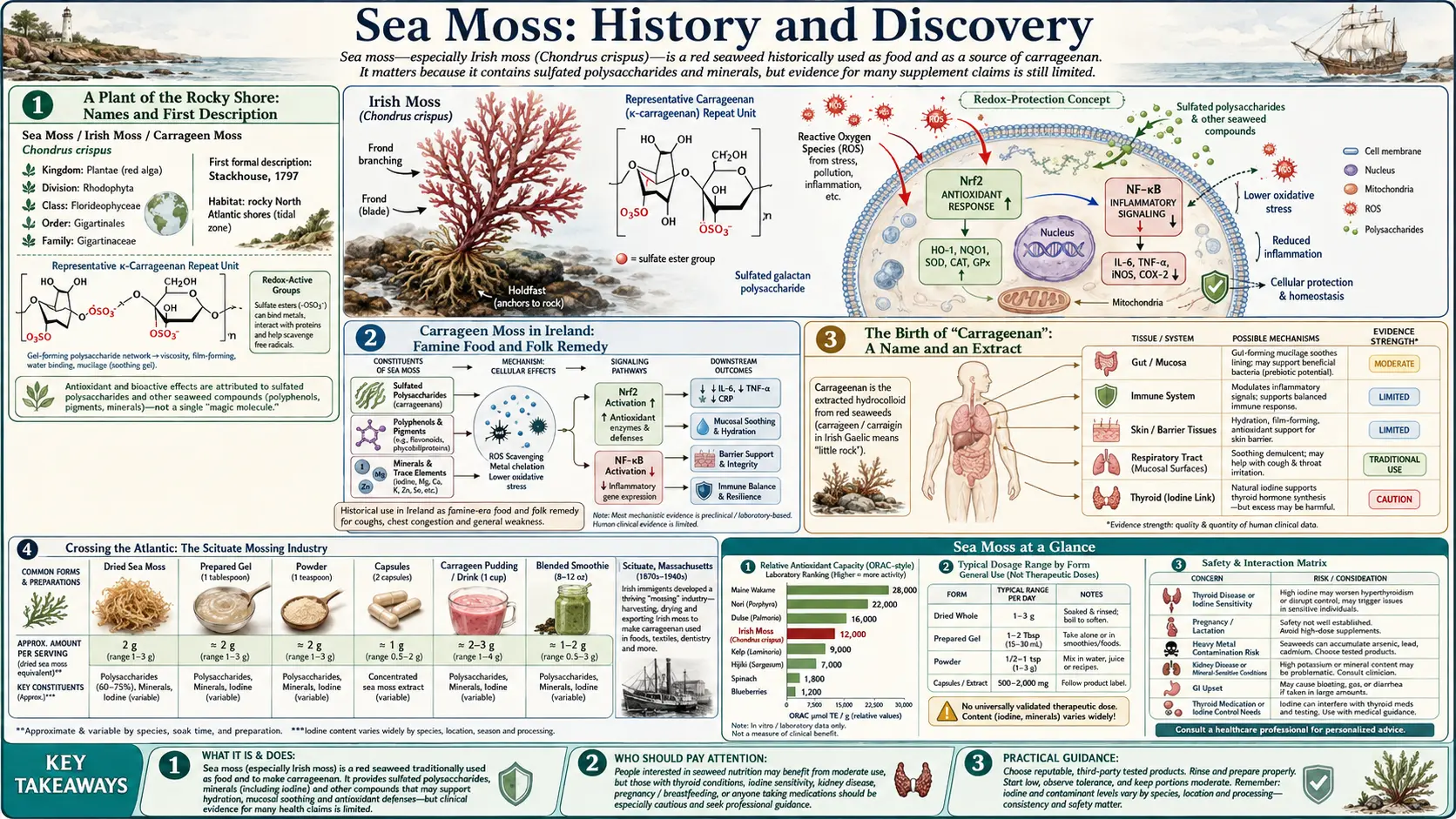
The seaweed we now call sea moss has one of the better-documented histories of any natural health food — and yet much of what circulates online about it is half-legend. The plant itself, Chondrus crispus, was growing on the rocky Atlantic shores of Ireland and New England long before anyone wrote it down, but the written record is surprisingly firm on the key moments: the year it was given its scientific name, the decade its famous gelling extract earned the word “carrageenan,” the Irish immigrant who turned it into an American industry, the wartime shortage that made it big business, and the modern teacher who revived it as a superfood. This article walks through what the historical record actually supports, and is careful to flag the places where popular tellings outrun the evidence. Where a date or a name is solid we say so; where a claim is folklore or still argued, we mark it as such.
Table of Contents
- A Plant of the Rocky Shore: Names and First Description
- Carrageen Moss in Ireland: Famine Food and Folk Remedy
- The Birth of “Carrageenan”: A Name and an Extract
- Crossing the Atlantic: The Scituate Mossing Industry
- War, Agar, and the Rise of an Industry
- From Sea Moss to Science: Carrageenan in the Laboratory
- Dr. Sebi and the Modern Sea Moss Revival
- What the History Does and Does Not Tell Us
- Research Papers and References
- Connections
- Featured Videos
A Plant of the Rocky Shore: Names and First Description
The first thing to understand about sea moss is that it is not a moss at all. The plant sold under that name — and under the older name Irish moss — is a red seaweed, a marine alga in the phylum Rhodophyta. Its scientific name is Chondrus crispus, and the most common species had been gathered from the shore for food and folk medicine for a very long time before any naturalist gave it a Latin name. People used the plant first; the science came later.
That naming happened in stages in the eighteenth century, and the record here is firm. The seaweed appeared in early British botanical works under the broad, catch-all genus Fucus — among the names applied to it was Fucus filiformis in William Hudson's Flora Anglica of 1762, and Linnaeus called the plant Fucus crispus in the 1767 edition of his work. The decisive step came in 1797, when the English botanist John Stackhouse, in his book Nereis Britannica (a survey of the seaweeds of the British coasts), separated this plant out of the overcrowded genus Fucus and placed it in a new genus he called Chondrus. The species he named Chondrus crispus, and that name is still the accepted one today. The name is, technically, a replacement name: Linnaeus's 1767 Fucus crispus was an illegitimate later homonym, because Hudson had already used the name Fucus crispus back in 1762 for a different seaweed — so a new name was needed, and Stackhouse's Chondrus crispus supplied it. A small piece of botanical housekeeping, but a well-documented one.
The names themselves carry the plant's story. The genus name Chondrus comes from the ancient Greek chondros, meaning “cartilage” or “gristle,” a nod to the tough, springy, cartilage-like feel of the fresh fronds. The species name crispus is Latin for “curled” or “crinkled,” describing the way the flat, fan-shaped fronds fork and ruffle. The everyday name carrageen (and the modern industrial word carrageenan built from it) comes from the Irish carraigín, meaning “little rock” — an apt description of a seaweed that clings to rocks in the splash zone. Two of these names describe what the plant feels like and where it grows; the third would go on to name one of the most widely used food ingredients in the world.
Carrageen Moss in Ireland: Famine Food and Folk Remedy
The richest early tradition of using Chondrus crispus grew up along the rocky Atlantic coast of Ireland, which is how it earned the English name “Irish moss.” Coastal families gathered it at low tide, dried and bleached it in the sun, and used it both as food and as a household remedy. Its most prized property was practical and easy to see: when the dried weed is simmered in milk or water it dissolves and then sets, on cooling, into a soft jelly. That made it a natural thickener and gelling agent long before anyone knew why it worked — the basis of the traditional carrageen moss pudding or blancmange still made in Ireland today, and a folk method for clarifying beer.
This gelling property was noticed in print early. In his 1819 work British Fuci, the naturalist Dawson Turner remarked that Chondrus crispus would “melt on boiling and afterwards harden into a gelatine, which I do not despair of seeing hereafter employed to useful purposes” — an observation that reads, two centuries later, like a quiet prediction of the entire carrageenan industry. The plant's other great traditional use was as a soothing remedy for coughs, sore throats, and chest complaints; the same gel that thickened a pudding was taken as a demulcent drink to coat an irritated throat.
Sea moss is bound up most famously with the Great Irish Famine of 1845–1852, when repeated failures of the potato crop brought mass starvation. Along the coast, families turned to what the sea would give, and Chondrus crispus — boiled into soups, porridges, and jellies that stretched scarce food — became one of the survival foods of that catastrophe. It is worth being precise here: carrageen was eaten in Ireland well before the famine (its culinary use is recorded much earlier), so the honest statement is not that the famine introduced sea moss, but that the famine cemented its place in Irish memory as a food of last resort and endurance. That association is part of why the plant travelled, as the next section describes.
The Birth of “Carrageenan”: A Name and an Extract
The story of sea moss as a substance — as opposed to a whole seaweed — is the story of carrageenan, the family of sulfated polysaccharides that give the plant its gelling power. Carrageenan is not a single chemical but a group of closely related long-chain carbohydrates (the main types are now labelled kappa, iota, and lambda), and it makes up a large share of the dried weed by weight. It is the reason a spoonful of dried sea moss can set a whole bowl of liquid into jelly.
The documented milestones here are reasonably tight. An extract of Chondrus crispus was being described in Ireland around 1810, recommended chiefly as a remedy for chest and respiratory ailments; Dawson Turner's 1819 note (above) recorded the gelling behaviour in print. The word “carrageen” itself seems to have come into use around 1829 as a name for the seaweed, and is generally traced to Carrigan Head in County Donegal, in the northwest of Ireland — the same Irish root, carraigín (“little rock”), that names the plant. Over the following century the suffix “-an” was attached to give carrageenan, the name now used for the purified extract rather than the whole weed.
A word of caution belongs here, because it is the kind of detail popular accounts tend to over-sharpen. The early-nineteenth-century dates describe when carrageen was being used and written about as a gelling extract and when the name took hold — not a single laboratory “discovery” of a pure molecule by a named chemist on a known day. Carrageenan was not invented; it was a property of a familiar seaweed that was gradually recognised, named, and eventually purified. The detailed chemistry — working out that carrageenan is a mixture of distinct sulfated galactans — came much later, in the twentieth century, and is taken up further down this page.
Crossing the Atlantic: The Scituate Mossing Industry
The same red seaweed grows on the other side of the North Atlantic, along the rocky coasts of Atlantic Canada and New England, and that is where Irish moss became an industry. The pivotal figure in the popular history is Daniel Ward, an Irish immigrant working as a fisherman out of Massachusetts. In the 1840s — many accounts give the year as around 1847 — Ward is said to have recognised the familiar carrageen growing in the waters off Scituate, a coastal town between Boston and Plymouth, and realised it was the very seaweed his countrymen harvested back in Ireland for pudding and for clarifying beer. He gave up fishing to gather it, and together with a partner usually named Miles O'Brien helped start what became the American Irish-moss, or “mossing,” trade.
The timing was no accident. The same famine that had made carrageen a survival food in Ireland was driving waves of Irish immigrants to New England, and Scituate drew so many mossing families that it later styled itself the “most Irish town in America.” Mossers worked the offshore rocks from small dories, raking the weed loose with long-handled rakes, then drying and sun-bleaching it on shore before selling it on. The harvest season ran through the calmer summer months, which is one reason the same men could serve as winter lifesavers along that wreck-prone coast. The Scituate mossing industry persisted, in declining form, well into the twentieth century before fading out late in the century.
This is a good place to weigh the evidence honestly. The Daniel Ward story is recounted by reputable outlets, including local Massachusetts histories and Irish-heritage publications, and the broad outline — an Irish immigrant founding the Scituate mossing trade in the 1840s — is well attested. The very precise version (“1847,” the exact partnership, individual quotations) varies a little from telling to telling, and some sober sources give only “the 1840s.” So this page reports Daniel Ward and Scituate as genuine, documented history, while treating the single-year precision as the traditional rather than the certain version of the date.
War, Agar, and the Rise of an Industry
For its first century the New England moss trade was a modest, regional business. What turned carrageenan into a global commodity was the Second World War. Before the war, the food and laboratory worlds relied heavily on agar, another seaweed gelling agent, most of which came from Japan. When the war cut off that supply, manufacturers in North America scrambled for a substitute — and carrageenan from Chondrus crispus, already known as a gelling extract, was the obvious candidate. Demand and production climbed steeply: Canadian Irish-moss output, for example, rose from a few hundred thousand pounds of dried weed in 1941 to several million pounds within about a year.
The wartime boom did not fade with the war. Carrageenan turned out to be cheaper and more versatile than the products it replaced, and through the second half of the twentieth century it became a workhorse ingredient of the food industry — used to thicken, stabilise, and gel dairy products, processed meats, plant milks, toothpaste, and countless other goods. By the late twentieth century carrageenan was the leading seaweed extract on the world market, with Atlantic Canada at one point supplying a large share of global production. The obscure shore-weed of the Irish famine had become an industrial staple sold by the tonne.
Two strands of sea moss's modern story diverge at this point, and it helps to keep them apart. One strand is industrial carrageenan, the purified, regulated food additive extracted from Chondrus crispus and several related tropical seaweeds. The other is whole sea moss, the dried weed or home-made gel eaten as a food and supplement. They come from the same family of seaweeds and share the same gelling chemistry, but they are not the same product — a distinction worth remembering whenever “sea moss” and “carrageenan” are discussed together.
From Sea Moss to Science: Carrageenan in the Laboratory
Once carrageenan mattered commercially, scientists set about understanding it. Through the twentieth century, chemists established that “carrageenan” is not one compound but a family of sulfated galactans — long chains of the sugar galactose carrying sulfate groups — and sorted them into the principal types now labelled kappa, iota, and lambda, which differ in how much sulfate they carry and therefore in how firm or soft a gel they form. This is the molecular explanation for the property Irish coastal families had been exploiting for generations without knowing the chemistry: the sulfated polysaccharides are what set the pudding.
More recently the same molecules have drawn biomedical interest. Laboratory and animal research has reported that the sulfated polysaccharides of Chondrus crispus can act as prebiotics — feeding beneficial gut bacteria and shifting the balance of the gut microbiome — and a 2015 study in BMC Complementary and Alternative Medicine by Liu and colleagues documented exactly such effects, along with changes in immune markers, in animals fed cultivated sea moss. Separately, carrageenans have been studied for antiviral activity in the test tube, where their sulfated chains appear to interfere physically with the ability of certain viruses to attach to and enter cells; a 2021 review in Marine Drugs by Álvarez-Viñas and colleagues surveys this evidence. These findings are genuine and interesting, but they are largely pre-clinical, and they describe isolated carrageenan more than whole sea moss gel — reasons for measured optimism rather than firm health claims.
Chondrus crispus has also become a workhorse of basic marine biology. As one of the most-studied red seaweeds, it has served as a model organism for understanding the biology and life cycles of the red algae, and its genome has been sequenced. The plant that began as a folk food has thus ended up in three different laboratories at once: the food chemist's, the gut-microbiome researcher's, and the marine biologist's.
Dr. Sebi and the Modern Sea Moss Revival
For most of the twentieth century, sea moss in the English-speaking world meant one of two things: an old-fashioned Irish pudding, or an anonymous ingredient on a food label. Its return as a celebrated “superfood” owes a great deal to one man: Alfredo Darrington Bowman (1933–2016), the Honduran-born herbalist far better known as Dr. Sebi. Bowman built a large following around an alkaline, plant-based diet and the idea that disease arises from mucus and acidity in the body. He promoted sea moss as a near-complete mineral food and a foundation of his nutritional program, and his advocacy — amplified by celebrity clients and, after his death, by social media — is the single biggest driver of the modern sea moss boom.
Honesty requires being clear about what this part of the history is. Bowman was a charismatic self-taught healer, not a scientist, and the core of his teaching — the “alkaline diet” theory and his claims to cure serious diseases — is not supported by mainstream science and has been specifically criticised by medical and scientific reviewers. He died in 2016 while in custody in Honduras following an arrest. None of this erases sea moss's real nutritional content or its long, genuine history as a food; but the popular framing of sea moss as a cure-all that “contains 92 of the body's 102 minerals” traces largely to Bowman's promotion, and that specific 92-mineral claim has not been established by a definitive laboratory study. The careful reader can hold both truths at once: sea moss is a genuinely mineral-rich seaweed with centuries of food use, and a good deal of what is said about it online is marketing built on a contested teacher's claims.
The result, in any case, is undeniable. From a few dried fronds boiled by Irish coastal families, sea moss has become a worldwide supplement sold as raw weed, gels, capsules, gummies, and powders — a multi-million-dollar market driven as much by endorsement and folklore as by the underlying science.
What the History Does and Does Not Tell Us
The history of sea moss is, refreshingly, a history with real dates and real names attached: the seaweed named Chondrus crispus by John Stackhouse in 1797; its gelling property noted by Dawson Turner in 1819; the name “carrageen” settling in around 1829 from a headland in County Donegal; Daniel Ward founding the Scituate mossing trade in the 1840s; the Second World War turning carrageenan into a global industry; and Dr. Sebi reviving sea moss as a superfood in the late twentieth century. Each of those is documented, and this article has tried to report them plainly.
But a long and well-recorded history is a reason to take a food seriously, not proof of any particular health benefit. The thread that runs unbroken from a famine-era jelly to a capsule on a shop shelf tells us that people have eaten this seaweed, valued its gel, and depended on it — it does not, by itself, tell us what it will do for any one person today. The genuinely interesting modern research on carrageenan's prebiotic and antiviral behaviour is mostly early-stage and often studies the isolated extract rather than whole sea moss. And the most extravagant claims — the precise “92 minerals,” the promise of curing disease — belong to the marketing layer of the story, not its documented core.
The detailed evidence on what sea moss may and may not do for the body — its iodine and thyroid effects, its minerals, its gut and skin benefits, and the real safety cautions around iodine — is covered in the companion Sea Moss Benefits articles and on the main Sea Moss page. This history has been concerned with a narrower and more answerable question: where this remarkable shore-weed came from, and how it travelled from the rocks of the Atlantic to the centre of a modern health movement.
Research Papers and References
The list below combines peer-reviewed sources on Chondrus crispus and carrageenan with curated PubMed topic-search links into the historical, phytochemical, and biomedical literature. Historical primary sources (Stackhouse's Nereis Britannica of 1797, Dawson Turner's British Fuci of 1819, and contemporary accounts of the Irish famine and the Scituate mossing trade) are named in the article as historical sources rather than as modern citations. Author names, titles, and journals are given as plain text; only the stable DOI, PMID, or archive link is hyperlinked, and each opens in a new tab.
- Liu J, Kandasamy S, Zhang J, et al. Prebiotic effects of diet supplemented with the cultivated red seaweed Chondrus crispus or with fructo-oligo-saccharide on host immunity, colonic microbiota and gut microbial metabolites. BMC Complementary and Alternative Medicine. 2015;15:279. — doi:10.1186/s12906-015-0802-5 · PMID: 26271359
- Álvarez-Viñas M, Souto S, Flórez-Fernández N, Torres MD, Bandín I, Domínguez H. Antiviral activity of carrageenans and processing implications. Marine Drugs. 2021;19(8):437. — doi:10.3390/md19080437 Search PubMed
- Khalifa M, Aftab HB, Kantorovich V. “Fueling the fire” — Irish sea-moss resulting in Jod-Basedow phenomenon in a patient with Graves' disease. Journal of the Endocrine Society. 2021;5(Suppl 1):A906. — doi:10.1210/jendso/bvab048.1849 · PMC8090171
- Collén J, Porcel B, Carré W, et al. Genome structure and metabolic features in the red seaweed Chondrus crispus shed light on evolution of the Archaeplastida. Proceedings of the National Academy of Sciences. 2013;110(13):5247-5252. — doi:10.1073/pnas.1221259110 · PMID: 23503846
- Chondrus crispus Stackhouse, 1797 — taxonomic record and nomenclature. AlgaeBase. — AlgaeBase: Chondrus crispus
- Chondrus crispus history, ethnobotany, and traditional use PubMed: Chondrus crispus history and ethnobotany
- Carrageenan chemistry, structure, and sulfated polysaccharides PubMed: carrageenan structure and chemistry
External Authoritative Resources
- NCCIH — Using Dietary Supplements Wisely
- MedlinePlus — Herbs and Supplements
- PubMed — All research on Chondrus crispus