Dietary Sources of Luteolin
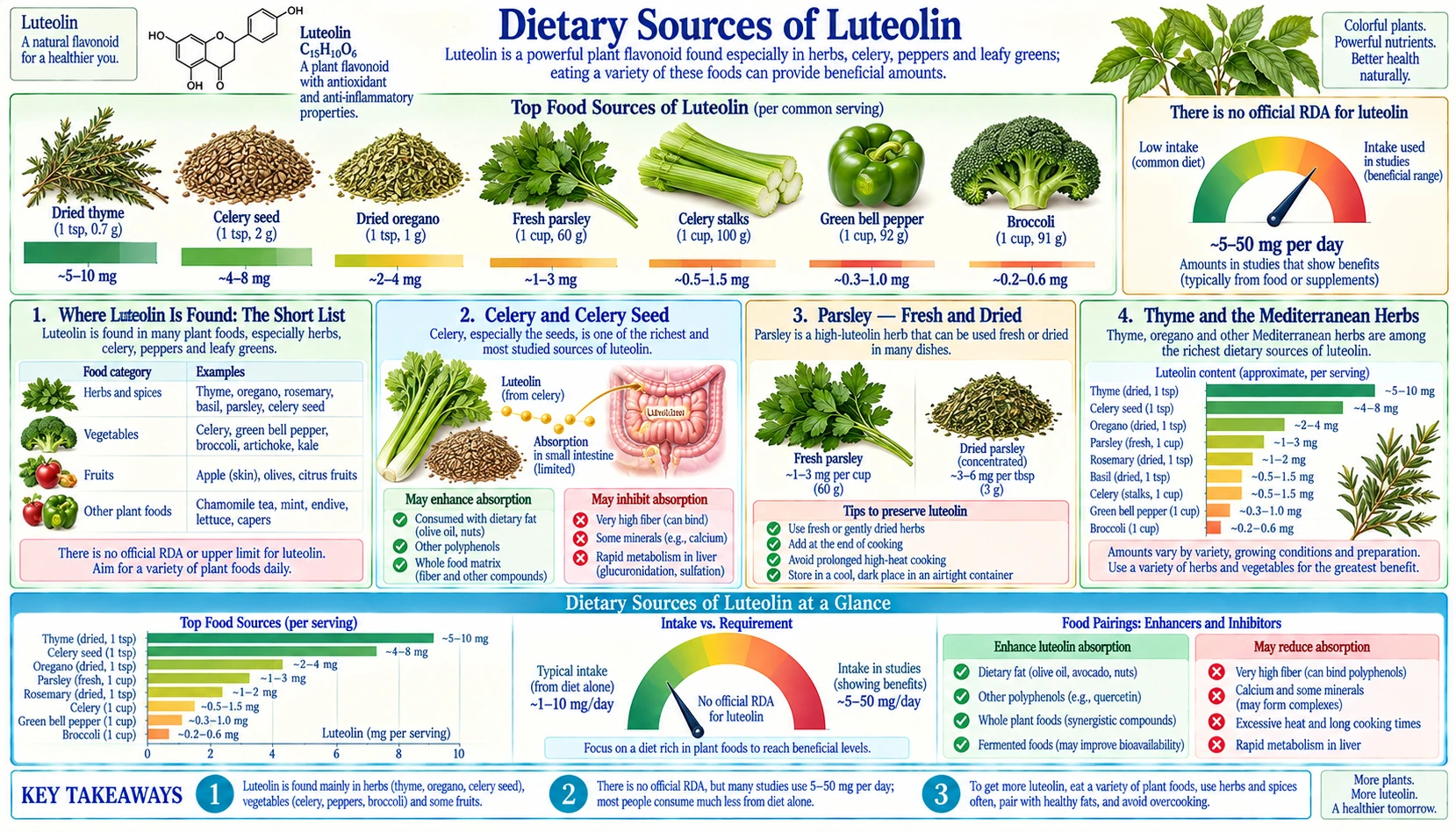
Luteolin comes from ordinary kitchen plants — celery, parsley, thyme, sweet and hot peppers, and chamomile are among the richest everyday sources. It is not a single “superfood” nutrient but a component of a Mediterranean, herb-and-vegetable pattern of eating. Two facts shape everything on this page: dried herbs are far more concentrated than fresh because water has been removed, and luteolin is poorly absorbed, so how much you eat is only part of the story. This page maps the real food sources, explains why the same herb can look weak (fresh) or extraordinary (dried) depending on how it is measured, and gives an honest account of the bioavailability problem that limits how much of what you eat actually reaches your bloodstream.
Table of Contents
- Where Luteolin Is Found: The Short List
- Celery and Celery Seed
- Parsley — Fresh and Dried
- Thyme and the Mediterranean Herbs
- Sweet and Chili Peppers
- Chamomile and Herbal Teas
- Other Notable Sources
- How Luteolin Travels in Food: Aglycone vs Glycosides
- The Bioavailability Problem
- Getting Enough From Food
- Key Research Papers
- Connections
- Featured Videos
Where Luteolin Is Found: The Short List
Luteolin is concentrated in a fairly specific set of plants — it is not spread evenly across the food supply the way, say, potassium is. The everyday sources worth knowing:
- Celery (stalks, leaves, and especially celery seed)
- Parsley (one of the richest common sources, particularly dried)
- Thyme, oregano, rosemary, and sage (Mediterranean culinary herbs, dramatically concentrated when dried)
- Sweet peppers and chili peppers (especially green and certain hot varieties)
- Chamomile (as tea)
- Artichoke, perilla (shiso), and radicchio
Food-composition surveys put numbers on this, and the results depend on which plants are tested. Miean and Mohamed (2001) measured luteolin and its sister flavone apigenin in 62 edible tropical plants and detected luteolin in only 12 of them; the highest were bird chili (1,035 mg per kg), belimbi leaves (464.5 mg/kg), onion leaves (391 mg/kg) and belimbi fruit (202 mg/kg), with local celery at 80.5 mg/kg and broccoli at 74.5 mg/kg dry weight. Local celery was richer in apigenin (338.5 mg/kg) than in luteolin. A useful mental model: if a plant is a green Mediterranean herb or a celery relative (the Apiaceae family — celery, parsley, carrot tops), it is a good bet for luteolin.
Celery and Celery Seed
Celery is the food most associated with luteolin in the popular literature, and for good reason — it is a reliable source, and it is eaten in meaningful quantities (unlike a garnish-sized sprig of herb). The luteolin is present throughout the plant, with the leaves generally richer than the pale inner stalks, and celery seed being a notably concentrated source used as a spice. Because celery is often eaten raw and in salad-sized portions, it contributes a steadier baseline of luteolin than herbs used only in pinches.
For the whole-food profile of celery beyond its luteolin content, see the Celery page.
Parsley — Fresh and Dried
Parsley is consistently one of the highest-luteolin foods in composition databases. There is an important nuance here that recurs with all herbs: dried parsley measures far higher than fresh, because drying removes water and concentrates the flavones by weight. A tablespoon of dried parsley therefore carries much more luteolin than the same weight of fresh — but you also eat far less of it. In practice, both count: a generous handful of fresh parsley in a tabbouleh or chimichurri, or dried parsley worked into a spice blend, both make a real contribution.
Parsley is a member of the same Apiaceae family as celery, which is part of why the two share this flavone-rich profile. The site's culinary-herb coverage focuses on other herbs; fresh flat-leaf parsley, used generously in cooking, is one of the common everyday ways luteolin enters the diet.
Thyme and the Mediterranean Herbs
The dried Mediterranean herbs — thyme, oregano, rosemary, and sage — are, gram for gram, among the most flavone-dense foods that exist, and dried oregano in particular is repeatedly among the very highest luteolin sources measured. This is the concentration effect taken to its extreme: a dried herb is essentially the plant with nearly all the water removed, so its per-gram flavone content is enormous.
The catch, again, is portion size. You sprinkle a teaspoon of dried thyme on a dish, not a cupful, so the total luteolin delivered is smaller than the eye-popping per-100-gram figures suggest. Still, a cooking style that leans on Mediterranean herbs — thyme in a braise, oregano on a tomato sauce, rosemary with roasted vegetables — adds up across a week and is one of the ways luteolin accumulates in an ordinary diet. See the Thyme page for that herb's broader profile.
Sweet and Chili Peppers
Peppers (Capsicum species) are a solid luteolin source and, like celery, are eaten in real portions rather than pinches. Green sweet peppers and various chili and hot peppers contribute luteolin along with a range of other flavonoids and, of course, vitamin C. Because peppers are versatile and eaten raw or lightly cooked in salad-sized amounts, they are a practical everyday contributor rather than a trace garnish.
As with all of these foods, exact luteolin content varies by variety, ripeness, growing conditions, and whether the pepper is raw, cooked, or dried — which is the honest reason this page avoids quoting single precise milligram figures that would imply a false precision.
Chamomile and Herbal Teas
Chamomile is a well-known dietary source of luteolin and its glycosides, delivered as a warm-water infusion — chamomile tea. Analytical work by Ishizaki and colleagues (2024), which measured luteolin and apigenin in 10 herbal teas after breaking down their sugar-bound forms, found these flavones in the brewed cup — but the luteolin-rich teas were peppermint and sage (375 and 99 µg per mL in the study's measurements), while German chamomile stood out instead for apigenin (110 µg per mL). In that study, then, peppermint tea (listed under Other Notable Sources below) was the measured luteolin tea, and chamomile the apigenin tea. Because chamomile is consumed as a large volume of liquid, it delivers its flavones in a modest dose, and it carries chamomile's own traditional calming associations.
See the Chamomile page for the herb's full profile.
Other Notable Sources
- Artichoke — a genuinely rich source of luteolin (present largely as luteolin glycosides), and one eaten in substantial portions.
- Perilla (shiso) — the Japanese and Korean herb, notably high in luteolin.
- Radicchio and other bitter chicories — the bitterness of many leafy greens tracks partly with their flavone content.
- Peppermint and other mint-family herbs — contribute luteolin alongside their essential oils.
- Olive and olive leaf — part of the Mediterranean-diet flavone contribution.
The consistent theme across all of these is that luteolin is a marker of a plant-rich, herb-forward, Mediterranean-style diet — the same dietary pattern independently associated with better long-term health. This is why the population data (for example, Yao and colleagues 2024, linking higher dietary luteolin to lower mortality in people with chronic kidney disease) are best read as reflecting an overall eating pattern, not proof that luteolin alone is responsible.
The numbers in that study are small. Among 2,393 U.S. adults with chronic kidney disease, the median luteolin intake was only 0.305 mg a day; over a median follow-up of 93 months, each unit of higher luteolin intake was associated with 27% lower death from any cause and 34% lower death from heart disease. This is an observational finding, not a trial. In a Chinese cohort of 6,417 adults followed for 5.3 years (Jin and colleagues 2021), higher luteolin intake combined with a high magnesium level was linked to a lower risk of metabolic syndrome (relative risk 0.52).
How Luteolin Travels in Food: Aglycone vs Glycosides
In plants, luteolin usually does not float around as the bare molecule (the “aglycone”). It is most often attached to a sugar, forming a glycoside — luteolin-7-O-glucoside is the most common. This matters for absorption:
- The aglycone (free luteolin) can be absorbed relatively directly in the small intestine.
- Glycosides generally must have their sugar removed — by enzymes in the gut wall or by colonic bacteria — before the luteolin can be absorbed, which changes where and how efficiently absorption happens.
Shimoi and colleagues (1998) studied this in rats: in rat small-intestine tissue, luteolin-7-glucoside was absorbed only after its sugar was removed to leave luteolin, and luteolin itself was turned into glucuronide conjugates as it passed through the gut wall. In people, only free luteolin was given, and free luteolin and its monoglucuronide then appeared in the blood serum. The upshot is that the “luteolin content” printed for a food is not the same as the “luteolin absorbed,” because it depends on which chemical form dominates and on your individual gut microbiome.
The Bioavailability Problem
This is the single most important honesty note on the page. Luteolin is poorly water-soluble and poorly absorbed, and what does get absorbed is rapidly transformed by the liver and gut into glucuronide and sulfate conjugates and cleared. As a result, the blood levels achieved after eating luteolin-rich food are much lower than the concentrations used to produce the dramatic effects in the cell-culture studies described on the other pages.
Several consequences follow:
- Fat may help. As a fat-soluble-leaning polyphenol, luteolin is described as absorbing somewhat better in the presence of dietary fat — olive oil on the herbs and vegetables, in true Mediterranean style.
- Supplement formulations exist to improve absorption. Because the raw molecule is so poorly soluble, researchers have developed delivery systems specifically to raise the bioavailability of luteolin — for example the oral-delivery microcomposite studied by Hong and colleagues (2026), which raised luteolin's oral bioavailability 2.34- to 3.36-fold over a standard luteolin product in an in vivo (living-body) pharmacokinetic study. This is an active formulation-science field precisely because plain luteolin absorbs badly.
- Dramatic dose claims outrun the evidence. The gap between “active in a dish” and “absorbed from a capsule” is the core reason luteolin's impressive laboratory potency has not yet translated into proven clinical results.
None of this means food luteolin is worthless — population studies still associate higher intake with benefit — but it means luteolin from food is one component of a diet, not a potent drug in a capsule.
Getting Enough From Food
There is no official recommended intake for luteolin — it is a beneficial dietary bioactive, not an essential nutrient, so no deficiency disease exists and no Daily Value has been set. The foods that supply most of the luteolin in everyday eating are:
- Fresh parsley, used in salads, sauces, and as a finishing herb.
- Celery, including the leaves, which are richer than the stalks.
- Dried Mediterranean herbs — thyme, oregano, rosemary — often cooked with olive oil.
- Sweet and chili peppers, eaten in real portions; bird chili was the top luteolin source in the 2001 tropical-plant survey.
- Herbal teas — peppermint and sage teas measured highest for luteolin in the 2024 tea study; chamomile tea is a low-dose source better known for apigenin.
- Artichoke — a rich source eaten in substantial amounts.
These are the foods of a varied, plant-rich, herb-forward, Mediterranean-style diet. Luteolin is one component of that pattern, not a shortcut around it.
Key Research Papers
- Miean KH, Mohamed S (2001). Flavonoid (myricetin, quercetin, kaempferol, luteolin, and apigenin) content of edible tropical plants. Journal of Agricultural and Food Chemistry — PubMed PMID: 11410016
- Shimoi K et al. (1998). Intestinal absorption of luteolin and luteolin 7-O-beta-glucoside in rats and humans. FEBS Letters — PubMed PMID: 9827549
- López-Lázaro M (2009). Distribution and biological activities of the flavonoid luteolin. Mini-Reviews in Medicinal Chemistry — PubMed PMID: 19149659
- Somerset SM, Johannot L (2008). Dietary flavonoid sources in Australian adults. Nutrition and Cancer — PubMed PMID: 18584477
- Yao X, Zhou Z (2024). Dietary intake of luteolin is negatively associated with all-cause and cardiovascular mortality in chronic kidney disease patients. BMC Public Health — PubMed PMID: 39080632
- Ishizaki A et al. (2024). Determination of Luteolin and Apigenin in Herbal Teas by Online In-Tube Solid-Phase Microextraction. Foods — PubMed PMID: 38890915
- Hertog MGL et al. (1993). Dietary antioxidant flavonoids and risk of coronary heart disease: the Zutphen Elderly Study. The Lancet — PubMed PMID: 8105262
- Jin S et al. (2021). The association of dietary flavonoids, magnesium and their interactions with the metabolic syndrome. British Journal of Nutrition — PubMed PMID: 33256855
- Hong JK et al. (2026). Calcium carbonate hybrid microcomposite for oral delivery of luteolin, a poorly water-soluble phytocompound. Food Chemistry — PubMed PMID: 41483986
- Shi M et al. (2024). Luteolin, a flavone ingredient: Anticancer mechanisms, combined medication strategy, pharmacokinetics. Phytotherapy Research — PubMed PMID: 38088265