Hesperidin for Heart & Blood Pressure
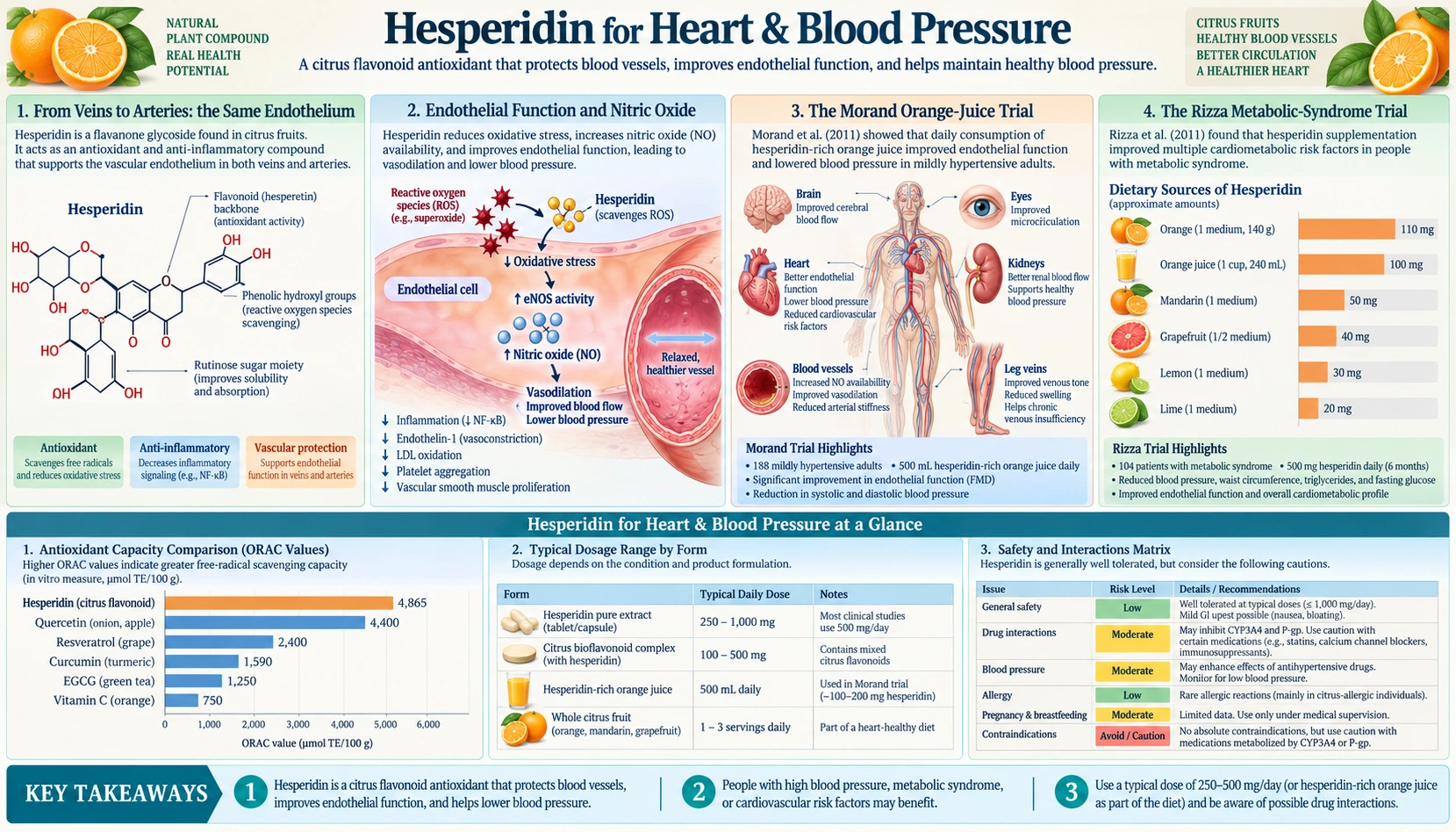
The same single layer of cells that hesperidin protects inside veins — the endothelium — also lines every artery in the body, and that is the bridge from hesperidin's venous reputation to its cardiovascular research. In test tubes, the absorbed form of hesperidin coaxes endothelial cells to make more nitric oxide, the molecule that relaxes and protects arteries. In people, hesperidin-rich orange juice has improved endothelial function and shaved a few points off blood pressure in several controlled trials. This is genuinely interesting work, but it deserves honest framing: the effects are small, they are measured mostly on surrogate markers rather than heart attacks or strokes, the trials are short, and not every study is positive. This page walks through the landmark trials, the mechanism, and exactly where the evidence is strong and where it is thin.
Table of Contents
- From Veins to Arteries: the Same Endothelium
- Endothelial Function and Nitric Oxide
- The Morand Orange-Juice Trial
- The Rizza Metabolic-Syndrome Trial
- Blood Pressure: What the Trials Show
- Cholesterol and Lipids
- Inflammation and Cardiometabolic Markers
- Preclinical Cardioprotection
- Honest Limits: Small Effects, Surrogate Markers, Orange Juice vs Supplement
- Practical Takeaways
- Key Research Papers
- Connections
- Featured Videos
From Veins to Arteries: the Same Endothelium
Hesperidin's venous benefits come largely from protecting the venous endothelium — reducing inflammation, leakiness, and leukocyte injury in the vein wall. Arteries are lined by the same endothelium, so it is a natural scientific question whether the molecule does anything useful on the arterial side, where the stakes are higher: arterial endothelial dysfunction is one of the earliest, most reversible steps on the road to atherosclerosis, high blood pressure, and cardiovascular disease.
The answer from human trials is a cautious yes — hesperidin appears to nudge arterial biology in a favorable direction — but the magnitude is modest and the outcomes measured are early-warning markers rather than clinical events. Keeping those two facts in mind is the difference between an accurate picture and hype.
Endothelial Function and Nitric Oxide
The endothelium is not just plumbing lining. It is an active organ that senses blood flow and releases signals, the most important of which is nitric oxide (NO). When endothelial cells make NO through the enzyme eNOS, the NO diffuses into the surrounding muscle of the artery wall and tells it to relax. That relaxation widens the artery, lowers resistance, and reduces blood pressure. NO also keeps platelets from clumping and discourages inflammatory cells from sticking — so healthy NO signaling is anti-clot and anti-atherosclerosis as well as blood-pressure-lowering.
Doctors and researchers gauge this system with flow-mediated dilation (FMD): they briefly cuff off blood flow to the forearm, release it, and measure how much the brachial artery widens in response to the rush of flow. A bigger, healthier dilation means better endothelial NO function. Much of the hesperidin cardiovascular literature is built on FMD and related microvascular-reactivity measures.
The mechanistic link is direct: in cultured cow (bovine) aortic endothelial cells, hesperetin (the absorbed aglycone form of hesperidin) increases NO production. Rizza and colleagues showed exactly this in their laboratory work alongside their clinical trial, giving a plausible molecular reason for the improvements they saw in patients.
The Morand Orange-Juice Trial
The trial that put hesperidin on the cardiovascular map was published by Morand and colleagues in the American Journal of Clinical Nutrition. It was a well-designed randomized, controlled, crossover study in 24 healthy, overweight men aged 50 to 65 — a group with early cardiovascular risk but not established disease.
The clever part of the design was a three-way comparison that isolated hesperidin as the active ingredient. Participants drank 500 mL a day, in random order over three 4-week periods: (1) orange juice, (2) a control drink spiked with pure hesperidin at the same amount found in the juice, and (3) a control drink with no hesperidin (placebo). Both the orange juice and the hesperidin-spiked drink improved postprandial microvascular endothelial reactivity and lowered diastolic blood pressure compared with placebo, while the two hesperidin-containing drinks behaved similarly to each other.
The details matter. Diastolic blood pressure was lower after 4 weeks of orange juice or the hesperidin drink than after the placebo drink (P = 0.02). Endothelial reactivity measured in the morning after an overnight fast, however, was not significantly changed after 4 weeks; the improvement appeared after a drink (postprandially), when it was measured at the peak of hesperetin in the blood (P < 0.05).
The interpretation was elegant: hesperidin is a genuine active vascular ingredient of orange juice, not just a bystander riding along with the vitamin C and sugar. That single result is why so many follow-up trials used orange juice or purified hesperidin to probe blood pressure and endothelial function.
The Rizza Metabolic-Syndrome Trial
Where Morand studied healthy-ish men, Rizza and colleagues tested people who already had metabolic syndrome — the cluster of abdominal obesity, high blood pressure, high blood sugar, and abnormal lipids that markedly raises cardiovascular risk. In a randomized, placebo-controlled crossover trial published in the Journal of Clinical Endocrinology & Metabolism, participants took 500 mg of hesperidin daily for three weeks.
Compared with placebo, hesperidin improved flow-mediated dilation and lowered several markers of vascular inflammation, including high-sensitivity C-reactive protein (hs-CRP), serum amyloid A, and soluble E-selectin (a molecule endothelial cells use to grab inflammatory cells). Paired with their cell-culture demonstration that hesperetin boosts endothelial NO, the trial offered a coherent mechanism-plus-outcome package: hesperidin makes the endothelium calmer and more responsive in exactly the population that needs it.
It is still a short trial in a small group measuring surrogate markers — but it is one of the more compelling pieces of the hesperidin cardiovascular case.
Blood Pressure: What the Trials Show
Blood pressure is where patients most want a number, so here is the honest version. Several trials show a small reduction; some show none.
- Homayouni and colleagues gave hesperidin (500 mg/day) to people with type 2 diabetes and reported reductions in systolic and diastolic blood pressure along with lower inflammatory markers — a supportive result in a higher-risk group.
- Valls and colleagues tested a hesperidin-enriched orange juice in people with mildly elevated blood pressure and found reductions in systolic and pulse pressure over sustained consumption.
- Pla-Pagà and colleagues studied hesperidin's effects on the cardiovascular system in pre- and stage-1 hypertensive subjects, adding supportive mechanistic and clinical data.
- Salden and colleagues, however, tested a standardized, more-bioavailable hesperidin (hesperidin 2S) in healthy overweight adults and did not find a significant improvement in the primary endpoint of endothelial function, a reminder that results are not uniform.
A 2025 systematic review and meta-analysis by Heidari and colleagues, pooling randomized trials published up to August 2023, found that hesperidin supplementation significantly lowered systolic blood pressure, fasting blood sugar, triglycerides, total cholesterol, low-density lipoprotein (LDL) cholesterol and the inflammatory signal tumor necrosis factor-alpha (TNF-α), but had no significant effect on diastolic blood pressure, insulin, insulin-resistance scores, HDL cholesterol or high-sensitivity C-reactive protein.
A 2024 meta-analysis by Gao and colleagues (14 trials, 656 patients) split the results by group. In healthy people, hesperidin had no effect on systolic blood pressure (weighted mean difference −0.50 mmHg, 95% CI −3.25 to 2.26) or diastolic blood pressure (−0.51 mmHg). In people with type 2 diabetes, it lowered systolic blood pressure (−4.32 mmHg, 95% CI −7.77 to −0.87), with a trend for diastolic pressure that did not reach significance (−3.72 mmHg, p = 0.06); the authors note the diabetes results need support from further research.
The fair summary: in people with elevated blood pressure or metabolic risk, hesperidin may lower blood pressure by a few millimeters of mercury; in already-healthy people, the effect is often undetectable. The trials compared hesperidin with placebo or a control drink, not with blood-pressure medicines — see our Hypertension page.
Cholesterol and Lipids
The lipid evidence is mixed, and the two main reviews disagree. Some trials and animal studies suggest hesperidin can modestly lower total and low-density lipoprotein (LDL) cholesterol or triglycerides, plausibly by influencing cholesterol-handling enzymes in the liver. But the human results are inconsistent, and a systematic review by Mohammadi and colleagues concluded that hesperidin might not meaningfully affect the lipid profile or blood pressure across the available trials. That 2019 review (10 trials, 577 participants, searched up to May 2018) found no effect on total, LDL or HDL cholesterol or triglycerides, and none on systolic (−0.85 mmHg) or diastolic (−0.48 mmHg) blood pressure.
The newer 2025 meta-analysis by Heidari and colleagues (searched up to August 2023) reached a different result: significant falls in total cholesterol, LDL cholesterol and triglycerides, with no effect on HDL cholesterol. In its subgroup analyses, trials lasting more than 12 weeks lowered total cholesterol, LDL cholesterol and triglycerides, and doses above 500 mg a day lowered total and LDL cholesterol.
Diet pattern, fiber, exercise, weight change and, where prescribed, statins are the interventions with strong evidence for improving lipids; set beside them, hesperidin's effect in these reviews is at most small.
Inflammation and Cardiometabolic Markers
A recurring, though not uniform, thread across the trials is a reduction in inflammatory markers. Rizza saw lower high-sensitivity C-reactive protein and serum amyloid A; Homayouni saw lower inflammatory markers in diabetes; and Haidari and colleagues reported that hesperidin supplementation modulated inflammatory responses in patients recovering from myocardial infarction (heart attack). In that trial, 75 patients took 600 mg of hesperidin or a placebo daily for 4 weeks: hesperidin lowered E-selectin and raised adiponectin and HDL cholesterol compared with placebo, while interleukin-6 (IL-6) and high-sensitivity C-reactive protein improved from baseline but not significantly more than with placebo. In the 2025 Heidari meta-analysis, hesperidin lowered TNF-α but not high-sensitivity C-reactive protein. Because chronic low-grade inflammation is a driver of atherosclerosis, this anti-inflammatory signal is biologically encouraging.
There is also mechanistic support for protecting the endothelium against the daily insults of eating. Rendeiro and colleagues showed that flavanone-rich citrus beverages blunted the transient dip in endothelial function that normally follows a high-fat meal — a real-world stress test of the vasculature. The deeper cellular machinery behind these anti-inflammatory effects — the Nrf2 and NF-κB pathways — is covered on the Antioxidant & Anti-Inflammatory page.
Preclinical Cardioprotection
A large body of animal and cell research suggests hesperidin can protect heart tissue from injury, particularly the damage that occurs when blood flow is restored after a period of blockage (ischemia-reperfusion injury, the situation during a heart attack and its treatment). For example, Li and colleagues found that short-term hesperidin pretreatment reduced myocardial ischemia-reperfusion injury in rats, apparently by limiting oxidative stress and cell death.
This kind of result is mechanistically illuminating and consistent with hesperidin's antioxidant biology — but it is limited in what it can show. Animal and cell studies do not establish a human benefit. They generate hypotheses and explain mechanisms; they do not tell a person that taking hesperidin will protect their heart during a cardiac event. We include preclinical work here for completeness and to explain the biology, not as a clinical claim.
Honest Limits: Small Effects, Surrogate Markers, Orange Juice vs Supplement
Three caveats apply to every positive finding on this page:
- Surrogate markers, not events. The trials measure flow-mediated dilation, blood pressure, and inflammatory proteins — useful early indicators, but not the same as fewer heart attacks or strokes. No trial has shown that hesperidin reduces hard cardiovascular outcomes.
- Small and variable effects. Where benefits appear, they are modest and depend on the population (more visible in people with metabolic risk than in the healthy) and on the individual's ability to absorb hesperidin, which varies enormously with gut bacteria — see Sources & Absorption.
- The orange-juice confound. Many trials deliver hesperidin as orange juice, which also contains sugar, vitamin C, potassium, folate, and other compounds. The Morand three-arm design helps isolate hesperidin, but orange juice also carries its sugar, while a whole orange adds fiber and the hesperidin-rich pith and membranes.
Practical Takeaways
- Whole citrus. Whole citrus fruit is the everyday food source of hesperidin, and the white pith and membranes carry it as well as the sweet segments.
- Supplements have small effects. In the trials above, hesperidin supplements of 500–600 mg a day produced small effects measured after weeks of daily use (3 weeks in the Rizza trial, 4 weeks in the Haidari trial). More-bioavailable forms exist, such as the hesperidin 2S tested by Salden and colleagues.
- Not tested as a replacement for treatment. The trials described here compared hesperidin with placebo or a control drink; none tested it as a replacement for blood-pressure medication, statins, or the lifestyle measures with strong outcome evidence.
- Combined effects with medicines. Trials found small falls in blood pressure with hesperidin (diastolic pressure in the Morand trial; systolic pressure in people with type 2 diabetes in the Gao meta-analysis), so any such effect would come on top of blood-pressure medicine taken at the same time. The studies reviewed for this page did not test hesperidin together with blood-pressure or blood-thinning medicines.
Key Research Papers
- Morand C, et al. (2011). Hesperidin contributes to the vascular protective effects of orange juice: a randomized crossover study in healthy volunteers. Am J Clin Nutr — PubMed PMID: 21068346
- Rizza S, et al. (2011). Citrus polyphenol hesperidin stimulates production of nitric oxide in endothelial cells while improving endothelial function and reducing inflammatory markers in patients with metabolic syndrome. J Clin Endocrinol Metab — PubMed PMID: 21346065
- Salden BN, et al. (2016). Randomized clinical trial on the efficacy of hesperidin 2S on validated cardiovascular biomarkers in healthy overweight individuals. Am J Clin Nutr — PubMed PMID: 27797708
- Homayouni F, et al. (2018). Blood pressure lowering and anti-inflammatory effects of hesperidin in type 2 diabetes. Phytother Res — PubMed PMID: 29468764
- Valls RM, et al. (2021). Effects of hesperidin in orange juice on blood and pulse pressures in mildly hypertensive individuals. Eur J Nutr — PubMed PMID: 32661681
- Pla-Pagà L, et al. (2021). Effects of hesperidin consumption on the cardiovascular system in pre- and stage 1 hypertensive subjects. Mol Nutr Food Res — PubMed PMID: 34272817
- Heidari Z, et al. (2025). Effects of hesperidin supplementation on cardiometabolic markers: a systematic review and meta-analysis. Nutr Rev — PubMed PMID: 39038797
- Mohammadi M, et al. (2019). Hesperidin, a major flavonoid in orange juice, might not affect lipid profile and blood pressure: a systematic review. Phytother Res — PubMed PMID: 30632207
- Rendeiro C, et al. (2016). Flavanone-rich citrus beverages counteract the transient decline in postprandial endothelial function in humans. Br J Nutr — PubMed PMID: 28065188
- Haidari F, et al. (2015). Hesperidin supplementation modulates inflammatory responses following myocardial infarction. J Am Coll Nutr — PubMed PMID: 25757593
- Gao H, Chen F, Wang S (2024). Hesperidin reduces systolic blood pressure in diabetic patients and has no effect on blood pressure in healthy individuals: a systematic review and meta-analysis. Phytother Res — PubMed PMID: 38772688
- Li X, et al. (2016). Short-term hesperidin pretreatment attenuates rat myocardial ischemia/reperfusion injury (preclinical, animal). Cell Physiol Biochem — PubMed PMID: 27744432
PubMed Topic Searches
- PubMed: Hesperidin & endothelial function
- PubMed: Hesperidin & blood pressure (RCTs)
- PubMed: Orange juice, hesperidin & cardiovascular
- PubMed: Hesperidin & metabolic syndrome
- PubMed: Hesperetin, nitric oxide & eNOS