Beta-Carotene as an Antioxidant and Skin Support
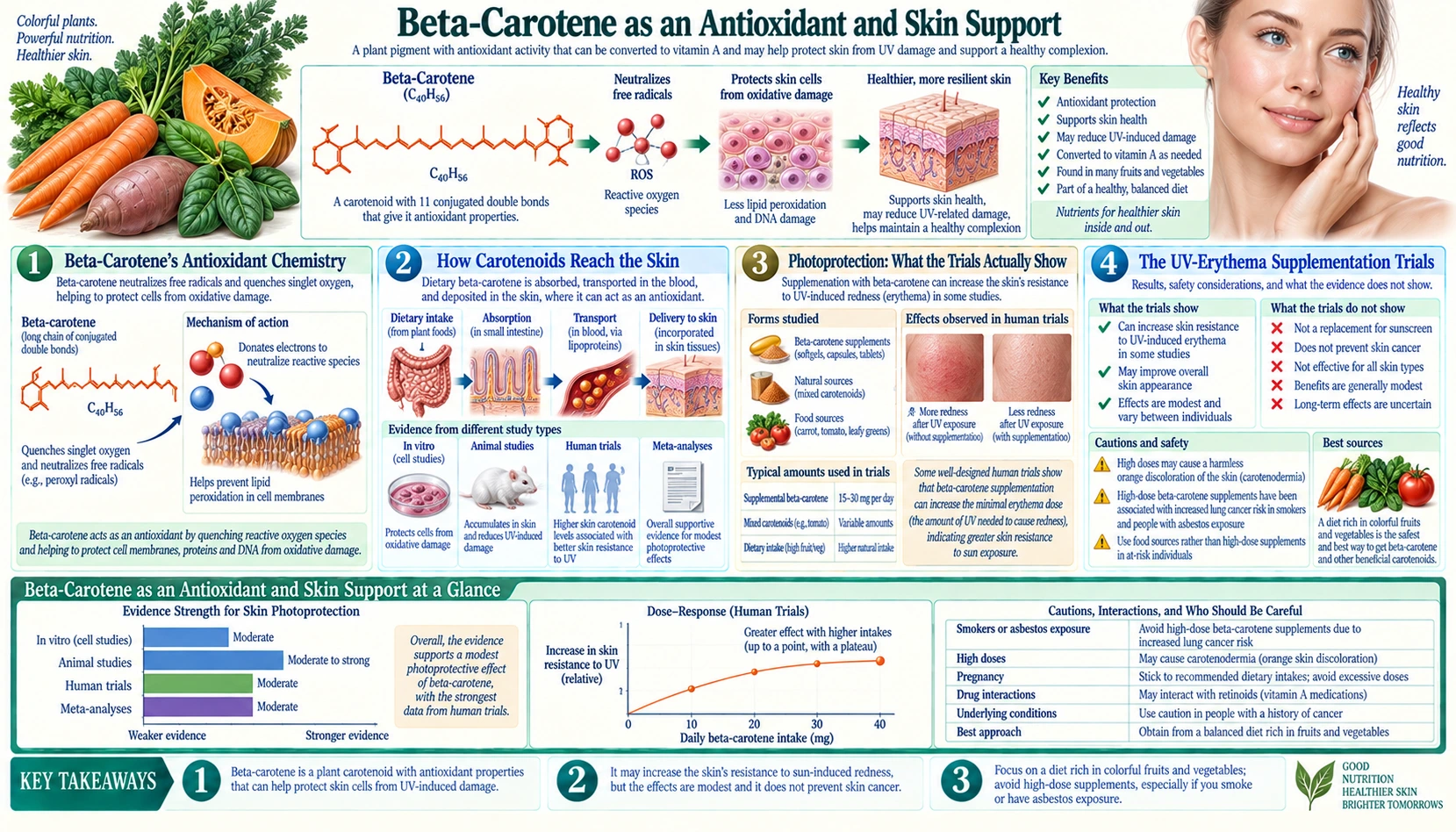
Beta-carotene is a genuine antioxidant — one of nature’s most efficient quenchers of a reactive molecule called singlet oxygen — and it accumulates in the skin, where it lends a subtle warm tone and offers a modest degree of protection against sun-induced redness. The honest picture matters here: controlled trials show a small, real effect on how easily skin burns after weeks of supplementation, but beta-carotene is not a sunscreen and does not replace one. This page separates the sound chemistry and human-trial evidence from the marketing.
Table of Contents
- Beta-Carotene’s Antioxidant Chemistry
- How Carotenoids Reach the Skin
- Photoprotection: What the Trials Actually Show
- The Ultraviolet-Erythema Supplementation Trials
- Dietary Carotenoids and Skin Appearance
- Honest Limits and the Pro-Oxidant Caveat
- A Historical Clinical Use: Photosensitivity Disorders
- What the Research Points To
- Key Research Papers
- PubMed Topic Searches
- External Resources
- Connections
- Featured Videos
Beta-Carotene’s Antioxidant Chemistry
Beta-carotene’s long chain of alternating single and double bonds — the same “conjugated” structure that makes it orange — is what makes it an antioxidant. That electron-rich chain is exceptionally good at absorbing the energy of singlet oxygen, a highly reactive, excited form of oxygen generated when light strikes the skin. Beta-carotene soaks up that energy and dissipates it harmlessly as heat, returning to its ground state to do it again. It is one of the most efficient singlet-oxygen quenchers known in biology.
It can also scavenge certain peroxyl radicals, interrupting the chain reaction of lipid peroxidation in cell membranes. Reviews of carotenoid biochemistry describe these complementary roles — singlet-oxygen quenching plus radical scavenging — as the basis for whatever protective effects carotenoids have in tissues exposed to light and oxygen, of which skin is the prime example.
An important nuance, explored below, is that this antioxidant behavior is context-dependent. At the modest concentrations and lower oxygen tensions typical of most tissues, beta-carotene behaves as an antioxidant. Under unusual conditions — very high concentrations combined with high oxygen tension and oxidative stress, as in a smoker’s lung — it can flip toward pro-oxidant behavior. That duality is the thread connecting this page to The Supplement Paradox.
How Carotenoids Reach the Skin
Because beta-carotene is fat-soluble, it circulates in the bloodstream inside lipoproteins and is deposited in fatty tissues, including the subcutaneous fat and the epidermis. Human studies using non-invasive reflection spectrophotometry (essentially measuring the color of the skin) have shown that dermal carotenoid levels rise with supplementation and correlate with blood levels. In other words, what you eat measurably reaches your skin.
This deposition is the mechanism behind carotenemia’s harmless orange tint at very high intakes, and it is also why skin is a plausible site for a carotenoid antioxidant effect: the pigment is physically present in the tissue that receives the ultraviolet dose. The palms, soles, and face — areas with thicker stratum corneum or more sebaceous activity — tend to show carotenoid coloration first.
Photoprotection: What the Trials Actually Show
Here is the honest bottom line, stated up front: oral beta-carotene provides a small, real reduction in ultraviolet-induced skin redness, but only after sustained supplementation, and the effect is far weaker than sunscreen. A meta-analysis of controlled human studies concluded that beta-carotene supplementation does protect against sunburn, but that the protection increased with the duration of supplementation — studies shorter than about 10 weeks showed little effect, while longer studies (many weeks to months) showed a measurable reduction in erythema.
The meta-analysis (Köpcke and Krutmann, 2008) found seven studies that tested beta-carotene against sunburn. Its regression analysis showed that protection “required a minimum of 10 weeks of supplementation”, with the protective effect growing by “0.5 standard deviations with every additional month of supplementation.” One of the trials behind it, a 2003 placebo-controlled study, gave volunteers with skin type II (12 per group) 24 mg a day of beta-carotene, or 24 mg a day of a carotenoid mix, for 12 weeks; skin redness 24 hours after a solar-simulator exposure was significantly lower than at the start after 12 weeks.
Translating that into everyday terms: the protection is on the order of a very low sun-protection factor at best — useful as a whole-body dietary backdrop, meaningless as a substitute for topical SPF on a beach day. The mechanism is consistent with the singlet-oxygen quenching described above: carotenoids in the skin blunt some of the oxidative damage from ultraviolet (UV), slightly raising the threshold at which visible redness appears.
The Ultraviolet-Erythema Supplementation Trials
Several human trials measured ultraviolet-induced erythema (redness) before and after weeks of carotenoid supplementation:
- Supplementation with beta-carotene, or a comparable amount of mixed carotenoids, for about 12 weeks reduced ultraviolet-induced erythema in healthy volunteers.
- Dietary lycopene from tomato paste — a related carotenoid — likewise protected against ultraviolet erythema over 10 weeks, showing this is a carotenoid-class effect, not unique to beta-carotene. In that study 9 volunteers ate 40 g of tomato paste (about 16 mg of lycopene a day) with olive oil; at week 10 their skin redness was 40% lower than in 10 controls who had olive oil only, while at week 4 there was no significant difference.
- A 24-week study in which all 22 volunteers took rising doses (30 mg, then up to 90 mg a day) of natural carotenoids found that the dose of simulated sunlight needed to redden the skin (the minimal erythema dose) rose significantly; the authors called the protective effect “modest.”
- A 12-week trial gave healthy volunteers 25 mg a day of carotenoids, either alone or with 335 mg (500 IU) a day of vitamin E; skin redness was significantly reduced after week 8, and “erythema suppression was greater with the combination of carotenoids and vitamin E than with carotenoids alone.”
The consistent themes across these trials are (1) the effect is modest, (2) it requires weeks of intake to build up skin carotenoid levels, and (3) combining carotenoids with vitamin E tended to enhance the effect (Stahl and colleagues, 2000). None of these studies suggests carotenoids can prevent sunburn from a genuinely high ultraviolet dose; they show a shift in threshold, not immunity.
Dietary Carotenoids and Skin Appearance
Separate from sun protection, carotenoids influence skin color in a way people often find appealing. Because dietary carotenoids deposit in the skin and add warmth to its tone, higher fruit-and-vegetable intake produces a subtle golden coloration that observational research links to perceived healthiness of appearance. This is a cosmetic, not a medical, effect — but it is a real, measurable consequence of eating carotenoid-rich produce, and it is achieved safely through food.
A 2012 study followed this effect over time in 35 people who wore no makeup or self-tanner. Over six weeks, changes in how much fruit and vegetables each person ate were significantly correlated with changes in their skin’s redness and yellowness, and the diet-linked colour changes matched the light absorption of carotenoids, not of melanin. Viewers judged skin perceptibly healthier-looking after a rise of 2.91 portions a day and more attractive after 3.30 portions. The study measured Caucasian skin.
It is worth being clear that this appearance effect is a marker of vegetable intake, not proof of any deep health benefit. The healthiest interpretation is simply that a diet producing a carotenoid glow is a diet rich in the vegetables and fruits associated with good health overall.
Honest Limits and the Pro-Oxidant Caveat
Several limits deserve emphasis so the benefit is not overstated:
- Not a sunscreen. The photoprotection is small and slow to develop. It is not a replacement for topical broad-spectrum sunscreen, shade, or protective clothing; the measured effect is far weaker than sunscreen’s.
- Antioxidant behavior is conditional. Beta-carotene is an antioxidant under ordinary conditions but can act as a pro-oxidant at high concentrations under high oxidative stress. This is not a concern for food intake. For isolated supplements, the US Preventive Services Task Force (USPSTF) concluded in 2022 “with moderate certainty that the harms of beta carotene supplementation outweigh the benefits for the prevention of cardiovascular disease or cancer,” and it recommends against beta-carotene supplements for that purpose (a “D” recommendation).
- Whole-diet context wins. The antioxidant network in the body is cooperative — vitamin C, vitamin E, and carotenoids regenerate and support one another. A single high-dose isolated carotenoid does not replicate that network and, in trials, has not delivered the benefits that carotenoid-rich diets are associated with.
A Historical Clinical Use: Photosensitivity Disorders
There is a long-standing medical use of high-dose beta-carotene worth noting for completeness and honesty. For decades, oral beta-carotene at pharmacologic doses was used to reduce sunlight-triggered pain and skin reactions in erythropoietic protoporphyria (EPP), a rare inherited disorder in which sunlight causes burning skin pain. The rationale is exactly the singlet-oxygen quenching chemistry described above — in EPP, light activates a build-up of protoporphyrin that generates singlet oxygen, and beta-carotene was given in the expectation that it would neutralize it.
The controlled trials did not confirm that it works. A 2009 systematic review found 25 treatment studies in EPP, 16 of them on beta-carotene, most published in the 1970s; only 5 of the 25 were randomized and controlled. “Four of the five well-designed studies suggested lack of efficacy of beta-carotene, NAC and vitamin C” (NAC is N-acetylcysteine), and the beta-carotene results were “strongly contradictory,” with “efficacy … inversely correlated with study quality.” A 2023 systematic review of 40 studies found that, taken together, the controlled trials showed “no effect” of oral beta-carotene, and a moderate positive effect of inorganic (mineral) sunscreen and of an afamelanotide implant.
Afamelanotide is the newer therapy for EPP. It is a lab-made version of the hormone that stimulates the skin’s pigment cells (an α-melanocyte-stimulating hormone analogue), given as a 16 mg implant under the skin every 60 days. Two randomized, double-blind, placebo-controlled trials, published in 2015, tested it in 94 patients in the United States and 74 in the European Union. The median pain-free time in direct sunlight was 69.4 hours versus 40.8 hours on placebo after 6 months in the U.S. study, and 6.0 hours versus 0.8 hours after 9 months in the European study, where phototoxic reactions were also fewer (77 versus 146). Quality of life improved, and adverse events were mostly mild.
Beta-carotene in EPP was a specialized use for one rare disease. It is included here as history: beta-carotene’s antioxidant chemistry was put to clinical use in light-sensitivity disorders, although well-controlled trials later failed to show that it worked.
What the Research Points To
- Carotenoids from orange and green vegetables reach the skin. Food is the carotenoid source described above as safe, and it measurably raises skin carotenoid levels.
- Absorption needs fat, and the antioxidants work together. Beta-carotene is fat-soluble, and carotenoids work as a network with other antioxidants such as vitamin E (from nuts and seeds) and vitamin C (from produce).
- Beta-carotene is not sun protection. The measured protection is far smaller than sunscreen’s; next to sunscreen, shade, and clothing, dietary carotenoids are a minor supporting player at most.
- Isolated high-dose beta-carotene pills carry a known concern. The USPSTF (2022) recommends against beta-carotene supplements for preventing cardiovascular disease or cancer, and the pro-oxidant behavior described above arises at high concentrations under high oxidative stress, as in a smoker’s lung.
Key Research Papers
- Köpcke W, Krutmann J (2008). Protection from sunburn with beta-carotene — a meta-analysis. Photochemistry and Photobiology — PubMed PMID: 18086246
- Sies H, Stahl W (2004). Nutritional protection against skin damage from sunlight. Annual Review of Nutrition — PubMed PMID: 15189118
- Heinrich U, Gärtner C, Wiebusch M, et al. (2003). Supplementation with beta-carotene or a similar amount of mixed carotenoids protects humans from UV-induced erythema. Journal of Nutrition — PubMed PMID: 12514275
- Stahl W, Heinrich U, Wiseman S, et al. (2001). Dietary tomato paste protects against ultraviolet light-induced erythema in humans. Journal of Nutrition — PubMed PMID: 11340098
- Lee J, Jiang S, Levine N, Watson RR (2000). Carotenoid supplementation reduces erythema in human skin after simulated solar radiation exposure. Proceedings of the Society for Experimental Biology and Medicine — PubMed PMID: 10654620
- Stahl W, Heinrich U, Jungmann H, et al. (1998). Increased dermal carotenoid levels assessed by noninvasive reflection spectrophotometry correlate with serum levels in women ingesting Betatene. Journal of Nutrition — PubMed PMID: 9567001
- Fiedor J, Burda K (2014). Potential role of carotenoids as antioxidants in human health and disease. Nutrients — PubMed PMID: 24473231
- Paiva SA, Russell RM (1999). Beta-carotene and other carotenoids as antioxidants. Journal of the American College of Nutrition — PubMed PMID: 10511324
- Krinsky NI, Johnson EJ (2005). Carotenoid actions and their relation to health and disease. Molecular Aspects of Medicine — PubMed PMID: 16309738
- Puertollano MA, Puertollano E, de Cienfuegos GA, de Pablo MA (2011). Dietary antioxidants: immunity and host defense. Current Topics in Medicinal Chemistry — PubMed PMID: 21506934
- Johnson EJ (2002). The role of carotenoids in human health. Nutrition in Clinical Care — PubMed PMID: 12134711
- Stahl W, Heinrich U, Jungmann H, et al. (2000). Carotenoids and carotenoids plus vitamin E protect against ultraviolet light-induced erythema in humans. American Journal of Clinical Nutrition — PubMed PMID: 10702175
- Minder EI, Schneider-Yin X, Steurer J, Bachmann LM (2009). A systematic review of treatment options for dermal photosensitivity in erythropoietic protoporphyria. Cellular and Molecular Biology — PubMed PMID: 19268006
- Heerfordt IM, Lerche CM, Philipsen PA, Wulf HC (2023). Experimental and approved treatments for skin photosensitivity in individuals with erythropoietic protoporphyria or X-linked protoporphyria: a systematic review. Biomedicine & Pharmacotherapy — PubMed PMID: 36525819
- Langendonk JG, Balwani M, Anderson KE, et al. (2015). Afamelanotide for erythropoietic protoporphyria. New England Journal of Medicine — PubMed PMID: 26132941
- US Preventive Services Task Force; Mangione CM, Barry MJ, Nicholson WK, et al. (2022). Vitamin, mineral, and multivitamin supplementation to prevent cardiovascular disease and cancer: US Preventive Services Task Force recommendation statement. JAMA — PubMed PMID: 35727271
- Whitehead RD, Re D, Xiao D, Ozakinci G, Perrett DI (2012). You are what you eat: within-subject increases in fruit and vegetable consumption confer beneficial skin-color changes. PLoS One — PubMed PMID: 22412966
PubMed Topic Searches
External Resources
- U.S. National Institutes of Health (NIH) Office of Dietary Supplements — Vitamin A & Carotenoids (Health Professional Fact Sheet)
- Linus Pauling Institute — Carotenoids
- Linus Pauling Institute — Vitamin A
- National Cancer Institute — Antioxidants and Cancer Prevention
- U.S. Department of Agriculture (USDA) FoodData Central — carotenoid content of foods
- PubMed — all research on beta-carotene