⚠ Evidence warning: Clinical trials or other evidence do not support the claim that small overnight protein or isoleucine doses help morning high blood sugar (the dawn phenomenon), or that a small branched-chain amino acid dose with fasted morning exercise combines isoleucine's glucose-uptake and muscle-sparing effects. This page keeps it as a report of what people, websites or other media say.
Isoleucine for Glucose Uptake
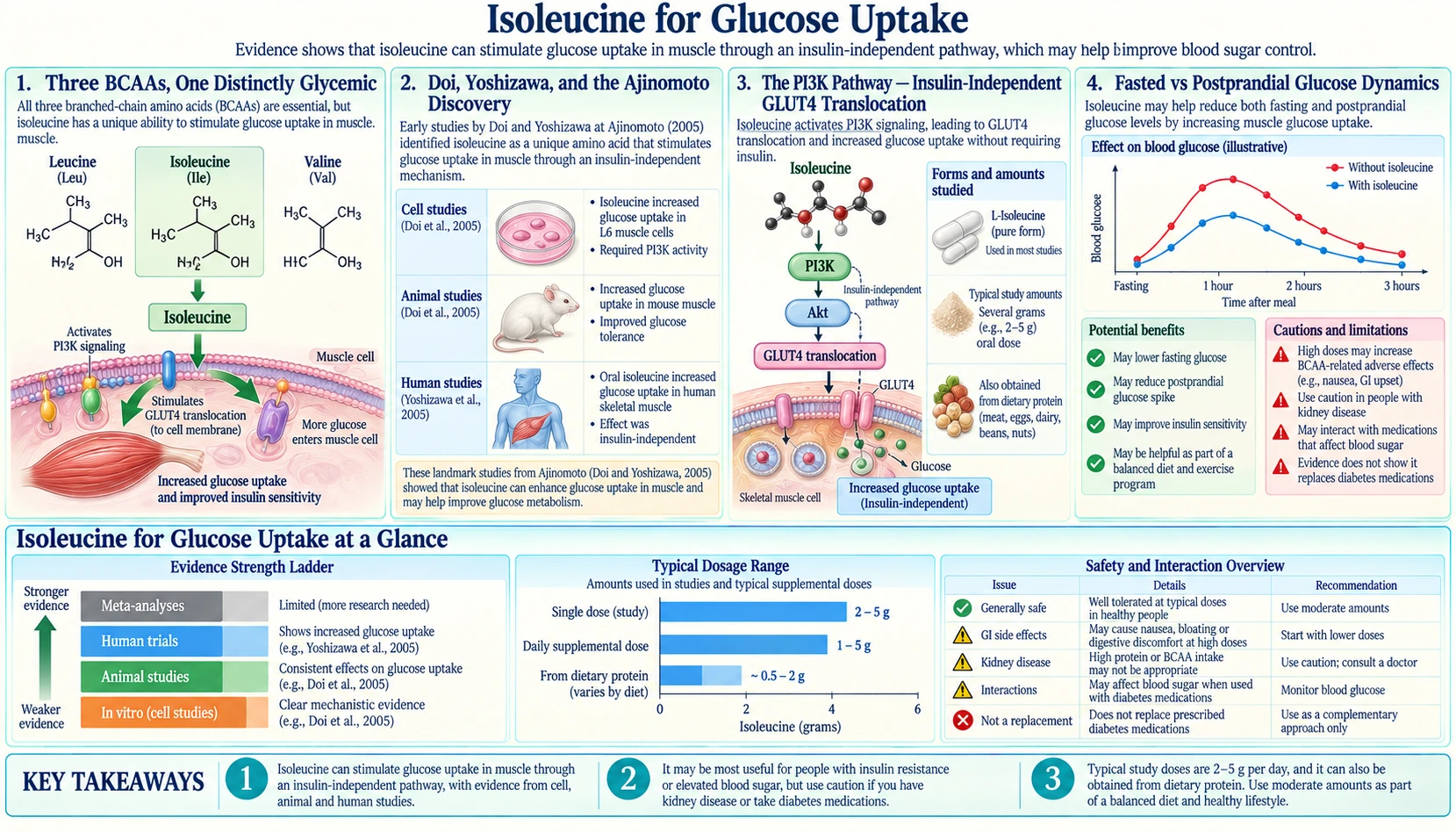
Isoleucine is the only one of the three branched-chain amino acids with a substantial, well-characterized, insulin-independent glucose-lowering effect. The pivotal research came from Japanese researchers led by Masako Doi in the early 2000s, who showed in rats that isoleucine given alone lowered plasma glucose, and showed in muscle cells grown in a dish without insulin that its effect on glucose uptake ran through the enzyme phosphatidylinositol 3-kinase (PI3-kinase). The clinical implication is significant: in insulin-resistant states, where the insulin receptor cascade is impaired, isoleucine's alternative pathway remains functional. Yet the picture is complicated by the so-called branched-chain amino acid (BCAA) paradox — cross-sectional studies show consistently elevated serum branched-chain amino acid levels in obesity, metabolic syndrome, and type 2 diabetes, and the elevation predicts future diabetes risk. This deep-dive walks through the molecular mechanism, the fasting versus postprandial dynamics, and the unresolved tension between the acute beneficial effect of isoleucine on glucose disposal and the apparent harm associated with chronically elevated circulating branched-chain amino acids (BCAAs).
Table of Contents
- Three Branched-Chain Amino Acids, One Distinctly Glycemic
- What the Doi Studies Measured in Rats and Muscle Cells
- The PI3K Pathway — Insulin-Independent GLUT4 Translocation
- Fasted vs Postprandial Glucose Dynamics
- Suppression of Hepatic Gluconeogenesis
- The Branched-Chain Amino Acid Paradox — Elevated Serum Branched-Chain Amino Acids in Metabolic Disease
- The mTORC1 Overactivation Hypothesis
- Clinical Applications and Practical Dosing
- Dietary Isoleucine vs Supplemental Isoleucine
- Cautions
- Key Research Papers
- Connections
- Featured Videos
Three Branched-Chain Amino Acids, One Distinctly Glycemic
Leucine, isoleucine, and valine share a metabolic pathway, but their downstream effects on glucose homeostasis differ markedly. Leucine acutely stimulates insulin secretion from pancreatic beta cells (the strongest insulinotropic effect of the three) but does not have a substantial insulin-independent glucose-uptake effect of its own. Valine's effects on glucose handling are modest. Isoleucine is the branched-chain amino acid with the strongest documented direct effect on peripheral glucose uptake, and the effect is independent of insulin.
This asymmetry has practical consequences. A supplement formula heavy in leucine drives an insulin spike but does not necessarily improve glucose disposal beyond what the resulting insulin secretion accomplishes. A supplement formula richer in isoleucine, or isolated isoleucine administered alone, produces a glucose-lowering effect through the parallel PI3K pathway that does not depend on intact insulin signaling. For an insulin-resistant patient, where insulin's downstream signaling is impaired, the isoleucine route remains operational while the leucine-induced insulin spike loses much of its functional effect on peripheral glucose uptake.
This is the mechanistic premise behind the proposed use of isoleucine as a glucose-lowering nutritional intervention. The premise is well-grounded in the cell-culture and rodent literature. Translation to consistent, robust clinical outcomes in humans has been more elusive, partly because of the branched-chain amino acid paradox discussed below, and partly because the effect size of isolated isoleucine, while statistically detectable, is small compared to pharmaceutical glucose-lowering agents.
What the Doi Studies Measured in Rats and Muscle Cells
The work on isoleucine was published by a Japanese research group in three papers with Masako Doi as first author; Fumiaki Yoshizawa is the senior (last) author of the 2005 and 2007 papers. All of the findings below come from rats and from muscle and liver cells studied in the laboratory, not from people.
The 2003 paper in Biochemical and Biophysical Research Communications (Doi et al., "Isoleucine, a potent plasma glucose-lowering amino acid, stimulates glucose uptake in C2C12 myotubes") compared leucine, isoleucine and valine (0.3 g/kg body weight by mouth) in normal rats given an oral glucose tolerance test. Isoleucine significantly reduced plasma glucose 30 and 60 minutes after the glucose dose, while leucine and valine did not, and insulin levels in the treated rats were lower than in the control rats at every measurement. In muscle cells grown in a dish (C2C12 myotubes) without insulin, 1 mM isoleucine raised glucose consumption by 16.8%; its effect on glucose uptake depended on PI3-kinase but not on the mammalian target of rapamycin (mTOR). The authors concluded that isoleucine stimulates insulin-independent glucose uptake in muscle cells.
The follow-up 2005 paper in the Journal of Nutrition (Doi et al., "Isoleucine, a blood glucose-lowering amino acid, increases glucose uptake in rat skeletal muscle in the absence of increases in AMP-activated protein kinase activity") found that in food-deprived rats, oral isoleucine, but not leucine, lowered plasma glucose, and glucose uptake into the muscles of the isoleucine-treated rats was 73% greater than in controls, without an increase in the activity of the energy-sensing enzyme AMP-activated protein kinase (AMPK).
The 2007 paper in the American Journal of Physiology - Endocrinology and Metabolism (Doi et al., "Hypoglycemic effect of isoleucine involves increased muscle glucose uptake and whole body glucose oxidation and decreased hepatic gluconeogenesis") mapped the dual mechanism more completely. In fasted rats, oral isoleucine lowered plasma glucose by 20% and raised muscle glucose uptake by 71% at 60 minutes, without a significant rise in plasma insulin; in isolated rat liver cells, isoleucine reduced the making of new glucose (gluconeogenesis), giving it two parallel routes to lower circulating glucose.
These findings have been replicated by multiple independent groups using different rodent models and different muscle cell lines. The phenomenon is robust at the animal and cell-culture level. The translation to human clinical outcomes is where the evidence becomes less consistent — not because the mechanism does not operate in humans, but because the magnitude of effect from isolated isoleucine supplementation is modest in the context of normal human dietary protein intake and the confounding factors of insulin resistance, branched-chain amino acid catabolism efficiency, and individual variation.
The PI3K Pathway — Insulin-Independent GLUT4 Translocation
The canonical insulin signaling cascade in skeletal muscle proceeds as follows: insulin binds the insulin receptor → insulin receptor substrate 1 (IRS-1) is phosphorylated → phosphoinositide 3-kinase (PI3K) is activated → PIP3 accumulates at the membrane → Akt (also called protein kinase B) is phosphorylated and activated → AS160 is phosphorylated, releasing inhibition of Rab GTPases → GLUT4 storage vesicles translocate to the sarcolemma → glucose enters the muscle cell down its concentration gradient.
In insulin resistance, the upper part of this cascade (insulin receptor, IRS-1, PI3K activation) is impaired. The receptor still binds insulin, but the downstream phosphorylation events are blunted, so the signal does not propagate efficiently to the GLUT4 translocation step. This is why insulin-resistant patients have hyperinsulinemia (the pancreas pours out more insulin to compensate) but still struggle to clear glucose from the bloodstream.
Isoleucine engages the same downstream machinery (PI3K, Akt, AS160, Rab GTPases, GLUT4) but enters the cascade through a different upstream input that does not require the insulin receptor. The exact molecular identity of the isoleucine sensor is still being characterized — candidates include leucyl-tRNA synthetase (a known mTORC1 input), various amino acid transporters with regulatory functions, and direct binding to upstream PI3K regulatory subunits — but the functional readout is clear: in muscle cells grown in a dish without insulin, isoleucine's effect on glucose uptake depended on PI3K (Doi 2003).
The therapeutic implication is that isoleucine's glucose-lowering effect would be expected to persist in insulin-resistant patients whose insulin signaling has degraded. This has been tested in mice: in a 2008 study, oral isoleucine lowered blood glucose after a glucose drink in normal mice, in mice made glucose-intolerant by a high-fat diet, and in db/db mice (a model of severe type 2 diabetes); in the db/db mice and the normal mice this happened without a rise in blood insulin. Long-term isoleucine supplementation in mice on a high-fat/high-sucrose diet lowered insulin release after a glucose challenge without any change in the glucose tolerance curve. The human evidence is still developing.
Fasted vs Postprandial Glucose Dynamics
The dynamics of isoleucine's glucose effect differ between fasted and fed states.
In the fasted state (overnight fast, no recent meal), plasma insulin is low, hepatic gluconeogenesis is the dominant source of circulating glucose, and skeletal muscle is in a relative glucose-sparing mode (glucose uptake is reduced, fatty acid oxidation is upregulated). An oral dose of isolated isoleucine in this state produces a clear, measurable drop in plasma glucose — the effect is easy to see because it is not masked by the much larger postprandial glucose excursion. This is the experimental paradigm that produced the cleanest results in the original Doi studies.
In the postprandial state (after a meal containing carbohydrate and protein), the situation is more complex. Plasma insulin rises in response to the meal, peripheral glucose uptake is already activated through the insulin pathway, and the additional contribution of isoleucine-driven uptake is incremental rather than dominant. Isoleucine consumed as part of a mixed meal still contributes to glucose disposal, but the contribution is harder to isolate from the overall postprandial response.
A 2021 randomized, double-blind study in 15 healthy men with an average age of 27 delivered 10 g of leucine, 10 g of isoleucine, 10 g of valine or a control directly into the stomach through a tube 30 minutes before a mixed-nutrient drink. Isoleucine and leucine lowered the peak blood glucose after the drink; valine did not. The authors concluded that, in healthy people, leucine and isoleucine lower blood glucose after a meal at least in part by slowing stomach emptying.
On this reasoning, isoleucine's glucose-lowering effect is most measurably useful in fasted conditions (between meals, overnight) and in states of impaired insulin signaling. Adding isoleucine to a meal that already contains adequate complete protein produces a small incremental benefit. Adding isoleucine in the form of pre-bedtime branched-chain amino acid or evening protein intake (when overnight fasting glucose excursion is being established) may be more impactful for patients with morning hyperglycemia.
For comparison, see the discussion of pre-workout branched-chain amino acid timing in the Muscle Protein Synthesis deep-dive: the fasted training paradigm overlaps with the fasted glucose-uptake paradigm. Fasted morning exercise consumed with a small branched-chain amino acid dose engages both isoleucine's glucose-uptake effect and its anti-catabolic muscle-sparing effect simultaneously.
Suppression of Hepatic Gluconeogenesis
Isoleucine's second mechanism for lowering plasma glucose is suppression of hepatic glucose output through reduction of gluconeogenesis. The liver, even in the fasted state, continuously produces new glucose from non-carbohydrate precursors (lactate from anaerobic muscle metabolism, glycerol from fat breakdown, amino acids from protein catabolism). This hepatic glucose production is the dominant source of overnight and inter-meal blood glucose.
The Doi 2007 study found that, in isolated rat liver cells kept without insulin, isoleucine significantly inhibited glucose production from alanine, together with lower messenger RNA levels for two key gluconeogenic enzymes (phosphoenolpyruvate carboxykinase, PEPCK; and glucose-6-phosphatase, G6Pase) and lower G6Pase activity. In the rats themselves, isoleucine lowered the level of adenosine monophosphate (AMP) in the liver but did not affect liver glycogen synthesis.
The dual mechanism — increased muscle glucose uptake plus decreased hepatic glucose output — gives isoleucine two independent routes to lower circulating glucose. From a clinical standpoint, this is similar to how metformin works (metformin's primary mechanism is suppression of hepatic gluconeogenesis, with a secondary effect on peripheral glucose uptake). Isoleucine is not a substitute for metformin in any clinical sense, but the parallel mechanisms suggest that adequate isoleucine intake could contribute meaningfully to overall glycemic control as part of a comprehensive nutritional approach.
The hepatic effect of isoleucine is one argument made for dietary protein intake, rather than isolated amino acid supplements, as the foundation of any isoleucine-related glycemic strategy. A meal that provides 30 grams of complete protein delivers 1.5-2 grams of isoleucine alongside the other essential and non-essential amino acids that the liver needs to maintain balanced metabolism. The mixed amino acid signal is what the liver evolved to interpret. Isolated amino acid signals (single-amino-acid supplements) produce metabolic perturbations that, while sometimes useful in research, do not necessarily replicate the physiology of normal eating.
The Branched-Chain Amino Acid Paradox — Elevated Serum Branched-Chain Amino Acids in Metabolic Disease
The branched-chain amino acid paradox refers to an observation that has unsettled the field of nutritional metabolism since the late 2000s: people with obesity, metabolic syndrome, insulin resistance, and type 2 diabetes have consistently elevated fasting serum concentrations of all three branched-chain amino acids — leucine, isoleucine, and valine — compared to lean, insulin-sensitive controls. The elevation is one of the most robust metabolomic signatures of insulin resistance, more reliable than many traditional biochemical markers.
The puzzling aspect is the directionality. If branched-chain amino acids (and isoleucine in particular) have beneficial effects on glucose disposal, why are insulin-resistant patients accumulating them in the bloodstream? Are the elevated branched-chain amino acids causing the insulin resistance, or are they a consequence of it?
Several mechanisms have been proposed to explain the elevation. The most-supported explanation is that insulin resistance impairs the activity of the BCKDH complex (the rate-limiting enzyme in branched-chain amino acid catabolism), particularly in adipose tissue. Insulin normally activates BCKDH to break down branched-chain amino acids. When insulin signaling fails, BCKDH activity drops, branched-chain amino acid catabolism slows, and the amino acids accumulate in the bloodstream. In this model, elevated branched-chain amino acids are a consequence of insulin resistance rather than a cause.
The Newgard 2009 paper in Cell Metabolism, however, suggested a causal contribution. Rats fed a high-fat diet plus branched-chain amino acid supplementation were as insulin-resistant as rats fed the high-fat diet alone, even though they ate less food and gained weight at the same low rate as rats on standard chow. Adding branched-chain amino acids to standard chow did not cause insulin resistance, and the insulin resistance of the high-fat plus branched-chain amino acid diet was reversed by the mTOR inhibitor rapamycin. The proposed mechanism: chronic elevation of branched-chain amino acids and their alpha-keto acid metabolites overactivates mTORC1 in muscle, which leads to feedback inhibition of insulin receptor substrate 1 (IRS-1) through S6K1-mediated serine phosphorylation. In other words, chronically elevated branched-chain amino acids may cause mTORC1 to hyperactivate to the point where it impairs the very insulin signaling that normally regulates it.
This creates a tension. Acute isoleucine supplementation in fasted rats clearly improves glucose disposal. Chronic high-dose branched-chain amino acid supplementation in the context of a high-fat Western diet appears to worsen insulin resistance over time. The reconciliation may be in the chronicity and context: short-term, fasted-state, acute isoleucine appears beneficial; long-term, postprandial, chronic high-dose branched-chain amino acid supplementation in the setting of caloric surplus appears harmful.
A 2021 mouse study points at isoleucine itself in the long-term picture. Each branched-chain amino acid had distinct effects: a low-isoleucine diet increased the liver's insulin sensitivity and the animals' energy expenditure, lowering valine had similar but more modest effects, and lowering leucine had none of these effects. Reducing isoleucine or valine rapidly restored metabolic health in mice made obese by diet, and in people, variation in dietary isoleucine helped explain differences in body mass index. The authors concluded that isoleucine is a key regulator of the harmful metabolic response to dietary branched-chain amino acids.
The practical implication for patients with metabolic syndrome or type 2 diabetes: relying on dietary protein from whole foods (which provides branched-chain amino acids in physiologically appropriate amounts and ratios) is safer than chronic high-dose isolated branched-chain amino acid supplementation. The acute beneficial effects of isoleucine on glucose disposal can be obtained through normal protein-rich meals without the apparent long-term risks of chronic supplementation.
The mTORC1 Overactivation Hypothesis
The mTORC1 overactivation hypothesis is the most-developed mechanistic explanation for why chronically elevated branched-chain amino acids might worsen insulin resistance. The pathway works as follows:
- Leucine (with isoleucine and valine as supporting inputs) activates mTORC1 through the sestrin2 sensor and Rag GTPase complex.
- Active mTORC1 phosphorylates and activates ribosomal S6 kinase 1 (S6K1).
- Active S6K1 phosphorylates IRS-1 on inhibitory serine residues (Ser307, Ser636/639), reducing IRS-1's ability to relay the insulin receptor signal to PI3K.
- Reduced IRS-1 signaling means reduced PI3K activation, reduced GLUT4 translocation, and impaired glucose uptake in response to insulin.
- The result is insulin resistance: insulin levels rise compensatorily, but the downstream effect is blunted.
This is a classic feedback inhibition loop: amino acids activate mTORC1, mTORC1 activates S6K1, S6K1 inhibits IRS-1, IRS-1 inhibition reduces insulin signaling. In acute and physiologic conditions, this feedback prevents runaway amino acid uptake. In chronic high-dose conditions, the inhibitory loop becomes pathologically active and drives true insulin resistance.
The clinical relevance: any intervention that chronically and excessively activates mTORC1 may contribute to insulin resistance over time. This includes (potentially) chronic high-dose branched-chain amino acid supplementation, chronic overfeeding of any high-protein diet beyond physiological need, and the natural elevation of branched-chain amino acids seen in obesity (which may be both consequence and contributor to the metabolic dysfunction). It also includes the use of mechanistic target of rapamycin-activating signals in cell biology research; pharmacological mechanistic target of rapamycin (mTOR) inhibition (rapamycin and its analogs) has been explored as a longevity intervention partly on the basis of these feedback dynamics.
For glucose management in insulin-resistant or pre-diabetic people, the implications drawn from this hypothesis are: (1) adequate complete protein from food rather than chronic megadoses of isolated branched-chain amino acid supplements; (2) protein intake spread across meals rather than concentrated; (3) caloric balance rather than chronic caloric surplus, which appears to be the context in which branched-chain amino acid elevation becomes pathological; (4) physical activity, which acutely increases muscle branched-chain amino acid uptake and oxidation, reducing the chronic circulating elevation.
Clinical Applications and Practical Dosing
The legitimate clinical applications of isoleucine for glucose management are narrower than the marketing literature would suggest, but they do exist:
- Acute pre-meal glucose mitigation. Consuming 25-35 grams of high-quality protein (which inherently includes 1.5-2 grams of isoleucine) at the start of a meal containing carbohydrate reduces the postprandial glucose spike compared to consuming the same carbohydrate without the protein pre-load. This effect is well-documented and does not require isolated isoleucine supplementation; it is achieved through normal eating.
- Whey protein for type 2 diabetes. Multiple clinical trials have demonstrated that whey protein consumption before carbohydrate-containing meals improves glycemic control in patients with type 2 diabetes. Whey is particularly rich in isoleucine and the other branched-chain amino acids and produces a substantial insulin response combined with the isoleucine-driven peripheral glucose uptake effect.
- Fasted morning protein for dawn phenomenon. Practitioners report that some patients with morning hyperglycemia (the dawn phenomenon) respond favorably to small overnight protein doses, which provide isoleucine to support insulin-independent muscle glucose uptake during the early morning hours when growth hormone and cortisol are driving hepatic glucose output. This is an off-label clinical strategy; practitioners who use it check each person's response with continuous glucose monitoring.
- Hepatic encephalopathy. A separate indication: cirrhotic patients with hepatic encephalopathy benefit from branched-chain amino acid-enriched amino acid formulations that improve nitrogen handling and reduce ammonia. This is a specialized clinical use unrelated to glucose management.
A 2021 randomized trial of isoleucine before a meal in type 2 diabetes found no glucose benefit: 14 men with type 2 diabetes received, on three separate days and in random, double-blind order, 10 g of isoleucine, 10 g of leucine or a control, delivered directly into the stomach through a tube 30 minutes before a mixed-nutrient drink. Both amino acids raised insulin, but neither lowered blood glucose or slowed stomach emptying (peak glucose 12.0 mmol/L with control and 12.0 mmol/L with isoleucine). The authors concluded that this "argues against a role for 'preloads' of either leucine or isoleucine in the management of T2D" (type 2 diabetes).
The use case that has the weakest support is chronic, high-dose, isolated branched-chain amino acid supplementation as a stand-alone treatment for type 2 diabetes. The acute glucose-lowering effect of isoleucine is real but small relative to pharmacological options, and the chronic supplementation raises concerns about the mTORC1 feedback loop discussed above. For type 2 diabetes management, the conventional pharmacological options (metformin first-line, glucagon-like peptide-1 (GLP-1) agonists, sodium-glucose cotransporter-2 (SGLT2) inhibitors) have substantially larger effect sizes than any amino acid intervention.
For the broader management of insulin resistance, see our pages on Insulin Resistance and Metabolic Syndrome.
Dietary Isoleucine vs Supplemental Isoleucine
A persistent question in this field is whether dietary isoleucine (consumed as part of whole protein) produces the same effects as isolated supplemental isoleucine.
The pharmacokinetics differ. Isolated free-form isoleucine taken on an empty stomach is absorbed within 30-60 minutes and produces a sharp peak in plasma isoleucine concentration that is roughly 2-3 times higher than what is achieved from an equivalent amount of dietary isoleucine in whole protein. The plasma peak is brief and returns to baseline within 2-3 hours. Whole protein, by contrast, produces a slower, lower, more sustained rise in plasma isoleucine that extends over 4-6 hours as the protein is digested and the amino acids are absorbed.
The metabolic effects differ accordingly. The sharp peak from isolated isoleucine produces a stronger transient activation of mTORC1 and a more dramatic transient effect on glucose uptake. The slower rise from whole protein produces a sustained but less intense activation. The isolated form is proposed for acute glucose disposal during a fasted morning workout; the whole-protein source is favoured for overall daily insulin sensitivity and metabolic flexibility because it provides isoleucine in balance with the other amino acids the body needs.
The complete-protein context matters for another reason. Free-form isoleucine taken alone competes with leucine, valine, and the aromatic amino acids for the same LAT1 transporter at the gut, the muscle cell, and the blood-brain barrier. Loading isoleucine in isolation can perturb the balance of other amino acids in tissues. Whole protein, which provides all the amino acids in the natural ratio, does not produce these competitive imbalances.
The pattern this reasoning points to: most isoleucine from whole protein-rich food, with isolated branched-chain amino acids or isoleucine supplements used selectively, for specific situations (fasted training, between-meal anti-catabolic protection during cutting phases, clinical protocols), rather than as a daily chronic substitute for dietary protein.
Cautions
- Maple syrup urine disease (MSUD) — absolute contraindication. The genetic defect prevents branched-chain amino acid catabolism. Any branched-chain amino acid supplementation is potentially lethal.
- Type 2 diabetes and pre-diabetes — the branched-chain amino acid paradox suggests that chronic high-dose branched-chain amino acid supplementation may worsen insulin resistance in the long term, despite the acute beneficial effect on glucose disposal. The concern is with chronic megadoses of isolated branched-chain amino acid supplements rather than with isoleucine from whole protein meals.
- Hypoglycemia risk — possible in theory. Patients on insulin or sulfonylurea therapy who add high-dose isolated isoleucine could potentially experience additive glucose-lowering effects, which blood glucose checks would show.
- Liver disease beyond hepatic encephalopathy — chronic high-dose branched-chain amino acids increase nitrogen load. Specialized branched-chain amino acid formulations for hepatic encephalopathy are appropriate under hepatologist supervision; over-the-counter branched-chain amino acid supplements in advanced liver disease are not.
- Renal impairment — chronic high protein intake (including isolated amino acid supplementation) accelerates progression in advanced chronic kidney disease (CKD).
- Pregnancy and lactation — isolated branched-chain amino acid supplementation in pregnancy lacks safety data; whole protein from food is the usual source.
- Drug interactions — levodopa (for Parkinson's disease) competes with branched-chain amino acids for the LAT1 transporter at the blood-brain barrier. High-dose branched-chain amino acids taken near levodopa doses can reduce levodopa efficacy. For this reason, people taking levodopa commonly separate dietary protein and any branched-chain amino acid supplements from medication times.
- The branched-chain amino acid-mTORC1 caveat — chronic mTORC1 activation through any input is associated with accelerated cellular aging in animal models. The relevance to human longevity is debated, but it is one more argument made for obtaining branched-chain amino acids through normal food intake rather than chronic isolated supplementation.
Key Research Papers
- Doi M, Yamaoka I, Fukunaga T, Nakayama M (2003). Isoleucine, a potent plasma glucose-lowering amino acid, stimulates glucose uptake in C2C12 myotubes. Biochemical and Biophysical Research Communications, 312(4):1111-1117. — PubMed PMID: 14651987
- Doi M, Yamaoka I, Nakayama M, Mochizuki S, Sugahara K, Yoshizawa F (2005). Isoleucine, a blood glucose-lowering amino acid, increases glucose uptake in rat skeletal muscle in the absence of increases in AMP-activated protein kinase activity. Journal of Nutrition, 135(9):2103-2108. — PubMed PMID: 16140883
- Doi M, Yamaoka I, Nakayama M, Sugahara K, Yoshizawa F (2007). Hypoglycemic effect of isoleucine involves increased muscle glucose uptake and whole body glucose oxidation and decreased hepatic gluconeogenesis. American Journal of Physiology - Endocrinology and Metabolism, 292(6):E1683-1693. — PubMed PMID: 17299083
- Yoshizawa F (2012). New therapeutic strategy for amino acid medicine: notable functions of branched-chain amino acids as biological regulators. Journal of Pharmacological Sciences, 118(2):149-155. — PubMed PMID: 22293293
- Newgard CB et al. (2009). A branched-chain amino acid-related metabolic signature that differentiates obese and lean humans and contributes to insulin resistance. Cell Metabolism, 9(4):311-326. — PubMed PMID: 19356713
- Wang TJ et al. (2011). Metabolite profiles and the risk of developing diabetes. Nature Medicine, 17(4):448-453. — PubMed PMID: 21423183
- Lynch CJ, Adams SH (2014). Branched-chain amino acids in metabolic signalling and insulin resistance. Nature Reviews Endocrinology, 10(12):723-736. — PubMed PMID: 25287287
- Felig P, Marliss E, Cahill GF Jr (1969). Plasma amino acid levels and insulin secretion in obesity. New England Journal of Medicine, 281(15):811-816. — PubMed PMID: 5809519
- Pal S, Ellis V, Dhaliwal S (2010). Effects of whey protein isolate on body composition, lipids, insulin and glucose in overweight and obese individuals. British Journal of Nutrition, 104(5):716-723. — PubMed PMID: 20377924
- Cummings NE et al. (2018). Restoration of metabolic health by decreased consumption of branched-chain amino acids. Journal of Physiology, 596(4):623-645. — PubMed PMID: 29266268
- Tremblay F et al. (2007). Identification of IRS-1 Ser-1101 as a target of S6K1 in nutrient- and obesity-induced insulin resistance. PNAS, 104(35):14056-14061. — PubMed PMID: 17709744
- Shou J, Chen PJ, Xiao WH (2020). Mechanism of increased risk of insulin resistance in aging skeletal muscle. Diabetology & Metabolic Syndrome, 12:14. — PubMed PMID: 32082422
- Ikehara O, Kawasaki N, Maezono K, Komatsu M, Konishi A (2008). Acute and chronic treatment of L-isoleucine ameliorates glucose metabolism in glucose-intolerant and diabetic mice. Biological & Pharmaceutical Bulletin, 31(3):469-472. — PubMed PMID: 18310912
- Elovaris RA, Hajishafiee M, Ullrich SS, Fitzgerald PCE, Lange K, Horowitz M, Feinle-Bisset C (2021). Intragastric administration of leucine and isoleucine does not reduce the glycaemic response to, or slow gastric emptying of, a carbohydrate-containing drink in type 2 diabetes. Diabetes Research and Clinical Practice, 171:108618. — PubMed PMID: 33310174
- Elovaris RA, Bitarafan V, Agah S, Ullrich SS, Lange K, Horowitz M, Feinle-Bisset C (2021). Comparative Effects of the Branched-Chain Amino Acids, Leucine, Isoleucine and Valine, on Gastric Emptying, Plasma Glucose, C-Peptide and Glucagon in Healthy Men. Nutrients, 13(5):1613. — PubMed PMID: 34064996
- Yu D, Richardson NE, Green CL et al. (2021). The adverse metabolic effects of branched-chain amino acids are mediated by isoleucine and valine. Cell Metabolism, 33(5):905-922.e6. — PubMed PMID: 33887198
PubMed Topic Searches
Connections
- All Amino Acids
- Isoleucine Overview
- Isoleucine Benefits Hub
- Isoleucine for Muscle Protein Synthesis
- Isoleucine for Endurance Performance
- Isoleucine for Hemoglobin & Wound Healing
- Leucine
- Valine
- Insulin Resistance
- Metabolic Syndrome
- Obesity
- Blood Sugar
- Fasting
- Eggs
- Insulin Resistance — the impaired-signaling state that isoleucine's insulin-independent PI3K route is meant to bypass, and the branched-chain amino acid paradox's other half.
- History
- Sources